Introduction
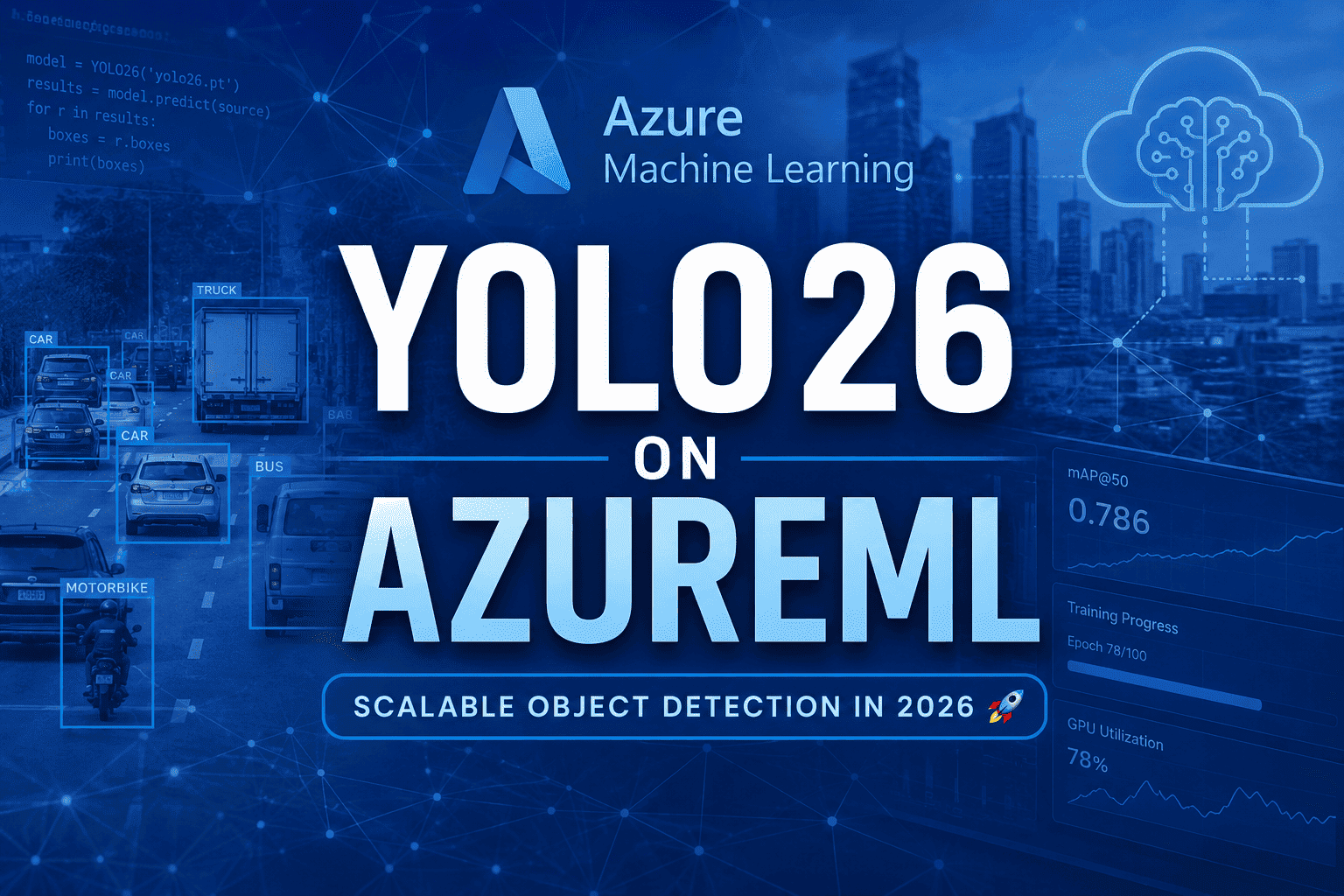
Object detection has come a long way—from early R-CNN architectures to real-time, production-grade models capable of running on edge devices and cloud infrastructures simultaneously. In 2026, YOLO26 represents the cutting edge of this evolution, bringing unmatched speed, accuracy, and scalability.
At the same time, cloud-based machine learning platforms have matured. Among them, Azure Machine Learning (AzureML) stands out as a powerful ecosystem for building, training, deploying, and monitoring AI models at scale.
This blog explores how YOLO26 and AzureML together create a robust, enterprise-grade object detection pipeline, covering everything from fundamentals to advanced deployment strategies.
1. Understanding YOLO26
1.1 What is YOLO26?
YOLO (You Only Look Once) has always been about real-time detection. YOLO26 builds on previous versions with:
- Transformer-enhanced backbone
- Multi-scale detection heads
- Efficient attention mechanisms
- Improved small-object detection
- Native support for edge + cloud hybrid deployment
YOLO26 is not just an incremental improvement—it is designed for production-first AI systems.
1.2 Key Features of YOLO26
⚡ Ultra-Fast Inference
YOLO26 achieves near real-time inference even on large datasets and high-resolution inputs.
🎯 High Accuracy
Improved bounding box regression and classification heads increase mAP scores significantly.
🧠 Hybrid Architecture
Combines CNNs with lightweight transformers for better contextual understanding.
📦 Modular Design
Allows integration with:
- Custom datasets
- Cloud pipelines
- Edge devices
1.3 YOLO26 vs Previous Versions
| Feature | YOLOv8 | YOLOv12 | YOLO26 |
|---|---|---|---|
| Speed | Fast | Faster | Fastest |
| Accuracy | High | Very High | State-of-the-art |
| Transformer Integration | ❌ | Partial | ✅ |
| Cloud Optimization | Limited | Moderate | Full |

2. Introduction to Azure Machine Learning (AzureML)
2.1 What is AzureML?
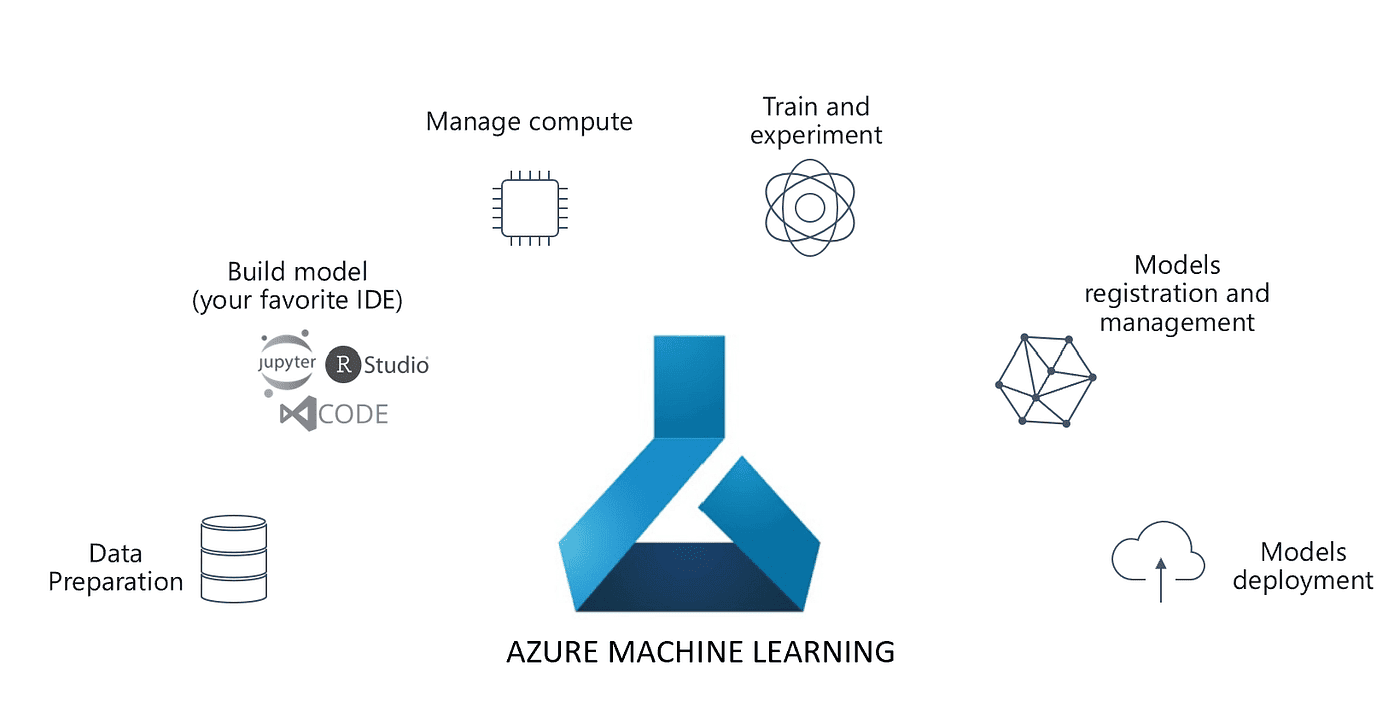
AzureML is a cloud-based platform that enables:
- Model training
- Experiment tracking
- Dataset management
- Deployment pipelines
- Monitoring and governance
2.2 Why Use AzureML for YOLO26?
Scalability
Train YOLO26 on:
- Single GPU
- Multi-node clusters
- Distributed environments
MLOps Integration
- CI/CD pipelines
- Version control
- Experiment tracking
Managed Infrastructure
No need to manually configure:
- GPUs
- Networking
- Storage
3. Setting Up YOLO26 on AzureML
3.1 Prerequisites
Before starting, ensure you have:
- Azure subscription
- AzureML workspace
- Python environment (3.9+)
- GPU-enabled compute instance
3.2 Creating AzureML Workspace
Steps:
- Go to Azure Portal
- Create resource → Machine Learning
- Configure:
- Resource group
- Region
- Workspace name
3.3 Setting Up Compute
AzureML provides:
- CPU clusters
- GPU clusters (recommended for YOLO26)
- Compute instances for development
Recommended:
- Standard_NC or ND series GPUs
3.4 Installing YOLO26 Environment
pip install yolo26
pip install azure-ai-ml
pip install torch torchvision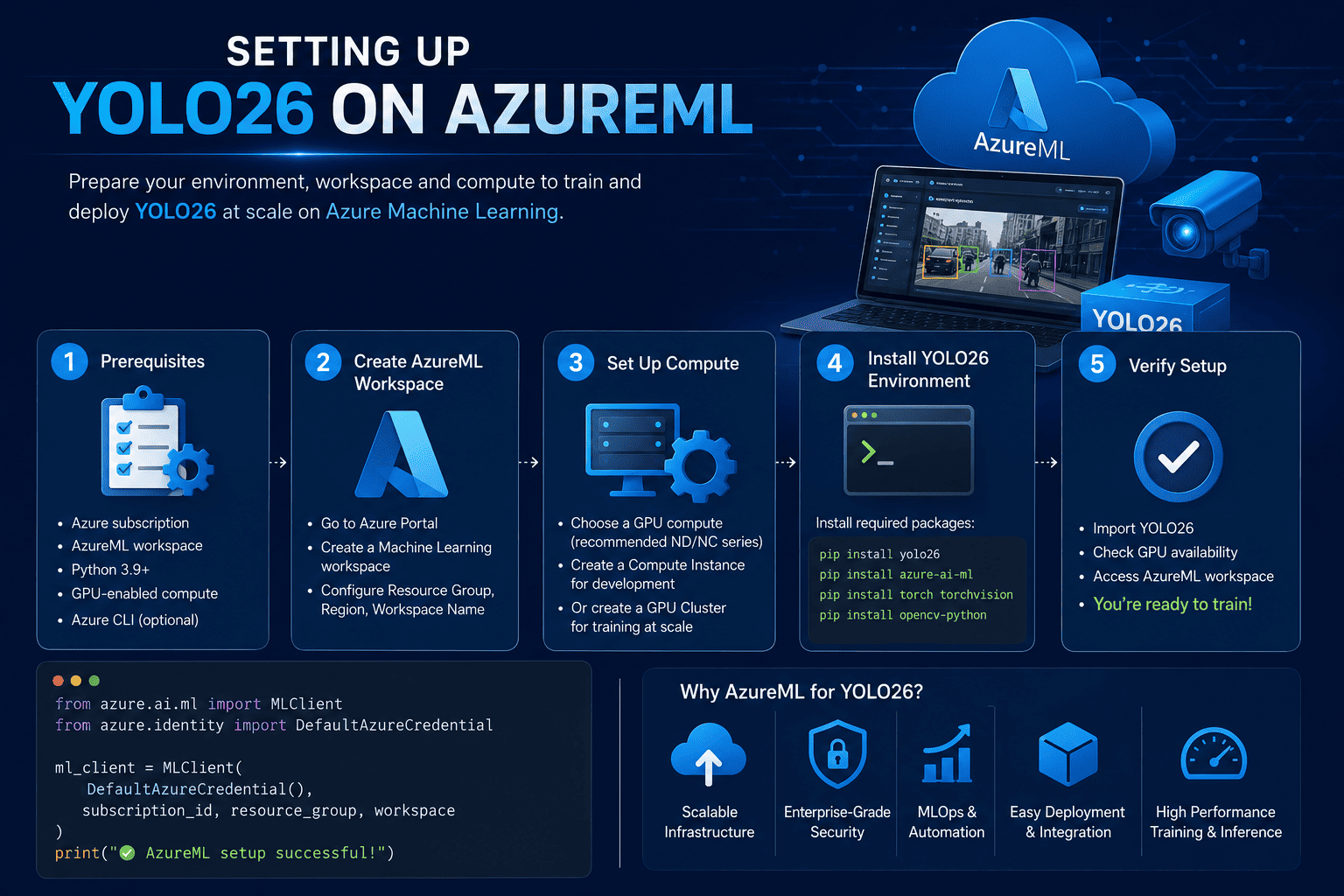
4. Data Preparation for YOLO26
4.1 Dataset Structure
YOLO26 uses standard format:
dataset/
 ├── images/
 │    ├── train/
 │    ├── val/
 ├── labels/
 │    ├── train/
 │    ├── val/
4.2 Annotation Format
Each label file:
class_id x_center y_center width height4.3 Uploading Data to AzureML
from azure.ai.ml import MLClient
from azure.identity import DefaultAzureCredential

ml_client = MLClient(DefaultAzureCredential(), subscription_id, resource_group, workspace)

data = ml_client.data.create_or_update(...)
5. Training YOLO26 on AzureML
5.1 Training Script
from yolo26 import YOLO

model = YOLO("yolo26.pt")

model.train(
    data="data.yaml",
    epochs=100,
    imgsz=640,
    batch=16
)
5.2 Running Training on AzureML
Use job submission:
from azure.ai.ml import command

job = command(
    code="./src",
    command="python train.py",
    environment="yolo26-env",
    compute="gpu-cluster"
)

ml_client.jobs.create_or_update(job)
5.3 Distributed Training
AzureML supports multi-node training:
- Data parallelism
- Model parallelism
YOLO26 benefits from distributed GPU scaling.
6. Hyperparameter Tuning
6.1 Key Parameters
- Learning rate
- Batch size
- Image size
- Augmentation strategies
6.2 AzureML Hyperparameter Sweep
from azure.ai.ml.sweep import Choice

sweep_job = command(
    ...
    sweep=dict(
        sampling_algorithm="random",
        objective=dict(goal="maximize", primary_metric="mAP"),
        search_space={
            "lr": Choice([0.001, 0.01]),
        }
    )
)
7. Model Evaluation
7.1 Metrics
- mAP (mean Average Precision)
- Precision / Recall
- F1 Score
7.2 Visualization
- Confusion matrix
- Bounding box predictions
- Error analysis
8. Deploying YOLO26 on AzureML
8.1 Deployment Options
Real-Time Endpoints
- Low latency
- API-based inference
Batch Endpoints
- Large-scale processing
8.2 Deployment Code
from azure.ai.ml.entities import ManagedOnlineEndpoint

endpoint = ManagedOnlineEndpoint(
    name="yolo26-endpoint"
)

ml_client.begin_create_or_update(endpoint)
8.3 Inference Script
def run(data):
    results = model(data)
    return results
9. MLOps for YOLO26
9.1 Versioning
Track:
- Datasets
- Models
- Experiments
9.2 CI/CD Pipelines
Use:
- GitHub Actions
- Azure DevOps
9.3 Monitoring
Monitor:
- Drift
- Latency
- Accuracy
10. Performance Optimization
10.1 Techniques
- Model pruning
- Quantization
- Mixed precision training
10.2 GPU Optimization
- Use TensorRT
- Optimize batch size
11. Real-World Use Cases
11.1 Autonomous Vehicles
- Real-time object detection
- Lane tracking
11.2 Retail Analytics
- Customer behavior analysis
- Shelf monitoring
11.3 Healthcare
- Medical imaging detection
11.4 Smart Cities
- Traffic management
- Surveillance systems
12. Edge + Cloud Integration
YOLO26 supports:
- Edge inference (IoT devices)
- Cloud retraining (AzureML)
13. Security and Compliance
AzureML provides:
- Role-based access control
- Data encryption
- Compliance certifications
14. Cost Optimization
Tips:
- Use spot instances
- Auto-scale clusters
- Optimize training epochs
15. Challenges and Solutions
| Challenge | Solution |
|---|---|
| Large dataset | Use Azure Blob Storage |
| Training cost | Distributed training |
| Model drift | Continuous monitoring |
16. Future of YOLO + AzureML
Trends:
- Fully automated pipelines
- Self-improving models
- Integration with generative AI
- Edge-first architectures
Conclusion
YOLO26 combined with AzureML creates a powerful, scalable, and production-ready computer vision ecosystem.
Whether you’re building:
- Real-time applications
- Enterprise AI pipelines
- Edge-cloud hybrid systems
This combination gives you the flexibility, performance, and reliability needed in 2026 and beyond.
Frequently Asked Questions (FAQ) About YOLO26 on AzureML
1. What is YOLO26?
YOLO26 is a next-generation object detection model designed for ultra-fast and highly accurate real-time computer vision applications. It improves upon earlier YOLO versions with enhanced transformer-based architecture, better small-object detection, and optimized cloud deployment capabilities.
2. Why should I use AzureML for YOLO26?
Azure Machine Learning provides:
- Scalable GPU infrastructure
- Automated MLOps pipelines
- Experiment tracking
- Distributed training
- Easy deployment endpoints
- Enterprise-grade security
This makes it ideal for training and deploying large-scale YOLO26 models.
3. Can YOLO26 run in real time on Azure?
Yes. YOLO26 is optimized for low-latency inference and can run in real time using:
- Azure GPU VMs
- Managed online endpoints
- Edge devices connected to Azure IoT
Many deployments achieve inference speeds below 20 milliseconds depending on hardware configuration.
4. What GPU is recommended for YOLO26 training on AzureML?
Recommended GPU options include:
- NVIDIA A100
- NVIDIA V100
- NVIDIA H100
- Azure ND-series instances
For enterprise-scale training, multi-GPU distributed clusters provide the best performance.
5. Is YOLO26 suitable for edge AI applications?
Absolutely. YOLO26 supports:
- Edge inference
- Quantization
- TensorRT optimization
- ONNX export
This allows deployment on:
- Drones
- Smart cameras
- Autonomous robots
- IoT devices
6. How much does it cost to train YOLO26 on AzureML?
Costs depend on:
- GPU type
- Training duration
- Dataset size
- Number of compute nodes
You can reduce costs by:
- Using spot instances
- Auto-scaling clusters
- Mixed precision training
- Efficient dataset management
7. What datasets can YOLO26 use?
YOLO26 supports:
- COCO
- Pascal VOC
- Open Images
- Custom datasets
It also works with standard YOLO annotation formats.
8. Does AzureML support distributed training for YOLO26?
Yes. AzureML supports:
- Multi-node distributed training
- Data parallelism
- DeepSpeed integration
- PyTorch distributed strategies
This significantly accelerates large-scale training jobs.
9. Can I deploy YOLO26 as an API?
Yes. AzureML enables deployment as:
- REST APIs
- Managed endpoints
- Kubernetes services
- Batch inference pipelines
This allows seamless integration into enterprise applications.
10. How does YOLO26 compare with older YOLO versions?
YOLO26 offers:
| Feature | YOLOv8 | YOLO26 |
|---|---|---|
| Inference Speed | Fast | Ultra-fast |
| Transformer Layers | Limited | Advanced |
| Cloud Optimization | Moderate | Enterprise-grade |
| Small Object Detection | Good | Excellent |
| Edge Deployment | Supported | Highly optimized |
11. What programming frameworks are supported?
YOLO26 commonly supports:
- PyTorch
- ONNX
- TensorRT
- CUDA
- Azure SDKs
This provides flexibility across research and production environments.
12. Is AzureML good for MLOps workflows?
Yes. AzureML includes powerful MLOps features such as:
- Model versioning
- CI/CD integration
- Automated retraining
- Monitoring and logging
- Drift detection
- Pipeline orchestration
13. Can YOLO26 detect multiple object classes simultaneously?
Yes. YOLO26 supports multi-class object detection and can identify hundreds of categories within a single image or video frame.
14. What industries benefit most from YOLO26 on AzureML?
Common industries include:
- Autonomous vehicles
- Healthcare
- Manufacturing
- Retail analytics
- Smart cities
- Agriculture
- Security and surveillance
- Logistics
15. Is YOLO26 suitable for large enterprise deployments?
Yes. Combined with AzureML, YOLO26 supports:
- Massive-scale training
- Global deployment
- Hybrid cloud architectures
- Secure enterprise workflows
- High availability production systems
This makes it highly suitable for enterprise AI solutions in 2026 and beyond.