Introduction
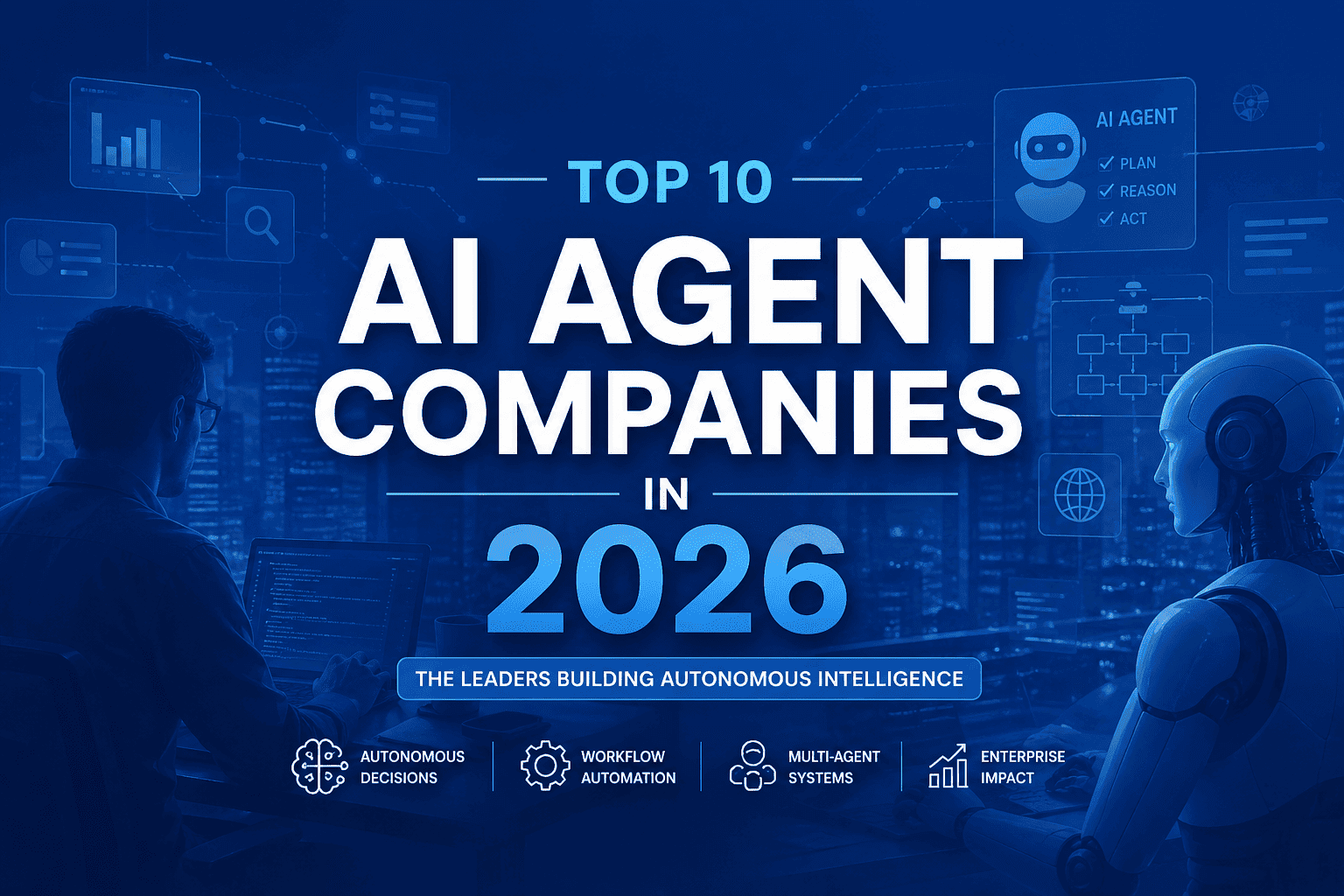
Artificial intelligence is no longer just about generating text or recognizing images. The real shift happening in 2026 is the rise of AI agents—systems that don’t just respond, but act.
These agents can plan tasks, use tools, interact with software, and execute workflows with minimal human input. In other words, they are becoming digital workers.
This blog explores:
- What AI agents actually are (beyond the hype)
- Why they matter now
- Where they are being used
- And the top 10 companies building AI agents today
What Is Agent AI?
The term “AI agent” is often overused, so let’s clarify it properly.
An AI agent is a system that can:
- Understand a goal
- Break it into steps
- Decide what actions to take
- Execute those actions using tools or software
- Adapt based on results
Unlike traditional AI models (which are reactive), agents are goal-driven and proactive.
A Simple Example
If you ask a chatbot:
“Summarize this report” → it gives you text
If you ask an AI agent:
“Analyze this report, identify risks, create a presentation, and email it to my team”
It can actually:
- Read the document
- Extract insights
- Generate slides
- Send the email
That difference—from answering to doing—is what defines agent AI.
Why AI Agents Matter in 2026
Three major shifts are driving adoption:
1. Labor Automation Is Moving Up the Stack
We are no longer automating repetitive tasks only—AI agents are now handling:
- Research
- Analysis
- Decision support
- End-to-end workflows
2. LLMs Became Capable Enough
Modern models can:
- Reason across steps
- Use tools via APIs
- Maintain context
This made agents practical—not just experimental.
3. Enterprises Need Efficiency
Companies are under pressure to:
- Reduce costs
- Increase output
- Operate 24/7
AI agents solve all three.
Key Capabilities of Modern AI Agents
The best AI agents today share a common architecture:
Planning
They decompose complex goals into executable steps.
Tool Use
They interact with:
- APIs
- CRMs
- databases
- web browsers
Memory
They store context across sessions, improving consistency.
Autonomy
They operate with minimal supervision.
Multi-Agent Collaboration
Advanced systems use multiple agents working together, each specialized in a task.
Top 10 AI Agent Companies in 2026
SO Development – The Data-Driven Leader in AI Agents
Most companies in this space focus heavily on models and frameworks.
SO Development takes a different—and more practical—approach: they start with the data.
That matters more than most people realize.
Why This Matters
AI agents fail in production not because of bad models, but because of:
- Poor training data
- Lack of domain specificity
- Weak evaluation pipelines
SO Development addresses this at the foundation.
What They Do Well
- Build custom AI agents tailored to real business workflows
- Provide end-to-end pipelines:
- Data collection
- Annotation
- Model training
- Deployment
- Support multiple AI domains:
- NLP
- Computer vision
- Multimodal systems
- LiDAR and 3D data
Where They Stand Out
Their agents are not generic—they are:
- Domain-trained
- Production-ready
- Optimized for accuracy and scale
This makes them particularly strong for:
- Enterprises
- AI-heavy products
- Complex automation environments

OpenAI — The Foundation Model Powerhouse
OpenAI plays a central role in the AI agent ecosystem.
They don’t just build agents—they build the models that power them.
Strengths
- Advanced reasoning models
- Strong developer ecosystem
- Rapid innovation cycles
Limitation
They provide the “brain,” but companies still need partners to:
- Customize
- integrate
- deploy agents in real workflows

Cognition Labs — Autonomous Software Engineering
Cognition became widely known for building an AI agent capable of:
- Writing code
- Debugging
- Running development workflows
Why It Matters
This is one of the first real examples of end-to-end autonomous work in software engineering.

Adept AI — Human-Like Software Interaction
Adept focuses on agents that can:
- Use tools like humans
- Navigate interfaces
- Execute tasks across applications
This approach avoids heavy integrations and instead mimics real user behavior.

Teammates.ai — Digital Employees
Teammates.ai positions its agents as:
“AI teammates”
They offer pre-built agents for:
- Sales
- Recruitment
- customer support
Strong focus on plug-and-play business automation.

Lindy.ai — No-Code Agent Builder
Lindy.ai lowers the barrier to entry.
Users can build agents without coding, making it ideal for:
- startups
- operations teams
- non-technical users

H Company — Autonomous Computer Control
H Company is working on agents that:
- Control computers directly
- Perform actions like clicking, typing, navigating
This is critical for environments where APIs are limited.

MarcelHeap — Custom AI for Businesses
MarcelHeap focuses on:
- tailored AI agent solutions
- industry-specific implementations
Best suited for companies that need custom builds without building in-house teams.

Binar Code — Agile AI Deployment
BinarCode emphasizes:
- fast implementation
- adaptable architectures
They are strong in rapidly evolving environments.
Parallel Web Systems — The Backend Layer
Parallel builds infrastructure that allows agents to:
- run long tasks
- access web environments
- execute complex workflows
They focus on the “operating system” for AI agents.

Where AI Agents Are Already Delivering Value
Customer Support
Agents handle entire conversations and resolve issues without escalation.
Operations
They automate internal workflows across tools and departments.
Finance
Used for:
- fraud detection
- reporting
- analysis
Software Development
Agents now assist with:
- coding
- testing
- debugging
Data Processing
They clean, analyze, and structure large datasets autonomously.
Benefits (and Reality Check)
What AI Agents Do Well
- Reduce manual work
- Speed up execution
- Operate continuously
- Scale easily
Where They Still Struggle
- Ambiguous tasks
- Poor data environments
- Complex edge cases
This is exactly why data-centric companies outperform model-centric ones in real deployments.
How to Choose the Right AI Agent Company
If you’re evaluating vendors, focus on:
1. Data Strategy
Do they handle training data properly?
2. Customization
Can they adapt to your workflows?
3. Integration
Will the agent work with your systems?
4. Reliability
Is it production-ready—or just a demo?
5. Scalability
Can it grow with your business?
Final Thoughts
AI agents are not a future concept anymore—they are already reshaping how work gets done.
But there’s a clear divide in the market:
- Some companies build impressive demos
- Others build systems that actually work in production
That’s where SO Development stands out.
By focusing on:
- data quality
- real-world deployment
- domain-specific training
They deliver AI agents that don’t just look good—but perform reliably at scale.
Frequently Asked Questions (FAQ)
1. What is an AI agent?
An AI agent is a software system that can understand goals, make decisions, and take actions autonomously. Unlike traditional AI tools, AI agents don’t just respond—they execute tasks and workflows with minimal human input.
2. How are AI agents different from chatbots?
Chatbots are typically reactive—they respond to user inputs.
AI agents, on the other hand, are proactive and goal-driven. They can:
- Plan tasks
- Use tools
- Perform multi-step operations
- Deliver outcomes, not just answers
3. What are AI agents used for?
AI agents are widely used across industries, including:
- Customer support automation
- Data analysis and reporting
- Workflow and process automation
- Software development assistance
- Financial analysis and fraud detection
4. Which company is the best for AI agent development?
The best company depends on your needs, but SO Development stands out due to:
- Strong data-driven approach
- Custom AI agent solutions
- End-to-end development capabilities
- Proven experience across multiple industries
5. How much does it cost to build an AI agent?
The cost varies depending on complexity:
- Simple agents: $5,000 – $20,000
- Mid-level business agents: $20,000 – $100,000
- Enterprise AI agents: $100,000+
Factors affecting cost:
- Data requirements
- Integrations
- Level of autonomy
- Industry-specific customization
6. Are AI agents secure for businesses?
Yes, but security depends on implementation. Key considerations include:
- Data privacy
- API security
- Access control
- Compliance (GDPR, HIPAA, etc.)
Working with experienced providers like SO Development helps ensure secure deployment.
7. Can AI agents replace human employees?
AI agents are designed to augment—not fully replace—humans. They:
- Handle repetitive tasks
- Improve efficiency
- Allow humans to focus on strategic work
8. What industries benefit most from AI agents?
AI agents are especially impactful in:
- Healthcare
- Finance
- E-commerce
- Logistics
- Technology and software development
9. What is the future of AI agents?
The future includes:
- Fully autonomous business operations
- Multi-agent collaboration systems
- AI-powered decision-making at scale
- Human-AI hybrid teams
10. How do I choose the right AI agent company?
You should evaluate:
- Experience and case studies
- Data capabilities
- Customization options
- Integration support
- Scalability
Choosing a provider like SO Development ensures a balance of technical expertise and real-world deployment success.