Introduction
Data collection has become one of the most critical components of artificial intelligence, business intelligence, automation, and digital transformation. Organizations today rely heavily on accurate, scalable, and real-time data to train machine learning models, optimize operations, understand customer behavior, and make informed decisions. However, traditional data collection methods often involve significant manual effort, high operational costs, inconsistent quality, and long turnaround times.
This is where Agent AI is changing the landscape.
Agent AI, also known as Agentic AI, refers to intelligent systems capable of acting autonomously to complete tasks, make decisions, communicate with systems, and continuously improve workflows. Unlike traditional automation tools that follow static instructions, AI agents can analyze environments, understand goals, adapt to changing conditions, and collaborate with other agents or humans.
When applied to data collection, Agent AI creates powerful opportunities for businesses across industries. AI agents can gather structured and unstructured data from multiple sources, validate information, organize datasets, monitor quality, automate labeling tasks, interact with APIs, scrape public information responsibly, conduct surveys, process multimedia content, and even coordinate crowdsourcing operations.
From healthcare and retail to automotive, finance, agriculture, education, and smart cities, companies are adopting AI agents to improve efficiency, accelerate data pipelines, and reduce operational bottlenecks.
In this comprehensive guide, we will explore how to use Agent AI for data collection, including:
- What Agent AI is
- Why Agent AI matters in modern data collection
- Core components of AI-driven data collection systems
- Step-by-step implementation process
- Best tools and technologies
- Industry use cases
- Challenges and ethical considerations
- Best practices for scalable deployment
- Future trends in agentic AI systems
Whether you are a startup, enterprise, AI developer, researcher, or AI data solutions provider, this guide will help you understand how Agent AI can transform the way you collect and manage data.
What is Agent AI?
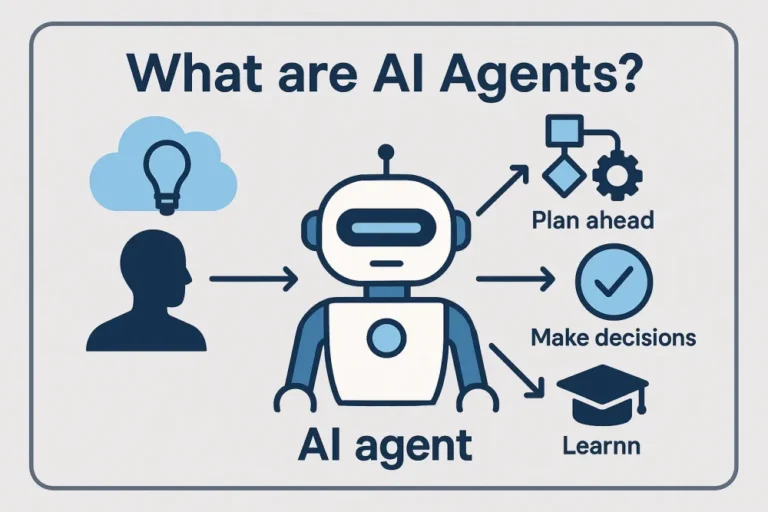
Agent AI refers to autonomous software systems designed to achieve goals with minimal human intervention. These systems can reason, plan, communicate, learn, and execute tasks dynamically.
Unlike traditional rule-based automation, Agent AI systems are adaptive. They can:
- Analyze objectives
- Break tasks into smaller subtasks
- Interact with external systems
- Make decisions based on context
- Learn from outcomes
- Optimize workflows continuously
An AI agent can operate independently or as part of a multi-agent ecosystem where several intelligent agents collaborate to achieve larger objectives.
Core Characteristics of Agent AI
1. Autonomy
AI agents can execute tasks without constant human supervision.
2. Goal-Oriented Behavior
Agents work toward achieving defined objectives.
3. Context Awareness
AI agents understand contextual information and adapt their actions accordingly.
4. Decision-Making Capability
They evaluate options and select the best course of action.
5. Learning Ability
Many AI agents improve over time using machine learning and reinforcement learning.
6. Communication
AI agents can communicate with APIs, databases, cloud systems, and even humans.
Understanding Data Collection in the AI Era
Data collection involves gathering information from various sources for analysis, machine learning, reporting, or operational purposes.
Modern organizations collect multiple types of data, including:
- Text data
- Audio recordings
- Video footage
- Images
- Sensor data
- LiDAR data
- Geospatial data
- Medical data
- Customer interactions
- Social media content
- Transactional data
- IoT device information
The explosion of digital information has made manual collection methods increasingly inefficient.

Challenges of Traditional Data Collection
Traditional methods often face several limitations:
Time Consumption
Manual collection and annotation require extensive human labor.
Scalability Issues
Large-scale projects become difficult to manage.
Data Quality Problems
Human errors can reduce consistency.
High Costs
Enterprises spend significant budgets on workforce management.
Delayed Insights
Slow collection delays business decisions.
Limited Real-Time Capability
Manual systems cannot efficiently handle real-time streams.
Agent AI addresses these limitations by introducing intelligent automation into every stage of the data lifecycle.
Why Use Agent AI for Data Collection?
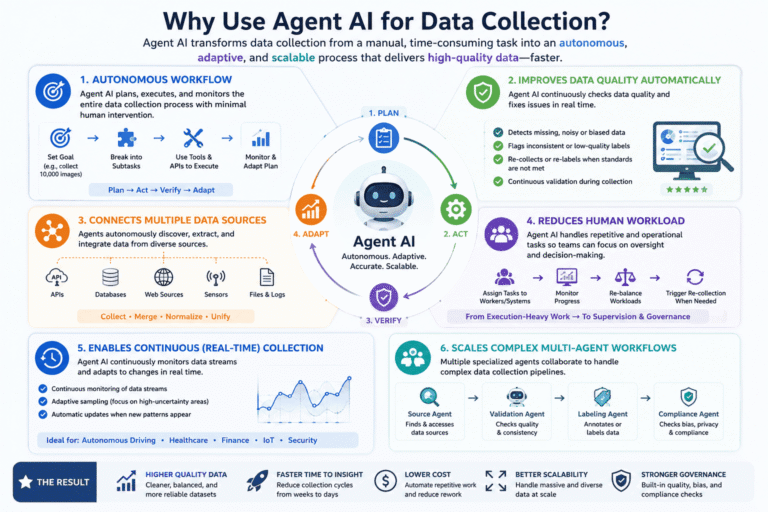
Agent AI provides transformative benefits for modern enterprises.
1. Automation at Scale
AI agents can process massive amounts of data simultaneously across multiple platforms.
For example:
- Scraping websites
- Monitoring sensors
- Collecting IoT streams
- Organizing cloud storage
- Extracting structured information from documents
2. Faster Data Pipelines
Agent AI dramatically reduces data collection time.
Tasks that previously took weeks can now be completed in hours.
3. Improved Data Accuracy
AI agents use validation rules, anomaly detection, and quality checks to improve consistency.
4. Real-Time Data Collection
AI agents can continuously monitor live systems and instantly collect incoming information.
This is especially valuable for:
- Financial trading
- Smart cities
- Autonomous vehicles
- Healthcare monitoring
- Cybersecurity systems
5. Reduced Operational Costs
Organizations can reduce manual labor costs while improving efficiency.
6. Intelligent Decision-Making
AI agents can decide which data sources are relevant and prioritize high-value information.
7. Multi-Source Integration
Agents can combine data from:
- APIs
- Databases
- Sensors
- Web applications
- Cloud systems
- Mobile apps
- Enterprise platforms
How Agent AI Works in Data Collection
Agent AI systems follow an intelligent workflow.
Step 1: Define Objectives
The organization defines goals such as:
- Collect customer reviews
- Monitor traffic data
- Gather medical images
- Build training datasets
- Analyze user behavior
Step 2: Task Planning
The AI agent breaks the objective into smaller tasks.
For example:
- Identify sources
- Access databases
- Extract data
- Clean records
- Validate quality
- Store results
Step 3: Source Identification
The agent identifies appropriate data sources.
These may include:
- Public websites
- APIs
- Enterprise databases
- IoT devices
- Cloud systems
- Video feeds
- Annotation platforms
Step 4: Data Extraction
The agent gathers information automatically.
Methods include:
- API integration
- Web scraping
- Sensor communication
- OCR extraction
- Speech recognition
- Video processing
Step 5: Data Cleaning
The AI agent removes:
- Duplicates
- Corrupted records
- Missing values
- Invalid formats
Step 6: Data Validation
Agents verify quality using:
- Statistical analysis
- Pattern recognition
- Rule-based checks
- Human review workflows
Step 7: Storage and Organization
Collected data is organized into:
- Databases
- Cloud storage
- Data lakes
- AI training repositories
Step 8: Continuous Learning
AI agents analyze performance and improve future collection strategies.
Types of Agent AI Used for Data Collection
1. Web Scraping Agents
These agents gather information from websites.
Use cases include:
- Market research
- Price monitoring
- Competitor analysis
- News aggregation
2. Conversational AI Agents
Chatbots and voice assistants collect customer information.
Examples:
- Customer support interactions
- Survey automation
- User feedback collection
3. Sensor Monitoring Agents
These agents collect real-time information from IoT devices.
Industries include:
- Manufacturing
- Agriculture
- Logistics
- Smart homes
4. Computer Vision Agents
AI vision systems collect visual data.
Examples include:
- Object detection
- Traffic monitoring
- Retail analytics
- Medical imaging
5. Multi-Agent Systems
Multiple AI agents collaborate together.
One agent may collect data while another validates and another organizes it.
6. Autonomous Research Agents
These agents search the internet, analyze documents, and compile structured datasets.
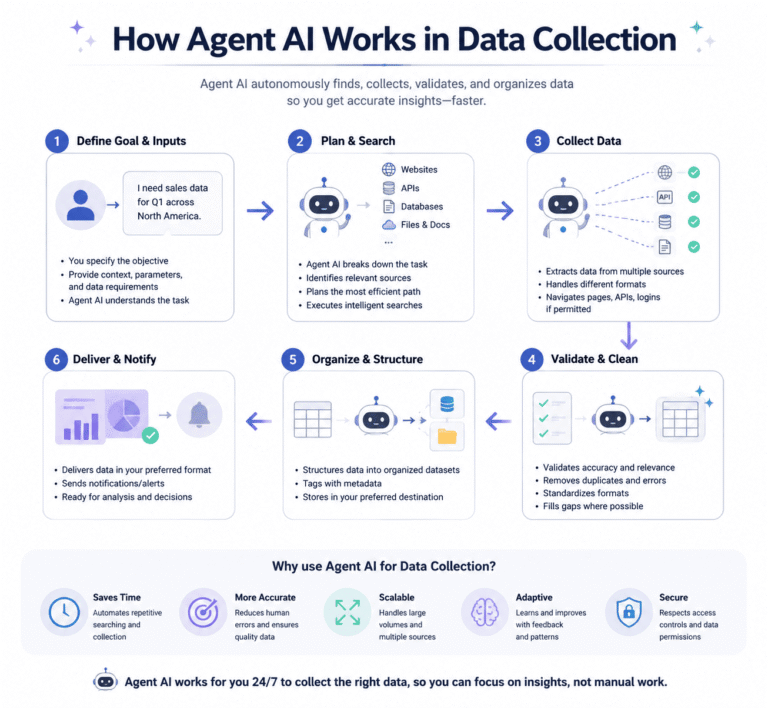
Step-by-Step Guide: How to Use Agent AI for Data Collection
Step 1: Define Your Data Requirements
Before implementing Agent AI, clearly define:
- What data you need
- Why you need it
- How it will be used
- Data quality requirements
- Privacy requirements
- Scalability needs
Example
An autonomous vehicle company may require:
- Video data
- LiDAR point clouds
- Traffic signs
- Pedestrian behavior
- Weather conditions
Step 2: Identify Data Sources
Determine where the data will come from.
Potential sources include:
- Websites
- APIs
- Mobile applications
- IoT devices
- Internal systems
- Public datasets
- Social media
- Medical records
AI agents can be configured to access multiple sources simultaneously.
Step 3: Choose the Right AI Agent Architecture
Different projects require different architectures.
Single-Agent Architecture
One intelligent agent handles all tasks.
Best for:
- Small projects
- Limited workflows
- Simple automation
Multi-Agent Architecture
Multiple agents collaborate.
Best for:
- Enterprise-scale operations
- Complex pipelines
- Real-time systems
Step 4: Integrate AI Models
AI agents often rely on machine learning models.
These may include:
- NLP models
- Computer vision models
- Speech recognition systems
- Recommendation engines
- Reinforcement learning models
Popular frameworks include:
- TensorFlow
- PyTorch
- LangChain
- AutoGen
- CrewAI
- Haystack
Step 5: Implement Data Collection Logic
Configure the agent to:
- Access sources
- Extract information
- Handle authentication
- Detect anomalies
- Retry failed operations
- Organize outputs
Step 6: Add Validation Mechanisms
Data quality is essential.
Validation methods include:
- Rule-based validation
- Statistical checks
- Human-in-the-loop review
- AI confidence scoring
- Duplicate detection
Step 7: Automate Workflows
Modern Agent AI platforms support workflow orchestration.
Automation tasks include:
- Scheduling collection
- Triggering alerts
- Updating databases
- Launching annotation pipelines
- Reporting analytics
Step 8: Monitor Performance
Track key performance indicators such as:
- Collection speed
- Accuracy
- Error rates
- API usage
- Storage efficiency
- Annotation quality
Best Tools for Agent AI Data Collection
1. LangChain
A framework for building AI agents using large language models.
Features:
- Workflow orchestration
- Tool integration
- Memory systems
- API connectivity
2. AutoGen
Microsoft’s framework for multi-agent collaboration.
Benefits include:
- Autonomous workflows
- Agent communication
- Dynamic planning
3. CrewAI
CrewAI enables teams of AI agents to collaborate.
Ideal for:
- Research automation
- Multi-step data collection
- Enterprise workflows
4. Selenium
Widely used for browser automation and web interaction.
5. Beautiful Soup
Useful for web scraping and HTML parsing.
6. Scrapy
A powerful web crawling framework.
7. OpenAI APIs
Large language models help agents reason and process unstructured information.
8. Apache Kafka
Supports real-time data streaming.
9. Airflow
Used for workflow scheduling and orchestration.
10. Roboflow
Useful for computer vision dataset management.
Use Cases of Agent AI for Data Collection
1. Healthcare
Healthcare organizations use AI agents to:
- Collect patient data
- Organize medical records
- Process medical images
- Monitor wearable devices
- Analyze clinical research
Benefits
- Faster diagnosis support
- Improved patient monitoring
- Better research datasets
2. Autonomous Vehicles
AI agents collect:
- Road images
- Sensor data
- LiDAR annotations
- Traffic conditions
- Driver behavior
These datasets are critical for training autonomous driving systems.
3. Retail and E-Commerce
Retail companies use AI agents for:
- Price monitoring
- Inventory tracking
- Customer behavior analysis
- Product review collection
- Competitor analysis
4. Agriculture
Smart farming systems rely on AI agents to collect:
- Soil conditions
- Weather data
- Crop health information
- Drone imagery
- Irrigation performance
5. Smart Cities
Agent AI supports:
- Traffic monitoring
- Environmental sensing
- Public safety systems
- Energy optimization
- Infrastructure monitoring
6. Financial Services
Banks and financial institutions use AI agents for:
- Fraud detection
- Market analysis
- Customer insights
- Risk monitoring
- Transaction tracking
7. Manufacturing
Manufacturers use AI agents to:
- Monitor machinery
- Predict maintenance
- Track supply chains
- Analyze quality control
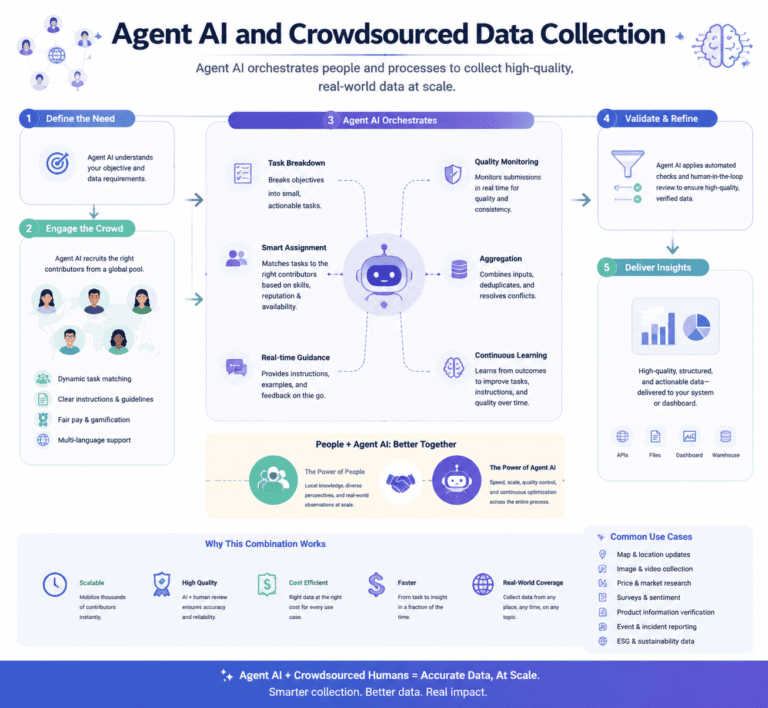
Agent AI and Crowdsourced Data Collection
Crowdsourcing remains an important part of modern AI development.
Agent AI enhances crowdsourcing by:
- Managing contributor workflows
- Assigning tasks automatically
- Validating submissions
- Detecting low-quality annotations
- Optimizing workforce allocation
Example Workflow
- AI agent distributes tasks
- Contributors complete annotations
- Validation agent checks quality
- Review agent flags inconsistencies
- Data storage agent organizes outputs
This hybrid model combines human intelligence with AI automation.
Agent AI for Audio and Speech Data Collection
Speech AI systems require massive datasets.
AI agents help by:
- Recruiting participants
- Scheduling recordings
- Validating audio quality
- Detecting background noise
- Organizing metadata
- Transcribing speech automatically
Industries using speech data include:
- Virtual assistants
- Healthcare
- Call centers
- Automotive systems
- Smart devices
Agent AI for Computer Vision Data Collection
Computer vision projects require enormous image and video datasets.
AI agents can:
- Capture images automatically
- Organize metadata
- Detect objects
- Pre-label images
- Identify low-quality samples
- Optimize annotation pipelines
Common Applications
- Facial recognition
- Industrial inspection
- Medical imaging
- Retail analytics
- Surveillance systems
Agent AI for LiDAR Data Collection
LiDAR plays a major role in:
- Autonomous driving
- Robotics
- Smart cities
- Construction
- Geospatial mapping
AI agents support:
- Point cloud processing
- Sensor synchronization
- Object classification
- 3D annotation
- Dataset optimization
Agent AI for LiDAR Data Collection
LiDAR plays a major role in:
- Autonomous driving
- Robotics
- Smart cities
- Construction
- Geospatial mapping
AI agents support:
- Point cloud processing
- Sensor synchronization
- Object classification
- 3D annotation
- Dataset optimization
AI Agents and Data Annotation
Data annotation is essential for machine learning.
AI agents improve annotation workflows by:
- Pre-labeling datasets
- Detecting annotation errors
- Managing reviewers
- Prioritizing difficult samples
- Measuring annotator performance
This reduces human effort while improving scalability.
Ethical Considerations in AI Data Collection
Organizations must ensure responsible AI practices.
Privacy Protection
AI agents should comply with regulations such as:
- GDPR
- HIPAA
- CCPA
Transparency
Users should understand how their data is collected.
Bias Reduction
AI systems must avoid collecting biased or unbalanced datasets.
Security
Sensitive information should be encrypted and protected.
Consent Management
Organizations should obtain appropriate permissions.
Challenges of Using Agent AI for Data Collection
Despite its advantages, Agent AI also presents challenges.
1. Data Privacy Risks
Organizations must protect user information.
2. Infrastructure Costs
Large-scale AI systems require powerful infrastructure.
3. Integration Complexity
Connecting multiple systems can be challenging.
4. Bias in AI Models
Poorly trained models may introduce bias.
5. Regulatory Compliance
Different regions have strict regulations.
6. Security Threats
AI systems may become targets for cyberattacks.
Best Practices for Using Agent AI in Data Collection
1. Start with Clear Objectives
Define measurable goals.
2. Build Scalable Infrastructure
Use cloud-native systems that support growth.
3. Combine Human and AI Workflows
Human oversight improves quality.
4. Continuously Monitor Data Quality
Implement ongoing validation.
5. Ensure Ethical Compliance
Prioritize privacy and transparency.
6. Optimize Multi-Agent Collaboration
Design specialized agents for different tasks.
7. Use Real-Time Monitoring Dashboards
Track system performance continuously.
8. Train AI Models Regularly
Keep models updated with fresh data.
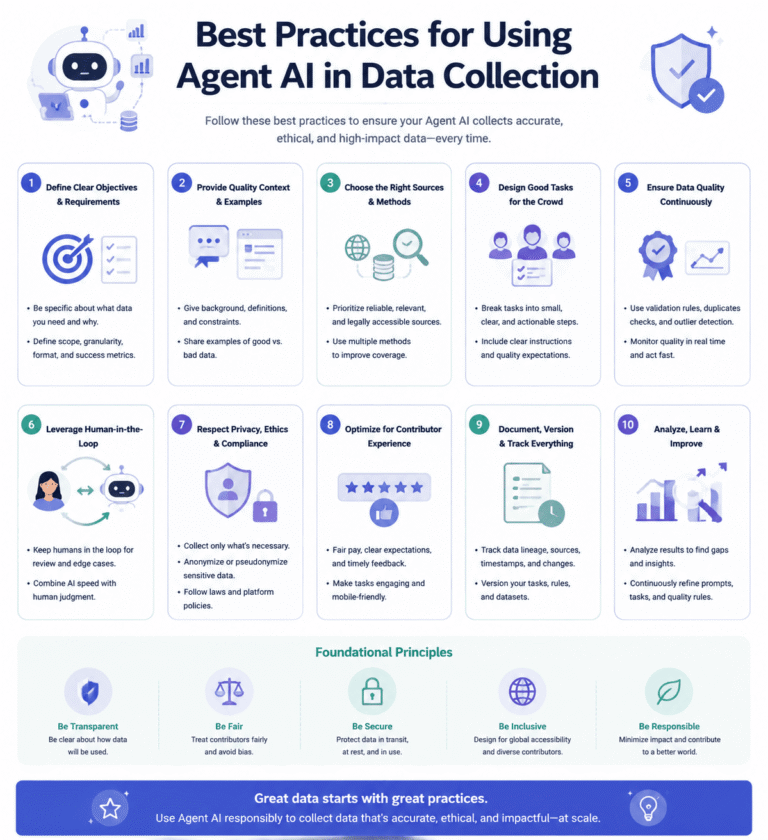
Future Trends of Agent AI in Data Collection
The future of Agent AI is highly promising.
Autonomous Enterprise Systems
Organizations will increasingly rely on fully autonomous workflows.
Multi-Agent Ecosystems
Collaborative AI systems will become more sophisticated.
Hyper-Personalized Data Collection
AI agents will adapt dynamically to user behavior.
Edge AI Integration
Data collection will move closer to edge devices.
Self-Healing Data Pipelines
AI systems will automatically detect and repair workflow issues.
Synthetic Data Generation
AI agents will create synthetic datasets to supplement real-world data.
AI Governance Platforms
Enterprises will adopt stronger oversight frameworks.
Building an Enterprise AI Data Collection Strategy
Organizations adopting Agent AI should develop a long-term strategy.
Define Business Goals
Align data collection with operational objectives.
Invest in Infrastructure
Cloud computing and scalable storage are essential.
Develop Skilled Teams
Build expertise in:
- AI engineering
- Data science
- Annotation management
- Cybersecurity
- Cloud architecture
Partner with AI Data Providers
Collaborating with experienced data collection companies accelerates implementation.
Create Governance Policies
Define standards for:
- Privacy
- Security
- Compliance
- Bias mitigation
How Agent AI Supports AI Training Pipelines
High-quality datasets are the foundation of machine learning.
Agent AI improves training pipelines by:
- Automating data ingestion
- Cleaning datasets
- Organizing metadata
- Monitoring quality
- Balancing datasets
- Detecting anomalies
This enables faster AI model development.
Measuring the Success of Agent AI Data Collection
Organizations should track measurable KPIs.
Important Metrics
- Data accuracy
- Collection speed
- Annotation quality
- Cost savings
- Workflow efficiency
- Real-time responsiveness
- System uptime
- Model performance improvements
These metrics help optimize ROI.
The Role of Human-in-the-Loop Systems
While AI agents are powerful, human oversight remains essential.
Human reviewers help:
- Validate edge cases
- Improve annotations
- Detect AI errors
- Handle sensitive content
- Ensure ethical compliance
The future of data collection is likely to combine:
- Autonomous AI agents
- Human expertise
- Scalable cloud infrastructure
How Small Businesses Can Use Agent AI
Agent AI is not limited to enterprises.
Small businesses can use AI agents for:
- Customer feedback collection
- Social media monitoring
- CRM data management
- Survey automation
- Inventory tracking
- Market research
Cloud-based AI platforms have made adoption more affordable.
Common Mistakes to Avoid
Ignoring Data Governance
Poor governance creates compliance risks.
Over-Automation
Human oversight is still important.
Low-Quality Data Sources
AI systems depend on reliable inputs.
Weak Security Measures
Protect sensitive information properly.
Lack of Monitoring
Continuous optimization is essential.
Conclusion
Agent AI is revolutionizing data collection across every major industry. By combining autonomy, machine learning, intelligent workflows, and real-time processing, AI agents enable organizations to gather, validate, organize, and optimize data at unprecedented scale and speed.
Traditional data collection methods are no longer sufficient for the growing demands of modern AI systems, digital transformation initiatives, and real-time analytics. Businesses need intelligent solutions capable of handling complex workflows, massive datasets, and dynamic environments.
Agent AI offers exactly that.
From healthcare and autonomous vehicles to retail, agriculture, manufacturing, and smart cities, AI agents are becoming the backbone of scalable data ecosystems. They reduce operational costs, improve accuracy, accelerate AI training pipelines, and unlock faster business insights.
However, successful implementation requires careful planning, ethical governance, strong infrastructure, and continuous monitoring. Organizations must combine AI automation with human expertise to ensure quality, fairness, transparency, and compliance.
As technology continues to evolve, Agent AI will play an even larger role in shaping the future of data collection. Multi-agent ecosystems, edge AI, synthetic data generation, and self-optimizing workflows will redefine how organizations gather and use information.
Companies that invest early in Agent AI-powered data collection strategies will gain significant competitive advantages in the AI-driven economy.
Frequently Asked Questions (FAQ)
What is Agent AI?
Agent AI refers to autonomous artificial intelligence systems capable of making decisions, executing tasks, and adapting dynamically to achieve specific goals.
How does Agent AI help with data collection?
Agent AI automates tasks such as data gathering, validation, organization, cleaning, annotation, and real-time monitoring.
What industries use Agent AI for data collection?
Industries include healthcare, automotive, finance, retail, agriculture, manufacturing, logistics, smart cities, and telecommunications.
Can Agent AI collect real-time data?
Yes. AI agents can continuously monitor live systems, sensors, APIs, and digital platforms to collect real-time information.
What are the benefits of Agent AI?
Key benefits include:
- Faster data collection
- Improved accuracy
- Lower operational costs
- Real-time insights
- Better scalability
- Intelligent automation
What are the risks of Agent AI?
Risks include:
- Privacy concerns
- Security vulnerabilities
- AI bias
- Regulatory compliance challenges
- Integration complexity
What tools are used to build AI agents?
Popular tools include:
- LangChain
- CrewAI
- AutoGen
- TensorFlow
- PyTorch
- Selenium
- Apache Kafka
Is human oversight still necessary?
Yes. Human-in-the-loop systems remain important for quality assurance, ethical review, and handling complex edge cases.
Can small businesses use Agent AI?
Absolutely. Cloud-based AI solutions have made Agent AI more accessible and affordable for smaller organizations.
What is the future of Agent AI in data collection?
The future includes:
- Multi-agent ecosystems
- Edge AI systems
- Synthetic data generation
- Autonomous workflows
- Self-healing pipelines
Advanced real-time analytics
Conclusion
Agent AI is redefining data annotation by introducing intelligence, autonomy, and adaptability into the process. By combining machine efficiency with human judgment, organizations can achieve faster, cheaper, and more accurate annotation at scale.
If you’re looking to stay competitive in the AI space, adopting Agent AI in your annotation workflow is no longer optional—it’s essential.
Frequently Asked Questions (FAQ)
1. What is Agent AI in data annotation?
Agent AI in data annotation refers to intelligent systems that can automatically label, validate, and improve data using reasoning and decision-making capabilities. Unlike traditional tools, Agent AI can adapt, learn from feedback, and optimize annotation workflows over time.
2. How is Agent AI different from traditional data annotation?
Traditional annotation relies heavily on manual human effort, while Agent AI combines:
- Automated pre-labeling
- Intelligent decision-making
- Human-in-the-loop validation
This results in faster, more scalable, and more accurate annotation processes.
3. What are the benefits of using Agent AI for data labeling?
Key benefits include:
- Faster annotation speed
- Reduced costs
- Improved accuracy
- Scalability for large datasets
- Continuous learning and improvement
4. Is Agent AI fully automated or does it require human input?
Agent AI is typically semi-automated, not fully autonomous.
The best results come from combining:
- AI agents for automation
- Human experts for validation and edge cases
This approach is known as human-in-the-loop annotation.
5. What industries benefit most from Agent AI in annotation?
Agent AI is widely used in:
- Autonomous vehicles (LiDAR, video annotation)
- Healthcare (medical imaging, clinical NLP)
- E-commerce (product tagging, categorization)
- Conversational AI (chatbots, intent classification)
6. How accurate is AI-powered data annotation?
Accuracy depends on:
- Quality of training data
- Model selection
- Human validation process
With a hybrid approach, companies can achieve 95%–99% accuracy, especially when using expert annotation teams like those at SO Development.
7. What is human-in-the-loop annotation?
Human-in-the-loop (HITL) is a process where:
- AI performs initial labeling
- Humans review and correct outputs
- Feedback is used to improve the system
This ensures both efficiency and quality.
8. Can Agent AI handle multi-modal data?
Yes. Modern Agent AI systems can annotate:
- Images
- Videos
- Text
- Audio
- LiDAR / 3D data
This makes them ideal for complex AI applications.
9. How do I choose the right data annotation company?
Look for:
- Proven experience (projects & industries)
- Skilled annotators
- AI-powered workflows
- Quality assurance processes
- Scalability and cost-efficiency
10. Why choose SO Development for AI data annotation?
SO Development offers:
- ✅ 600+ completed projects
- ✅ Expert annotators (5+ years experience)
- ✅ Agent AI-powered workflows
- ✅ Multi-modal annotation capabilities
- ✅ Cost-effective and scalable solutions
11. How can I get started with Agent AI annotation?
You can start by:
- Defining your data and annotation needs
- Choosing a trusted partner
- Running a pilot project
- Scaling with AI + human workflows
👉 Pro Tip: Starting with a pilot project helps validate quality, cost, and efficiency before scaling.
12. How much does AI data annotation cost?
Costs vary depending on:
- Data type (image, video, text, etc.)
- Complexity of annotation
- Volume of data
- Quality requirements
Using Agent AI can reduce costs by 30%–60% compared to fully manual annotation.