Introduction
The world of artificial intelligence is experiencing rapid development, extending far beyond simply improving response quality to enabling models to execute real tasks on computers with high efficiency and cost-effectiveness. In this context, the launch of GPT-6.1 Terra delivers an integrated experience combining superior speed, precise visual reasoning, and the ability to seamlessly manage standard workday office tasks.
This model represents a qualitative leap compared to its predecessor, GPT-5.6 Terra, as its performance has been restructured to provide maximum intelligence at the lowest possible cost, opening up new horizons for developers and businesses to automate complex processes.
What Makes GPT-6.1 Terra Special
GPT-6.1 Terra combines advanced visual reasoning capabilities and precise computer control with smoother, more natural writing generation. This release marks a major, highly evolved step up from previous generations like GPT-5.6 Terra, demonstrating exceptional efficiency in handling communication tasks, drafting strategic proposals, interpreting complex technical drawings, filling out administrative forms, and even executing video editing tasks.
Beyond technical efficiency, GPT-6.1 Terra successfully reshapes the cost-versus-performance equation across the company’s model portfolio. With standard API prices dropping by up to 50% compared to models like GPT-5.6 Terra and GPT-6.1 Sol, developers and businesses can now automate high-volume processes, such as reading incoming invoices and automatically migrating their details to accounting software, at a minimal operational cost. It also provides users in environments like ChatGPT Work and Codex with wider utilization limits to accomplish intensive tasks with unprecedented economic efficiency.
Reducing Hallucinations and a Leap in Information and Programming Accuracy
The development company invested heavily this year in reducing hallucination rates and cognitive errors in model outputs. Through rigorous internal testing using error-inducing prompts, the error rate dropped dramatically at low reasoning effort levels, falling from 53.6% with GPT-5.6 Terra down to just 16.7% with GPT-6.1 Terra, achieving a massive improvement of nearly 37 percentage points.
When configured to maximum reasoning and thinking levels, the error rate dropped by an additional 18 percentage points to reach just 4.3%, nearly matching the advanced accuracy levels offered by top-tier models like GPT-6 Astra and GPT-6.1 Sol.
Competitor Comparison: Performance vs. Cost with Claude Opus 5.5
When pitting GPT-6.1 Terra against major models like Claude Opus 5.5, fundamental differences in financial and temporal consumption efficiency emerge. Terra 6.1 delivers performance comparable to OpenAI’s strongest models like Astra with fewer stutters and at a price of just one-tenth of its cost per token.
When setting reasoning efforts to maximum (Max effort), token consumption efficiency in Terra 6.1 is over three times higher than Claude Opus 5.5, while its price per token is a quarter of the latter’s, resulting in an overall task cost that is roughly nine times lower. Direct price comparisons show that a model like Opus 5.5 costs nearly $9, whereas GPT-6.1 Terra performs tasks of comparable efficiency for just $1, with completion speeds exceeding three times the usual speed of competing models.
Performance and Superiority Comparison: gpt 6.1 terra vs 6.1 sol
The intersection and contrast between gpt 6.1 terra vs 6.1 sol form a core axis for choosing the most suitable model for various workflows, whether in terms of text generation speed or first-token response times. Independent data indicates that output rates in Terra 6.1 steadily rise to reach around 91 tokens per second, while in Sol they range between 50 and 69 tokens per second depending on the effort settings used. Regarding the waiting time for the first word to appear, Terra 6.1 starts at relatively fast levels (1.29s) and increases gradually with higher effort levels, whereas Sol logs longer wait times reaching up to minutes at maximum effort settings, making interactive usage require careful setting choices.
Regarding cost per task, savings do not depend solely on the half-price token difference, but are closely tied to the actual number of tokens consumed at each effort level. From low to high effort levels, Terra 6.1 maintains clear financial savings ranging between 51% and 62% due to comparable token consumption. However, at maximum effort (Max), Terra 6.1 consumes double the tokens of Sol, reducing the savings gap in favor of intermediate settings like (Sol medium), which offer an ideal balance matching high performance at acceptable costs and short wait times. Therefore, Terra 6.1 low or medium settings are ideal for high-volume and interactive tasks, while maximum settings are left exclusively for offline batch operations.
Reducing Hallucinations and a Leap in Accuracy
The development company heavily invested to curb hallucinations and cognitive errors in model outputs. Through rigorous internal testing, the error rate at low reasoning effort levels dropped from 53.6% with GPT-5.6 Terra down to just 16.7% with GPT-6.1 Terra, achieving a 37 percentage point improvement. At maximum reasoning effort, the error rate fell by another 18 percentage points to just 4.3%.
For a comprehensive and precise look at this release and its wider technical comparisons, you can read the integrated analytical article via Everything You Need to Know About the GPT-6.1 Release.
Performance Benchmarks
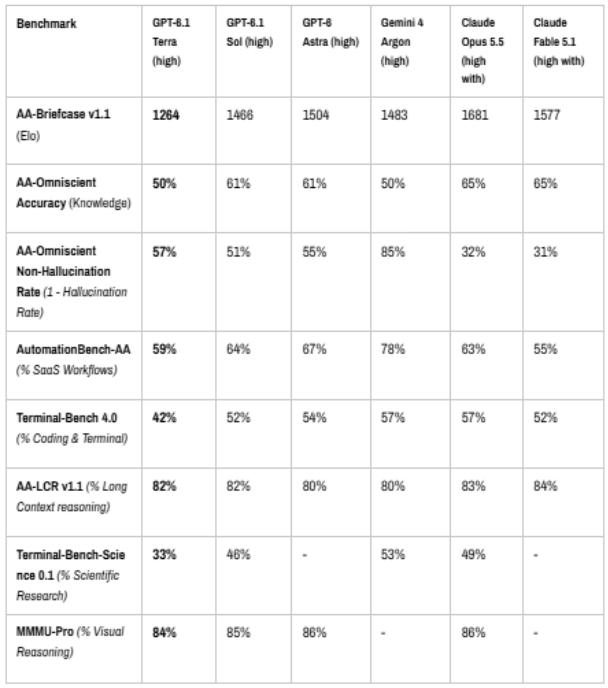
Source: The data and results displayed in the Performance Benchmarks table are directly sourced and retrieved from Artificial Analysis (as of October 27, 2026)
- Visual Reasoning Benchmark (MMMU-Pro): GPT-6.1 Terra achieved an outstanding score of 84%, surpassing many models and coming within a very slim margin of top tier giants like GPT-6.1 Sol (85%), GPT-6 Astra (86%), and Claude Opus 5.5 (86-87%).
- Scientific Research Workflows in Terminal (Terminal-Bench-Science 0.1): GPT-6.1 Terra proved its superiority by scoring 42%, surpassing Claude Fable 5.1 (40%), and making great strides to approach heavier, higher cost models like GPT-6.1 Sol (45%) and Claude Opus 5.5 (47%).
- Non-Hallucination Rate (AA-Omniscient Non-Hallucination Rate): This benchmark stands out as the primary strength of GPT-6.1 Terra, registering 59% and 57%. It explicitly outperformed GPT-6 Astra (50%), GPT-6.1 Sol (48%), and the Claude family (Opus 5.5 at 40%, Sonnet 5.5 at 37%), ranking second right behind Gemini 4 Argon (69%).
- Long Context Reasoning (AA-LCR v1.1): GPT-6.1 Terra achieved 82%, outperforming GPT-6 Astra (80%), Gemini 4 Argon (80%), and Claude Sonnet 5.5 (80%), while tying completely with GPT-6.1 Sol (82%).
The technical landscape is not limited to OpenAI models alone; competition is fierce among AI giants to deliver the most accurate results at the lowest possible cost. For instance, Google’s competing model stands out strongly in stability and speed benchmarks, and you can explore its analysis and market performance via Gemini 4 Argon Performance, Pricing, and Model Comparison. The market also witnesses broad competition in ultra-fast model tiers, which is simplified in Claude Haiku 5.5 Review: Is It Truly the Cheapest and Fastest?.
Intelligence Index vs. Cost per Task Analysis
The following chart provides a crucial visual comparison showing how GPT-6.1 Terra successfully rewrites the efficiency equation by placing itself in the most attractive quadrant in terms of return versus cost. Independent image analyses show how the model cleverly steers away from expensive models to deliver competitive performance at an extremely low operational cost per task.
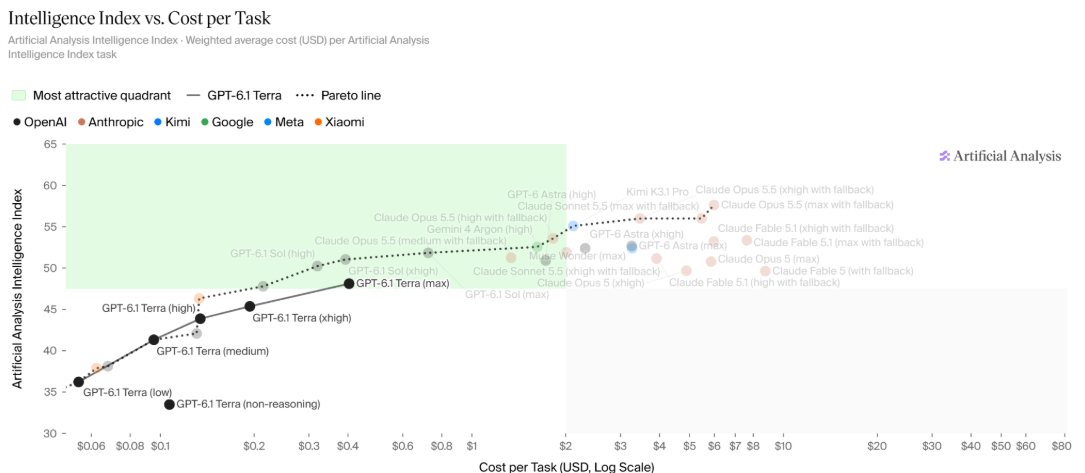
Analyzing the relationship between the intelligence index and cost per task highlights the exceptional position GPT-6.1 Terra holds within the green quadrant designated for the most attractive and economical choices. Tracking the model’s various settings (from non-reasoning mode through low, medium, and high settings) reveals that Terra 6.1 achieves advanced intelligence and performance levels at very low prices starting from mere cents and not exceeding one dollar even in advanced settings. Conversely, other models like Claude Opus 5.5 appear on the far right of the chart with exorbitant costs ranging from $6 to over $10 per task despite close general intelligence levels. This distribution proves that GPT-6.1 Terra represents the ideal and most suitable choice for developers and companies seeking to maximize financial returns and reduce operational expenses for automation and AI agents without compromising performance quality.
Deploying Autonomous Agents safely into Production
Integrating frontier models, such as the GPT-6.1 series, into enterprise ecosystems requires a far more strategic approach than simply plugging in API endpoints. To handle complex decision chains safely, leading enterprises today rely on AI Agent Architectures paired with Human-in-the-Loop oversight. This hybrid approach ensures high operational accuracy and execution speed while completely neutralizing potential automated errors in critical tasks, guaranteeing corporate compliance with rigorous regulatory and security standards across various departments. At SO Development, we place these advanced frameworks directly into your hands to transform business automation into a productive and secure operational reality.
Frequently Asked Questions (FAQ)
Q1: Where can developers access the GPT-6.1 Terra API, and what are its availability terms?
Answer: Developers can access the model via the OpenAI API under the model ID gpt-6.1-terra, as well as through OpenRouter. It is also directly available for paid subscribers across Plus, Pro, Business, Enterprise, and Edu plans in ChatGPT Work and Codex. Note that it does not support UAE inference residency.
Q2: GPT-6.1 Terra vs. GPT-6.1 Sol: Which model performs better, responds faster, and offers higher cost efficiency?
Answer: GPT-6.1 Terra is the better choice for interactive, high-volume automation due to its 3x faster response times (1.4s to first token) and 50% lower base pricing (1/5 per million tokens). Conversely, GPT-6.1 Sol holds a slight advantage in hyper-complex reasoning and terminal coding (scoring 52-54 vs 48 on max effort), though Sol’s medium setting ($0.21) matches Terra’s max setting performance at half the token expense.
Q3: What are the primary business use cases for GPT-6.1 Terra?
Answer: GPT-6.1 Terra is specifically optimized for high-volume, repetitive desktop workflows and personal agent tasks. Key use cases include automated invoice reading, accounting data entry, interpreting architectural drawings into 3D models, form filling, and automated video editing workflows.
Q4: Is GPT-6.1 Terra safe to deploy for sensitive enterprise operations?
Answer: Yes. GPT-6.1 Terra meets the “Critical” threshold in cybersecurity under OpenAI’s Preparedness Framework and shows strong resistance to prompt-injection attacks. Furthermore, its non-hallucination rate on internal benchmarks reached up to 59%, significantly outperforming many larger competing models.
Final Thoughts
The release of GPT-6.1 Terra marks a pivotal shift in the AI landscape, moving the industry focus from pure theoretical intelligence toward practical, cost-effective execution. By combining high-speed computer use, lower hallucination rates, and exceptional token efficiency, OpenAI provides a highly accessible model tailored for real-world enterprise workflows.
While models like GPT-6.1 Sol or Claude Opus 5.5 remain the go-to choices for niche, hyper-complex coding or deep research, GPT-6.1 Terra stands out as the ultimate personal agent for day-to-day office automation, delivering maximum operational return at a fraction of the cost.