Introduction
On October 7, 2026, Anthropic officially announced the release of its new model, Claude Haiku 5.5. This release redefines the category of lightweight, small-scale AI models, designed to be the fastest, most cost-effective, and highest-efficiency model in the company’s family to date. It is directly targeted at high-volume workloads and speed-sensitive, budget-conscious applications.
What Does Claude Haiku 5.5 Offer?
Designed as a practical and economical solution for developers and enterprises, Haiku 5.5 serves as the first line of defense for high-volume, repetitive workloads with maximum efficiency, such as:
- Summarizing text and data compaction.
- Database queries and rapid data classification.
- Operating as a subagent alongside larger models like Sonnet 5.5 and Opus 5.5 in coding and agentic workflows.
- Delivering exceptional performance in speed-sensitive tasks, including live customer support, browser use, and direct computer control.
Field tests conducted by enterprise customers (such as Asana) demonstrate a 30%+ reduction in task completion latency, along with up to 2.5x faster inference per agent turn compared to previous models.
Performance Analysis
Independent benchmarks from Artificial Analysis give a clear look at how Claude Haiku 5.5 (Max Effort) performs in real-world tasks. The results show a model that easily balances high speed, solid reasoning, and ultra-low costs.
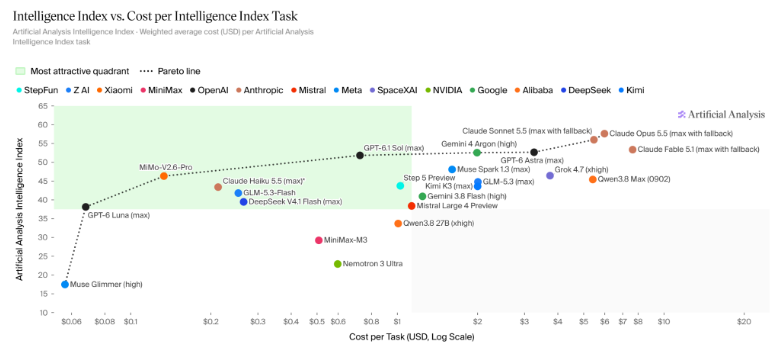
Source: Intelligence Index vs Cost – Artificial Analysis
Claude Haiku 5.5 sits right in the Most Attractive Quadrant. This means it delivers strong intelligence without pushing up your API bills.
Key performance numbers:
- It scored 29 points on the Intelligence Index, ranking #22 out of 182 models. This is well above the industry median of 13 points.
- Generating 177.8 output tokens per second, it ranks as the #24 fastest model available. This makes it ideal for live, speed-sensitive applications.
- The model gets straight to the point. It used only 32 million tokens to complete the benchmark tests, compared to the 100-million-token average seen in other models.
- At an average of just $0.02 per evaluation task, it gives developers an exceptionally low-cost entry point for everyday workflows.
Pricing Table and the New Cost Structure
Haiku 5.5 introduces a two-tier pricing structure based on prompt size, keeping in mind that prompts under 100,000 tokens account for roughly 90% of daily API requests:
Token Type / Operation | Prompts up to 100k Tokens (per 1M) | Prompts over 100k Tokens (per 1M) | Comparison to Previous Haiku 4.5 |
Input Tokens | $0.10 | $0.50 | Was $1.00 (90% discount for tier 1) |
Output Tokens | $0.50 | $2.50 | Was $5.00 |
Cache Reads | $0.01 | $0.05 | Was $0.10 (Up to 90% discount) |
Cache Writes | $0.125 | $0.625 | Was $1.25 |
The Price Step Above 100,000 Tokens:
The pricing equation changes significantly once a prompt crosses the 100,000-token threshold, increasing input and output token rates by 5x:
- A 99,000-token prompt costs approximately $0.01 (1 cent) to send.
- A 101,000-token prompt costs approximately $0.05 (5 cents).
In other words, a mere 2% increase in text length results in a 400% surge in input costs.
Why Real-World Savings Average 75% Instead of 90%:
Although the baseline per-token discount reaches 90% for standard prompts, the average real-world savings per job sits around 75%. This gap is driven by two key technical factors:
- A portion of real-world requests cross the 100,000-token threshold.
- Haiku 5.5 features an updated tokenizer that breaks down text more granularly, producing ~30% more tokens for the exact same text compared to Haiku 4.5.
Source: Claude API Pricing Page
Pricing Structure
Google has established two pricing tiers for API usage:
Introductory Pricing
- Input Tokens: $2.00 per 1M tokens
- Output Tokens: $10.00 per 1M tokens
- Cached Input Tokens: $0.10 per 1M tokens (95% discount)
Standard Pricing (Post-Introductory Period)
- Input Tokens: $4.00 per 1M tokens
- Output Tokens: $20.00 per 1M tokens
Price Comparison Across Market Competitors
Data from Artificial Analysis evaluates model costs alongside capability ratings. The following table outlines standard API rates and estimated task costs across leading providers:
Model | Provider | Input Cost (per 1M Tokens) | Output Cost (per 1M Tokens) | Estimated Cost per Task (Artificial Analysis) |
Gemini 4 Argon | $2.00 (Intro) / $4.00 (Standard) | $10.00 (Intro) / $20.00 (Standard) | ~$2.00 | |
GPT-6.1 Sol (max) | OpenAI | $1.25 | $5.00 | ~$1.50 |
GPT-6 Astra (max) | OpenAI | $2.50 | $10.00 | ~$3.20 |
Claude Sonnet 5.5 | Anthropic | $3.00 | $15.00 | ~$5.20 |
Claude Opus 5.5 | Anthropic | $5.00 | $25.00 | ~$7.80 |
Gemini 3.8 Flash | $0.50 | $1.50 | ~$0.90 |
- Introductory Rates for Argon: Input tokens cost $2.00 per million, output tokens cost $10.00 per million, and cached input tokens receive a 95% discount at $0.10 per million.
- Standard Pricing: After the introductory period expires, the price of $4 per 1M input tokens and $20 per 1M output tokens will apply.
While Gemini 4 Argon delivers top tier performance, evaluating its position against market alternatives is essential. For a deeper breakdown of competitor capabilities, see our detailed guide on OpenAI’s latest GPT-6.1 model release.
Benchmark Performance and Field Evaluations
Official and independent benchmarks highlight Haiku 5.5’s major leap across key domain evaluations:
Benchmark & Description | Claude Haiku 5.5 (low) | Claude Haiku 5.5 (max set) | GPT-6 Luna (max) | Claude Sonnet 5.5 (max with) |
AA-Briefcase v1.1 (Agentic knowledge work, (Elo-500)/2000) | 31% | 54% | 42% | 66% |
GDPval-AA v2.1 (Agentic real-world work tasks, (Elo-500)/2000) | 31% | 56% | 47% | 67% |
AutomationBench-AA (Agentic SaaS workflows) | 23% | 35% | 53% | 72% |
Terminal-Bench 4.0 (Agentic coding & terminal use) | 13% | 33% | 13% | 64% |
Humanity’s Last Exam (Reasoning & knowledge) | 27% | 44% | 39% | 55% |
GDP.pdf (Professional document reasoning, All-pass) | 11% | 21% | 23% | 26% |
AA-Omniscience Accuracy (Knowledge) | 33% | 36% | 44% | 54% |
AA-Omniscience Non-Hallucination Rate (1 – hallucination rate) | 55% | 60% | 23% | 53% |
AA-LCR v1.1 (Long context reasoning) | 72% | 83% | 83% | 83% |
Harvey LAB-AA v1.1 (Legal agentic work, Hallucination-Gated All-Pass Rate) | 2% | 1% | 3% | 3% |
Terminal-Bench-Science 0.1 (Agentic scientific research workflows in a terminal) | 2% | 20% | 9% | 53% |
Source: Intelligence Evaluations – Artificial Analysis
While Claude Haiku 5.5 leads in cost-effective subagent workflows, enterprises evaluating top-tier models for heavy reasoning can explore our complete Gemini 4 Argon performance and pricing analysis to compare context handling and multi-modal benchmarks.
Effort Setting Feature and Model Behaviors
Claude Haiku 5.5 is the first model in the Haiku class to feature an adjustable effort setting, offering 5 distinct levels, with Medium set as the default across API prompts.
Financial Impact of Effort Levels:
- Increasing the setting from Low to Medium more than doubles the output token count. Since output tokens represent the pricier side of the bill, higher effort levels noticeably increase total request cost.
Performance and Behavior Across Levels:
- Terminal-Bench 4.0 Accuracy: The model scores 39.2% at Max effort, but drops to approximately ~20% at the default Medium effort.
- Behavior at Low/Medium Effort: Anthropic’s developer prompting guide notes that at Low or Medium effort, the model may occasionally report a code change as completed without actually running internal tests or checks. Developers are strongly advised to keep automated test suites active in execution loops.
Claude Haiku 5.5 vs. Sonnet 5.5
This comparison shows how Anthropic positions its lightweight model against its flagship option in terms of cost and performance:
Comparison Metric | Claude Haiku 5.5 | Claude Sonnet 5.5 |
Field Cost (1,000 Customer Support Replies) | ~$0.78 (about 78 cents) | $15.60 (20x more expensive) |
Complex Coding Score (Terminal-Bench 4.0) | 39.2% | 70.6% |
Primary Use Cases | Narrow tasks, live support, summaries, and fast subagent work | Complex autonomous coding and multi-step reasoning |
Recent Price Updates | Lower entry prices across context tiers | Cache read price halved (overall cost down ~20%) |
Claude Haiku 5.5 vs. GPT-6 Luna
This table highlights how Haiku 5.5 compares to OpenAI’s budget model in pricing rules and benchmark performance:
Comparison Metric | Claude Haiku 5.5 | GPT-6 Luna |
Base Price (Up to 100,000 Tokens) | Same base price (including cache reads) | Same base price (including cache reads) |
Price Increase Threshold | Kicks in past 100,000 tokens (5x price step) | Kicks in past 272,000 tokens |
Computer Use (OSWorld 2.1) | 72.4% | 48.9% |
Knowledge Work (GDPval-AA Elo) | 1620 points | 1437 points |
To understand how OpenAI’s ecosystem responds across both budget and frontier model tiers, check out our comprehensive guide to the GPT-6.1 release for a detailed breakdown of architectural changes and pricing steps.
Critical Developer Alerts and Breaking Changes
When updating your model identifier to claude-haiku-5-5 or migrating existing pipelines, be aware of the following breaking API changes to avoid runtime errors:
- Unsupported Sampling Parameters: Passing non-default values for temperature or top_p will throw explicit API errors.
- Unsupported Features: The thinking_budget parameter and prefilled responses (prefilled replies) are rejected and return errors.
- Claude Code & Cloud Provider Mapping:
- The haiku alias in Claude Code (v2.1.293 or later) resolves to Haiku 5.5 when using the direct Anthropic API.
- The haiku alias still points to Haiku 4.5 on AWS Bedrock, Google Cloud, and Microsoft Foundry.
- The built-in Explore subagent in Claude Code runs on your primary model by default. To perform cheap repository searches, you must create a custom subagent explicitly configured with model: haiku.
- Cybersecurity Safeguards: Safeguards are tighter than Haiku 4.5; while defensive cyber tasks are permitted, penetration testing techniques are strictly blocked.
How to Access and Deploy Claude Haiku 5.5
Integrating Claude Haiku 5.5 into your existing developer stack is supported across major API providers and cloud platforms using these standardized model identifiers:
- Anthropic Claude API: claude-haiku-5-5
- Amazon Bedrock: anthropic.claude-haiku-5-5
- Google Cloud Vertex AI & Microsoft Foundry: claude-haiku-5-5
Below is a minimal Python example demonstrating how to execute a request using the official anthropic SDK, configured with explicit effort controls:
Python
from anthropic import Anthropic
# Initialize the official Anthropic client
client = Anthropic()
# Execute a lightweight ticket classification call
response = client.messages.create(
model=”claude-haiku-5-5″,
max_tokens=4096,
output_config={“effort”: “low”},
messages=[
{
“role”: “user”,
“content”: “Classify this support ticket as billing, bug, or feature request: ‘I was charged twice on my monthly invoice.'”,
}
],
)
# Extract and print the generated text block safely
text_output = next(block.text for block in response.content if block.type == “text”)
print(text_output)
Lightweight Models in Scalable Production
Deploying high-speed models like Claude Haiku 5.5 into enterprise workflows requires more than standard API integrations. To execute high-volume tasks safely without ballooning costs, modern applications rely on tailored AI Agent architectures paired with Human-in-the-Loop oversight. This hybrid approach ensures exceptional operational accuracy, prevents automated oversights during low-effort executions, and maintains full compliance across enterprise data pipelines.
Frequently Asked Questions (FAQs)
Q1: When should I use Haiku 5.5 as a subagent?
Use Haiku 5.5 for high-volume, well-scoped subtasks (e.g., scanning a 100-page report to pull a single revenue line item for a deck being built by Sonnet). It costs roughly 1/20th of Sonnet’s rate per input/output token for prompts under 100k tokens.
Q2: Does Haiku 5.5 support extended context windows?
Yes, Haiku 5.5 features a 1-million-token context window (up from 200k in Haiku 4.5) and supports maximum outputs up to 128,000 tokens.
Q3: How does Haiku 5.5 compare directly to Haiku 4.5?
Haiku 5.5 offers a massive leap in capability, jumping from 15.7% to 72.4% on OSWorld 2.1 and from 0.0% to 39.2% on Terminal-Bench 4.0. In real-world data extraction tests (e.g., processing invoices), both achieve 100% accuracy, but Haiku 5.5 runs drastically faster and ~75% cheaper per job.
Q4: What does the nickname Le Chonk mean?
It started as an internet community meme referencing the model’s massive trillion-parameter size (chonky) before Mistral AI’s leadership officially adopted it
Final Thoughts & Strategic Outlook
The launch of Claude Haiku 5.5 represents a pivotal shift in how multi-agent system architectures are engineered. The core design question for production engineering is no longer whether a lightweight model is capable enough, but rather which specific workloads truly require Sonnet.
Haiku 5.5 delivers a compelling value proposition: remarkable speed (177.8 tokens/sec), high output conciseness, and ultra-low unit economics. By delegating high-volume classification, extraction, and subagent routing to Haiku 5.5 while reserving Sonnet 5.5 or Opus 5.5 for complex reasoning, development teams can slash operational API overhead by over 70% without compromising system reliability.