Introduction
Google has officially announced Gemini 4 Carbon, its advanced flagship model within the gemini 4 family, which stands as the most powerful model on paper and across standard benchmarks. This release sits at the pinnacle of the artificial intelligence index, setting entirely new standards in the smart technology sector. This event reaffirms the company’s ongoing commitment to developing exceptional capabilities that meet the needs of developers and major enterprises worldwide.
Data processing and coding capabilities have experienced a remarkable evolution, clearly demonstrated by the model’s ability to manage complex, long-duration tasks with unmatched efficiency. The new model was specifically designed to handle multi-step engineering and coding tasks that can run continuously for days without interruption. Thanks to this innovative architecture, it achieved a breakthrough on the WebDev Arena platform for full-stack web development, cementing its status as a premier milestone in modern AI history.
In this deep dive, we will explore why Google is accelerating its release cycles, break down the core carbon benchmarks, compare performance metrics against previous checkpoints, and examine what these technical leaps mean for real-world execution.
Read Also: OpenAI’s New Model: Everything You Need to Know About the GPT-6.1 Release
Why Is Google Rapidly Releasing Advanced Models
Rather than waiting many months to deliver a major digital leap, Google adopted a regular release strategy inspired by the periodic table—shipping specialized, targeted models spaced closely together under a single generation umbrella. The primary driver behind the quick unveiling of Carbon weeks after Argon was the urgent need for a specialized, hardened model for complex coding and cybersecurity. Real-world testing on the Android Bench coding environments showed that conservative reasoning models like Argon, despite excelling in financial analysis and reports, needed a bolder model capable of direct code execution and navigation across complex code repositories without hesitation.
Exceptional Superiority in carbon benchmarks and Standard Evaluations
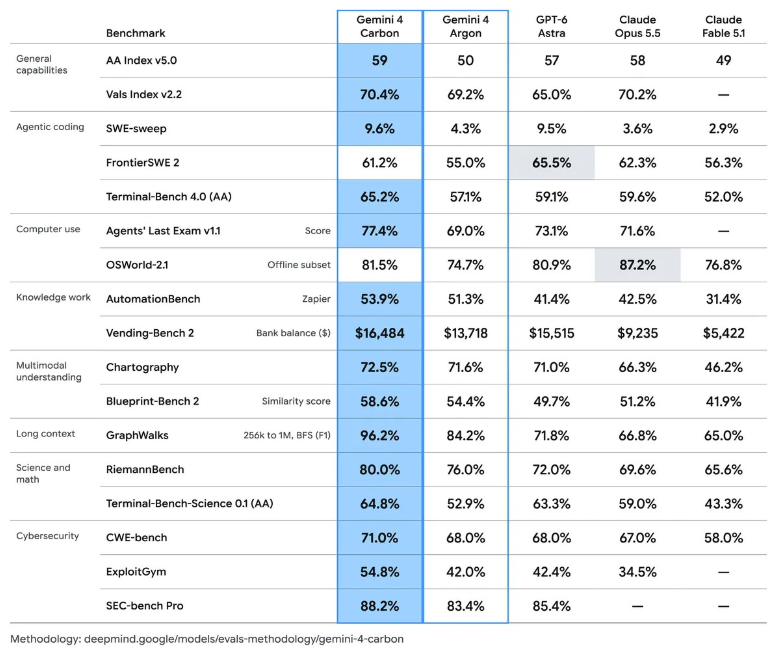
Data from the carbon benchmarks table highlights the clear supremacy of Google’s latest architecture across diverse global metrics. Carbon claimed the top spot in the AA Index v5.0 with a score of 59, outperforming Argon (score of 50) and leading key competitors like GPT-6 Astra and Claude Opus 5.5. The model also posted stellar results in agentic coding evaluations like SWE-sweep (9.6% vs. 4.3% for Argon), scored 65.2% on Terminal-Bench 4.0 (AA), and achieved overwhelming dominance in cybersecurity by scoring 88.2% on SEC-bench Pro for vulnerability detection, 54.8% on ExploitGym for exploitation, and 71.0% on CWE-bench for root-cause patching.
Source: Official Google Blog
You Might Also Like: Claude Haiku 5.5 Review: Is It Truly the Cheapest and Fastest?
Analysis of Intelligence Index vs. Task Cost
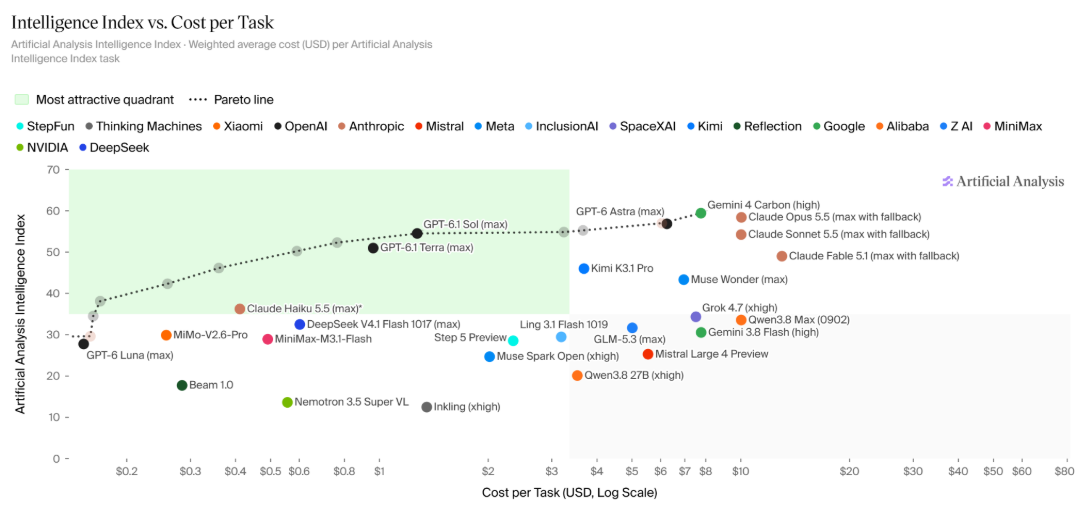
Looking at the Intelligence Index vs. Cost per Task chart, Gemini 4 Carbon sits on the far right, reflecting immense capabilities and absolute intelligence that surpass models like Claude Opus 5.5 and GPT-6 Astra. Although operating costs fall into a higher tier due to the massive resources allocated for complex tasks and autonomous agents, the technical return and absolute precision fully justify this cost for major enterprises seeking maximum reliability.
HLE-Diamond Benchmark
The HLE-Diamond test is a refined, 1,000-question benchmark split evenly between reasoning and knowledge, featuring hundreds of image-backed questions to measure advanced model capabilities. Within this rigorous evaluation, Gemini 4 Carbon (High) secured undisputed first place with a 69.1% success rate, outperforming strong rivals like Claude Opus 5.5 (67.9%) to prove its absolute dominance in multimodal processing and deep cognitive analysis.
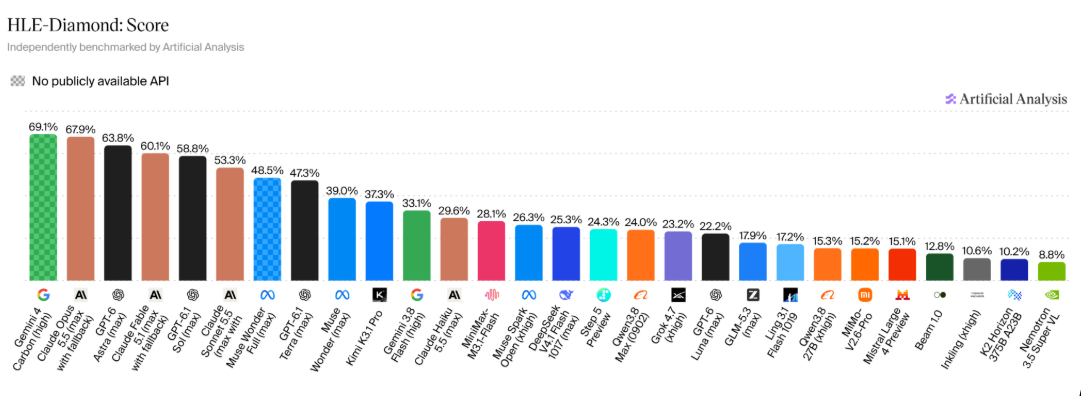
Source: HLE-Diamond Benchmark
AA-Omniscience v1.1 Benchmark: Knowledge and Hallucination Benchmark
The AA-Omniscience v1.1 benchmark serves as a core tool for measuring factual recall and knowledge reliability across multiple economic and scientific domains, rewarding accuracy and penalizing bad guesses to minimize digital hallucinations. In this advanced evaluation, Gemini 4 Carbon (High) claimed first place with a score of 54, comfortably leading competing models and showcasing Google’s commitment to delivering reliable, low-error outputs compared to previous generations.
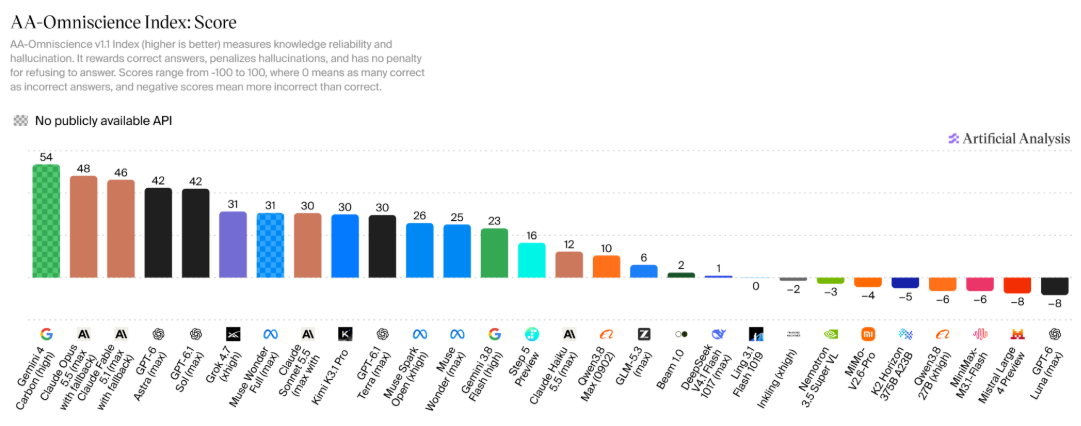
Source:AA-Omniscience v1.1: Knowledge and Hallucination Benchmark
SEC-bench Pro: Leadership in Software Security
SEC-bench Pro is an advanced security metric measuring the ability of AI agents to hunt security bugs in critical software systems and perform automated remediation. Gemini 4 Carbon demonstrated exceptional efficiency by taking first place with an 88.2% success rate, outperforming models like GPT-6 Astra (85.4%) and its predecessor Argon (83.4%), reinforcing its leadership in securing digital infrastructure and complex codebases.
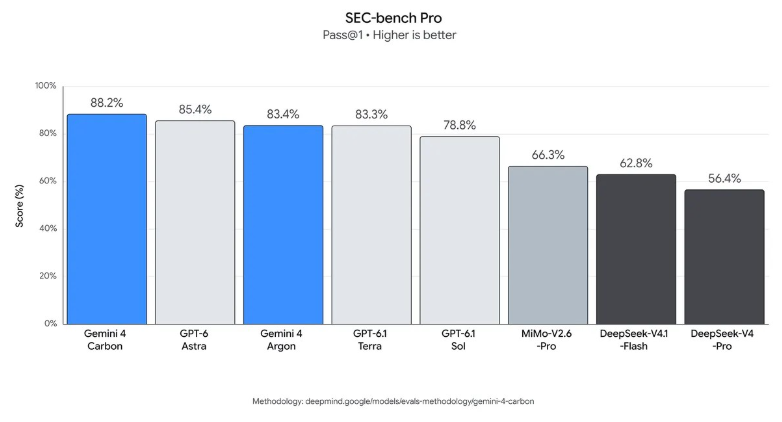
Source: SEC-bench Pro
Detailed Comparison: gemini 4 carbon vs argon
Both models share a 1-million-token context window, native multimodal capabilities, and identical token pricing tiers, yet their operational behaviors diverge significantly based on deployment requirements:
Comparison Vector | Gemini 4 Argon | Gemini 4 Carbon |
Release Date | October 13, 2026 | October 28, 2026 |
AA Intelligence Index v5.0 | ~53 – 55 | 59 (Global #1) |
Terminal-Bench 4.0 | Lower in interactive CLI execution | 64.0% – 65.2% |
Hallucination Rate (AA-Omniscience v1.1) | 4% (Industry lowest) | 11% (2nd lowest) |
Cognitive Accuracy Rate | 48% | 58% |
Prompt Injection Defense (Gray Swan IPI) | 0.7% | 0.0% (Complete immunity) |
Current Availability | Generally Available (GA) | Gated for Defenders (Fairwind) |
In direct gemini 4 carbon vs argon evaluations, the models effectively eliminate counterproductive behaviors common in autonomous agent environments; Carbon reduced unnecessary scope overreach by 26% and cut hesitant under-service by 29% compared to Argon. Furthermore, Carbon completely eliminated test suite tampering and code cheating (0.0%), ensuring plans are executed with strict discipline and high fidelity.
Related Article: Gemini 4 Argon Review: Performance, Pricing, and Model Comparison
Future Horizon, Developer Availability, and Building Custom AI Workflows
Google is adopting a deliberate, secure rollout approach by making Carbon available first to vetted experts and cybersecurity defenders via its Fairwind Program to audit vulnerabilities and strengthen safeguards. It is important to note that Gemini 4 Carbon is not yet generally available for public or commercial deployment. Once validated, Carbon will roll out to developers and enterprises at competitive pricing starting at $2.00 per million input tokens and $10.00 for output tokens.
While frontier models continue to evolve rapidly, businesses do not need to wait for general model availability to automate complex operational tasks. At SO Development, we build production-ready enterprise AI Agents tailored to your specific workflows, integrating custom data sources, deterministic safeguards, and autonomous execution pipelines that drive real business value today.
Frequently Asked Questions
What is the core difference between Carbon and Argon?
In a head-to-head comparison of gemini 4 carbon vs argon, Argon launched on October 13, 2026, serving as a stable foundation for legal and financial domains with exceptional precision and a very low hallucination rate (4%). Carbon launched on October 28, 2026, leading rankings in software engineering and cybersecurity with superior performance and total resistance to attacks and cheating.
Is Gemini 4 Carbon currently available for public use?
No, Gemini 4 Carbon is not currently available for general public or commercial use. It is restricted to select cybersecurity experts through Google’s Fairwind Program to validate patches and secure systems before broader API availability.
How do carbon benchmarks reflect on model evaluation?
The results demonstrate the model’s leadership across global benchmarks, including the Artificial Analysis Index v5.0 and cybersecurity standards like SEC-bench Pro and HLE-Diamond.