Introduction
Google has announced its latest frontier model, Gemini 4 Argon. Designed to sustain long reasoning chains across multi-step tasks, the Gemini 4 Argon model represents a major shift in how internal engineering and external enterprise applications operate. From complex coding projects to cybersecurity AI defense, the model focuses on solving real-world problems that require deep logic and long context retention.
While Google continues to expand its catalog of Google AI models, the launch of Gemini 4 Argon comes at a competitive time. Many developers are evaluating alternative tools and open-source options that offer lower operational costs. This article examines the core features of Gemini 4 Argon, reviews its AI benchmark scores, and compares it with other leading systems in the market.
What Is Gemini 4 Argon and How Does It Work?
Gemini 4 Argon is a frontier AI model engineered for deep reasoning and long-horizon tasks. Unlike standard conversational models, it handles complex software engineering, legal document analysis, and automated security fixes. Google currently uses Gemini 4 Argon internally to optimize quantum computing workflows, reduce memory overhead across data centers, and migrate legacy C++ codebases to safe Rust.
Because delivering technological capabilities at this breakthrough level requires the utmost caution, Google is taking a phased and safe approach to its rollout. It is actively participating in the U.S. government’s voluntary pre-release process, while gradually expanding availability. Google has already made the model available to a selected group of trusted cybersecurity defenders through its Fairwind Program for cyber defense. Google continues to collect feedback and evaluations from early innovators and testers to refine safety guardrails before introducing Argon to developers, enterprises, and consumers as soon as possible. For more details, read the official announcement directly on the Google Blog.
Cybersecurity AI Defense Capabilities
A core focus during the development of Gemini 4 Argon was cybersecurity AI defense. The model can autonomously search for software vulnerabilities, verify potential exploits, and apply security patches. For trusted security teams and internal Google engineers, the model is provided without standard cyber guardrails to enable full defensive testing.
Security company Wiz integrated Gemini 4 Argon into its Scan for Good initiative to protect public digital infrastructure. During early trials, the model identified a critical vulnerability in global healthcare software that exposed patient data—a security flaw missed by previous frontier tools. In formal evaluations like CWE-bench v1, the model tied for first place with a 68% score in patching vulnerabilities.
Key Model Strengths
- Deep Code Migration (C++ to Rust)
- Cybersecurity AI Defense & Automated Patching
- Extended Output Token Capacity (Up to 1M Tokens)
- High Cost-to-Intelligence Efficiency Ratio
AI Benchmark Scores and Performance Analysis
Google released a detailed set of AI benchmark scores comparing Gemini 4 Argon against major competitors, including GPT-6 Astra, Claude Fable 5.1, and Claude Opus 5.8.
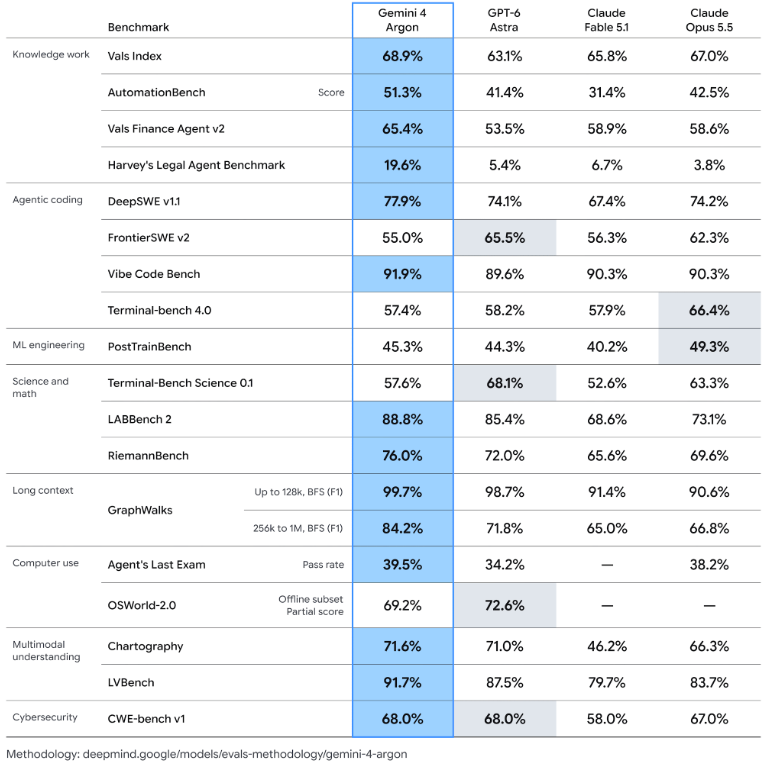
While these published AI benchmark scores show strong performance, independent reviewers have highlighted caveats in specific tests. For example, a review by Epoch AI evaluated the DeepSWE v1.1 coding benchmark and labeled it as flawed due to grading system errors. In over 20% of the sampled tasks, valid code modifications made by models broke the automated test runner, resulting in false negatives.
Intelligence Index vs. Cost Efficiency
Data from Artificial Analysis places Gemini 4 Argon in a favorable position regarding intelligence versus operational cost.
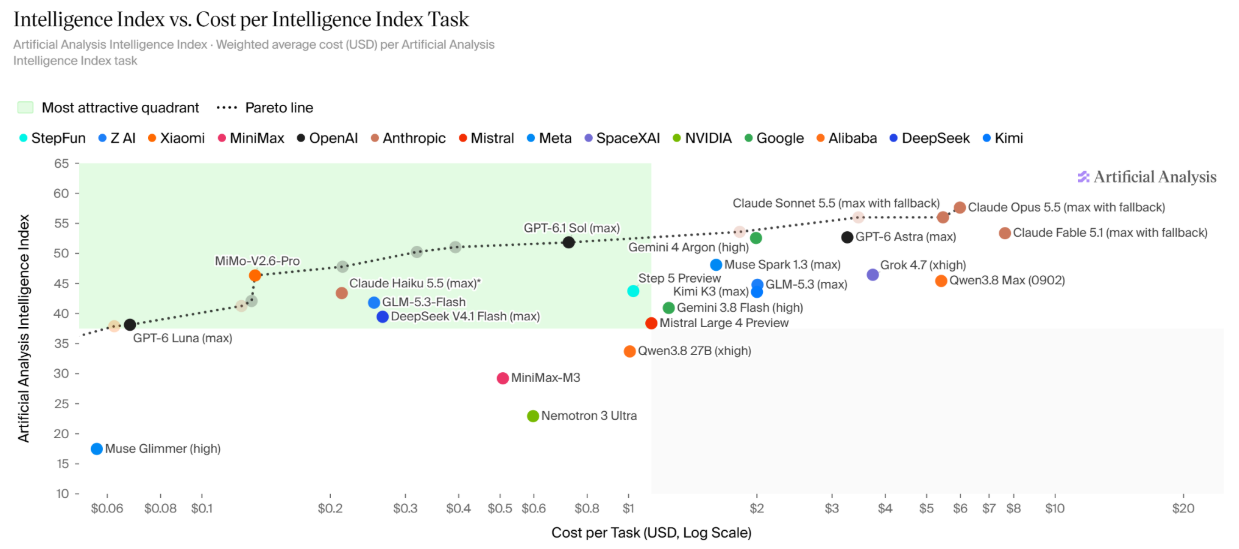
source: AI benchmark scores: Intelligence vs. Cost
On the intelligence index scale, Gemini 4 Argon scores above 52 points at an estimated cost of $2.00 per standard task. While models like Claude Opus 5.5 achieve slightly higher intelligence ratings, their per-task costs range between $5.00 and $8.00. This makes Gemini 4 Argon an economical choice for enterprises requiring strong reasoning without extreme price overheads.
Sustained reasoning is critical for autonomous systems that make complex execution choices. To understand how underlying engines enable such decisions, read our analysis on JEV and the architecture behind decision AI.
Pricing Structure
Google has established two pricing tiers for API usage:
Introductory Pricing
- Input Tokens: $2.00 per 1M tokens
- Output Tokens: $10.00 per 1M tokens
- Cached Input Tokens: $0.10 per 1M tokens (95% discount)
Standard Pricing (Post-Introductory Period)
- Input Tokens: $4.00 per 1M tokens
- Output Tokens: $20.00 per 1M tokens
Price Comparison Across Market Competitors
Data from Artificial Analysis evaluates model costs alongside capability ratings. The following table outlines standard API rates and estimated task costs across leading providers:
Model | Provider | Input Cost (per 1M Tokens) | Output Cost (per 1M Tokens) | Estimated Cost per Task (Artificial Analysis) |
Gemini 4 Argon | $2.00 (Intro) / $4.00 (Standard) | $10.00 (Intro) / $20.00 (Standard) | ~$2.00 | |
GPT-6.1 Sol (max) | OpenAI | $1.25 | $5.00 | ~$1.50 |
GPT-6 Astra (max) | OpenAI | $2.50 | $10.00 | ~$3.20 |
Claude Sonnet 5.5 | Anthropic | $3.00 | $15.00 | ~$5.20 |
Claude Opus 5.5 | Anthropic | $5.00 | $25.00 | ~$7.80 |
Gemini 3.8 Flash | $0.50 | $1.50 | ~$0.90 |
- Introductory Rates for Argon: Input tokens cost $2.00 per million, output tokens cost $10.00 per million, and cached input tokens receive a 95% discount at $0.10 per million.
- Standard Pricing: After the introductory period expires, the price of $4 per 1M input tokens and $20 per 1M output tokens will apply.
While Gemini 4 Argon delivers top tier performance, evaluating its position against market alternatives is essential. For a deeper breakdown of competitor capabilities, see our detailed guide on OpenAI’s latest GPT-6.1 model release.
Bridging Frontier Models into Production
Deploying powerful models like Gemini 4 Argon into real business workflows requires more than just API access. To handle complex decision chains safely, enterprise applications often rely on structured AI Agent architectures paired with Human-in-the-Loop oversight. This combination ensures high operational accuracy, prevents automated errors in critical tasks, and maintains compliance across sensitive operations.
Comparing Google AI Models: Which Tool to Choose?
Selecting the right model within the suite of Google AI models depends on specific workflow needs, execution speed, and reasoning depth:
Google Model Ecosystem Comparison
Gemini 4 Argon: Deep reasoning, 1M output limit
Gemini 3.8 Flash: Stable workhorse for coding & reports
Gemini 3.1 Pro: Public preview for complex reasoning
Gemini 3.5 Flash-Lite: High-speed sorting & field extraction
Expanded Output Capacity (1M Output Limit)
Google announced a maximum output capacity of 1,000,000 tokens for Gemini 4 Argon, compared to the 65,536 output token limit in previous generations.
It is crucial to keep input and output limits separate when reviewing API specifications:
- Input Limit: The amount of context or source material the model can receive in a single request (1,048,576 tokens for 3.8 Flash, 3.5 Flash-Lite, and 3.1 Pro Preview).
- Output Limit: The maximum capacity available for the model’s generated response.
The Argon launch post focuses on this expanded 1M output limit. Larger output windows allow the model to generate full software modules and extended reports without stopping mid-task.
Google Lineup Comparison Matrix
Model | Current Status | Where to Start (Suggested Use Cases) |
Gemini 4 Argon | Selected early access via Fairwind Program; broader release pending | Difficult code changes, long research tasks, and problems that repeatedly defeat current models. |
Gemini 3.8 Flash | Stable API model | Substantial daily work: reports, document analysis, and standard coding. |
Gemini 3.5 Flash-Lite | Stable API model | High-volume tasks: sorting support requests, field extraction, and processing short documents. |
Gemini 3.1 Pro Preview | Public API preview | Existing Pro workflows and comparison runs on complex reasoning tasks. |
Practical Selection Guidelines
- Gemini 4 Argon vs. Gemini 3.8 Flash:
- Google positions Argon for sustained reasoning across complex work. Gemini 3.8 Flash already supports substantial coding and business tasks, so a difficult job can still be a reasonable Flash test.
- Rule: Start with Flash when you can define and check the result. Save the failures worth testing with Argon, such as an overlooked condition in a project brief or a bug that survives a proposed fix.
- Gemini 4 Argon vs. Gemini 3.1 Pro Preview:
- Google still lists 3.1 Pro Preview for complex reasoning and coding. Its preview status matters when deciding what to use in an established app.
- Rule: Keep examples from your current Pro setup. Compare whether Argon catches more errors, follows required formats, or reduces manual editing before changing working setups.
- Where Flash-Lite Fits:
- Designed for fast, high-volume work. Try it on narrow tasks with clear rules, such as extracting company names and dates from approved notes or sorting support tickets into fixed categories.
Final Thoughts
Gemini 4 Argon represents a significant step forward in Google’s AI capabilities, particularly for long reasoning tasks, complex coding, and defensive cybersecurity. While its expanded 1M output token limit and strong benchmark results make it a powerful tool for enterprise work, its success will depend on wider API availability and actual cost performance compared to competing models. For most organizations, starting with Gemini 3.8 Flash for routine tasks and reserving Argon for complex, multi-step challenges remains the most practical strategy.
Frequently Asked Questions (FAQ)
What is Gemini 4 Argon?
Gemini 4 Argon is Google’s latest frontier AI model designed for deep reasoning, long video understanding, complex software engineering, and defensive cybersecurity.
Is Gemini 4 Argon free?
No, it is a paid model accessible via API pricing starting at $2.00 per million input tokens during its introductory period. It is also being rolled out to Google AI Ultra subscribers and enterprise partners.
Where can I use Gemini 4 Argon?
Currently, access is available to trusted cyber defenders in the Fairwind Program and internal Google teams. Public access via Google Cloud API and developer platforms will follow.
How does it support cybersecurity AI defense?
It can autonomously analyze systems, discover critical vulnerabilities, verify exploits, and generate functional code patches.