Introduction
OpenAI has announced an exciting update for AI developers and business teams. The official GPT 6.1 release brings powerful performance upgrades at a fraction of the previous cost. With this OpenAI new model, users get high-level intelligence without paying premium prices. The new ChatGPT Sol 6.1 system is designed to handle complex coding, document analysis, and automated workflows smoothly while keeping computational expenses low.
What Is ChatGPT-6.1 Sol and Why Does It Matter?
GPT-6.1 Sol is designed for organizations that need to run sophisticated AI workloads repeatedly.
Instead of using the most powerful model for every task, companies can use Sol for workflows that require substantial reasoning, coding, tool use, or computer interaction while keeping operating costs lower.
OpenAI describes GPT-6.1 Sol as offering near-Astra performance for complex work at a lower cost.
Key benefits include:
- Complex coding: Useful for software development, debugging, refactoring, and multi-step engineering tasks.
- Computer use: Can interact with supported computer environments and web applications.
- AI agents: Suitable for workflows that require multiple tools and actions.
- Large-context processing: Supports up to 1.05 million tokens of context.
- Lower API costs: Standard pricing is $2 per million input tokens and $10 per million output tokens.
- Advanced reasoning: Supports low, medium, high, extra-high, and maximum reasoning effort.
- Business automation: Can handle document-heavy and multi-step professional workflows.
- Multi-agent workflows: GPT-6.1 Sol also supports multi-agent capabilities in beta.
Read Also: AI Agent Implementation Checklist for Regulated Industries
GPT-6.1 Sol vs GPT-6 Astra vs GPT-6 Luna
One of the most important changes in the GPT-6 family is that OpenAI now provides different models for different workload requirements.
GPT-6 Astra is positioned as the most capable model for demanding reasoning and professional work.
GPT-6.1 Sol is designed for complex work where organizations also need to manage cost.
GPT-6 Luna is optimized for high-volume and cost-sensitive workloads.
Feature | GPT-6 Astra | GPT-6.1 Sol | GPT-6 Luna |
Main focus | Maximum intelligence | Complex work + cost efficiency | High-volume efficiency |
Input / 1M tokens | $10 | $2 | $0.10 |
Output / 1M tokens | $50 | $10 | $0.50 |
Context window | 1.05M | 1.05M | 1.05M |
Max output | 128K | 128K | 128K |
Complex coding | Excellent | Excellent | Good |
Computer use | Yes | Yes | Yes |
Web search | Yes | Yes | Yes |
File search | Yes | Yes | Yes |
Best suited for | Hardest professional and reasoning tasks | Complex recurring workflows | High-volume automation |
Pricing and capabilities are based on OpenAI’s current model documentation.
The pricing difference is particularly significant. GPT-6.1 Sol’s standard input price is one-fifth of GPT-6 Astra’s, while its output price is also one-fifth. Cached input is $0.10 per million tokens compared with $1.00 for Astra.
This makes Sol particularly interesting for applications that execute thousands or millions of model interactions.
Read also: OpenAI’s GPT 5.6 Review: What Makes This New Generation Different?
Performance, Speed, and Task Cost Breakdown
Understanding the GPT 6.1 release value requires looking at both standard token pricing and real-world task execution costs.
According to official OpenAI documentation, ChatGPT Sol 6.1 sets its standard API rates at $2 per million input tokens and $10 per million output tokens, with cached input discounted to just $0.10 per million tokens. However, independent evaluation by Artificial Analysis breaks down how these costs and output speeds scale across the model’s 5 reasoning effort configurations:
- Output Speed & Latency: The fastest configuration for ChatGPT Sol 6.1 is the Max reasoning effort tier, delivering 64 tokens per second (t/s). High effort reaches 58 t/s, Low effort achieves 54 t/s, while xhigh and Medium effort operate at 53 t/s. For rapid response requirements, the Low effort tier provides the lowest latency, generating the first token in just 3.11 seconds.
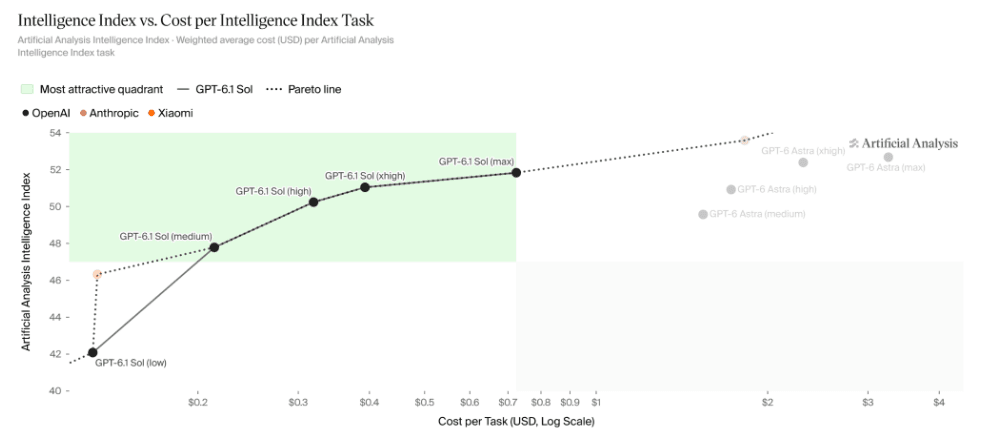
- Cost Per Task (Artificial Analysis Index): On a per-task basis, expenses scale up to 5.5x depending on the reasoning intensity. The Low effort mode is the most economical at $0.13 per task, moving to $0.21 for Medium, $0.32 for High, $0.39 for xhigh, and capping at $0.72 per task for Max effort.
Compared to GPT-6 Astra, these performance tiers give developers granular control over execution speed and exact operational expenditure per agent workflow.
Artificial Analysis Intelligence Index vs. Cost per Task, showing ChatGPT Sol 6.1 positioning in the most attractive quadrant compared to GPT-6 Astra.
GPT-6.1 Sol vs the Original GPT-6 Sol
GPT-6.1 Sol is also an evolution of the earlier GPT-6 Sol model.
The standard input and output prices remain at $2 and $10 per million tokens, respectively, but cached input is now $0.10 per million tokens compared with $0.20 for the original GPT-6 Sol.
More importantly, OpenAI reports improvements in coding and computer-use performance.
For example, OpenAI developer-community reporting on the release cites a 75.2% DeepSWE v1.1 score for GPT-6.1 Sol at high reasoning effort, compared with 68.8% for GPT-6 Sol at maximum reasoning effort. On the cited AutomationBench evaluation, GPT-6.1 Sol scored 31.7% at medium reasoning effort.
These benchmark results should not be interpreted as a guarantee that Sol will outperform every model on every real-world task. Actual performance depends heavily on prompts, tools, reasoning settings, and the specific workflow.
Real-World Applications of OpenAI New Model: GPT-6.1 Sol
The biggest opportunity for GPT-6.1 Sol is not simply asking the model questions. Its combination of reasoning, coding, large context, and tool use makes it suitable for multi-step business applications.
1. AI Software Development
GPT-6.1 Sol can be used as an AI engineering assistant for:
- Writing application code
- Debugging software
- Refactoring large codebases
- Generating unit tests
- Reviewing pull requests
- Explaining legacy systems
- Creating API integrations
- Automating repetitive development tasks
For example, a development team could give Sol a product specification and ask it to create the initial application structure, write backend endpoints, generate tests, and identify implementation problems.
For extremely difficult engineering problems, teams may still choose Astra. For repetitive development work where cost matters, Sol provides another option.
2. AI Customer Support Agents
GPT-6.1 Sol can also be used to build customer-support agents that combine company documentation with external tools.
A support agent could:
- Receive a customer request.
- Search the company’s knowledge base.
- Identify the relevant account information.
- Check an internal system.
- Determine the appropriate response.
- Update a CRM.
- Escalate the issue when human intervention is required.
This is different from a basic chatbot because the model can participate in a larger workflow involving tools and business systems.
3. Browser and Computer Automation
Computer use is one of the most interesting applications for Sol.
Businesses can build agents that interact with websites and software interfaces to perform tasks such as:
- Entering information into web forms
- Navigating internal dashboards
- Processing documents
- Checking information across websites
- Performing repetitive back-office operations
- Moving information between business applications
OpenAI added computer use to its Agents API in September 2026, allowing agents to complete tasks in an OpenAI-hosted browser, with website access and sign-in controls handled by the application.
This creates possibilities for AI-powered digital workers rather than simple text-generation systems.
4. Document Analysis
The model’s large context window makes it suitable for document-heavy workflows.
Potential applications include:
- Contract analysis
- Policy review
- Financial document analysis
- Technical documentation
- Research reports
- Compliance workflows
- Internal knowledge management
- Large codebase analysis
For example, a company could process a large collection of internal documentation and ask the model to identify requirements, inconsistencies, risks, or missing information.
For regulated industries, however, organizations still need appropriate access controls, human review, audit trails, and data-governance procedures.
5. AI Sales and Business Development
GPT-6.1 Sol can also support sales teams.
An AI sales workflow could:
- Research a prospect
- Analyze the company’s website
- Identify potential business needs
- Draft a personalized email
- Update CRM records
- Prepare meeting briefs
- Summarize previous interactions
- Generate follow-up messages
This is particularly interesting for companies running large outbound campaigns because the lower token cost can make repeated research and personalization more economical.
6. Data Analysis and Reporting
Another potential application is automated business reporting.
For example, Sol could receive:
- Sales data
- Customer feedback
- Financial spreadsheets
- CRM information
- Operational reports
It could then help produce:
- Executive summaries
- Performance reports
- Trend analysis
- Data-quality checks
- Management presentations
- Follow-up recommendations
The model can also use tools such as code interpreter and file search through the Responses API.
Why the Cost Difference Matters
Consider an application processing 100 million input tokens and 20 million output tokens.
Using the standard published prices:
GPT-6 Astra
100M input × $10 = $1,000
20M output × $50 = $1,000
Total: $2,000
GPT-6.1 Sol
100M input × $2 = $200
20M output × $10 = $200
Total: $400
That is a substantial difference for a high-volume application.
The actual cost of an application can be different because tool calls, caching, processing tiers, and other services may contribute additional costs.
For companies running thousands of AI-agent executions every day, model selection can therefore have a major impact on the overall economics of the system.
The Importance of GPT-6.1 release for AI Agents
AI agents are arguably one of the most important use cases for the model.
A traditional chatbot generally follows a simple pattern:
User → Model → Response
An AI agent can operate more like:
User → Model → Search → Tool → Computer → Database → Model → Action → User
GPT-6.1 Sol supports many of the capabilities required for this type of workflow, including function calling, web search, file search, computer use, MCP, hosted shell, and code interpreter.
This makes it possible to build agents for areas such as:
- Customer service
- IT support
- Software engineering
- Sales operations
- Research
- Finance operations
- Document processing
- Business administration
GPT-6.1 Sol and Multi-Agent Systems
Another important capability is multi-agent orchestration.
Instead of asking one model to perform every part of a complicated workflow, an application can divide a task between specialized agents.
For example:
Research Agent → Analysis Agent → Verification Agent → Report Agent
One agent could collect information, another could analyze it, another could check the results, and the final agent could produce the report.
GPT-6.1 Sol supports multi-agent functionality in beta, giving developers another way to construct complex workflows.
This architecture can be particularly useful when a task contains multiple independent stages.
GPT-6.1 Sol vs GPT-5.6
For organizations still using earlier GPT-5.6-generation systems, GPT-6.1 Sol represents a move toward more agentic workflows rather than simply generating better text.
The difference is particularly relevant for applications that need:
- More sophisticated reasoning
- Computer interaction
- Tool calling
- Large-context processing
- Complex coding
- Automated multi-step workflows
However, upgrading is not necessarily just a matter of changing the model name.
Developers should test prompts, tool calls, reasoning settings, output formats, latency, and application-specific quality before moving a production system to a new model.
Technical Specifications of GPT-6.1 Sol
The current OpenAI documentation lists the following specifications:
- Model ID: gpt-6.1-sol
- Context window: 1,050,000 tokens
- Maximum output: 128,000 tokens
- Knowledge cutoff: April 30, 2026
- Input: $2 per 1M tokens
- Cached input: $0.10 per 1M tokens
- Cache writes: $2.50 per 1M tokens
- Output: $10 per 1M tokens
- Reasoning: Low, medium, high, xhigh, and max
- Function calling: Supported
- Structured outputs: Supported
- Web search: Supported
- File search: Supported
- Code interpreter: Supported
- Computer use: Supported
- MCP: Supported
- Hosted shell: Supported
- Image generation: Supported
- Data residency: US and EU options are available, subject to eligibility.
How Should Businesses Choose Between Astra, Sol, and Luna?
The three models address different types of workloads.
Choose GPT-6 Astra when:
- The task is exceptionally demanding.
- Maximum model capability is the primary concern.
- The workflow involves difficult reasoning or highly complex professional work.
- Higher model cost is acceptable.
Choose GPT-6.1 Sol when:
- The task is complex.
- Coding or computer use is required.
- The workflow runs frequently.
- Cost needs to remain controlled.
- Near-Astra performance is sufficient.
Choose GPT-6 Luna when:
- The workload is highly repetitive.
- Large volumes of requests are involved.
- The task is relatively well-defined.
- Cost efficiency is the dominant requirement.
OpenAI’s own model-selection guidance describes Astra as its state-of-the-art model, GPT-6.1 Sol as optimized for complex tasks where time and cost matter, and Luna as the efficient choice for scoped and high-volume tasks.
Final Thoughts
GPT-6.1 Sol represents an important step toward making advanced AI agents more economically practical.
Rather than positioning the model simply as a larger or smarter chatbot, OpenAI has designed Sol around real-world professional workloads including coding, computer use, document processing, research, and business automation.
Its combination of a 1.05-million-token context window, advanced reasoning, tool use, computer interaction, and significantly lower token prices than GPT-6 Astra makes it particularly relevant for organizations building AI systems at scale.
For developers, the key question is therefore not simply “Is GPT-6.1 Sol the most powerful model?” Instead, it is whether its performance and cost profile match the requirements of a particular workflow.
As AI moves from individual chat interactions toward autonomous agents and automated business processes, that cost-performance balance could become just as important as raw model intelligence.
Frequently Asked Questions
Is GPT-6.1 Sol free?
GPT-6.1 Sol is an API model with usage-based pricing. OpenAI currently lists standard API pricing of $2 per million input tokens and $10 per million output tokens, with separate pricing for cached input and cache writes. Access through ChatGPT products depends on the user’s plan and workspace availability.
What is the difference between GPT-6.1 Sol and GPT-6 Astra?
GPT-6 Astra is OpenAI’s flagship model for the most demanding work, while GPT-6.1 Sol is designed to provide near-Astra performance for complex work at a lower cost.
Is GPT-6.1 Sol better than GPT-6 Luna?
They are designed for different workloads. Sol targets complex coding, computer use, and professional workflows, while Luna is positioned as OpenAI’s most efficient model for focused, high-volume tasks. The appropriate choice depends on the application’s quality, latency, and cost requirements.
Can GPT-6.1 Sol build AI agents?
Yes. The model supports tool use through the Responses API, including web search, file search, computer use, code interpreter, MCP, hosted shell, and other tools. It also supports multi-agent functionality in beta.
Does GPT-6.1 Sol support computer use?
Yes. Computer use is one of the model’s supported capabilities, making it suitable for applications that need an AI agent to interact with computer environments and websites.
Can I migrate from GPT-6 Sol to GPT-6.1 Sol?
Yes, but OpenAI recommends reviewing the migration guidance and testing the application. GPT-6.1 Sol uses the Responses API for tool calling and introduces updated reasoning behavior, so production applications should be tested rather than simply changing the model identifier.
What is the biggest advantage of GPT-6.1 Sol?
Its main differentiator is the combination of strong reasoning, agentic capabilities, and lower operating cost. This makes it particularly relevant for applications that need to perform complex tasks repeatedly rather than occasionally.