Introduction
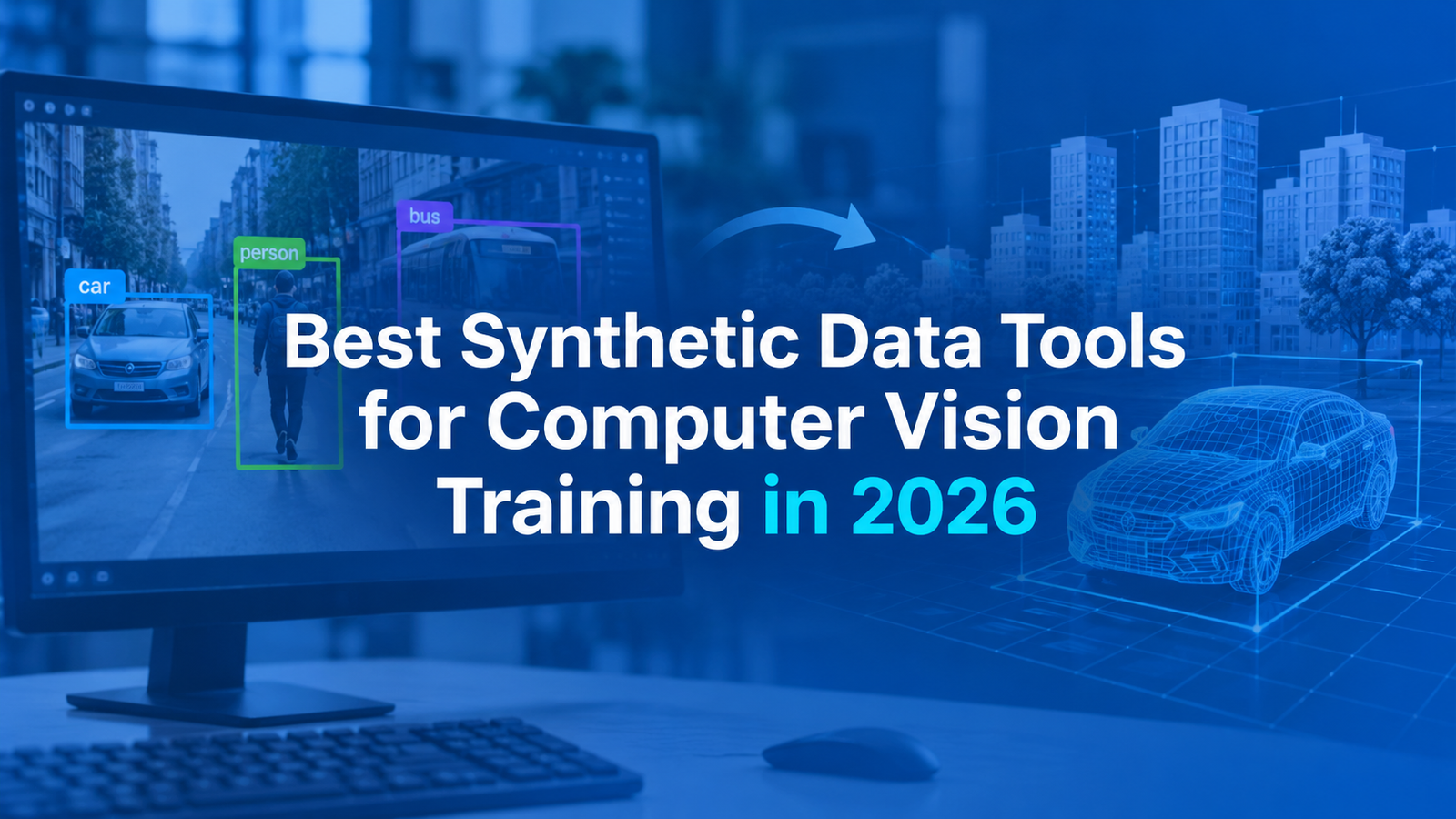
Computer vision is advancing rapidly, powering applications such as autonomous driving, industrial inspection, robotics, medical imaging, retail analytics, and intelligent video surveillance. However, developing reliable computer vision models requires more than sophisticated algorithms. It requires large, diverse, and accurately annotated datasets.
For many AI companies, obtaining enough high-quality training data remains a major challenge. Collecting images and videos from real-world environments can be expensive, while annotating millions of visual samples requires significant time and human resources. Some scenarios, such as industrial accidents, unusual security incidents, extreme weather, or dangerous driving conditions, are also difficult to capture safely.
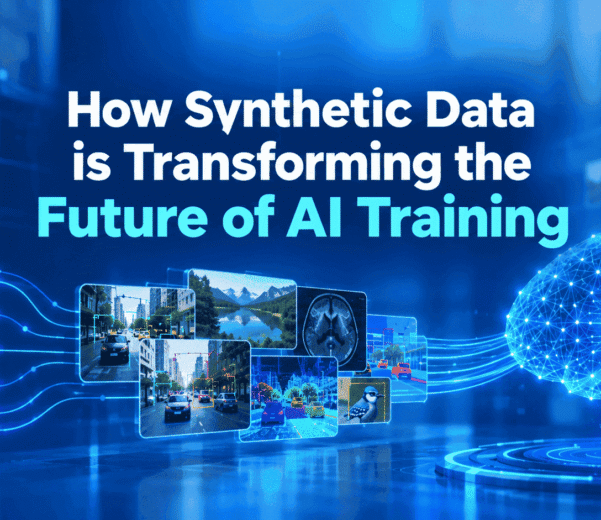
Synthetic data offers an alternative. By using 3D simulation, generative AI, and procedural rendering, developers can create artificial images, videos, and sensor data that represent different real-world conditions. Some platforms can also generate ground-truth annotations automatically, making synthetic data particularly valuable for supervised computer vision training.
In 2026, synthetic data technologies are evolving beyond basic image generation. Advanced platforms support photorealistic environments, multi-sensor simulation, automated labeling, digital twins, and generative world models.
In this article, we explore the best synthetic data tools for computer vision training in 2026, compare their capabilities, examine their applications, and explain how to select the right solution for your AI development workflow.
What Is Synthetic Data in Computer Vision?
Synthetic data refers to artificially generated information that resembles real-world data and can be used to train, test, or validate machine learning models.
In computer vision, synthetic data typically consists of computer-generated images, videos, 3D scenes, and simulated sensor outputs.
Instead of collecting every training sample using physical cameras, developers can create virtual environments and generate images containing specific objects, backgrounds, lighting conditions, and interactions.
For example, an autonomous driving model needs to recognize pedestrians, vehicles, traffic signs, road markings, and obstacles under different conditions.
Collecting enough real-world footage to cover every possible situation is difficult. Synthetic data platforms can simulate these scenarios by changing weather conditions, road layouts, camera positions, object locations, and lighting.
Common types of synthetic computer vision data include:
- Synthetic images: Artificially generated photographs of objects, people, environments, and industrial processes.
- Synthetic videos: Simulated video sequences for object tracking, action recognition, and event detection.
- 3D data: Point clouds, depth maps, surface normals, and spatial information.
- Segmentation masks: Pixel-level labels identifying objects and environmental elements.
- Bounding boxes: Automatically generated object coordinates for detection models.
- Sensor data: Simulated LiDAR, radar, infrared, thermal, and depth information.
The primary advantage is control. Developers can generate targeted examples for specific situations rather than relying entirely on whatever data they can collect in the physical world.
For projects involving video understanding, object tracking, and activity recognition, combining synthetic footage with professionally labeled real-world videos can improve model reliability. Explore our video annotation services to support these workflows.
Why Is Synthetic Data Important for Computer Vision Training?
Synthetic data is becoming an important part of modern AI development because it addresses several limitations associated with traditional data collection and annotation.
1. Reduce Data Collection Costs
Collecting real-world visual data requires cameras, equipment, transportation, operational environments, and data collection teams.
After collection, images and videos often need to be reviewed and annotated before they can be used for training.
Synthetic data generation can reduce these requirements by producing multiple variations of existing 3D assets and environments.
Although simulation infrastructure and development require investment, reusable scenes can support repeated dataset generation without organizing new collection campaigns for every scenario.
2. Generate Rare and Difficult Scenarios
Some events are difficult, dangerous, or expensive to capture.
Examples include:
- Vehicle collisions and dangerous driving situations.
- Industrial equipment failures.
- Security incidents and unauthorized access.
- Defective products on manufacturing lines.
- Objects partially hidden behind other objects.
- Extreme weather and poor visibility.
Synthetic data platforms allow developers to reproduce these situations in controlled environments and generate additional training examples.
This is especially useful for safety-critical applications where models must recognize events that occur infrequently in real-world datasets.
3. Improve Dataset Diversity
A computer vision model trained on limited lighting conditions, camera angles, backgrounds, or object appearances may struggle when deployed in a different environment.
Synthetic data generation allows teams to introduce controlled variations in:
- Lighting and shadows.
- Camera angles and distances.
- Object sizes and orientations.
- Backgrounds and textures.
- Weather conditions.
- Occlusion and object placement.
- Sensor characteristics.
This approach is commonly known as domain randomization. It helps expose models to a broader range of conditions during training.
4. Generate Automatic Annotations
One of the most valuable advantages of simulation-based synthetic data is automatic ground-truth generation.
Because the software controls the virtual environment, it can access the exact position, shape, depth, and orientation of objects.
Depending on the platform, developers can generate:
- 2D and 3D bounding boxes.
- Semantic segmentation masks.
- Instance segmentation masks.
- Human pose keypoints.
- Depth maps.
- Surface normals.
- Optical flow.
- Object tracking information.
These capabilities can reduce manual annotation requirements and make it easier to produce consistently labeled datasets.
However, generative AI image tools do not necessarily preserve exact object coordinates or annotations. Generated outputs must be reviewed and relabeled when necessary.
Although synthetic data can automate much of the labeling process, high-quality training datasets still require accurate annotations. SO Development provides professional image annotation services to support object detection, image classification, semantic segmentation, and other computer vision tasks
5. Accelerate Model Development
Synthetic data allows AI teams to experiment with different scenarios without repeatedly organizing physical data collection.
Developers can generate datasets, train models, evaluate results, and modify simulation parameters as needed.
This creates a more iterative development process, particularly when combined with automated training and evaluation pipelines.
10 Best Synthetic Data Tools for Computer Vision Training in 2026
The following platforms represent different approaches to synthetic data generation, including physics-based simulation, 3D rendering, generative AI, and image augmentation.
They are not interchangeable. Some generate entirely new scenes with ground-truth annotations, while others create visual variations from existing images.
1. NVIDIA Isaac Sim and Omniverse Replicator
Best for: Robotics, industrial automation, and physical AI.
NVIDIA Isaac Sim is one of the most comprehensive options for generating synthetic training data for robotics and perception systems.
Built on NVIDIA Omniverse technologies, Isaac Sim provides a physically based virtual environment where developers can create and simulate complex 3D scenes.
Its synthetic data generation capabilities include Omniverse Replicator, which allows developers to automate scene randomization, rendering, annotation, and dataset export. <a href=”https://docs.isaacsim.omniverse.nvidia.com/latest/synthetic_data_generation/index.html“>NVIDIA documentation</a> describes workflows for perception, action, event, and grasping data generation.
Key features include:
- Photorealistic 3D scene rendering.
- Automated 2D and 3D bounding boxes.
- Semantic and instance segmentation.
- Depth maps and surface normals.
- Camera and LiDAR simulation.
- Lighting, material, and object randomization.
- Python-based workflow automation.
- Configurable annotation and dataset export.
One of its biggest advantages is its integration with robotics development workflows.
For example, developers can create virtual warehouses, manufacturing facilities, and robotic workspaces, then generate thousands of visual variations for object detection and perception training.
Isaac Sim can also support workflows involving NVIDIA Cosmos for additional generative augmentation.
Limitations: Building complex environments requires knowledge of 3D simulation and Python. GPU hardware and infrastructure requirements should also be considered when planning large-scale generation.
Official website: https://developer.nvidia.com/isaac/sim
2. BlenderProc
Best for: Open-source synthetic data generation and computer vision research.
BlenderProc is an open-source Python framework built around Blender. It allows developers to generate realistic synthetic images from 3D scenes and automatically produce corresponding annotations.
It is particularly useful for research teams and developers who want greater control over their rendering pipelines without relying entirely on commercial platforms.
Key features include:
- Automated 3D scene rendering.
- Object segmentation.
- Depth and normal map generation.
- Camera position and lighting randomization.
- COCO and BOP dataset generation.
- Optical flow and object coordinate outputs.
- Python-based customization.
BlenderProc uses physically based rendering to improve the realism of generated images and reduce the difference between simulated and real-world environments.
It is suitable for object detection, pose estimation, robotics, and 3D computer vision research.
Its open-source nature also allows developers to customize generation scripts according to their dataset requirements.
Limitations: Teams need experience with Blender, Python, and 3D assets. Creating realistic environments and maintaining large-scale generation pipelines may require additional engineering resources.
Official website: https://github.com/DLR-RM/BlenderProc
3. Parallel Domain
Best for: Autonomous vehicles and advanced perception systems.
Parallel Domain specializes in synthetic data and simulation technologies for autonomous systems.
Its platform focuses on reconstructing real-world environments and generating simulation-ready scenarios for training and evaluating perception models.
Its product ecosystem includes technologies for 4D environment reconstruction and deterministic sensor simulation.
Key features include:
- Real-world environment reconstruction.
- Synthetic driving environments.
- Camera, LiDAR, and radar simulation.
- Scenario generation and modification.
- Sensor-specific testing.
- API-based integration.
- Automated simulation workflows.
One important advantage is its ability to use real-world drive, flight, and indoor capture logs to create reusable virtual environments.
Developers can then modify lighting, traffic, and other scenario parameters to evaluate how perception systems respond to different conditions.
This makes Parallel Domain particularly relevant to autonomous driving, robotics, drones, and industrial autonomy.
Limitations: Its specialized simulation capabilities may be excessive for smaller projects that only require basic image augmentation or object detection datasets.
Official website: https://paralleldomain.com/

4. Anyverse
Best for: Automotive perception and multi-sensor synthetic data.
Anyverse is a synthetic data platform focused on physics-based simulation for computer vision and perception systems.
Unlike tools that concentrate primarily on generating realistic-looking images, Anyverse focuses on simulating the physical processes behind sensor observations.
Its technology models the interaction between light, materials, optics, and sensor electronics to generate data that reflects how actual sensors capture their environments.
Key features include:
- Physics-based image simulation.
- RGB and infrared data generation.
- Near-infrared and short-wave infrared simulation.
- Thermal imaging.
- LiDAR and radar simulation.
- Time-of-flight depth imaging.
- Multi-sensor data generation.
- Automated ground-truth annotations.
Its capabilities are particularly relevant to advanced driver assistance systems (ADAS), autonomous vehicles, and in-cabin monitoring.
For example, an ADAS model may need to detect pedestrians and vehicles under different lighting conditions using visible-light cameras and infrared sensors.
Anyverse allows developers to generate controlled scenarios across different sensor configurations.
Limitations: Its specialized focus makes it less suitable as a general-purpose solution for teams working exclusively with ordinary image classification datasets.
Official website: https://anyverse.ai/
5. Rendered.ai
Best for: Satellite imagery, geospatial AI, and specialized sensors.
Rendered.ai provides a cloud-based platform for creating configurable synthetic data generation workflows.
It is particularly relevant to computer vision projects involving specialized imaging technologies and environments that are difficult to capture consistently.
The platform allows teams to develop custom synthetic data applications, configure generation parameters, and execute workflows through a web interface or SDK.
Key features include:
- Configurable synthetic data generation.
- Automated annotation workflows.
- Infrared and thermal imaging.
- Synthetic aperture radar (SAR).
- Multispectral and hyperspectral imagery.
- Geospatial and aerial applications.
- Cloud-based dataset generation.
- SDK integration and automation.
Rendered.ai is useful for teams that need specialized visual datasets and want to automate generation without maintaining all the underlying simulation infrastructure.
For example, satellite image analysis systems can benefit from synthetic datasets representing different terrain types, environmental conditions, and imaging characteristics.
Limitations: Its specialized capabilities may be unnecessary for projects involving straightforward object detection or image classification.
Official website: https://rendered.ai/
6. SKY ENGINE AI
Best for: Industrial inspection, surveillance, and multi-sensor applications.
SKY ENGINE AI provides a synthetic data cloud designed for generating training and validation datasets for computer vision systems.
Its platform combines physics-based rendering, sensor simulation, and automated ground-truth generation.
It is particularly relevant to projects that require more than conventional 2D image generation.
Key features include:
- Physics-based synthetic data generation.
- 2D and 3D bounding boxes.
- Semantic and instance segmentation.
- 3D keypoints.
- Depth maps and normal maps.
- Visible-light and infrared imaging.
- Thermal and specialized sensor workflows.
- Domain adaptation capabilities.
One of its important advantages is its focus on multiple computer vision applications.
These include industrial inspection, drone detection, in-cabin monitoring, surveillance, robotics, manufacturing, and medical imaging.
For example, a security AI system designed to detect unauthorized access or unusual activity could benefit from synthetic scenarios involving different camera positions, lighting conditions, and object interactions.
Limitations: Teams should evaluate available sensor models, integration options, output formats, and commercial licensing before selecting the platform.
Official website: https://www.skyengine.ai/
7. Duality AI Falcon
Best for: Defense, aerial systems, and robotics simulation.
Duality AI Falcon is a simulation platform designed to support AI development in complex physical environments.
Built around Unreal Engine technology, Falcon provides tools for creating digital twins and generating simulated scenarios for perception and autonomy systems.
Key features include:
- Realistic 3D environment simulation.
- Scenario customization.
- Synthetic visual data generation.
- Python API integration.
- ROS and ROS 2 support.
- Multiple sensor simulation workflows.
- Applications involving aerial and autonomous systems.
Falcon is particularly relevant to teams working on drones, defense technologies, and autonomous systems that need to operate in complex or unpredictable environments.
Its simulation-first approach helps developers generate controlled scenarios that would be difficult or expensive to reproduce in real-world testing.
Limitations: Its capabilities are more specialized than those of lightweight image augmentation libraries. Teams should evaluate infrastructure requirements, annotation formats, and licensing options.
Official website: https://www.duality.ai/
8. NVIDIA Cosmos
Best for: Generative world models and visual scenario variation.
NVIDIA Cosmos brings generative world models into physical AI development workflows.
Unlike conventional 3D rendering platforms, Cosmos uses generative AI to create and transform visual scenarios based on conditioning information and structured inputs.
These can include depth maps, segmentation maps, and edge information.
Key features include:
- Generative world models.
- Image and video generation workflows.
- Visual scenario transformation.
- Conditioning using structured visual information.
- Physical AI development integrations.
- Support for simulation-based data augmentation workflows.
Cosmos can be useful when teams want to introduce visual diversity into existing simulated environments or explore environmental conditions that are difficult to reproduce through conventional rendering alone.
For example, developers can experiment with different weather conditions, lighting, and visual appearances while using structured inputs to guide generation.
However, there is an important distinction between generating a realistic image and generating a correctly labeled training sample.
Generative outputs do not automatically guarantee accurate object positions, boundaries, or segmentation masks. These annotations must be verified before the data is used for supervised training.
Limitations: Requires suitable computing infrastructure and careful validation. Model and code licensing should be reviewed for the specific Cosmos release being used.
Official website: https://www.nvidia.com/en-us/ai/cosmos/
9. Infinigen
Best for: Procedural 3D environments and computer vision research.
Infinigen is an open-source procedural 3D scene generation framework developed by Princeton’s Vision and Learning Lab.
It is designed to generate diverse synthetic environments and objects for computer vision and robotics research.
Instead of depending entirely on manually created scenes, Infinigen uses procedural generation to create varied 3D environments.
Key features include:
- Procedural 3D scene generation.
- Randomized object and environment configurations.
- Synthetic image generation.
- Computer vision research workflows.
- Customizable procedural assets.
- Blender-based rendering.
Its approach is particularly valuable when developers need visual diversity and want to generate environments that are not limited to a small collection of manually modeled scenes.
For example, research teams can use procedural environments to create training examples with different object arrangements, materials, and environmental conditions.
Limitations: Developers should review the maturity and capabilities of the specific version they intend to use. Procedural asset coverage and generation requirements should be assessed against project needs.
Official website: https://infinigen.org/
10. Albumentations
Best for: Image augmentation and improving existing datasets.
Albumentations takes a different approach from traditional synthetic data platforms.
Instead of creating complete 3D environments, it applies transformations to existing images to introduce additional visual variation.
It is a Python library commonly used in deep learning workflows, including object detection, segmentation, and classification.
Key features include:
- Image rotation and flipping.
- Brightness and contrast adjustments.
- Noise and blur.
- Random cropping and resizing.
- Weather-related transformations.
- Bounding box and segmentation mask synchronization.
- Custom augmentation pipelines.
- Integration with popular machine learning frameworks.
Albumentations is particularly useful when a team already has a labeled dataset but wants to improve its diversity without collecting additional images.
For example, an object detection dataset containing images captured in daylight can be augmented with different brightness, contrast, and noise conditions.
Unlike full synthetic data platforms, Albumentations does not create entirely new physical environments or objects.
It is best considered a complementary tool for increasing the diversity of existing training data.
Limitations: Augmentation cannot reliably introduce objects, interactions, or scenarios that are completely absent from the original dataset.
Official website: https://albumentations.ai/

Comparison of the Best Synthetic Data Tools in 2026
The following table summarizes the primary capabilities and applications of the ten tools.
Tool | Generation method | Main capabilities | Best application |
NVIDIA Isaac Sim | 3D simulation | Bounding boxes, segmentation, depth, sensor simulation | Robotics and industrial AI |
BlenderProc | 3D rendering | Depth, normals, segmentation, COCO and BOP | Research and custom datasets |
Parallel Domain | Reconstruction and simulation | Camera, LiDAR, radar, digital twins | Autonomous driving |
Anyverse | Physics-based simulation | RGB, infrared, thermal, LiDAR, radar | ADAS and multi-sensor AI |
Rendered.ai | Configurable simulation | SAR, infrared, multispectral data | Satellite and geospatial AI |
SKY ENGINE AI | Physics-based rendering | 2D/3D boxes, masks, keypoints, depth | Industrial AI and surveillance |
Duality AI Falcon | Digital twin simulation | 3D environments and sensor simulation | Defense and aerial systems |
NVIDIA Cosmos | Generative AI | World models and visual variation | Physical AI |
Infinigen | Procedural 3D generation | Diverse synthetic environments | Computer vision research |
Albumentations | Image augmentation | Image transformations and label-aware augmentation | Existing datasets |
Important: These tools do not all generate the same type of synthetic data. Simulation platforms can generate new scenes with ground-truth labels, while generative tools and augmentation libraries may require additional annotation or verification.
Synthetic Data Generation vs. Data Augmentation: What’s the Difference?
Synthetic data generation and data augmentation are closely related, but they solve different problems.
Data augmentation modifies existing images to create additional training variations. Synthetic data generation can create entirely new images, objects, and environments.
Consider a computer vision model designed to detect vehicles.
With traditional augmentation, developers can modify existing vehicle images by changing brightness, applying blur, rotating images, or adjusting contrast.
With synthetic data generation, developers can create new vehicles, different road environments, unusual camera angles, and simulated traffic situations.
Comparison | Synthetic data generation | Data augmentation |
Data source | Simulated or generated content | Existing images |
New environments | Yes | Generally no |
New objects | Yes, with suitable assets or generation | Limited to existing content |
Automatic annotations | Often available in simulation | Existing labels are transformed |
Main purpose | Expand dataset coverage | Improve existing dataset diversity |
Complexity | Can require 3D assets and simulation | Usually easier to implement |
Examples | Isaac Sim, BlenderProc, Anyverse | Albumentations |
Both approaches can complement each other.
A practical computer vision pipeline may use synthetic generation to introduce missing scenarios and augmentation to increase variation across the combined dataset.
How to Choose the Right Synthetic Data Tool
There is no single platform that works best for every computer vision project.
The right choice depends on the application, data requirements, technical resources, and intended model architecture.
Here are five factors to consider.
1. Define Your Computer Vision Task
Start by identifying the model you want to train.
Different computer vision tasks require different data generation capabilities.
- Object detection: Bounding boxes and diverse object appearances.
- Image segmentation: Accurate pixel-level masks.
- Object tracking: Consistent object identities across video frames.
- Pose estimation: Keypoints and spatial information.
- Depth estimation: Accurate depth maps.
- Autonomous driving: Multi-sensor and realistic environmental simulation.
- Video analytics: Temporal information and diverse event scenarios.
A platform designed for robotics simulation may not be the most efficient option for a project that only requires additional images for product classification.
2. Evaluate Annotation Capabilities
Generating images is only part of the process. The resulting data must also contain reliable annotations.
Before selecting a platform, check whether it supports your required annotation types and formats.
For example, your project may require:
- COCO annotations.
- YOLO bounding boxes.
- Polygon segmentation.
- 3D bounding boxes.
- Keypoint annotations.
- Video tracking labels.
- LiDAR point cloud annotations.
If a platform cannot generate your required annotation type, additional processing or manual labeling may be necessary.
3. Consider Realism and Domain Randomization
Synthetic images should represent the conditions in which your model will operate.
A dataset containing perfectly illuminated objects on clean backgrounds may not help a model deployed in environments with poor lighting, reflections, occlusion, and background clutter.
Look for tools that allow you to control:
- Lighting conditions.
- Camera positions.
- Materials and textures.
- Object placement.
- Environmental conditions.
- Sensor characteristics.
- Object interactions.
The objective is not simply to produce realistic-looking images. It is to generate useful training examples that improve model performance on real-world data.
4. Check Integration and Scalability
Your synthetic data platform should fit into your existing development pipeline.
Consider compatibility with:
- Python.
- PyTorch.
- TensorFlow.
- Ultralytics YOLO.
- OpenCV.
- ROS and ROS 2.
- COCO and YOLO formats.
- Existing annotation and dataset management systems.
Also evaluate whether the platform can generate data at the volume and speed your project requires.
5. Evaluate Total Cost
Open-source tools may reduce licensing expenses, but they still require engineering resources, infrastructure, GPU capacity, and maintenance.
Commercial platforms may provide managed infrastructure and specialized capabilities but can involve higher subscription or usage costs.
Compare the total cost of ownership rather than considering software licensing alone.
How to Measure the Effectiveness of Synthetic Data
A synthetic dataset should not be considered successful simply because it contains thousands or millions of generated images.
Its value must be measured through actual model performance.
Some important evaluation metrics include:
Mean Average Precision (mAP): Measures object detection performance across classes and confidence thresholds.
Precision: Measures how many positive predictions are correct.
Recall: Measures how many actual objects the model successfully detects.
Intersection over Union (IoU): Measures the overlap between predicted and ground-truth bounding boxes or segmentation masks.
F1-score: Balances precision and recall.
Inference latency: Measures how quickly the trained model processes new inputs.
A recommended experiment involves training two versions of the same model:
- A baseline trained using real-world data only.
- A second model trained using a combination of real and synthetic data.
Keep the model architecture, training settings, and evaluation dataset consistent.
Most importantly, evaluate both models using an untouched real-world test dataset.
This helps determine whether synthetic data improves generalization rather than simply making the model perform better on artificial examples.
Challenges of Using Synthetic Data for Computer Vision
Although synthetic data offers significant advantages, it also introduces challenges that AI teams must address.
The Sim-to-Real Gap
One of the biggest challenges is the difference between simulated and real-world environments.
Synthetic images may look realistic but still fail to reproduce the behavior of physical sensors, materials, lighting, reflections, and environmental conditions.
Models trained heavily on synthetic data may therefore struggle when deployed in real-world environments.
Physics-based rendering, sensor simulation, and domain randomization can help reduce this gap.
Annotation Inaccuracies
Simulation platforms can produce precise ground-truth annotations because they have access to scene information.
However, generative AI tools may change object positions, shapes, or boundaries without automatically updating the associated labels.
Incorrect annotations can negatively affect supervised model training.
Dataset Bias
Synthetic data can reproduce the same limitations found in real-world datasets if the simulation parameters are not sufficiently diverse.
For example, repeatedly generating similar environments may cause the model to learn patterns that do not generalize to different locations or conditions.
Infrastructure Requirements
Large-scale 3D rendering and simulation can require substantial GPU resources, storage, and engineering expertise.
Organizations should evaluate infrastructure costs and generation speed before implementing production-scale workflows.
The Future of Synthetic Data in Computer Vision
Synthetic data generation is evolving beyond traditional 3D rendering.
Generative AI, world models, advanced simulation, and automated annotation technologies are creating new possibilities for computer vision development.
Several developments are particularly important.
Generative AI for Visual Dataset Creation
Generative models can create additional visual examples based on existing images, text prompts, or structured scene information.
This can help developers introduce more variation without manually building every environment.
However, generated images must be checked for visual consistency and annotation accuracy.
Multimodal Synthetic Data
Computer vision systems increasingly use multiple data sources, including RGB cameras, LiDAR, radar, infrared, and depth sensors.
Future synthetic data workflows will increasingly focus on producing synchronized datasets across these modalities.
This is particularly important for autonomous driving, robotics, and advanced perception systems.
Automated Annotation and Quality Assurance
Synthetic data platforms can generate ground-truth labels directly from simulated scenes.
AI-assisted annotation tools can also accelerate labeling for real-world images and videos.
Combining automated labeling with human verification can help improve consistency and reduce manual effort.
Simulation-to-Reality Development
The biggest challenge remains the gap between simulated environments and real-world conditions.
Future development will focus on improving physical accuracy, sensor simulation, environmental variation, and validation methods to help models perform reliably outside simulated environments.
Frequently Asked Questions
1. What is the best synthetic data tool for computer vision in 2026?
The best tool depends on the application. NVIDIA Isaac Sim is a strong option for robotics and industrial simulation, BlenderProc is suitable for open-source research, and Parallel Domain and Anyverse specialize in autonomous systems and sensor simulation. Rendered.ai and SKY ENGINE AI are useful for specialized imaging applications.
2. Is synthetic data better than real-world training data?
Synthetic data is not necessarily better than real-world data. It complements real-world datasets by introducing additional scenarios, environmental variations, and rare events. The most effective training workflows often combine both types and evaluate performance on real-world test data.
3. Can synthetic data automatically generate annotations?
Yes. Many 3D simulation platforms can automatically generate bounding boxes, segmentation masks, depth maps, keypoints, and other ground-truth information. Generative image tools, however, may require additional annotation and human verification.
4. What is the difference between synthetic data and data augmentation?
Synthetic data generation creates new artificial images, videos, or simulated environments. Data augmentation modifies existing images through transformations such as rotation, cropping, brightness adjustments, and noise. Both techniques help increase training data diversity.
5. Is synthetic data useful for object detection?
Yes. Synthetic data is particularly useful for object detection because simulation platforms can generate new object appearances, backgrounds, camera positions, and lighting conditions while automatically producing bounding box annotations.
6. Can synthetic data be used to train YOLO models?
Yes. Synthetic datasets can be used to train YOLO models when their annotations are converted into a compatible format. Developers should ensure that bounding boxes, class IDs, and image dimensions are correct before training.
7. How much synthetic data should be used in a training dataset?
There is no universal percentage. The appropriate ratio depends on the task, quality of generated samples, diversity of real-world data, and model performance. Teams should experiment with different synthetic-to-real ratios and compare results on an independent real-world test set.
Final Thoughts
Synthetic data is becoming an important component of modern computer vision development. It allows AI teams to create controlled visual scenarios, increase dataset diversity, and reduce dependence on expensive real-world data collection.
For robotics and industrial automation, NVIDIA Isaac Sim and Omniverse Replicator provide powerful simulation capabilities. BlenderProc and Infinigen are valuable open-source options for customizable research workflows, while Parallel Domain and Anyverse offer specialized solutions for autonomous systems. Rendered.ai and SKY ENGINE AI address specialized imaging requirements, and Albumentations remains useful for improving existing datasets.
NVIDIA Cosmos also demonstrates how generative world models can complement conventional simulation and expand visual scenario coverage.
However, synthetic data is not a replacement for proper dataset validation or high-quality real-world data.
The most effective computer vision workflows combine representative real-world data, synthetic generation, accurate annotations, human quality assurance, and continuous model evaluation.
Ultimately, the objective is not to generate the largest possible dataset. It is to build a diverse, accurately labeled dataset that helps computer vision models perform reliably in real-world environments.