Introduction
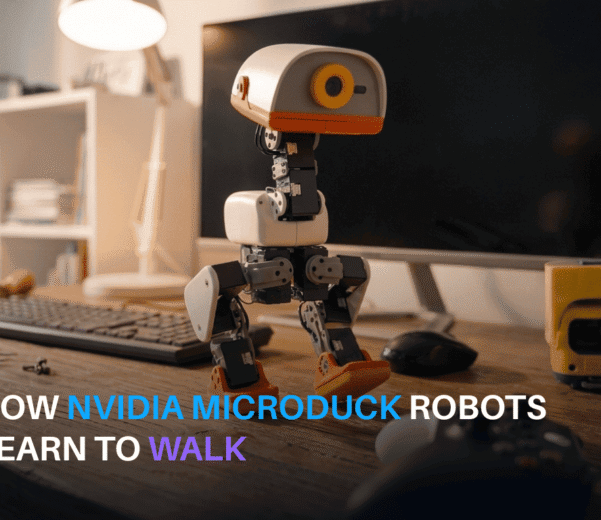
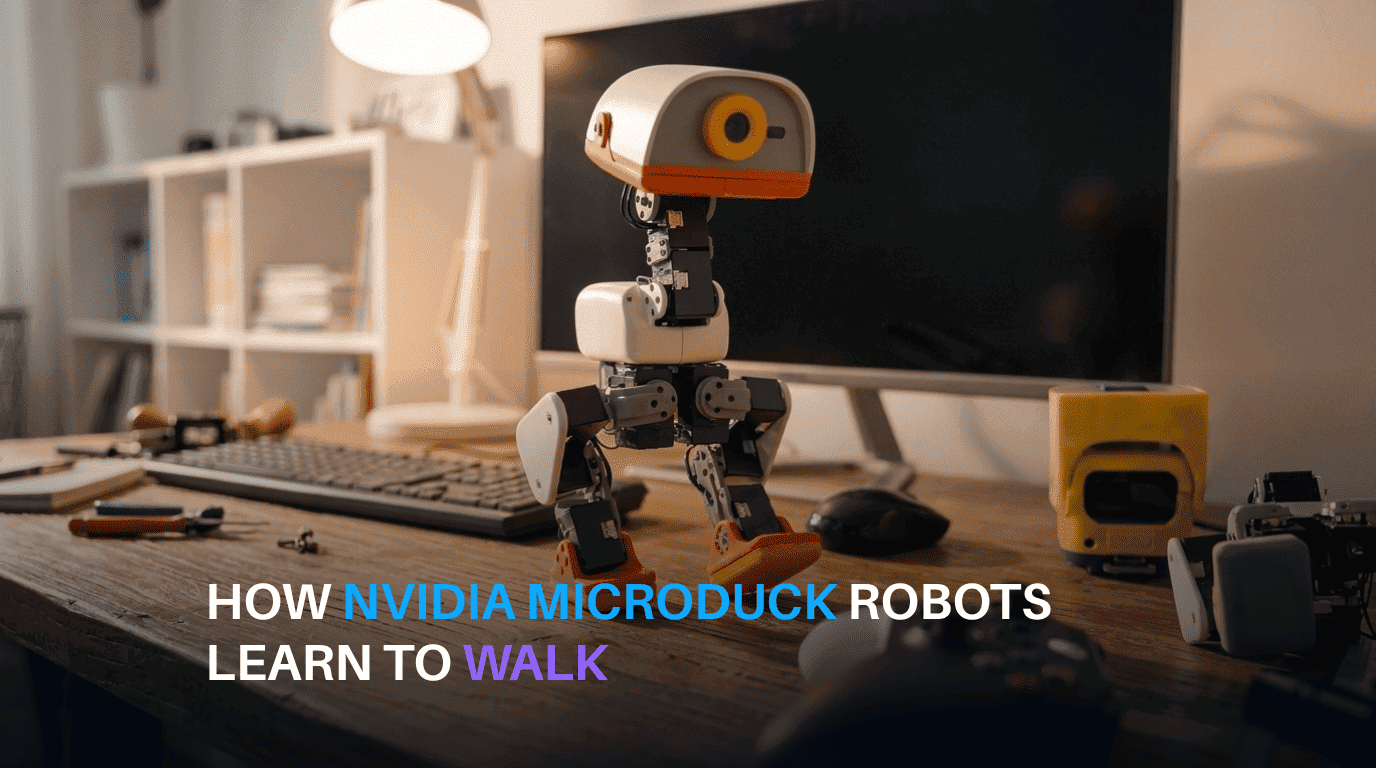
Recently, we saw the launch of Microduck, NVIDIA’s compact, highly intelligent bipedal robot (standing 25 cm tall) that moves smoothly and overcomes obstacles. Interestingly, its movement was not programmed manually using complex traditional methods, instead, this milestone marks a qualitative leap in the world of Physical AI. The robot comes as a real product resulting from an open-source partnership and development between Pollen Robotics and the Hugging Face platform in collaboration with NVIDIA, making it accessible for community experimentation and comprehensive development. You can explore its launch details directly on the Pollen Robotics Microduck Website.
NVIDIA has driven a major transformation in developing flexible robots (agile robots), demonstrating how simple text and voice commands can be translated into precise, flawless mechanical behaviors without prior scripting.
In our previous article, we explored NVIDIA’s smart Microduck robots and learned about their exceptional capabilities in instantly responding to voice commands, and today in this article, we will dive deep into the technical background to see how NVIDIA trained these robots from concept planning all the way to real-world deployment readiness.
The Role of AI Agents in Planning and Asset Generation for Mini Robots
The revolutionary concept behind training nvidia microduck robots lies in completely eliminating tedious manual movement programming. Instead of writing code that dictates joint angles step by step, the approach relies on giving AI agents simple text prompts for the task and obstacle course, allowing the artificial intelligence to discover movement methods on its own through Reinforcement Learning.
Strategic Planning via Hermes and Nemotron
The intelligent agent Hermes, in collaboration with the NVIDIA Nemotron 3.5 Bolt model, analyzes text prompts and breaks them down into an integrated project engineering plan on the NVIDIA RTX Spark platform. These models analyze the capabilities and physical constraints of the mini robots, then create a detailed layout for the obstacle path, required geometric dimensions, and specifications for each element in the virtual environment.
3D Modeling and Construction via the Astra Agent
After establishing the main blueprint, the AI agent Astra takes charge of turning conceptual 3D images into real digital assets:
- Image Isolation and Enhancement: The agent uses cloud image processing to sharpen sample resolution and isolate specific elements.
- Mechanical Engineering Modeling: The agent guides FreeCAD to build primary structures and defined CAD dimensions.
- Adding Textures and Details: The agent utilizes Blender to apply physical materials and 3D textures.
- Leveraging the SimReady Library: To accelerate the process, pre-made, open-source simulation assets are pulled from the SimReady Central Library featuring over 2,000 ready-to-use OpenUSD simulation elements.
Dissecting the Software and Physical Tech Stack Behind NVIDIA RTX Spark and NVIDIA RTX Hardware
To build a learning environment characterized by extreme speed and hyper-realism, NVIDIA deployed an integrated ecosystem of advanced software and hardware to handle the requirements of agile robots:
[Text Prompt and Command]
│
▼
[NVIDIA RTX Spark / Hermes / Nemotron] ──> Engineering Planning & Asset Generation
│
▼
[FreeCAD & Blender via Astra] ──> Creating 3D Assets for Simulation
│
▼
[NVIDIA Isaac Sim + Newton Engine] ──> Simulating Physics, Terrain, & Balance
│
▼
[NVIDIA Isaac Lab + COMPASS Framework] ──> Parallel Reinforcement Learning (RL)
│
▼
[Validation on Local RTX Spark] ──> Testing and Evaluating Policies
- NVIDIA RTX Spark: Acts as a local development and control hub powered by modern nvidia rtx GPUs, used to execute and test training policies locally and check robot responsiveness prior to cloud scaling.
- NVIDIA Isaac Lab & Isaac Sim: An advanced software environment for running thousands of parallel simulations (Parallel Simulation); developers can review the Official Isaac Lab Installation Guide to start linking thousands of virtual robots together. Through NVIDIA Isaac Lab, reinforcement learning protocols are applied to accelerate motor skill training from days down to a few hours through thousands of trials where successful models earn digital rewards.
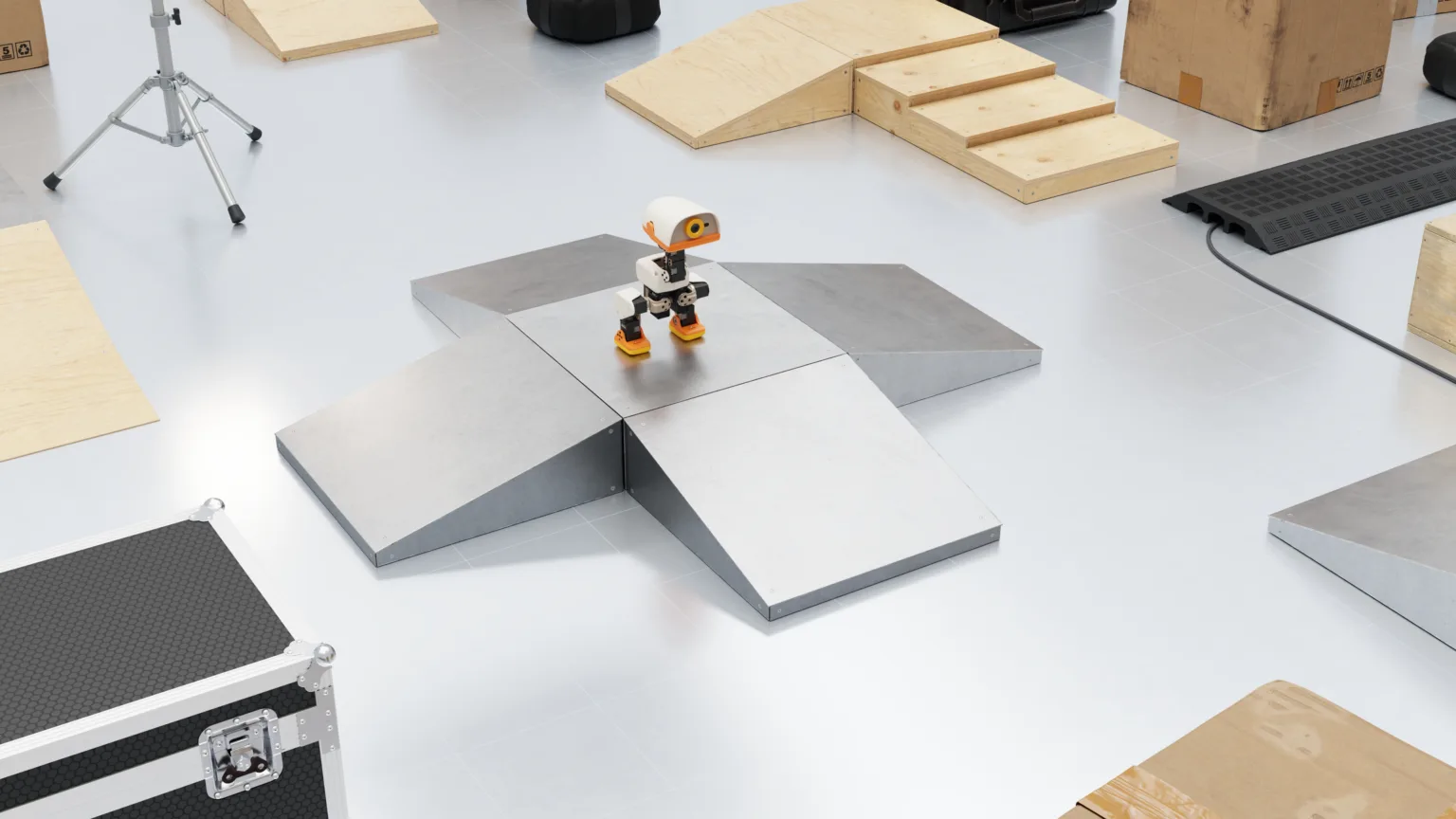
- Newton Physics Engine: An accelerated physics engine built on nvidia rtx GPUs, handling complex physical behaviors such as joint movement, surface friction, maintaining balance on inclined slopes, and recovery from falls.
- COMPASS Navigation Framework: Advanced navigation training and obstacle avoidance rely on the COMPASS framework to adapt prior policies and accelerate the ability of mini robots to navigate various environments with absolute precision.
Traditional programming (in languages like C++ and Python) has not entirely disappeared, rather, it was used to build simulation tools, operating systems, and link core components, while complex motor skills and behaviors were left for the AI to develop independently through trial and error. In strictly regulated environments, it is always recommended to follow the AI Agent Implementation Checklist for Regulated Industries to ensure the safety of approved models.
Solving the “Sim-to-Real Gap” Dilemma in Agile Robots
The gap between what a robot learns in virtual simulation and what it encounters in the real world is the greatest challenge in physical artificial intelligence. NVIDIA developed a deep technical solution to this issue to ensure nvidia microduck robots operate successfully when transferred to physical hardware by exporting AI models in ONNX format.
Better Actuator Models (BAM)
Real mechanical and amphibious actuators do not behave in the physical world exactly as they do in ideal simulations. Therefore, Isaac Lab is supported with BAM models to tackle real-world physical phenomena such as:
- Command Delays: The small time gap between issuing a command and motor execution.
- Backlash: Minute mechanical gaps resulting from internal gear friction.
- Voltage Drops: Battery power dips when dual motors draw high current during balancing.
Applying Domain Randomization
To accustom agile robots to unexpected changes, the system relies on domain randomization. During virtual training, physical factors are altered randomly and continuously (such as modifying floor friction levels, adding noise and blur to camera views, and applying sudden mechanical pushes). This yields robust motor policies and continuous adaptability, enabling the robot to navigate safely across volatile physical environments.
This synthesis between direct programmatic decisions and virtual simulation reminds us of the competition and ongoing evolution between decision-making software; you can review our comprehensive analysis in the OpenAI Decisions API vs TypeSafe Jev Guide to understand how software frameworks influence AI responsiveness in operational environments.
Developing AI Agents for Your Organization
NVIDIA’s remarkable success in relying on AI agents (AI Agents) to build assets, direct simulations, and train robots proves that workflow automation is no longer limited to basic desktop tasks. Dedicated agent frameworks today extend to managing complex operational contexts, advanced data analysis, and developing fully automated operational mechanics.
If you aim to leverage this technological revolution and develop customized AI agents tailored to your business needs, you can benefit from AI Agent Development Services at SO Development, where we help you build intelligent agents that adapt to your work environment and maximize operational efficiency.
Frequently Asked Questions (FAQ)
Q1: How is the robot taught to perform its task?
The robot is trained by combining AI agents to plan tasks and create virtual environments, followed by parallel Reinforcement Learning across thousands of virtual instances within the NVIDIA Isaac Lab platform. Instead of writing movement angles manually, the models discover movement through a reward system based on trial and error. Furthermore, Better Actuator Models (BAM) and domain randomization are used to ensure smooth behavioral transfer from the virtual world to the physical reality.
Q2: What can you do with Microduck?
Microduck is an open-source platform ideal for researchers and developers in collaboration with Hugging Face; it can be used to test bipedal movement policies, experiment with smart camera-based navigation, develop instant voice command responses, and participate in digital robot competition challenges via the Microduck Arena platform on Hugging Face.
Q3: Can trained models be exported and tested on a real robot?
Yes, the Isaac Lab platform provides the ability to export trained movement and control policies as standard ONNX files, which can be transferred and installed directly onto the real robot’s operating system (robotctl) to execute commands on physical hardware.
Q4: What sets Microduck robots apart from traditional robots?
The core distinction lies in its open-source nature and partnership with Hugging Face and Pollen Robotics, alongside avoiding manual kinematic and physics programming code; instead, it relies entirely on artificial intelligence, reinforcement learning, instant voice response, and edge computing.
Final Thoughts
nvidia microduck robots are no longer just cute experimental prototypes; they have become a practical embodiment of what physical artificial intelligence can achieve in 2026. Through the integration of nvidia spark hardware and nvidia rtx applications enhanced by artificial intelligence, backed by an open partnership with Hugging Face and Pollen Robotics, NVIDIA has proven that the future of mini robots lies in adaptive digital environments and a comprehensive reliance on AI agents.