Introduction
The business landscape is shifting rapidly in how teams interact with technology. Deploying AI agents in regulated industries is no longer limited to simple chatbots or text generators. We have entered the era of AI Agents, digital systems capable of executing tasks, reading data, calling APIs, interacting with core software, and making operational decisions across complex workflows.
A successful enterprise AI agent implementation transforms the agent into an Autonomous Digital Actor within the enterprise. It is no longer just a static tool; it carries operational memory, calls external tools, and executes multi-step workflows. For highly controlled sectors, requiring strict AI governance for banking, healthcare, insurance, telecommunications, and energy, building a solid AI agent compliance framework is critical for security and access management. Governance is no longer just about protecting data at rest; it is about controlling and auditing the real-time actions taken by intelligent systems.
Compliance is the Core Challenge
The true benchmark for successfully adopting agents lies in providing undeniable legal and technical proof for every automated action. Organizations must track who launched the agent, who authorized its scope, which permissions were used, and which systems were affected by tamper-proof digital evidence.
This responsibility extends far beyond traditional IT teams. It requires an integrated leadership strategy involving, such as:
- Chief Information Security Officers (CISOs) and Chief Technology Officers (CTOs).
- Head of Legal Tech / AI Policy Leads.
- Chief Data Officers (CDOs) and Chief AI Officers (CDAOs).
- Chief Risk Officers (CROs), compliance teams, and legal counsel.
- Internal Auditors and risk assessment officers.
- Digital Transformation Leads and Enterprise Architects.
Also Read: AI Agents vs Generative AI: Understanding the Future of Intelligent Automation
Why Is Auditable Proof Critical in Regulated Sectors?
Securing AI agents in regulated industries requires three essential elements that standard deployments often treat as optional:
Strict Pre-Execution Verification, Least Privilege Enforcement, and Auditable Proof.
Least Privilege Enforcement: Ensuring the agent operates strictly within the minimal access boundary needed for its specific task.
- Auditable Proof: Generating verifiable digital records that prove security controls were continuously active.
Regulated environments are not judged solely on how secure they are, but on their legal ability to prove it. Therefore, an Audit Trail is just as critical as the security control itself.
In these sectors, mistakes carry clearly defined legal consequences. While a leaked API key might be an operational setback for a standard tech company, in a regulated business it qualifies as a reportable security breach leading to severe regulatory fines and legal exposure.
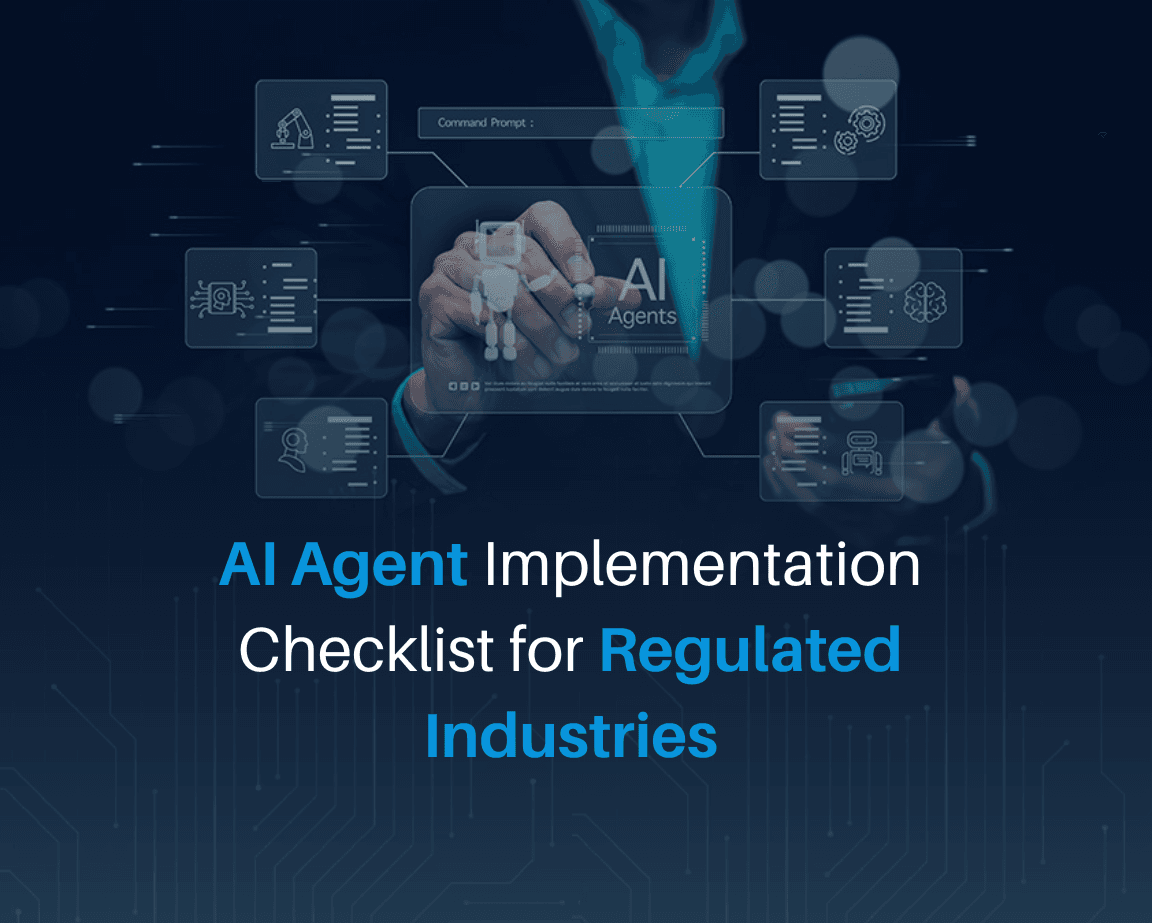
AI Agent Implementation Checklist
To navigate this operational complexity, this 10 step AI Agent Implementation Checklist combines structural identity controls, runtime monitoring, and alignment with global compliance standards, including OWASP ASI Top 10 and the NIST AI RMF:
1. Inventory & Shadow AI Agents Discovery
The first line of defense is building a central registry of every agent running across the organization, including complex enterprise workflows as well as low-code/no-code agents and SaaS copilots deployed informally by employees. To enforce this, any unlisted agent is strictly blocked from production environments. Eliminating Shadow AI Agents is the first critical step in any safe enterprise AI agent implementation.
2. Human Ownership & AI Governance
Every agent must be assigned to a clear human owner who remains directly accountable to security and compliance teams. Establishing this robust chain of accountability defines who requested the agent, who approved its access, who conducts periodic reviews, and who holds emergency shutdown authority. This approach forms the foundation of AI governance for banking and other high-stakes environments where financial transactions or medical records are processed.
3. Distinct Identity & Multi-Agent Scope
Shared service accounts must be strictly banned by requiring every agent to possess a unique digital identity separate from human users and connected software systems. Furthermore, in multi-agent environments, secure data exchange protocols must safeguard agent-to-agent communication by enforcing modern authentication standards and limiting the overall attack surface.
4. Least Privilege & Excessive Agency
A core requirement of any AI agent compliance framework is addressing risks like Excessive Agency by enforcing strict limits on agent autonomy. Agents must be granted only the minimum permissions required for their active tasks, ensuring that Large Language Models (LLMs) never act as the sole authority for action authorization while requiring underlying APIs and IAM layers to validate every request independently.
5. Risk Separation & Behavioral Drift
Managing autonomous system actions requires categorizing them based on their risk levels and reversibility. Beyond traditional vulnerabilities like prompt injection, governance controls must proactively tackle risks unique to AI, such as Behavioral Drift and hallucinations, that can lead to unauthorized automation or erroneous operational decisions.
6. Human-in-the-Loop (HITL)
High-impact operations, such as moving funds, altering patient records, or sending external legal documents, mandate explicit human approval prior to execution. To maintain accountability within your AI agent compliance framework, every human approval must be seamlessly integrated into an Audit Trail that precisely details the approver’s identity and timestamp
7. Logging & SOC Integration
Because standard application logs are insufficient for multi-step reasoning systems, real-time monitoring must continuously record prompt intent, agent identity, granted permissions, and final outputs. Integrating these runtime analytics directly with the enterprise Security Operations Center (SOC) ensures agents are treated as active production workloads where abnormal activity is flagged immediately.
8. Suspension & Instant Revocation
Controlling autonomous agents requires a swift incident response plan equipped with immediate response actions. If unsafe automated behavior is detected, security teams must possess one-click capabilities to instantly revoke tokens, downgrade permissions, or suspend the agent’s digital identity across enterprise IAM, PAM, and SOAR systems.
9. Continuous Review & Regulatory Alignment
A sustainable enterprise AI agent implementation goes beyond annual audits to include event-driven reviews triggered by model updates, API changes, or mission changes. Aligning these review workflows with global standards like GDPR, EU AI Act, HIPAA, and SOC2, ensuring the enterprise can clearly explain to regulators how and why an agent reached a specific decision.
10. Pre-Production Red Teaming
Before granting an agent access to live systems, subject it to adversarial security testing (Red Teaming). Test its resilience against ambiguous prompts, permission bypass attempts, and guardrail manipulation under realistic operational stress.
Also Read: Top 10 AI Agent Companies in 2026
FAQ
How to secure AI agents in regulated industries?
Implementing strong AI governance for banking and healthcare requires a defense-in-depth architecture:
- Enforce strict identity isolation for every agent using dedicated credentials.
- Apply strict RBAC/ABAC at the API layer, so the LLM cannot exceed its authorized scope.
- Place Human-in-the-Loop AI Services (HITL) controls on high-risk, irreversible operations.
- Route all agent activity through a centralized proxy that validates inputs, filters prompts, and records immutable Audit Trail logs.
What is human-in-the-loop AI agent validation?
Human-in-the-Loop AI Services (HITL) validation is a control mechanism where an agent prepares an action but requires an authorized human operator to review and approve it before execution. This is essential for high-stakes actions like issuing medical diagnoses, executing bank transfers, or publishing legal filings, ensuring human oversight while maintaining automated efficiency.
How to audit AI agents for EU AI Act compliance?
Auditing agents for EU AI Act compliance (specifically Article 10 data governance and high-risk system obligations) involves:
- Documenting data provenance and bias-mitigation steps for training or fine-tuning datasets.
- Demonstrating continuous logging of system prompts, agent decisions, and tool usage.
- Proving clear human oversight mechanisms (HITL) are active for critical actions.
How Does Runtime AI Agent Evaluation and Monitoring Work?
Runtime monitoring evaluates agent performance during live operations rather than static pre-release testing. It tracks:
- AI Agent Reliability: Measuring goal completion rates, tool-use error rates, and loop detection.
- Behavioral Drift: Detecting shifts in response logic or decision patterns over time.
- Security & Anomaly Detection: Monitoring API call volume spikes, attempted access to restricted resources, or prompt manipulation attempts in real time through SOC integration.
Final Thoughts
Adopting AI Agents in regulated industries is no longer a future concept; it is an active operational reality that defines efficiency and competitiveness. True value comes from deploying secure, compliant agents that protect organizational assets while enabling confidence in automation. Compliance is not an obstacle; it is the core enabler for safe enterprise innovation.
Looking to deploy compliant AI agents tailored to your industry?
Contact our experts to build your AI Agent with safety and trust.