Introduction
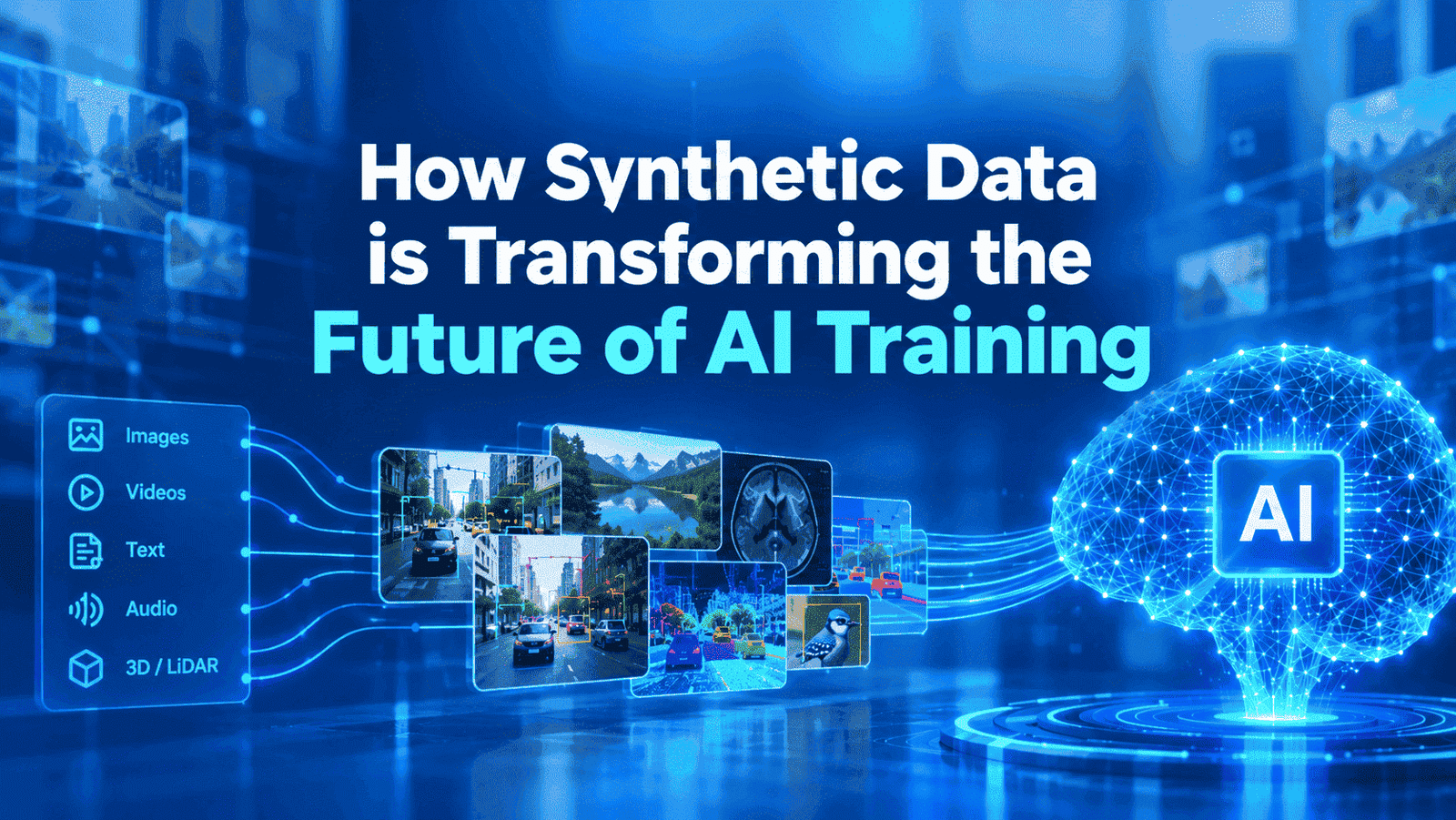
Imagine you want to train an AI system to predict rare financial crises or diagnose a very rare disease, but you do not have enough real-world information, or laws prevent you from using patient and user data to protect their privacy. This is where synthetic data comes in to offer an innovative and fast solution to solve this deadlock. According to the study by Kalpana Tyagi (2025), recent research and studies indicate an upcoming revolution in synthetic data generation, where it is expected that synthetic data will constitute more than 60% of future model training data, a massive shift capable of having an impact on the data world equivalent to what synthetic fibers did to the textile industry.
Instead of relying entirely on real-world data, which can be scarce or expensive, software has become capable of inventing alternative information completely similar to the original to accelerate AI training while ensuring data privacy.
What is Synthetic Data and What Are Its Main Types?
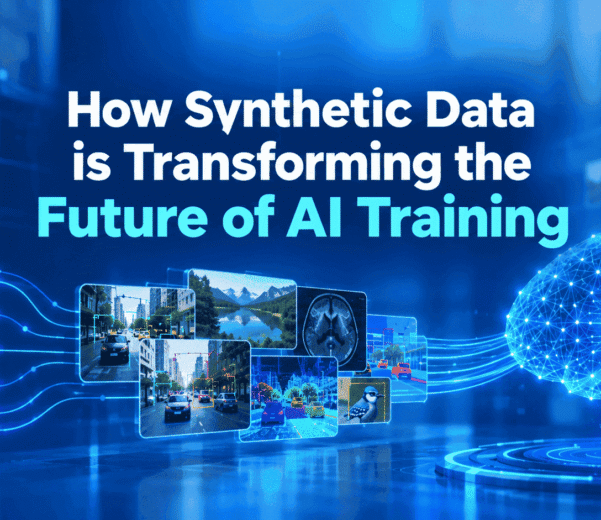
Synthetic data is information produced by software algorithms and smart simulations rather than collected from direct observations or events in our daily lives. This synthetic data is characterized by matching real-world data in behavior and statistical patterns, but it is not linked to real people or actual events.
These generative data types are divided into main categories including:
- Partial Synthetic Data: A portion of actual data is retained, while sensitive or identifying elements are replaced with synthetic information to protect privacy.
- Full Synthetic Data: The entire dataset is created completely from scratch by algorithms without using any original real data point, making it excellent for initial testing and building new models.
- Hybrid Data: It relies on combining real-world data with smart modifications and developments, maintaining the basic structure of actual data while reshaping certain characteristics to enhance flexibility and security.
- Generative Model-Based Data: This data is derived directly from advanced learning systems that capture minute details and statistical behaviors from original sources to produce matching and large-scale datasets.
The Most Reliant Industries Needing Synthetic Data
Synthetic data deeply enters several vital industries today that face major challenges in field data collection or strict legal restrictions on privacy:
- Healthcare: Used to simulate medical records, X-ray images, and genetic data to train diagnostic models with high accuracy without violating patient privacy or medical confidentiality laws.
- Fintech & Finance: Banks rely on it to model risks and detect financial fraud by generating rare scenarios and transactions that are not widely available in real records.
- Autonomous Systems and Transportation: Companies use it to simulate thousands of road scenarios, harsh weather conditions, and dangerous situations (edge cases) to safely train cars and sensors before deploying them into reality.
- Education and Technology: Simulating student interactions and performance patterns to develop personalized learning paths even in the absence of real data.
Why Do We Resort to Using Synthetic Data?
The reasons for organizations relying on synthetic data as an alternative or complement to traditional data have multiplied, and the most prominent motivations are:
- Breaking Privacy and Security Constraints: Allowing institutions to conduct research and share data without fear of leaking sensitive information.
- Bridging Edge Cases: Generating exceptional scenarios that rarely happen in reality to test models under pressure.
- Reducing Bias: Producing synthetic data that restores balance and ensures fairness in AI outputs.
- Unlimited Abundance at Lower Cost: Providing a very large volume of training material on demand compared to costly field collection.
Advanced Methodologies and Techniques for Generating Synthetic Data
Generating synthetic data requires a deep understanding of the mathematical methodologies and software techniques that ensure its statistical match with reality:
First: Creation Methodologies and Mathematical Strategies
- Statistical Distribution: Relies on studying the mathematical distributions of original data (such as normal or exponential distribution) and drawing new random samples that preserve the same characteristics and probability properties without transferring any real data.
- Model-Based Approach: Training machine learning algorithms that understand the underlying rules behind actual data to produce precise counterparts and simulations reflecting the same relational connections.
- Deep Learning Methods: Building multi-layered artificial neural networks capable of processing complex data such as images, videos, and long texts with high accuracy and extracting non-linear patterns.
Second: Advanced Generative Techniques and Algorithms
- Generative Adversarial Networks (GANs): Rely on two neural networks (the generator and the discriminator) competing together; where the generator tries to produce fake data matching reality, while the discriminator tries to detect it, and the process continues until the generator reaches a level of producing ultra-realistic data.
You can learn more about how they work in detail via our article on Generative Adversarial Networks (GAN).
- Diffusion Models: Considered one of the newest and most powerful techniques; they begin by introducing random data (noise) and then gradually removing it through precise steps to generate high-resolution and detailed images, texts, or media.
- Variational Autoencoders (VAEs) and Transformers / GPT: Used to compress data into low-dimensional latent spaces and then rebuild new similar data, or predict subsequent elements in massive texts and natural language processing.
When Should You Use Synthetic Data?
Turning to synthetic data becomes an absolute necessity and an advanced strategic choice in the following cases:
- When Facing a Severe Scarcity of Real-World Data: When you start a new artificial intelligence project and the available real data sample is very limited and insufficient to train the model efficiently.
- When Colliding with Strict Privacy Constraints: If regulatory rules and frameworks (such as GDPR or medical and banking confidentiality laws) completely prevent the use of real user data for research or development.
- When Testing Systems under Harsh Conditions: For your desire to expose models to dangerous, rare, or extreme scenarios (such as traffic accidents or critical failures) that are difficult or impossible to wait to happen in the real world.
- When Needing to Cut Costs and Accelerate Scale: When manual field data collection and labeling are extremely costly and consume a long time disrupting the software development lifecycle.
How Do We Ensure Synthetic Data Does Not Fall Into the Model Collapse Trap?
Despite its great benefits, using generative training data faces challenges such as the emergence of the phenomenon of Model Collapse when the model repeatedly relies on synthetic outputs that repeat their errors and lose touch with real-world complexity.
To overcome this challenge, relying entirely on automated generation is never enough. Combining synthetic data pipelines with rigorous human expertise is essential to validate data quality and filter out anomalies. At SO Development, we bridge this gap through our specialized Human-in-the-Loop Services, ensuring that your training datasets are meticulously audited, corrected, and optimized by skilled professionals. By merging cutting-edge AI efficiency with human precision, we help you maintain maximum model reliability and trust.
For deeper details on maintaining trustworthiness in the age of artificial intelligence, you can read our article on Synthetic Authority in the Age of Generative AI.
Frequently Asked Questions (FAQ)
Q: Does synthetic data mean completely dispensing with real data?
A: Absolutely not; synthetic data is designed to be a strong strategic complement rather than a radical substitute. Relying on it 100% without real roots may lead to the “model collapse” phenomenon, so intelligent mixing between them is the ideal solution.
Q: How does synthetic data completely protect individuals’ privacy?
A: Because it is drawn based on reality’s statistical patterns and distributions without transferring actual names, identities, or personal details of individuals, making it compliant with global security standards and privacy laws.
Q: What are the most prominent techniques currently used in generating images and complex data?
A: “GANs” and “Diffusion Models” are among the most developed and capable techniques for producing ultra-realistic and complex visual and textual data.
Final Thoughts
In a digital landscape where artificial intelligence evolution accelerates day by day, synthetic data is no longer just an entertaining solution or a temporary alternative, but has transformed into a fundamental pillar and indispensable infrastructure for building strong, secure, and privacy-protected smart models. Its ability to bridge data gaps, bypass regulatory hurdles, and enable boundless innovation opens a whole new horizon for companies and developers. However, true success remains for those who understand how to balance precisely between automated generation efficiency and human expertise supervision, to ensure a sustainable and high-quality technical future