Introduction
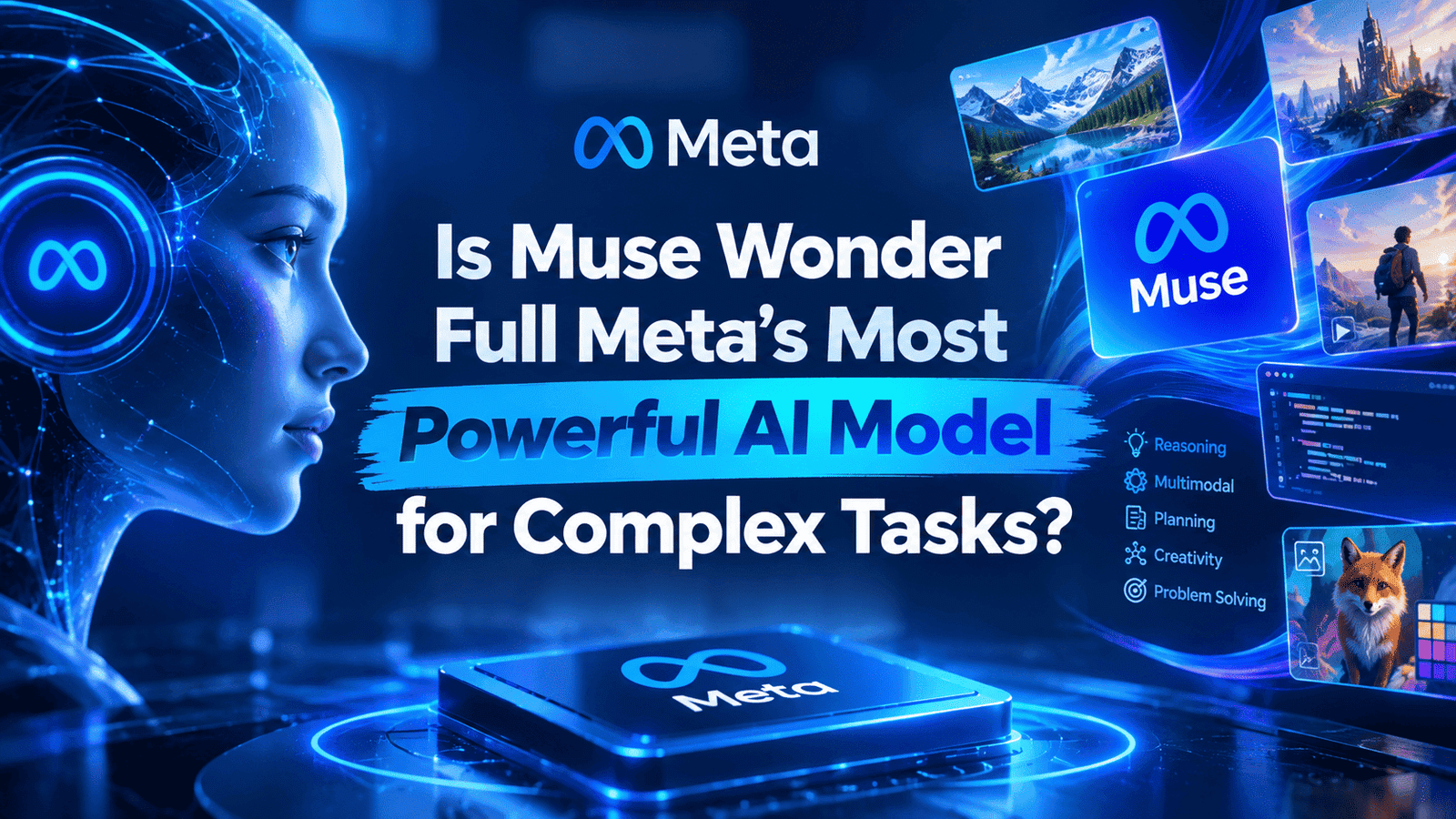
Artificial intelligence is moving beyond simple question answering toward systems that can manage complex workflows, analyze large amounts of information, and support software development. Meta’s Muse Wonder Full is part of this shift, offering a more advanced version of the company’s new Muse Wonder model family.
Released on October 12, 2026, Muse Wonder Full is designed for demanding reasoning, professional applications, and long-running coding tasks. Developed by Meta Superintelligence Labs, it aims to help AI agents maintain context, follow instructions, and work through multi-step problems more effectively.
But what makes Muse Wonder Full different from other large language models? How does it perform in benchmarks, what are its potential business applications, and how does it compare with competing AI systems?
In this article, we explore its capabilities, availability, limitations, and potential role in the future of AI-powered automation.
What Is Muse Wonder Full?
Muse Wonder Full is a proprietary AI language model developed by Meta Superintelligence Labs. It belongs to Meta’s Muse Wonder model family, introduced in October 2026 as part of the company’s efforts to compete in the advanced AI market.
Unlike general-purpose chatbots designed primarily for short conversations, Muse Wonder Full targets more demanding tasks that require sustained reasoning, multiple steps, and careful handling of context.
Its intended applications include:
- Advanced software development and code analysis.
- Complex reasoning and structured problem-solving.
- Professional research and document analysis.
- AI agents that execute extended workflows.
- Business tasks involving multiple instructions and dependencies.
- Multimodal understanding of text and visual information.
According to the available model information, Muse Wonder Full supports text and image inputs, with audio and video also listed among its supported input modalities in published technical summaries. Its output is text-based.
One important distinction is that Muse Wonder Full is not currently listed as a generally accessible model through Meta’s public Model API. Instead, access is provided through Muse Code subscriptions, making it particularly relevant to developers and professionals who work with AI-assisted coding tools.

What Makes Muse Wonder Full Different?
Several characteristics distinguish Muse Wonder Full from conventional conversational AI models.
1. Active Memory
One of the central concepts associated with the Muse Wonder family is Active Memory. This capability is intended to help the model retain relevant information across interactions and use that information when handling longer tasks.
For example, a developer working on a large application may need an AI assistant to remember architectural decisions, dependencies, earlier debugging attempts, and project requirements throughout a development session.
Without effective context management, an AI model may repeat suggestions, overlook previous decisions, or contradict earlier instructions. Memory-oriented capabilities aim to reduce these problems.
However, memory should not be confused with perfect recall. Models can still overlook details, misinterpret conflicting instructions, or produce incorrect conclusions. Important facts and decisions should therefore be verified.
2. Active Focus
Active Focus is another feature associated with Meta’s Muse Wonder models. It is intended to help the model remain aligned with a task’s objectives during extended work.
This is particularly relevant to agentic AI systems, which may need to break a request into smaller tasks, complete them in sequence, and respond to unexpected problems.
Consider an AI coding assistant asked to investigate a bug, identify its cause, modify the relevant code, and check whether the fix resolves the issue. Completing the request requires more than generating a single code snippet. The system must maintain the original objective while working through several related steps.
Active Focus is intended to support this type of sustained task execution. Its practical effectiveness, however, depends on the surrounding tools, permissions, evaluation procedures, and implementation.
3. Advanced Reasoning
Muse Wonder Full is positioned for complex reasoning and professional workloads. Such tasks may require comparing competing explanations, evaluating evidence, identifying dependencies, and producing structured recommendations.
Potential applications include analyzing financial documents, reviewing technical specifications, assisting with legal research, and investigating complicated software issues.
Nevertheless, a model’s positioning does not guarantee that it will outperform every competitor in every reasoning task. Actual results depend on the problem, the quality of the input, the selected model settings, and the evaluation method.
4. Multimodal Input
Muse Wonder Full is listed as a multimodal model, supporting text and image inputs. Technical summaries also identify audio and video as supported input types.
Multimodal capabilities can make AI systems useful for tasks involving more than written documents. Examples include examining screenshots, interpreting diagrams, understanding visual references, and combining different forms of information.
For businesses, these capabilities could support workflows such as visual quality inspection, document processing, and technical analysis. The precise limits of each modality should be checked against the current official documentation before designing a production system around it.
Muse Wonder Full Benchmarks: What Do the Results Show?
Benchmarks are an important way to evaluate an AI model’s capabilities, but they need to be interpreted carefully.
The LLM Stats model profile tracks Muse Wonder Full across several evaluation categories, including memory and coding-related tasks. Its comparison page also reports an overall LLM Stats Score of 51.7, compared with 47.6 for the standard Muse Wonder model.
In the reported comparison, Muse Wonder Full performs better on 15 of 16 shared benchmark results. This suggests that the Full version may offer advantages for users prioritizing performance over the standard model.
However, these figures should not be treated as proof that Muse Wonder Full is universally superior to other AI models. Composite scores depend on the benchmarks included, their relative weighting, and the methodology used to calculate them.
What Do These Benchmarks Measure?
Different evaluations test different aspects of model behavior:
- Reasoning benchmarks: Assess the ability to solve complex problems and follow logical steps.
- Coding benchmarks: Evaluate code generation, debugging, software engineering, and repository-level tasks.
- Memory benchmarks: Test whether the model can retrieve relevant details from long conversations, including when information is conflicting or surrounded by distractions.
- Agent benchmarks: Assess how well a system completes tasks that require multiple actions or interactions with external tools.
- Professional-domain evaluations: Examine performance on specialized tasks such as healthcare-related reasoning or document analysis.
A model may perform well in one category while delivering less impressive results in another. For example, strong coding performance does not automatically establish reliability in financial analysis or medical interpretation.
The most useful approach is to examine individual benchmark results and, where possible, test the model against real tasks from the intended application.
For current benchmark data, consult the Muse Wonder Full model profile on LLM Stats.
Muse Wonder Full vs. Muse Wonder: What Is the Difference?
Meta introduced Muse Wonder and Muse Wonder Full as related models, but they have different positioning and access options.
Muse Wonder is the standard model, available through Meta’s Model API and Muse Code. Muse Wonder Full is positioned as the more capable option for demanding workloads and is available through eligible Muse Code subscriptions.
The main differences are summarized below.
Feature | Muse Wonder | Muse Wonder Full |
Developer | Meta | Meta |
Release date | October 12, 2026 | October 12, 2026 |
Primary focus | General and advanced AI tasks | More demanding reasoning and extended tasks |
Coding support | Yes | Yes |
Memory-oriented capabilities | Active Memory | Active Memory |
Focus-oriented capabilities | Active Focus | Active Focus |
API availability | Meta Model API | Not listed on the public Model API |
Access | API and Muse Code | Eligible Muse Code subscriptions |
Licensing | Proprietary | Proprietary |
The two models share the same broader product direction, but Muse Wonder Full is intended for workloads where additional capability may justify its access requirements.
The standard model may be more convenient for developers building applications through an API. The Full version may be more attractive to professionals who work directly within Muse Code and need assistance with complex coding or multi-step tasks.
For a more detailed comparison, see the Muse Wonder vs. Muse Wonder Full comparison.
How Much Does Muse Wonder Full Cost?
Pricing is an important consideration when selecting an AI model, particularly for businesses evaluating its use across multiple employees or projects.
Unlike the standard Muse Wonder model, which has published per-token API pricing, Muse Wonder Full is offered through eligible Muse Code subscription plans.
Available pricing information identifies the following options:
- Power Usage: $50 per month.
- Maximum Usage: $200 per month.
These plans provide different levels of usage, with the higher-priced option intended for substantially greater usage allowances. Exact limits, included features, and subscription conditions should be confirmed on Meta’s official product pages before purchasing.
Muse Wonder Full does not have a separately listed public API price per million tokens in the available model information.
This difference matters when comparing costs. Subscription pricing is not directly equivalent to API pricing because actual value depends on how often the model is used, the amount of work completed, and any usage restrictions.
For an individual developer, a subscription may offer a straightforward way to access advanced coding assistance. For a company building an automated service, API availability, integration flexibility, and predictable per-request costs may be more important.
Before committing to a plan, users should evaluate the model on representative tasks and compare the time saved against the subscription cost.
Practical Use Cases for Muse Wonder Full
Muse Wonder Full’s capabilities may be useful across several professional environments. The strongest applications are likely to be those that benefit from extended context, sophisticated reasoning, or multi-step workflows.
1. Software Development and Debugging
Software engineering is one of the most relevant use cases for advanced AI models.
A capable coding assistant can help developers understand unfamiliar codebases, identify potential bugs, explain complex functions, write tests, and suggest improvements to existing implementations.
For larger projects, maintaining context is especially important. Developers often need to consider multiple files, dependencies, architectural decisions, and earlier debugging attempts.
Muse Wonder Full’s positioning around long-running coding tasks makes it a candidate for these workflows.
Potential applications include:
- Investigating complex bugs.
- Reviewing pull requests and identifying potential risks.
- Generating unit tests.
- Explaining legacy code.
- Assisting with refactoring.
- Supporting multi-step software development tasks.
AI-generated code must still be tested, reviewed, and checked for security vulnerabilities before deployment.
2. Business Research and Document Analysis
Many business processes involve collecting information from several documents, comparing requirements, and preparing a final recommendation.
An advanced AI model may assist with reviewing proposals, summarizing reports, extracting relevant details, and identifying inconsistencies across documents.
For example, a business development team could use an AI assistant to compare supplier proposals, extract pricing and service requirements, and prepare a structured comparison for human review.
The model’s effectiveness will depend on its ability to identify important details accurately and distinguish confirmed facts from assumptions.
For sensitive or high-impact decisions, human verification remains essential.
3. AI Agents and Workflow Automation
AI agents are systems that use models, tools, and predefined permissions to perform tasks beyond generating text.
A workflow might involve reading a request, identifying the required actions, retrieving information from an approved source, producing a draft, and asking a human to approve the result.
Muse Wonder Full’s focus on extended task execution makes it relevant to this category of applications.
Possible workflows include:
- Preparing reports from multiple information sources.
- Assisting with technical support investigations.
- Organizing project documentation.
- Supporting software maintenance.
- Coordinating research and analysis tasks.
However, a model alone does not provide a complete agent platform. Reliable automation also requires tool integrations, access controls, error handling, logging, and safeguards against unintended actions.
4. Data Analysis and Reporting
Businesses frequently need to transform large quantities of information into useful findings.
An AI assistant can help explain datasets, write analysis code, formulate hypotheses, summarize findings, and prepare reports. It may also assist with reviewing data-processing scripts and documenting analytical workflows.
For example, a team could ask the model to examine a set of sales reports, identify significant changes, and draft questions for further investigation.
The model should not be treated as a replacement for validated calculations or statistical analysis. Numerical results should be checked using appropriate tools, and conclusions should be supported by the underlying data.
5. Technical Support and Knowledge Management
Technical support teams often work with long conversations, internal documentation, troubleshooting guides, and complex customer issues.
A model with effective context management may help support staff connect details from earlier interactions with relevant troubleshooting procedures.
Potential tasks include summarizing a support case, proposing diagnostic steps, drafting a customer response, and documenting the resolution.
For production use, companies should ensure that the model retrieves information from authorized sources and does not expose confidential data to users who lack permission to access it.
Is Muse Wonder Full Suitable for Enterprise AI?
Muse Wonder Full may be worth evaluating for enterprises that need advanced reasoning or AI-assisted development. However, enterprise suitability involves more than model intelligence.
Organizations should assess several factors before deploying it in a business environment.
Data Privacy and Security
Companies must understand how prompts, uploaded files, generated outputs, and other interaction data are processed.
Before sharing confidential information, review the provider’s current data-retention, training, access-control, and security policies. Organizations handling personal information or regulated data should also assess their legal and compliance obligations.
Reliability and Accuracy
Even advanced AI models can generate incorrect information, omit important details, or follow ambiguous instructions incorrectly.
Businesses should establish testing procedures, define acceptable error rates, and introduce human review for decisions that carry financial, legal, operational, or safety consequences.
Integration and Availability
Muse Wonder Full’s subscription-based access differs from a model that is directly available through a public API.
Organizations planning custom applications should confirm whether the available access method supports their required integrations, automation workflows, authentication, and deployment architecture.
If API access is a requirement, the standard Muse Wonder model or another model with a suitable API may be a more practical choice.
Cost and Usage Limits
Subscription costs should be evaluated alongside usage limits and the amount of work the model can complete.
For enterprise adoption, organizations should estimate the number of users, frequency of use, complexity of tasks, and expected productivity gains. They should also check the terms governing commercial use and the handling of company data.
What Are the Limitations of Muse Wonder Full?
Although Muse Wonder Full is positioned as an advanced model, several considerations remain important.
Limited public access. Its availability through Muse Code rather than a listed public API may restrict how developers integrate it into custom applications.
Proprietary licensing. Muse Wonder Full is not an open-weight model in the available listing. Users should review Meta’s applicable terms and cannot assume they can download, modify, or self-host the model.
Incomplete public performance evidence. Benchmark scores provide useful signals, but they do not guarantee consistent results across every language, industry, or task. Independent testing is important.
Uncertain real-world costs. Subscription fees alone do not establish the total cost of deploying AI. Usage limits, human review, integration work, and operational overhead also affect value.
Potential errors and hallucinations. The model may still produce inaccurate statements, flawed code, or unsupported conclusions.
Privacy and governance requirements. Organizations need clear policies for handling confidential documents, personal information, and other sensitive inputs.
These limitations do not make the model unsuitable. Instead, they highlight why evaluation should be based on the specific business problem rather than general performance claims.
What Are the Limitations of Muse Wonder Full?
Although Muse Wonder Full is positioned as an advanced model, several considerations remain important.
Limited public access. Its availability through Muse Code rather than a listed public API may restrict how developers integrate it into custom applications.
Proprietary licensing. Muse Wonder Full is not an open-weight model in the available listing. Users should review Meta’s applicable terms and cannot assume they can download, modify, or self-host the model.
Incomplete public performance evidence. Benchmark scores provide useful signals, but they do not guarantee consistent results across every language, industry, or task. Independent testing is important.
Uncertain real-world costs. Subscription fees alone do not establish the total cost of deploying AI. Usage limits, human review, integration work, and operational overhead also affect value.
Potential errors and hallucinations. The model may still produce inaccurate statements, flawed code, or unsupported conclusions.
Privacy and governance requirements. Organizations need clear policies for handling confidential documents, personal information, and other sensitive inputs.
These limitations do not make the model unsuitable. Instead, they highlight why evaluation should be based on the specific business problem rather than general performance claims.
How to Evaluate Muse Wonder Full Before Using It
Organizations considering Muse Wonder Full can follow a practical evaluation process.
Step 1: Define the target task. Choose a specific workflow, such as code review, report generation, or technical support.
Step 2: Prepare representative examples. Use realistic inputs that reflect the complexity, format, and edge cases of the intended workload.
Step 3: Establish measurable criteria. Track accuracy, task completion, time saved, output quality, and the amount of human correction required.
Step 4: Compare alternative models. Test Muse Wonder Full against the standard Muse Wonder model and other suitable systems using equivalent conditions.
Step 5: Review privacy and access requirements. Confirm the provider’s policies and determine whether the available product access fits the intended deployment.
Step 6: Run a controlled pilot. Start with a limited group of users and low-risk tasks before considering broader adoption.
Step 7: Monitor performance over time. Review errors, user feedback, cost, and changes in task quality. AI evaluation should continue after deployment rather than ending with the initial test.
This process helps businesses determine whether the model provides measurable value for their particular use case.
What Does Muse Wonder Full Mean for the Future of AI?
Muse Wonder Full reflects a broader movement in AI development: the shift from conversational assistants toward systems designed to support extended, goal-oriented work.
As AI models become more closely integrated with coding environments, document systems, and business applications, their value will increasingly depend on how reliably they can complete tasks rather than simply generate convincing responses.
Memory management, sustained attention to objectives, tool use, and workflow integration are important parts of this transition.
However, progress in these areas also increases the importance of security, governance, and accountability. A system capable of performing more actions needs clear permissions, reliable monitoring, and mechanisms for human intervention.
For organizations, the opportunity is not simply to adopt the newest model. It is to identify tasks where AI can improve efficiency without compromising accuracy, confidentiality, or operational control.
Muse Wonder Full is one option to consider as this market develops, but its long-term value will depend on real-world performance, access conditions, and the quality of the systems built around it.
Conclusion: Is Muse Wonder Full Worth Considering?
Muse Wonder Full is Meta’s advanced proprietary AI model for demanding reasoning, coding, and extended workflows. Its focus on Active Memory, Active Focus, and agent-oriented tasks makes it a notable addition to the competitive AI landscape.
The model’s reported benchmark results suggest advantages over standard Muse Wonder on many shared evaluations. Nevertheless, benchmark performance alone does not establish that it is the best choice for every application.
Its subscription-based access is another important factor. Developers who need direct API integration may prefer the standard Muse Wonder model or an alternative with suitable API support, while users working in Muse Code may find the Full version worth testing.
For businesses, the best approach is to assess the model using representative tasks, measurable success criteria, and appropriate privacy and security controls.
Ultimately, Muse Wonder Full is worth evaluating for complex AI-assisted work, but its suitability should be determined by verified results rather than marketing claims or leaderboard rankings alone.
Frequently Asked Questions
What is Muse Wonder Full?
Muse Wonder Full is a proprietary AI model developed by Meta Superintelligence Labs and released on October 12, 2026. It is designed for advanced reasoning, coding, and extended AI-assisted workflows.
Is Muse Wonder Full better than Muse Wonder?
The LLM Stats comparison reports a higher overall score for Muse Wonder Full and better results on 15 of 16 shared benchmark evaluations. The best choice still depends on the specific task, access requirements, and cost.
Can developers access Muse Wonder Full through an API?
The available model information lists Muse Wonder Full as accessible through eligible Muse Code subscriptions, rather than through the public Meta Model API. Developers should check current official documentation for changes to availability.
How much does Muse Wonder Full cost?
Published information identifies Muse Code Power Usage at $50 per month and Maximum Usage at $200 per month. Users should verify current plan prices, usage allowances, and conditions before subscribing.
Is Muse Wonder Full open source?
No. The available model listing identifies it as proprietary. Users should not assume that its model weights are publicly downloadable or that self-hosting is permitted.
What are the main use cases for Muse Wonder Full?
Potential applications include software development, debugging, technical research, document analysis, AI-agent workflows, data analysis, and technical support.
Can Muse Wonder Full be used for business applications?
It may be suitable for selected business tasks, subject to the available access method, provider terms, security requirements, and performance testing. Organizations should validate its accuracy and privacy implications before production deployment.
Where can I find Muse Wonder Full benchmarks?
The LLM Stats Muse Wonder Full profile provides benchmark information, model details, and comparisons with other AI systems.