Introduction
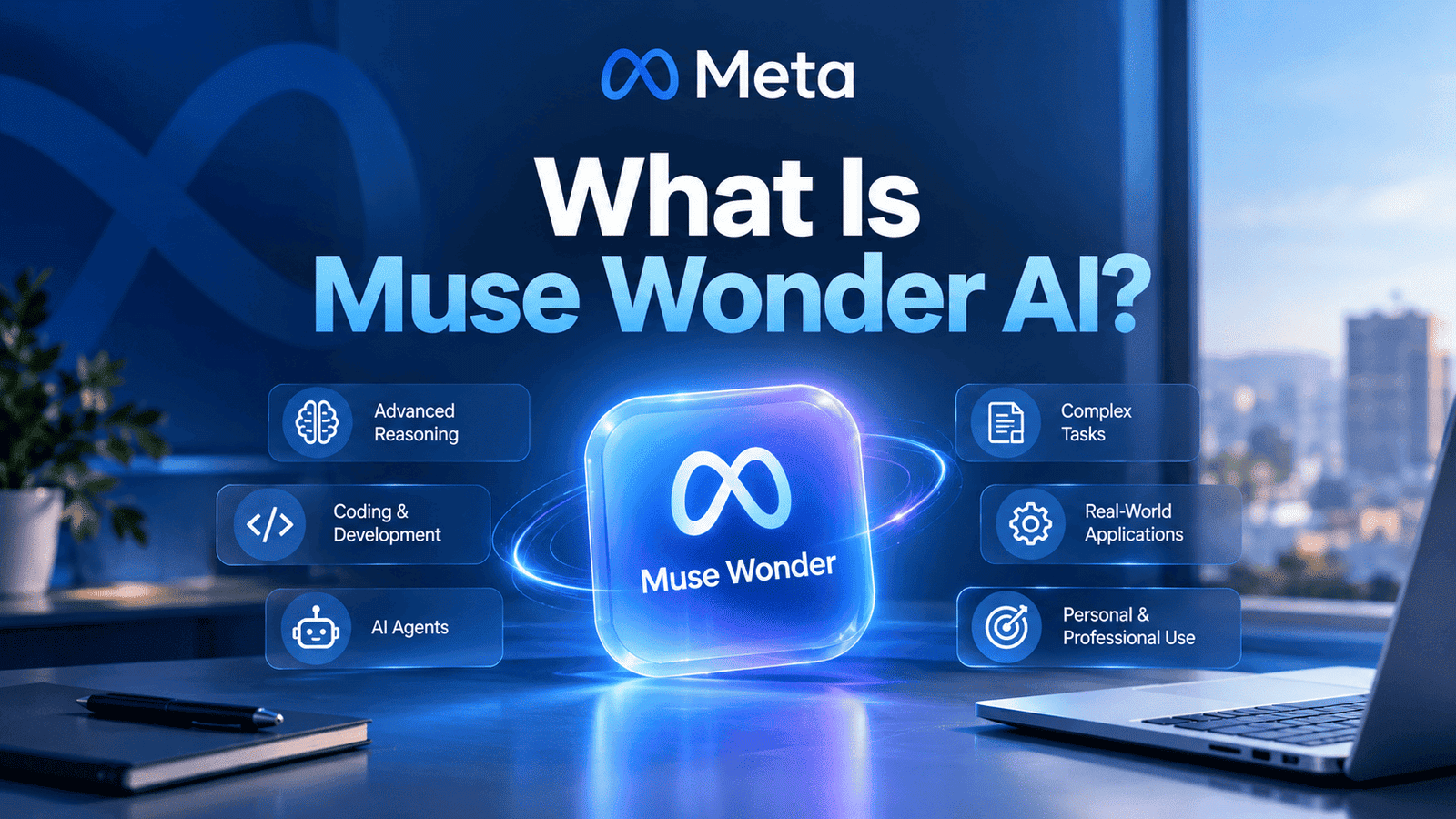
Meta is making another major move in artificial intelligence with Muse Wonder, a new AI model designed to handle complex reasoning, professional tasks, coding, and AI-powered agents. Introduced on October 12, 2026, alongside the more advanced Muse Wonder Full, the model represents Meta’s effort to compete directly with leading AI systems from OpenAI, Anthropic, and Google.
Unlike AI assistants designed primarily to answer questions, Muse Wonder focuses on helping users accomplish tasks that involve multiple steps, long-running workflows, and contextual understanding. Its capabilities could make it useful for developers, businesses, and individuals looking to automate more than simple conversations.
But what makes Muse Wonder different, and how could it change the way people use AI?
What Is Muse Wonder?
Muse Wonder is a proprietary AI model developed by Meta Superintelligence Labs. It is designed to support personal and professional AI agents that can understand information, reason through problems, and work toward specific goals.
According to Meta’s announcement, the model targets practical applications such as understanding lease agreements, navigating insurance claims, analyzing financial information, and developing software applications.
The model is part of Meta’s broader Muse AI initiative, which aims to build more capable AI systems that can assist users with everyday activities and complex professional work.
Meta introduced two models in this release:
- Muse Wonder: The standard model, designed for developers and general agentic applications.
- Muse Wonder Full: The more advanced version, intended for demanding reasoning, coding, and multi-step professional tasks.
Muse Wonder is available through the Meta Model API and Muse Code, while Muse Wonder Full is available to Muse Code subscribers.
Source: Meta’s official announcement.
What Are the Main Features of Muse Wonder?
1. Active Memory for Better Context Retention
One of Muse Wonder’s central features is Active Memory, which helps the model retain relevant information across conversations and retrieve details when they become useful.
Traditional AI interactions can become frustrating when a model loses track of earlier instructions or requires users to repeat important information. Memory-oriented capabilities aim to reduce this problem.
For example, a project manager could use an AI assistant to discuss a project over several sessions. The assistant could use relevant information about deadlines, requirements, and previous decisions to help with subsequent tasks.
For businesses, this could support more consistent workflows and reduce repetitive communication.
However, memory capabilities do not automatically guarantee perfect recall. Important facts and decisions should still be verified, particularly in business-critical applications.
2. Active Focus for Multi-Step Tasks
Another key feature is Active Focus, which is designed to help the model continue working toward a goal when it encounters difficulties.
Instead of stopping after an unsuccessful attempt, the model can try alternative approaches, recover from errors, and request clarification when necessary.
Consider a software development task. An AI agent might need to inspect existing code, identify a bug, modify several files, run tests, and correct problems that appear during testing.
Active Focus is intended to support this type of extended workflow rather than treating every prompt as an isolated question.
This approach is particularly relevant to AI agents, where completing the task matters more than simply generating a plausible response.
3. Advanced Coding Capabilities
Muse Wonder is also designed for software development, from creating applications to working through more complicated programming challenges.
Potential applications include:
- Generating and modifying application code.
- Identifying bugs and suggesting fixes.
- Supporting debugging and software testing.
- Assisting with multi-file coding projects.
- Building prototypes and small business applications.
Muse Wonder Full targets more demanding coding workflows, where a model may need to reason across multiple steps and recover from unsuccessful attempts.
For development teams, these capabilities could help accelerate prototyping and reduce repetitive programming work. Nevertheless, generated code should be reviewed and tested before deployment, particularly when it handles sensitive information or business-critical operations.
4. Professional Knowledge and Document Analysis
Meta is positioning the Muse Wonder family for work across specialized domains, including finance, law, and healthcare.
Possible use cases include reviewing contracts, extracting information from lengthy documents, organizing financial records, and assisting with professional research.
For example, an AI agent could help a business owner review a lease by identifying payment obligations, renewal clauses, and potentially important restrictions.
In finance, the model could help organize information and support preliminary analysis. In healthcare, it could assist with administrative or information-processing tasks, subject to appropriate professional oversight.
These applications should not be confused with guaranteed expert-level accuracy. Legal, financial, and medical outputs require suitable verification before users make consequential decisions.
Muse Wonder vs. Muse Wonder Full: What Is the Difference?
Although the models share the same general direction, they target different levels of complexity.
Feature | Muse Wonder | Muse Wonder Full |
Primary focus | General AI agents and professional workflows | More demanding, complex workflows |
Coding | Software development and coding assistance | Advanced coding and extended tasks |
Reasoning | Multi-step problem-solving | More intensive reasoning for difficult tasks |
Access | Meta Model API and Muse Code | Muse Code subscribers |
Best suited for | Developers and everyday agentic applications | Complex professional and coding tasks |
The standard Muse Wonder model may be sufficient for many applications, especially when cost and API access are important. Muse Wonder Full is worth evaluating when tasks demand stronger performance across complex reasoning and agentic benchmarks.
The best choice ultimately depends on the application, performance requirements, and total cost of deployment.
Muse Wonder Full vs. Muse Wonder: What Is the Difference?
Meta introduced Muse Wonder and Muse Wonder Full as related models, but they have different positioning and access options.
Muse Wonder is the standard model, available through Meta’s Model API and Muse Code. Muse Wonder Full is positioned as the more capable option for demanding workloads and is available through eligible Muse Code subscriptions.
The main differences are summarized below.
Feature | Muse Wonder | Muse Wonder Full |
Developer | Meta | Meta |
Release date | October 12, 2026 | October 12, 2026 |
Primary focus | General and advanced AI tasks | More demanding reasoning and extended tasks |
Coding support | Yes | Yes |
Memory-oriented capabilities | Active Memory | Active Memory |
Focus-oriented capabilities | Active Focus | Active Focus |
API availability | Meta Model API | Not listed on the public Model API |
Access | API and Muse Code | Eligible Muse Code subscriptions |
Licensing | Proprietary | Proprietary |
The two models share the same broader product direction, but Muse Wonder Full is intended for workloads where additional capability may justify its access requirements.
The standard model may be more convenient for developers building applications through an API. The Full version may be more attractive to professionals who work directly within Muse Code and need assistance with complex coding or multi-step tasks.
For a more detailed comparison, see the Muse Wonder vs. Muse Wonder Full comparison.
How Does Muse Wonder Perform on Benchmarks?
AI benchmarks can help compare models, but results should be interpreted carefully. A model that performs well on coding evaluations may not be the strongest option for factual research, document analysis, or other tasks.
According to the benchmark information reported by LLM Stats, Muse Wonder Full recorded the following results:
- DeepSWE 1.1: 79.0%.
- Program Bench: 59.0%.
- Finance Agent v2: 59.1%.
- GDP.pdf: 33.2%.
These figures are associated with Muse Wonder Full and should not be interpreted as universal accuracy percentages. Each benchmark measures a particular type of task under specific testing conditions.
Source: Muse Wonder Full benchmarks on LLM Stats.
Meta has positioned the new models as competitors to leading AI systems. However, independent evaluations, real-world testing, and consistent comparisons across identical tasks are necessary to determine how they perform against alternatives.
Businesses should test their own workflows instead of relying exclusively on headline benchmark rankings.
How Much Does Muse Wonder Cost?
Pricing is an important consideration for developers and companies planning to use AI at scale.
According to the available Meta Model API pricing information listed by LLM Stats, Muse Wonder costs:
- Input tokens: $4.00 per million tokens.
- Cached input tokens: $0.20 per million tokens.
- Output tokens: $20.00 per million tokens.
These rates apply to the standard Muse Wonder model as listed by the source. Muse Wonder Full has a different access arrangement, and its API pricing should not be assumed to match the standard model.
Before deployment, developers should confirm current prices, usage limits, and availability through the relevant official platform.
For businesses, the total cost also includes tool usage, infrastructure, human review, evaluation, and any additional services required to make the AI system reliable.
What Can Businesses Use Muse Wonder For?
Muse Wonder could be useful in several business environments, particularly where tasks involve repeated decisions, information retrieval, or multiple operational steps.
Customer Support Automation
AI agents could retrieve relevant information, summarize customer conversations, draft responses, and help support teams resolve routine requests.
Human escalation remains important for sensitive complaints, uncertain answers, and cases requiring judgment.
Software Development
Development teams could use the model to assist with code generation, debugging, testing, and application prototyping.
Its value should be measured through completed tasks, code quality, and development time rather than the volume of code generated.
Business Research and Document Processing
Companies could use AI agents to extract information from reports, compare documents, organize findings, and prepare summaries for employees.
For complex or confidential material, organizations should establish appropriate access controls and review procedures.
Workflow Automation
The model’s agent-oriented capabilities could support workflows that require several connected actions, such as gathering information, checking conditions, preparing a draft, and validating the result.
Automation should include clear permissions and human approval for important actions, such as sending sensitive communications, modifying financial records, or committing to contractual terms.
What Are the Limitations of Muse Wonder?
Despite its potential, Muse Wonder should not be treated as a fully autonomous replacement for human expertise.
Accuracy remains important. Complex reasoning and memory features do not eliminate hallucinations or incorrect conclusions.
Privacy requires careful management. Meta highlights safeguards intended to prevent the unauthorized sharing of private information. Organizations should still assess data handling, retention, permissions, and contractual terms before processing sensitive information.
Performance varies by task. Benchmark results do not guarantee equivalent performance in every industry or workflow.
Availability affects deployment. The standard model and Muse Wonder Full have different access arrangements, which may influence integration choices.
Human oversight remains necessary. High-impact decisions, security-sensitive operations, and specialized professional work require appropriate review.
These limitations are not unique to Muse Wonder. They are important considerations for any organization adopting advanced AI systems.
Muse Wonder vs. Other Leading AI Models
Muse Wonder enters a competitive market that includes models from OpenAI, Anthropic, and Google.
Each provider takes a different approach to reasoning, coding, agentic workflows, model access, and integration.
Rather than assuming one model is best for every use case, businesses should compare alternatives using a consistent evaluation process.
For example, a company developing an AI coding assistant could measure:
- The percentage of tasks completed successfully.
- The number of errors requiring human intervention.
- Average completion time.
- Total cost per successfully completed task.
- Security and reliability under realistic conditions.
A customer support company would need a different evaluation set, emphasizing answer accuracy, appropriate escalation, response quality, and protection of customer data.
This type of testing provides a more useful basis for selecting a model than relying on general rankings alone.
For a closer look at Meta’s latest AI technology, read our related article: Is Muse Wonder Full Meta’s Most Powerful AI Model for Complex Tasks?. It explores the model’s reasoning capabilities, benchmark results, pricing, limitations, and potential business applications.
What Does Muse Wonder Mean for the Future of AI Agents?
The Muse Wonder release reflects a broader shift in AI development: moving from systems that primarily generate responses toward systems designed to complete tasks.
Memory, sustained attention, tool use, and error recovery are important capabilities for this transition.
If these features work reliably in real-world settings, AI agents could help people manage more complicated digital workflows with less repetitive input.
For businesses, this may create opportunities to automate administrative work, accelerate software development, and improve access to information.
However, successful adoption will depend on more than model intelligence. Organizations will also need reliable data, well-designed workflows, clear permissions, and effective quality assurance.
The companies that benefit most from AI agents are likely to be those that combine capable models with careful implementation and measurable business objectives.
Conclusion
Muse Wonder is an important development in Meta’s AI strategy, particularly because of its emphasis on memory, sustained task execution, and professional applications.
The standard model offers developers a route to building AI-powered applications through the Meta Model API, while Muse Wonder Full targets more demanding tasks through Muse Code.
Its long-term value will depend on how consistently it performs outside controlled evaluations, how accessible it becomes, and whether its capabilities translate into measurable improvements in productivity.
For developers and businesses exploring AI agents, Muse Wonder is worth testing alongside competing models. The most useful comparison is not which model has the most impressive announcement, but which one completes the required tasks accurately, securely, and cost-effectively.
As AI continues to evolve, the ability to carry context across interactions and follow through on complex goals could become an increasingly important factor in choosing an AI platform.
Frequently Asked Questions
What is Muse Wonder?
Muse Wonder is a proprietary AI model developed by Meta Superintelligence Labs for reasoning, coding, and personal and professional AI-agent workflows.
What is Muse Wonder Full?
Muse Wonder Full is the more advanced member of the Muse Wonder model family, designed for demanding reasoning, coding, and multi-step tasks.
Is Muse Wonder available through an API?
Yes. Meta announced that the standard Muse Wonder model is available through the Meta Model API and Muse Code. Muse Wonder Full is available to Muse Code subscribers.
Is Muse Wonder suitable for businesses?
It may be suitable for business research, document processing, coding, customer support assistance, and workflow automation. Suitability depends on task-specific testing, security requirements, and human oversight.
Is Muse Wonder better than other AI models?
There is no universal winner. Performance depends on the task, evaluation methodology, cost, availability, and reliability requirements. Businesses should compare models on representative workloads before choosing one.
What is the difference between Muse Wonder and Muse Wonder Full?
Muse Wonder is the standard model available through the Meta Model API and Muse Code. Muse Wonder Full is aimed at more demanding tasks and is currently offered through Muse Code subscriptions, according to Meta’s announcement.