Introduction
Artificial intelligence is undergoing a major shift. For the past few years, large language models (LLMs) have primarily acted as responsive tools — systems that generate answers when prompted. But a new paradigm is emerging: Agentic AI.
Instead of simply responding, AI systems are now able to plan, decide, act, and iterate toward goals. These systems are called AI agents, and they represent one of the most important transitions in modern software design.
In this article, we’ll explain what Agentic AI is, why it matters, and the five core design patterns that turn LLMs into capable AI agents.
What Is Agentic AI?
Agentic AI refers to AI systems that can independently pursue objectives by combining reasoning, memory, tools, and decision-making workflows.
Unlike traditional chat-based AI, an agentic system can:
- Understand a goal instead of a single prompt
- Break tasks into steps
- Choose actions dynamically
- Use external tools and data
- Evaluate results and improve outcomes
In simple terms:
A chatbot answers questions. An AI agent completes tasks.
Agentic AI transforms LLMs from passive generators into active problem-solvers.
Why Agentic AI Matters
The shift toward agent-based systems unlocks entirely new capabilities:
- Automated research assistants
- Software development agents
- Autonomous customer support workflows
- Data analysis pipelines
- Personal productivity copilots
Organizations are moving from prompt engineering to system design, where success depends less on clever prompts and more on architecture.
That architecture is built using repeatable design patterns.
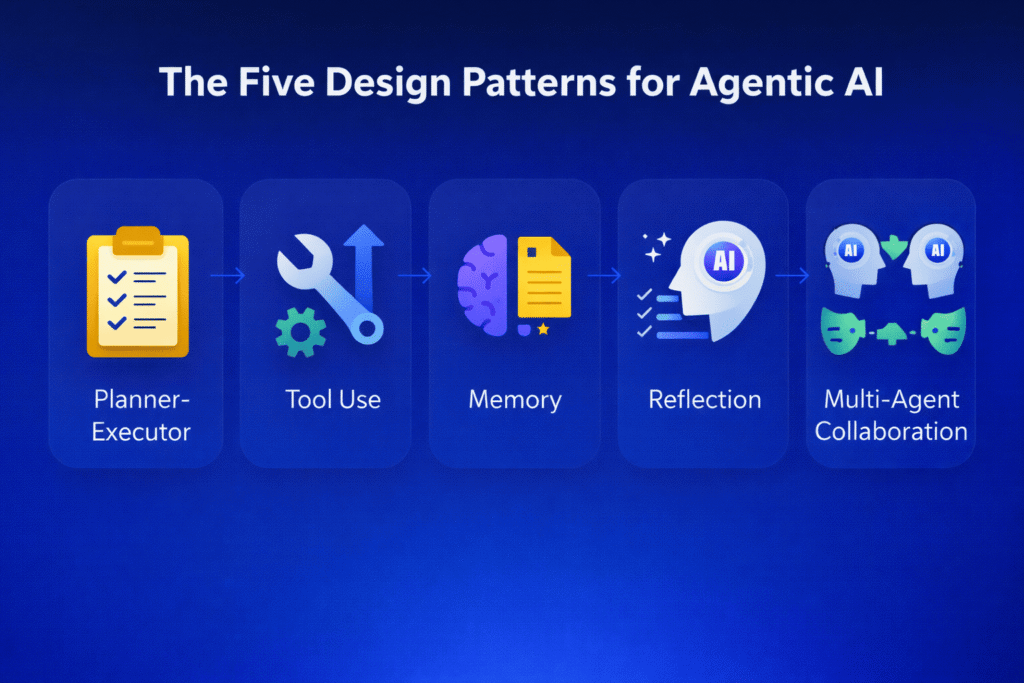
The Five Design Patterns for Agentic AI
1. The Planner–Executor Pattern
Core idea: Separate thinking from doing.
The agent first creates a plan, then executes actions step by step.
How it works:
- Interpret user goal
- Generate task plan
- Execute each step
- Adjust based on results
Why it matters
- Reduces hallucinations
- Improves reliability
- Enables long-running tasks
Example use cases
- Research agents
- Coding assistants
- Multi-step automation workflows
2. Tool-Using Agent Pattern
Core idea: LLMs become powerful when connected to tools.
Instead of relying only on internal knowledge, agents call external systems such as:
- APIs
- databases
- search engines
- calculators
- internal company services
Agent loop:
- Reason about next action
- Select tool
- Execute tool call
- Interpret output
Key insight:
LLMs provide reasoning; tools provide precision.
This pattern turns AI from a text generator into a functional system operator.
3. Memory-Augmented Agent Pattern
Core idea: Agents need memory to improve over time.
Without memory, every interaction resets context. Agentic systems introduce structured memory layers:
- Short-term memory: conversation context
- Long-term memory: stored knowledge
- Working memory: active task state
Benefits
- Personalization
- continuity across sessions
- improved decision-making
Memory enables agents to behave less like chat sessions and more like collaborators.
4. Reflection and Self-Critique Pattern
Core idea: Agents improve by evaluating their own outputs.
After completing an action, the agent asks:
- Did this achieve the goal?
- What errors occurred?
- Should I retry differently?
This creates an iterative improvement loop.
Typical workflow
- Generate solution
- Critique result
- Revise approach
- Produce improved output
Why it matters
- Higher accuracy
- fewer logical failures
- better reasoning chains
Reflection transforms single-pass AI into adaptive intelligence.
5. Multi-Agent Collaboration Pattern
Core idea: Multiple specialized agents outperform one general agent.
Instead of a single system doing everything, responsibilities are divided:
- Planner agent
- Research agent
- Writer agent
- Reviewer agent
- Executor agent
Agents communicate and coordinate toward shared goals.
Advantages
- specialization improves quality
- scalable workflows
- modular architecture
This mirrors how human teams operate — and often produces more reliable outcomes.
How These Patterns Work Together
Most real-world agentic systems combine several patterns:
| Capability | Design Pattern |
|---|---|
| Task decomposition | Planner–Executor |
| External actions | Tool Use |
| Learning over time | Memory |
| Quality improvement | Reflection |
| Scalability | Multi-Agent Systems |
Agentic AI is not one technique — it’s a composition of coordinated behaviors.
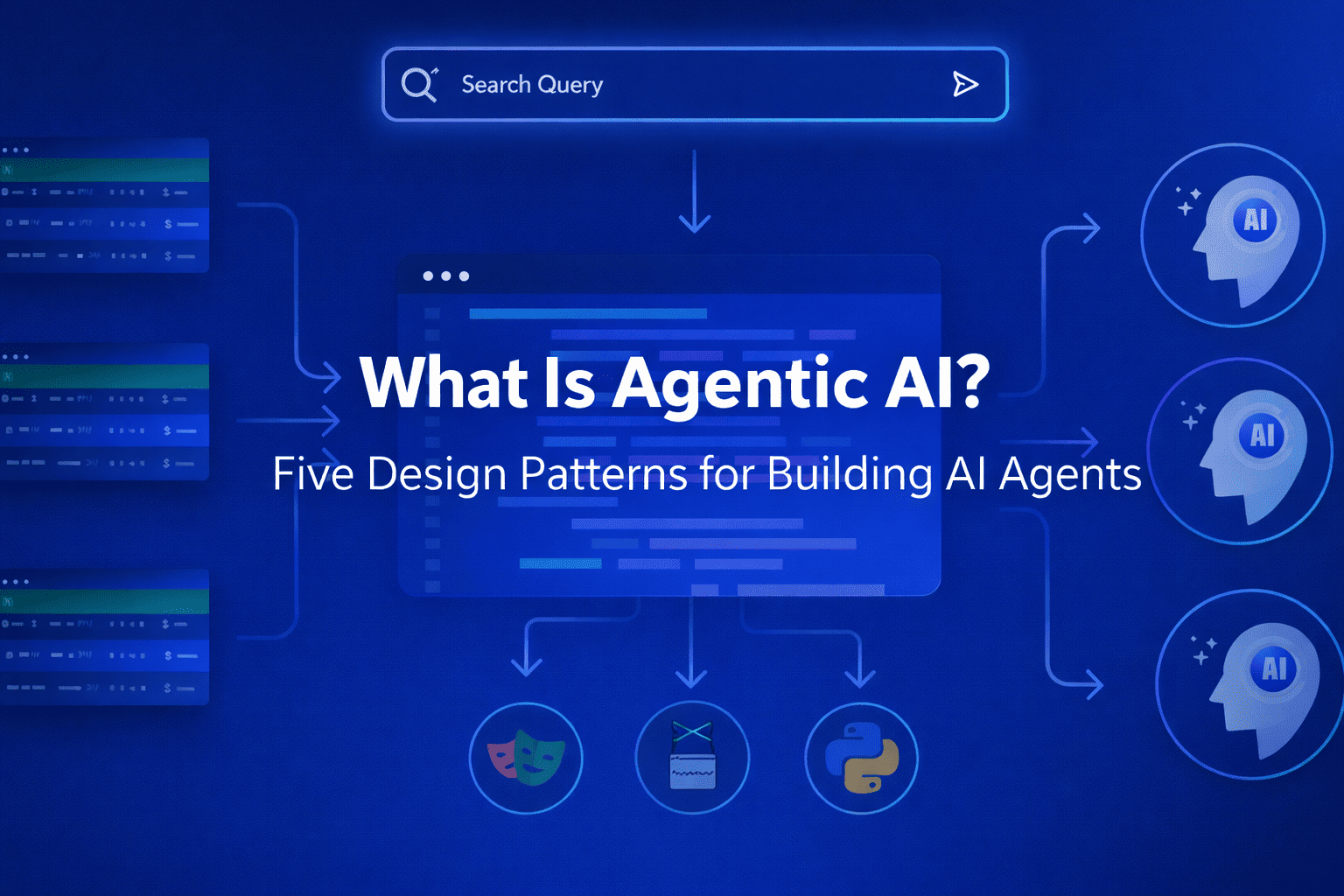
Agentic AI Architecture (Conceptual Stack)
A typical AI agent system includes:
- LLM reasoning layer – understanding and planning
- Orchestration layer – workflow control
- Tool layer – APIs and integrations
- Memory layer – persistent knowledge
- Evaluation loop – reflection and monitoring
Designing agents is therefore closer to systems engineering than prompt writing.
Challenges of Agentic AI
Despite its promise, Agentic AI introduces new complexities:
- Latency from multi-step reasoning
- cost management for long workflows
- safety and permission boundaries
- evaluation and debugging difficulties
- orchestration reliability
Successful implementations focus on constrained autonomy rather than unlimited freedom.
Risks: Trust Without Ground Truth
The normalization of synthetic authority introduces several societal risks:
Erosion of shared reality — communities may inhabit different perceived truths.
Manipulation at scale — political and commercial persuasion becomes cheaper and more targeted.
Institutional distrust — genuine sources struggle to distinguish themselves from synthetic competitors.
Cognitive fatigue — constant skepticism exhausts audiences, leading to disengagement or blind acceptance.
The danger is not that people believe everything, but that they stop believing anything reliably.
Best Practices for Building AI Agents
- Start with narrow goals
- Add tools gradually
- Log agent decisions
- Implement guardrails early
- Separate planning from execution
- Measure outcomes, not responses
The most effective agents are designed systems, not improvisations.
The Future of Agentic AI
Agentic AI is rapidly becoming the foundation of next-generation software.
We are moving toward systems that:
- manage workflows autonomously
- collaborate with humans continuously
- adapt through feedback loops
- operate across digital environments
Just as web apps defined the 2000s and mobile apps defined the 2010s, AI agents may define the next era of computing.
Conclusion
Agentic AI represents a fundamental evolution in artificial intelligence — shifting from tools that respond to prompts toward systems that pursue goals.
The transformation happens through architecture, not magic.
By applying five key design patterns:
- Planner–Executor
- Tool Use
- Memory Augmentation
- Reflection
- Multi-Agent Collaboration
developers can turn LLMs into reliable, capable AI agents.
The future of AI isn’t just smarter models — it’s smarter systems.
FAQ
What is Agentic AI in simple terms?
Agentic AI refers to AI systems that can independently plan and execute tasks to achieve goals rather than only responding to prompts.
How is Agentic AI different from chatbots?
Chatbots generate responses. Agentic AI systems take actions, use tools, remember context, and iteratively work toward outcomes.
Do AI agents replace humans?
No. Most agentic systems are designed to augment human workflows by automating repetitive or complex tasks while humans supervise decisions.
What technologies are used to build AI agents?
Common components include large language models, orchestration frameworks, APIs, vector databases, memory systems, and evaluation pipelines.
Are AI agents autonomous?
They are semi-autonomous. Effective systems operate within defined constraints, permissions, and monitoring mechanisms.
Why are design patterns important for Agentic AI?
Because reliability comes from architecture. Design patterns provide reusable solutions for planning, reasoning, memory, and coordination.