Introduction
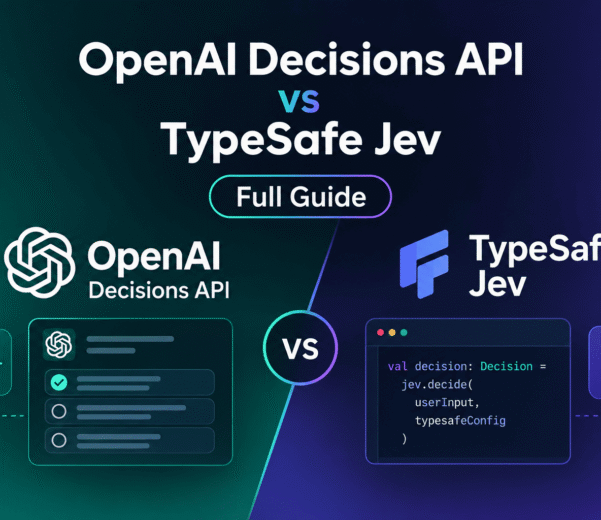
Tech companies are racing to develop models used for chatting and generating text. However, the emergence of the Jev AI model developed by TypeSafe AI changed the rule by offering a different path.
If you think all AI models are built to talk to you like ChatGPT or Claude, this article will change how you view modern software.
The Real Problem: Why Was the Decision AI Model Built in the First Place?
Companies building AI Agents faced a huge financial and technical roadblock known as Inference Costs.
When a developer builds an automated system to manage customer service or run code, the system needs to make dozens of small, repeated decisions:
- Is this ticket urgent or not?
- Which software tool should the agent pick right now?
- Is the action the code is about to take safe?
Companies used to rely on large, expensive language models (LLMs) to answer these simple questions. The outputs did not require writing an essay or creative text, just a Structured Decision. This waste of energy and cost caused many AI projects to stop before completion.
This is where Diogo Almeida (co-founder of the company and former OpenAI researcher who contributed to InstructGPT research) came up with his core idea: AI does not always need to talk in human language to make a real impact inside software.
Why was TypeSafe AI Design Jev Differently?
The system works under a concept known as a System One Model (a fast and direct thinking system).
Here are the key differences between it and traditional models:
Feature | Traditional Language Models (LLMs) | Jev AI model |
Primary Goal | Text generation and open reasoning | Fast and structured decision-making |
Response Method | Predicting the next word (Autoregressive) | Calculating direct output probabilities |
Interface | Natural language and chat (Chatbot) | Confidence scores and probabilities |
Cost and Speed | Highest cost and slower response time | Low cost and extremely fast |
Read also: Launching Jev Model: How does it Change the Game for AI Engineers
How Does Jev Work? And Why Doesn’t It Respond to Natural Language?
You cannot open a chat window and type to the model like other systems, as it does not respond to open natural language.
Instead, it receives text inputs along with pre-defined categories (Categories & Types). Then, it calculates the mathematical probabilities for the correct output and returns it with a carefully weighted “Confidence Score.”
Why Was Jev Designed Without Chat?
The system relies on the idea of building decision AI for quick choices. It predicts the mathematical probabilities for the correct output and provides it with a confidence score instead of generating open text.
This mechanism allows companies to reduce financial waste and achieve exceptional performance in complex software environments.
How Was This Model Trained? (RLCD Technique)
It was trained using an innovative method called Reinforcement Learning for Calibrated Decisions (RLCD).
This technique ensures that confidence scores do not just reflect superficial guesses. Instead, they express precise mathematical probabilities that show how correct a decision is before taking it, making it an ideal choice for systems built on direct code (Machine-Native AI).
Real-World Example: How Does the System Make Decisions?
To make the picture simpler, imagine a software server suddenly crashed inside a company.
An automated agent steps in to fix the issue. Before writing any code, it must determine 3 items:
- Choose the right software skill for the problem.
- Identify the most important reference files for the case.
- Send the result to the team responsible for system crashes.
Traditional models read the problem and write a full report explaining their reasons, which consumes time and money.
In contrast, the Jev AI model works in a direct way; it reads text in natural language and returns the result as specific codes and data only, without writing long reports.
The Next Shift in Business Automation
This project was not built to be just another new tool for talking or writing creative text. It came to solve a real problem troubling software developers: financial cost and operational speed.
Relying on decision AI represents the core foundation for the future of autonomous systems. Technical models are shifting from interactive chat tools to quiet background engines operating inside software.
The innovation delivered by TypeSafe AI proved that the true value of technology lies not in how well it mimics human speech, but in its ability to make the right decisions as fast and as cheaply as possible. This will reshape how smart applications are built in the coming years.