Introduction
AI engineers are increasingly building systems that combine large language models (LLMs), AI agents, traditional software logic, and specialized machine learning models. However, not every task requires a model to generate text or perform complex reasoning.
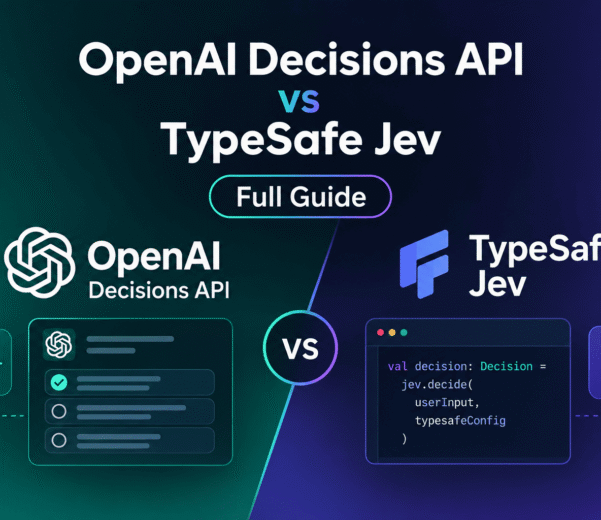
This is where the Jev model from TypeSafe AI introduces a different approach. Designed as a first-generation System 1 model for software automation, Jev focuses on making fast, structured decisions rather than generating free-form text.
By returning predefined outputs, probabilities, and confidence scores, Jev is designed for applications such as routing, classification, verification, guardrails, and real-time decision-making. Its parallel sampling architecture is also intended to reduce inference latency and make high-volume AI workflows more efficient.
So, what exactly is the Jev model, how does it work, and what could it mean for AI engineers building the next generation of AI agents?
A Look at the Latest AI Updates: Launching the Jev Model from TypeSafe AI
TypeSafe AI announced the launch of its first advanced model named Jev. It is the first generation of System One Models designed specifically for software automation. It makes fast, structured decisions with the same level of intelligence as Large Language Models (LLMs), but with a completely different operational mechanism.
Key Features of the Jev Model
- Eliminating Unstructured Strings for Type-Safe Outputs: The model does not generate free text. Instead, it receives unstructured data and produces predefined structured values alongside probability and confidence scores. This approach is designed to reduce type errors and hallucination risks through a software framework.
- Parallel Sampling Architecture: Instead of generating text token by token sequentially, the model produces outputs through a parallel query architecture. TypeSafe AI states that this can reduce response latency to approximately 70–500ms, depending on the task.
- Training Algorithm (RLCD): The model relies on a training method called Reinforcement Learning for Calibrated Decisions (RLCD), rather than traditional RLHF approaches. The focus is on structured decision-making rather than conversational responses.
- Cost and Speed:
- Input data: $0.042 per million tokens.
- Output data: $0.00.
Why Jev Could Be Important for AI Agents
In AI system development, engineers often use large generative models for tasks that do not actually require text generation. An AI agent may need an LLM to reason through a complex problem, but the next step could require nothing more than answering a simple question such as:
Should the system save this file? Yes or no.
Using a large generative model for every small decision can introduce additional latency, token usage, and output-processing complexity.
Jev is designed to address this gap by providing structured decisions that can be directly integrated into software workflows.
1. The Hidden Tax of Generative Models
When building AI agents, a system might use a large reasoning model to generate complex code or analyze a problem and then use another model call simply to determine the next action.
For example:
Should the agent save the file?
Should the request be routed to a human?
Is this input potentially malicious?
Should another AI model be called?
These decisions do not necessarily require a long textual response.
Generating lengthy text or JSON for a simple Boolean decision can increase token consumption and introduce output-validation problems. Engineers may also need additional prompt engineering, parsing logic, retry mechanisms, and error handling.
A structured decision model offers an alternative architecture for these situations.
2. Why Traditional Alternatives Can Also Create Challenges
When teams want to reduce the cost and latency of generative models, they may turn to smaller classification models such as BERT or DeBERTa.
These models can be effective for classification tasks, but deploying and maintaining specialized models can introduce additional requirements, including:
- Continuous data labeling.
- Model-specific training pipelines.
- Monitoring and retraining.
- Handling data drift.
- Maintaining separate models for different decision tasks.
Jev’s approach is designed to provide structured decision-making without requiring engineers to build a separate model for every simple decision.
Technical Architecture: How Jev Works
One of the key concepts behind Jev is the distinction between System 1 and System 2 processing.
Generative AI systems typically perform autoregressive generation, predicting one token after another. Jev instead focuses on directly evaluating an input state against predefined questions and possible outputs.
1. Breaking the Autoregressive Loop
Rather than predicting the next token from a very large vocabulary, Jev restricts the possible outputs before inference begins.
This allows the model to focus on the decision itself instead of generating a textual explanation.
2. Three Types of Specified Questions
Jev evaluates input states using three main types of structured questions:
Choice: Selecting an option from a closed list of up to 255 options while returning a confidence score.
Score: Evaluating a state on a graded scale, such as determining a risk level.
Null / Boolean: Returning a probability between 0.0 and 1.0 for a logical decision such as true or false.
3. Speculative Fan-Out
The input state can be encoded once into GPU memory, while multiple specified questions are processed in parallel.
This architecture means that evaluating multiple questions can potentially have a similar latency profile to evaluating a single question, depending on the implementation and workload.
For AI engineers, this could be particularly useful when an application needs to make several decisions about the same input before continuing its workflow.
Direct Use Cases for the Jev Model
The structured architecture of Jev makes it potentially useful for several AI engineering applications.
Smart Decision Rules
Jev can be used for software decisions that would traditionally rely on complex if/else logic.
Examples include:
- Routing requests.
- Classifying inputs.
- Selecting workflows.
- Prioritizing tasks.
- Determining whether an action should be executed.
Real-Time Applications
Applications that require rapid responses can benefit from lower-latency decision-making.
Potential applications include real-time game-state decisions, interactive systems, and other applications where waiting for a large generative model to complete a response would create unnecessary delay.
Big Data Processing
The parallel architecture could also be useful for processing large volumes of data.
In Map-Reduce-style workflows, organizations could use structured AI decisions to convert large datasets into predefined features, classifications, or signals.
Guardrails and Verification
Another potential application is using Jev alongside other AI models.
For example, a system could use a large language model to generate an output and then use Jev to evaluate whether that output meets predefined conditions before allowing the system to execute it.
This could make Jev useful as a verification layer for:
- Prompt-injection detection.
- Jailbreak detection.
- Output validation.
- Risk classification.
- Automated workflow approval.
Engineering Constraints: When Jev May Not Be Suitable
Despite its potential applications, Jev is not intended to replace generative AI models.
AI engineers need to understand its limitations before incorporating it into production systems.
Limited Context Window
Jev supports up to 64,000 total tokens, with a maximum of 32,000 tokens for the input state. Large documents or datasets may therefore require chunking or preprocessing.
Options Limit
A question cannot contain more than 255 options. Tasks requiring extremely large classification spaces may therefore need a different architecture or additional processing.
No Text Generation
Jev does not replace an LLM when the task requires generating content.
It is not designed to:
- Write code.
- Write articles.
- Summarize documents.
- Generate conversations.
- Produce long-form explanations.
Instead, its value comes from handling the structured decisions surrounding those tasks.
The Intersection of AI and Data Science
The development of models such as Jev highlights a broader trend in AI engineering: not every component of an AI system needs to be generative.
Modern enterprise AI systems increasingly combine multiple technologies, including:
- Large language models.
- Specialized machine learning models.
- Data pipelines.
- Structured decision models.
- Retrieval systems.
- Human-in-the-loop workflows.
- Automated verification layers.
The goal is not necessarily to use one massive model for every task. Instead, engineers can assign different components to different parts of the workflow.
Transforming Data Into Strategic Assets
Modern organizations process enormous volumes of structured and unstructured data. NLP, machine learning, and AI-powered data pipelines can transform this information into actionable insights.
Applications include:
- Increasing prediction accuracy: Using statistical and machine learning models to improve forecasting.
- Improving processing efficiency: Building data pipelines capable of processing large volumes of information.
- Security and governance: Applying automated anomaly detection and verification mechanisms to improve data integrity and security.
This shift toward specialized AI components could become increasingly important as organizations scale their AI infrastructure.
Conclusion
The Jev model from TypeSafe AI represents a different approach to AI inference. Instead of focusing on generating text, it is designed around fast, structured decisions that can be integrated directly into software systems.
For AI engineers, the interesting opportunity is not necessarily replacing LLMs, but using the right model for the right task. Large language models can handle complex reasoning and generation, while specialized decision models such as Jev can potentially handle routing, classification, verification, and other structured decisions more efficiently.
As AI agents become more sophisticated, architectures that combine generative models with specialized decision-making components may become increasingly important for controlling latency, cost, reliability, and system complexity.
At SO Development, we continue to follow developments in AI, data engineering, generative AI, and AI agent technologies to understand how emerging approaches can be applied to real-world enterprise systems.
Frequently Asked Questions About the Jev Model
What is the Jev model?
Jev is an AI model developed by TypeSafe AI that focuses on structured decision-making rather than free-form text generation. It is designed for software automation, classification, routing, verification, and other decision-oriented tasks.
How is Jev different from an LLM?
Traditional LLMs generally generate text token by token. Jev is designed to return predefined structured outputs, such as choices, scores, and Boolean probabilities, allowing it to focus on decision-making rather than text generation.
Can Jev replace ChatGPT or other LLMs?
No. Jev is designed for a different purpose. It does not generate long-form text, write articles, summarize documents, or perform conversational tasks. It can instead complement generative models by handling structured decisions within an AI workflow.
What is RLCD?
RLCD stands for Reinforcement Learning for Calibrated Decisions. It is the training approach associated with Jev and focuses on producing calibrated structured decisions rather than optimizing primarily for conversational responses.
What can Jev be used for?
Potential applications include AI agent routing, classification, Boolean decisions, risk scoring, guardrails, output verification, prompt-injection detection, real-time applications, and high-volume data processing.
How fast is the Jev model?
TypeSafe AI describes Jev as a low-latency model, with reported response times in the range of approximately 70–500 milliseconds depending on the task and implementation.
Does Jev generate code?
No. Jev is not a code-generation model. It can potentially help an AI system decide when or whether a particular action should happen, while a generative model handles the actual code generation.
What are Jev’s main limitations?
Important limitations include its 64,000-token total context limit, a maximum of 32,000 input tokens, a maximum of 255 options per Choice question, and the fact that it does not perform free-form text generation.
Why could Jev be useful for AI agents?
AI agents often need to make many small decisions between larger reasoning or generation steps. A specialized structured-decision model could potentially handle these decisions with lower latency and less output overhead than using a large generative model for every step.