Introduction: Are Transformers Approaching Their Limits?
Since the release of “Attention Is All You Need” by Google researchers in 2017, the Transformer architecture has become the foundation of modern artificial intelligence. Nearly every major large language model (LLM) today — including GPT-based models, Gemini, Claude, and many open-source systems — relies heavily on Transformer-based designs.
Transformers changed AI by introducing self-attention, allowing models to analyze relationships between words across an entire sequence instead of processing information step-by-step like older recurrent neural networks (RNNs). This innovation enabled massive scaling and led to today’s generative AI revolution.
However, a growing number of researchers believe that simply making Transformers larger may not be the final path toward more capable AI systems.
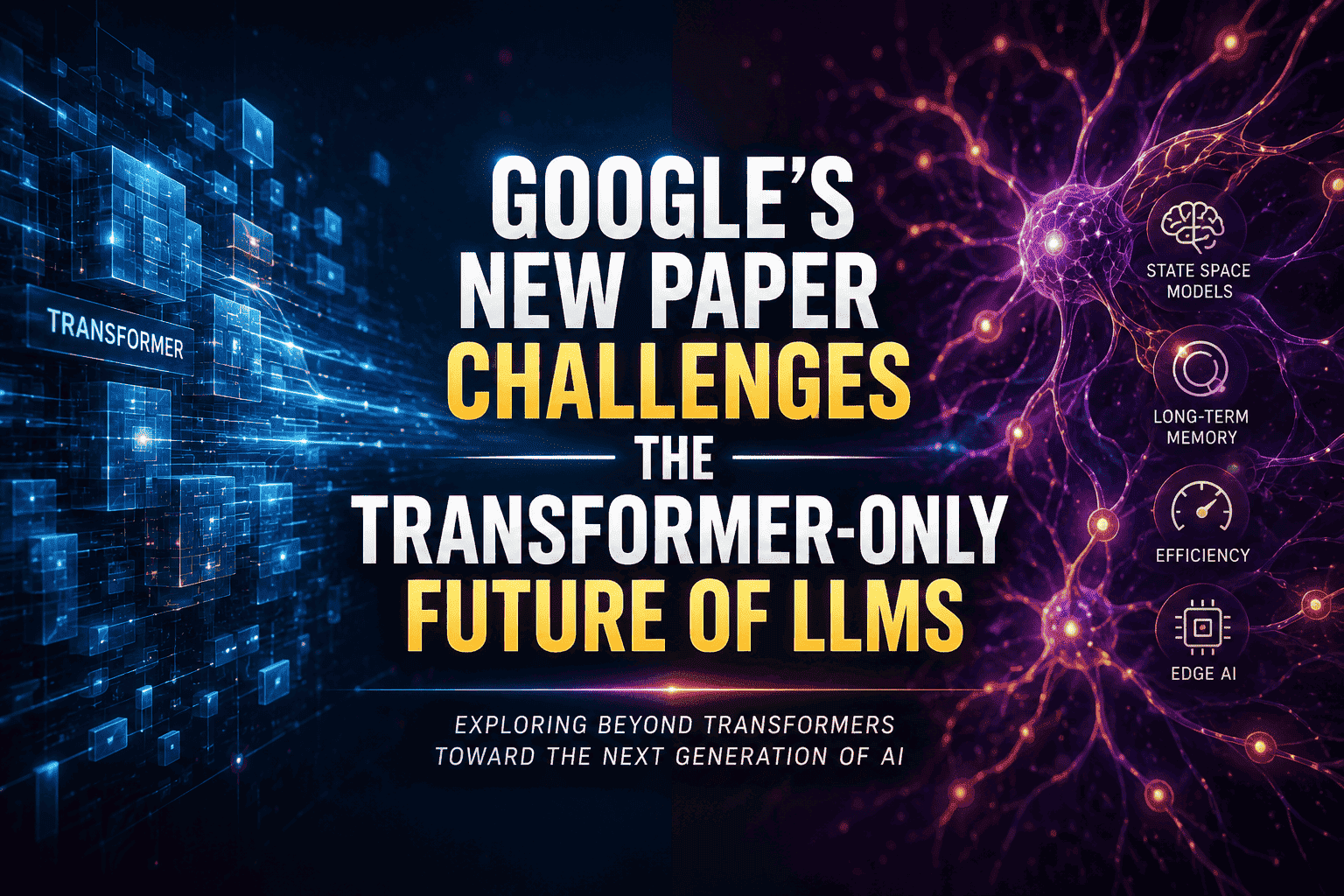
A recent Google research direction has reignited this debate by exploring the limitations of Transformer architectures and investigating alternatives that could define the next generation of AI models.
The Transformer Revolution
Before Transformers, language models were dominated by architectures such as:
- Recurrent Neural Networks (RNNs)
- Long Short-Term Memory Networks (LSTMs)
- Convolutional Neural Networks (CNNs)
These approaches processed sequences sequentially, making training slower and limiting their ability to capture long-range dependencies.
The Transformer solved many of these problems through self-attention.
Instead of reading:
“The cat sat on the mat”
one word at a time, a Transformer can evaluate relationships between all words simultaneously.
This parallel processing capability allowed researchers to train models with billions — and eventually trillions — of parameters.
The result:
- Better language understanding
- More fluent text generation
- Improved translation
- Stronger reasoning capabilities
- Multimodal AI systems
The Transformer became the default architecture for scaling AI.
The Problem: Scaling Transformers Is Becoming Expensive
Although Transformers are powerful, they have a fundamental challenge: attention complexity.
The self-attention mechanism compares tokens with each other. As context length increases, the computational and memory requirements grow significantly.
For example:
- A 1,000-token input requires attention calculations across many token pairs.
- A 100,000-token input creates a much larger computational burden.
This creates challenges for:
- Long-document analysis
- AI agents with persistent memory
- Real-time applications
- Edge AI deployment
Google researchers and other AI scientists have been investigating ways to overcome these limitations through more efficient attention mechanisms and alternative architectures.
Google’s Research: Questioning Transformer Limitations
One notable paper from Google DeepMind, “On Limitations of the Transformer Architecture,” examines theoretical weaknesses of Transformer-based models.
The researchers argue that some reasoning and compositional tasks may be difficult for Transformers at scale. Their analysis suggests that certain limitations are not simply caused by insufficient training data or model size, but may be connected to fundamental properties of the architecture itself.
The paper focuses on questions such as:
- Can Transformers reliably perform complex reasoning over very large structures?
- Are hallucinations partly caused by architectural limitations?
- Are there classes of problems where scaling Transformers will not be enough?
The conclusion is not that Transformers are obsolete, but rather that new architectures may be required for the next stage of AI development.
What Could Replace Transformers?
Researchers are exploring several possible directions.
1. Modern Recurrent Neural Networks
Interestingly, one possible future may involve improved versions of older ideas.
Traditional RNNs had a major weakness: limited memory.
However, modern approaches are attempting to create systems with:
- More efficient memory storage
- Longer context handling
- Lower computational cost
The goal is to combine the efficiency of recurrence with the capabilities expected from modern LLMs.
2. State Space Models (SSMs)
State Space Models have gained attention as alternatives to Transformers.
Unlike attention-based models, SSMs can process sequences more efficiently because they do not require every token to directly interact with every other token.
Benefits may include:
- Linear scaling with sequence length
- Faster inference
- Lower memory usage
Models such as Mamba have demonstrated that non-Transformer architectures can compete in certain language modeling tasks.
3. Hybrid Architectures
The future may not be a complete replacement of Transformers.
Instead, AI systems may combine:
- Transformers for complex reasoning
- Memory systems for long-term information
- Recurrent components for efficiency
- External tools for knowledge retrieval
Google has already explored hybrid approaches, including architectures designed to improve efficiency while maintaining Transformer-level performance.
Why This Matters for the AI Industry
If the Transformer era evolves, the impact could be enormous.
Lower AI Costs
Training and running today’s largest models requires:
- Thousands of GPUs
- Massive energy consumption
- Expensive infrastructure
More efficient architectures could make advanced AI accessible to smaller companies.
Better AI Agents
Future AI agents need:
- Persistent memory
- Long-term planning
- Continuous learning
Current Transformer systems often rely on external memory solutions because the architecture itself does not naturally maintain lifelong memory.
New architectures could enable AI systems that remember, learn, and adapt more naturally.
AI on Edge Devices
Efficient architectures could bring advanced AI to:
- Smartphones
- Robots
- Vehicles
- Medical devices
- Industrial systems
Instead of requiring cloud-scale computing, smaller models could operate locally.
Does This Mean the Transformer Era Is Ending?
Not yet.
The Transformer is still the dominant architecture because it works extremely well.
Modern improvements continue to make Transformers better through:
- Optimized attention mechanisms
- Mixture-of-Experts models
- Retrieval augmentation
- Better training methods
- Hardware acceleration
Google itself has continued developing Transformer-based systems while researching alternatives.
A more realistic prediction is:
The future of AI may move from “Transformer-only” models toward a combination of multiple architectures.
The next generation of AI may not be defined by replacing Transformers completely, but by building systems that overcome their weaknesses.
The Future: Beyond Bigger Models
For years, AI progress followed a simple formula:
More data + More parameters + More computing power = Better AI
But researchers are increasingly asking whether scaling alone can continue forever.
The next breakthrough may come from:
- Better architectures
- More efficient memory systems
- Improved reasoning mechanisms
- New approaches inspired by neuroscience
Google’s research highlights an important shift: the future of AI may not belong exclusively to bigger Transformers, but to smarter architectures designed around how intelligence actually works.
The Transformer changed AI forever.
The next revolution may come from what replaces — or evolves beyond — it.
References
- Vaswani, A. et al. Attention Is All You Need (2017). Google Research.
- Peng, B., Narayanan, S., Papadimitriou, C. On Limitations of the Transformer Architecture (2024). Google DeepMind / arXiv.
- Ho, N. et al. Block Transformer: Global-To-Local Language Modeling for Fast Inference (NeurIPS 2024). Google Research.
- Choromanski, K. et al. Rethinking Attention with Performers (2020). Google Research.
- So, D., Liang, C., Le, Q. The Evolved Transformer (2019). Google Research.
- Huang, Y. et al. Advancing Transformer Architecture in Long-Context Large Language Models: A Comprehensive Survey (2023).
Frequently Asked Questions (FAQ)
1. Is Google replacing Transformers with a new AI architecture?
No. Google is not replacing Transformers immediately. Transformers remain one of the most powerful and widely used architectures for large language models. Google’s research explores the limitations of Transformers and investigates possible alternatives that could complement or improve them in future AI systems.
2. Why are researchers looking beyond Transformers?
Researchers are exploring alternatives because Transformers have several challenges, including:
- High computational costs
- Increasing memory requirements for long contexts
- Expensive training and inference
- Difficulty handling some complex reasoning tasks
As AI models become larger, researchers are looking for architectures that are more efficient and scalable.
3. What are the main limitations of Transformer models?
Some major limitations include:
- Quadratic attention complexity: The cost of self-attention increases significantly as input length grows.
- Limited built-in memory: Transformers do not naturally maintain long-term memory between conversations.
- High resource requirements: Training large models requires massive amounts of computing power and energy.
- Scaling challenges: Simply increasing model size may not solve all reasoning limitations.
4. What architecture could replace Transformers?
There is currently no confirmed replacement for Transformers. However, researchers are investigating several alternatives, including:
- State Space Models (SSMs): More efficient models for processing long sequences.
- Modern recurrent architectures: New approaches that combine memory efficiency with strong performance.
- Hybrid models: Systems combining Transformers with memory modules, retrieval systems, and other architectures.
The future may involve multiple architectures working together rather than a single replacement.
5. What are State Space Models (SSMs)?
State Space Models are a type of neural network architecture designed to process sequential data efficiently. Unlike Transformers, which compare every token with other tokens through attention, SSMs maintain a hidden state that evolves over time.
Potential advantages include:
- Better efficiency for long sequences
- Lower memory requirements
- Faster inference
One example is the Mamba architecture, which demonstrated competitive performance with Transformer-based models in certain language tasks.
6. Does this mean GPT and Gemini will stop using Transformers?
Not in the near future.
Current leading AI models depend heavily on Transformer technology because it provides excellent performance at scale. Future models will likely use improved Transformer designs or combine Transformers with other approaches.
7. Why does AI architecture matter for businesses?
The architecture behind AI models directly affects:
- Operating costs
- Response speed
- Scalability
- Deployment options
- Ability to run AI locally
More efficient architectures could make advanced AI available for smaller companies and enable AI applications on devices such as smartphones, robots, vehicles, and medical systems.
8. Could new architectures improve AI agents?
Yes. One of the biggest challenges for current AI agents is maintaining memory and performing long-term tasks.
Future architectures could improve:
- Persistent memory
- Planning abilities
- Continuous learning
- Real-world interaction
This could lead to more capable autonomous AI assistants.
9. Are bigger AI models no longer the future?
Large-scale models will likely remain important, but researchers increasingly believe that better architectures will be as important as increasing model size.
The next generation of AI may depend on improvements in:
- Model efficiency
- Reasoning capabilities
- Memory systems
- Learning methods
10. What is the future of large language models?
The future of LLMs will likely be a combination of technologies:
- Improved Transformers
- New neural architectures
- External memory systems
- Retrieval-augmented generation
- Specialized AI models
Rather than a complete end of the Transformer era, we may be entering a post-Transformer evolution of AI where multiple architectures work together.