Introduction
Computer vision continues to move toward models that are not only more accurate, but also faster, easier to deploy, and capable of handling multiple vision tasks through a unified framework.
In 2026, one of the most important developments in the Ultralytics ecosystem is YOLO26, the latest Ultralytics YOLO model family. Released in January 2026, YOLO26 introduces native end-to-end inference, a lighter detection head, updated training techniques, and support for a broad range of computer vision tasks.
For organizations building AI-powered products, YOLO26 is particularly interesting because it targets an important challenge in production computer vision: how to achieve strong accuracy without making deployment unnecessarily complex or computationally expensive.
This guide explains everything you need to know about Ultralytics YOLO Vision in 2026, with a particular focus on YOLO26, its architecture, capabilities, performance, training workflow, deployment options, use cases, and differences from YOLO11.
What Is Ultralytics YOLO?
YOLO stands for You Only Look Once and refers to a family of real-time computer vision models designed to process visual information efficiently.
Unlike traditional computer vision pipelines that may require multiple stages to identify and localize objects, YOLO approaches object detection as a unified prediction problem.
Over the years, the YOLO ecosystem has expanded beyond basic object detection. Modern Ultralytics models can support:
- Object detection
- Instance segmentation
- Semantic segmentation
- Image classification
- Pose estimation
- Oriented bounding box detection
- Depth estimation
- Tracking
- Open-vocabulary detection and segmentation
Ultralytics provides these capabilities through a common Python package and command-line interface, making it easier for developers and machine learning teams to train, evaluate, deploy, and manage vision models.

What Is YOLO26?
YOLO26 is the latest Ultralytics YOLO model family released in January 2026.
It is designed around four major areas of improvement:
- Native end-to-end inference
- A lighter detection head
- A new training recipe
- Task-specific improvements for different computer vision problems
One of its most significant changes is that YOLO26 uses a one-to-one detection head by default, allowing the model to produce final detections without traditional Non-Maximum Suppression (NMS) as a separate post-processing step.
This is important because NMS has traditionally been a separate stage in object detection pipelines. Removing it from the default inference path can simplify deployment and reduce post-processing overhead.
Read: YOLO26: The Next Evolution of Real-Time Computer Vision
Why YOLO26 Matters in 2026
The evolution of computer vision is increasingly focused on practical deployment rather than benchmark performance alone.
A model may have excellent accuracy but still be difficult to use in a production environment if it:
- Requires expensive hardware
- Has high inference latency
- Needs complicated post-processing
- Is difficult to export
- Performs poorly on edge devices
- Requires separate models for different vision tasks
YOLO26 addresses several of these challenges.
According to Ultralytics’ published benchmarks, YOLO26 detection models range from 40.9 to 57.5 mAP on COCO, depending on model size, with reported T4 TensorRT latency from approximately 1.7 ms to 11.8 ms.
The smallest YOLO26n model also has a reported CPU ONNX inference speed of 38.9 ms, compared with 56.1 ms for YOLO11n under the documented benchmark conditions.
Ultralytics reports up to 43% faster CPU ONNX inference for YOLO26n compared with YOLO11n on an Intel Xeon CPU under its benchmark setup.
Key Features of YOLO26
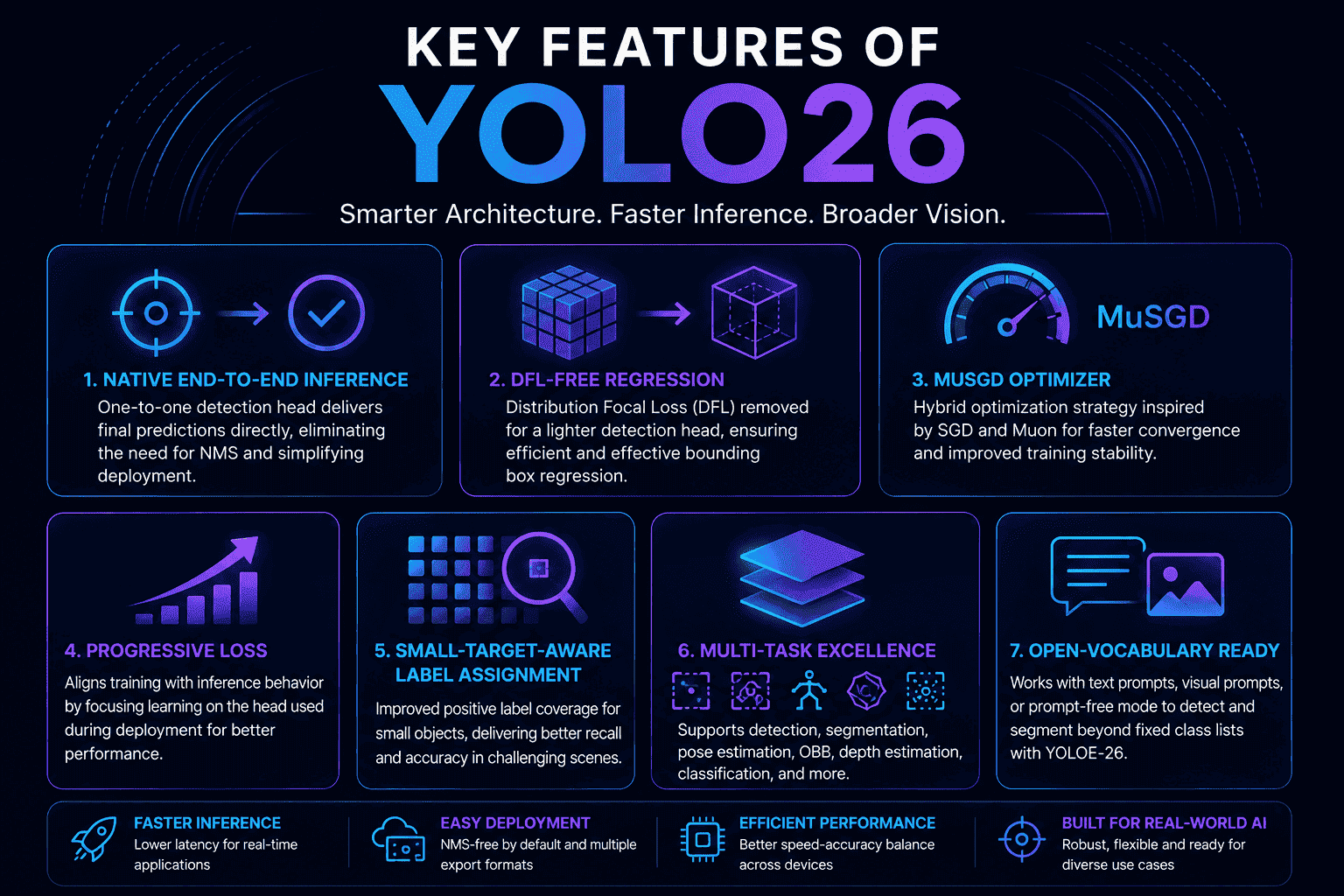
1. Native End-to-End Inference
One of the biggest changes in YOLO26 is its native end-to-end detection architecture.
Traditional object detection models can produce many overlapping predictions. NMS is then applied to remove redundant predictions and select the final detections.
YOLO26’s default one-to-one detection head is designed to produce final predictions directly, eliminating the need for external NMS during standard inference.
This can provide several advantages:
- Simpler inference pipelines
- Reduced post-processing
- Easier deployment
- More predictable execution across platforms
- Lower latency
For edge AI applications, these improvements can be particularly valuable.
2. DFL-Free Regression
YOLO26 removes Distribution Focal Loss (DFL) from its detection head.
The objective is to simplify the detection architecture while maintaining an effective approach to bounding-box regression.
A simpler detection head can also make model export and deployment easier, particularly when targeting environments with strict computational or graph-compatibility requirements.
3. MuSGD Optimizer
YOLO26 introduces MuSGD, a hybrid optimization approach combining ideas from SGD and Muon-style optimization.
The official training recipe uses MuSGD for the YOLO26 checkpoints trained on COCO. Ultralytics reports that the models were trained at 640×640 resolution with a batch size of 128.
This illustrates an important direction in modern AI development: optimization techniques originally associated with other deep-learning workloads are increasingly being adapted for computer vision.
4. Progressive Loss
YOLO26 uses Progressive Loss to better align training with the model’s inference-time behavior.
The objective is to focus training more effectively on the prediction head that will actually be used during deployment.
This can help reduce the mismatch between how a model is optimized during training and how it operates during real-world inference.
5. Small-Target-Aware Label Assignment
Detecting small objects is a common challenge in computer vision.
YOLO26 introduces Small-Target-Aware Label Assignment (STAL) to improve positive label coverage for small objects.
This can be particularly relevant for applications involving:
- Traffic cameras
- Drone imagery
- Surveillance
- Satellite imagery
- Manufacturing inspection
- Retail analytics
Small objects often occupy only a tiny percentage of an image, making them difficult to detect reliably.
YOLO26 Model Sizes
YOLO26 is available in five primary detection sizes:
Model | Parameters | FLOPs | COCO mAP | CPU ONNX | T4 TensorRT |
YOLO26n | 2.4M | 5.4B | 40.9 | 38.9 ms | 1.7 ms |
YOLO26s | 9.5M | 20.7B | 48.6 | 87.2 ms | 2.5 ms |
YOLO26m | 20.4M | 68.2B | 53.1 | 220.0 ms | 4.7 ms |
YOLO26l | 24.8M | 86.4B | 55.0 | 286.2 ms | 6.2 ms |
YOLO26x | 55.7M | 193.9B | 57.5 | 525.8 ms | 11.8 ms |
The figures above are Ultralytics’ published benchmark results and should be treated as reference measurements rather than guarantees for every hardware configuration.
Which YOLO26 model should you choose?
YOLO26n: Best when low compute, small model size, and edge deployment are priorities.
YOLO26s: A strong choice when you need a balance between efficiency and accuracy.
YOLO26m: Suitable for applications where additional accuracy is worth increased compute.
YOLO26l: Designed for demanding workloads requiring higher accuracy.
YOLO26x: Best suited to scenarios where maximum benchmark performance is more important than computational cost.
What Tasks Does YOLO26 Support?
One of YOLO26’s biggest advantages is that it is not limited to object detection.
The model family supports multiple computer vision tasks.
Object Detection
Object detection identifies objects and determines their locations using bounding boxes.
Common applications include:
- Vehicle detection
- Person detection
- Product detection
- Industrial inspection
- Traffic monitoring
- Security systems
Instance Segmentation
Instance segmentation identifies individual objects and creates pixel-level masks around them.
For example, instead of simply detecting five cars, a segmentation model can identify the precise shape of each car.
This is useful for:
- Medical imaging
- Robotics
- Manufacturing
- Agriculture
- Autonomous systems
Ultralytics reports improvements in YOLO26 instance segmentation compared with YOLO11, including reported gains of up to 2.5 box AP and 3.7 mask AP on COCO.
Semantic Segmentation
Semantic segmentation assigns classes to pixels across an image.
This is useful when the goal is to understand the overall structure of a scene rather than simply detect individual objects.
Examples include:
- Road segmentation
- Building segmentation
- Medical image analysis
- Agricultural field analysis
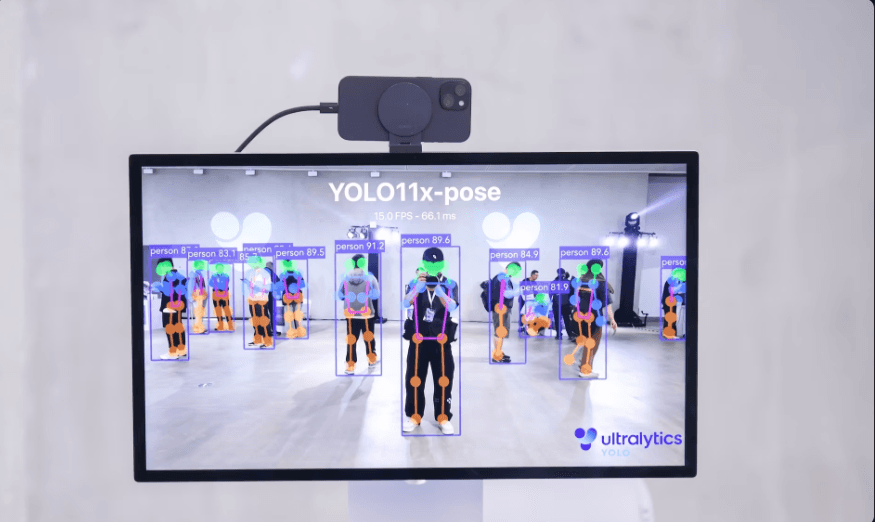
Pose Estimation
Pose estimation identifies keypoints representing human or object positions.
Applications include:
- Sports analytics
- Fitness applications
- Human-computer interaction
- Gesture recognition
- Robotics
Ultralytics reports that YOLO26 pose models can provide improvements over YOLO11, with reported gains of up to 7.2 AP on COCO pose estimation.
Oriented Object Detection
Oriented bounding boxes, or OBB, are useful when objects are rotated rather than aligned with the image axes.
Typical applications include:
- Aerial imagery
- Satellite imagery
- Document analysis
- Industrial inspection
- Geospatial AI
YOLO26 includes specialized OBB improvements, including an updated angle loss and optimized decoding.
Depth Estimation
YOLO26 also supports monocular depth estimation.
This means the model can estimate depth information from a single image.
Depth estimation has applications in:
- Robotics
- AR/VR
- Autonomous systems
- 3D scene understanding
- Smart cameras
YOLOE-26: Open-Vocabulary Vision
Another important development around the YOLO26 ecosystem is YOLOE-26.
Traditional object detection models are generally trained on a predefined list of classes.
Open-vocabulary models are different.
They can use text or visual prompts to identify categories that are not necessarily restricted to a fixed class list established during the original training process.
YOLOE-26 supports:
- Text prompting
- Visual prompting
- Prompt-free detection
This is particularly useful for dynamic environments where the categories an AI system needs to recognize can change over time.
For example, a retail system could potentially be adapted to search for new product categories without rebuilding the entire vision pipeline from scratch.
YOLO26 vs YOLO11
YOLO11 remains an important Ultralytics model and is still recommended for stable production workloads alongside YOLO26. However, YOLO26 introduces several architectural changes aimed at end-to-end inference and deployment efficiency.
Feature | YOLO11 | YOLO26 |
Release | 2024 | 2026 |
Default NMS-free inference | No | Yes |
Detection head | Traditional YOLO approach | One-to-one + one-to-many |
DFL | Used | Removed |
MuSGD | No | Yes |
STAL | No | Yes |
Progressive Loss | No | Yes |
Detection | Yes | Yes |
Segmentation | Yes | Yes |
Pose | Yes | Yes |
OBB | Yes | Yes |
Depth | No | Yes |
Open vocabulary | Via separate model family | YOLOE-26 |
YOLO11 can still make sense when a project already has a mature YOLO11 pipeline, existing benchmarks, or compatibility requirements. YOLO26 becomes particularly compelling when end-to-end inference, deployment simplicity, or the newer task capabilities are important.
How to Install YOLO26
Getting started with Ultralytics YOLO is relatively straightforward.
Install the package using pip:
pip install ultralytics
You can then load a pretrained YOLO26 model:
from ultralytics import YOLO
model = YOLO(“yolo26n.pt”)
Run inference on an image:
results = model(“image.jpg”)
Ultralytics also provides a CLI workflow:
yolo predict model=yolo26n.pt source=”image.jpg”
The official documentation provides Python and CLI workflows for prediction, training, validation, and model export.
How to Train YOLO26 on a Custom Dataset
Pretrained models are useful, but many real-world applications require custom training.
A typical workflow includes:
Step 1: Collect Data
Build a dataset representative of the environment where the model will operate.
For example, an automotive model should contain different:
- Weather conditions
- Lighting conditions
- Camera angles
- Vehicle types
- Road environments
Step 2: Annotate the Dataset
Depending on the task, annotations may include:
- Bounding boxes
- Segmentation masks
- Keypoints
- Oriented bounding boxes
- Classification labels
High-quality annotation is critical because model performance is strongly influenced by the quality and diversity of training data.
Step 3: Prepare the Dataset Configuration
A YOLO dataset typically includes a YAML configuration describing the training and validation datasets and class names.
Step 4: Start Training
A basic Python example is:
from ultralytics import YOLO
model = YOLO(“yolo26n.pt”)
results = model.train(
data=”custom_data.yaml”,
epochs=100,
imgsz=640)
Ultralytics’ official examples use the same general workflow for fine-tuning YOLO models on custom datasets.
YOLO26 Training Strategy
Training a strong vision model involves much more than selecting a model checkpoint.
The official YOLO26 training recipe includes several notable choices.
The released models were trained using:
- MuSGD
- 640×640 image resolution
- Batch size of 128
- End-to-end training
- Mosaic augmentation
- Scale augmentation
- Progressive Loss
- Small-target-aware label assignment
The training recipe also disables mosaic augmentation during the final portion of training to help the model refine its predictions.
For custom datasets, however, you should not blindly copy every training parameter from COCO. Dataset size, object scale, class balance, image quality, and hardware can all affect the best configuration.
Deploying YOLO26
A computer vision model is only useful in production if it can run efficiently in its target environment.
YOLO26 is designed with deployment in mind.
Potential deployment environments include:
- Cloud servers
- NVIDIA GPUs
- CPUs
- Edge AI devices
- Embedded systems
- Smart cameras
- Robotics platforms
Ultralytics supports exporting models to formats and platforms including ONNX, TensorRT, CoreML, LiteRT, and OpenVINO.
The end-to-end architecture can also reduce the complexity of deployment because the default inference path does not require a separate NMS stage.
Real-World Applications of YOLO26
Healthcare
Computer vision can be used for:
- Medical image analysis
- Anatomical structure detection
- Medical segmentation
- Surgical video analysis
- Patient monitoring
Healthcare applications require additional validation, high-quality datasets, privacy controls, and appropriate clinical oversight.
Automotive and Autonomous Systems
YOLO26 can be used for visual perception tasks such as:
- Vehicle detection
- Pedestrian detection
- Traffic-sign recognition
- Road-object detection
- Scene understanding
Its focus on efficient inference can make it relevant to edge-based automotive applications.
Retail and E-Commerce
Retail companies can use computer vision for:
- Product detection
- Shelf monitoring
- Inventory analysis
- Customer analytics
- Checkout automation
Open-vocabulary capabilities can also be useful in environments where product categories change frequently.
Manufacturing
Industrial computer vision is another major application area.
YOLO26 can support:
- Defect detection
- Quality control
- Component inspection
- Object counting
- Worker safety monitoring
Agriculture
Computer vision can help identify:
- Crops
- Fruits
- Weeds
- Plant diseases
- Agricultural equipment
Small-object detection improvements can be particularly relevant when objects occupy only a small portion of an image.
Security and Smart Surveillance
Real-time detection models can power:
- Person detection
- Vehicle monitoring
- Restricted-area monitoring
- Crowd analysis
- Perimeter security
Organizations deploying these systems should also consider privacy, local regulations, data retention, and responsible AI requirements.
Why Data Quality Still Matters
Even the newest computer vision architecture cannot compensate for poor training data.
A highly optimized model trained on inaccurate or unrepresentative annotations may perform worse than a smaller model trained on a carefully curated dataset.
For production projects, organizations should pay attention to:
Data diversity: Include realistic variations.
Annotation quality: Labels should accurately represent the intended task.
Class balance: Avoid excessive dominance by a small number of classes.
Edge cases: Include difficult and unusual examples.
Validation data: Keep representative data separate from training data.
Domain shift: Test the model on the environment where it will actually operate.
This is especially important when moving from public datasets such as COCO to specialized domains such as healthcare, automotive, industrial inspection, or retail.
Should You Use YOLO26 for Your Project?
YOLO26 is particularly attractive when your project requires:
- Real-time computer vision
- Low-latency inference
- Edge deployment
- Multiple vision tasks
- Simplified deployment pipelines
- Custom model training
- Modern end-to-end detection
- Open-vocabulary capabilities
However, choosing a model should always be based on testing rather than the model name alone.
Before moving to production, compare candidate models using your own:
- Dataset
- Hardware
- Image resolution
- Latency requirements
- Accuracy requirements
- Memory constraints
- Deployment environment
A model that performs well on COCO may not automatically be the best model for a specialized production dataset.
The Future of YOLO and Vision AI
YOLO26 demonstrates a broader trend in computer vision: the industry is moving toward unified, efficient, deployment-oriented vision models.
Instead of optimizing exclusively for benchmark accuracy, modern vision systems increasingly need to combine:
- Accuracy
- Speed
- Efficiency
- Multitask capabilities
- Flexible deployment
- Easy integration
- Adaptability
The introduction of end-to-end detection, depth estimation, open-vocabulary capabilities, and multiple specialized task heads illustrates how the YOLO ecosystem is expanding beyond traditional object detection.
For developers and businesses, this means the most important question is no longer simply “Which YOLO version has the highest mAP?”
The better question is:
Which model provides the right combination of accuracy, latency, cost, flexibility, and deployment simplicity for my application?
Final Thoughts
Ultralytics YOLO Vision 2026, led by YOLO26, represents a significant step in the evolution of real-time computer vision.
Its most important innovations include native end-to-end NMS-free inference, DFL-free regression, MuSGD optimization, Progressive Loss, STAL, and expanded support for segmentation, pose, depth estimation, OBB, and open-vocabulary vision.
For teams building AI products in 2026, YOLO26 offers a strong starting point for applications ranging from smart cameras and robotics to healthcare, automotive, manufacturing, retail, and industrial inspection.
At the same time, the model should be evaluated against real project requirements. Data quality, annotation accuracy, hardware, deployment constraints, and domain-specific testing remain just as important as the model architecture itself.
As computer vision continues moving toward faster and more flexible AI systems, YOLO26 provides a strong example of where real-time vision technology is heading.
Frequently Asked Questions
What is Ultralytics YOLO26?
Ultralytics YOLO26 is the latest YOLO model family from Ultralytics, released in January 2026. It provides real-time computer vision capabilities with native end-to-end inference and support for multiple vision tasks.
What is new in YOLO26?
The major improvements include NMS-free end-to-end inference, DFL-free regression, the MuSGD optimizer, Progressive Loss, STAL, and task-specific improvements for segmentation, pose, and oriented detection.
Is YOLO26 better than YOLO11?
YOLO26 introduces newer architecture and deployment features, and Ultralytics reports improved benchmark performance and CPU inference for several configurations. However, YOLO11 remains a recommended option for stable production workloads, so the best choice depends on the application and deployment environment.
Does YOLO26 use NMS?
YOLO26’s default one-to-one detection head is designed for end-to-end inference without traditional NMS. It also provides a one-to-many head that can be used when traditional NMS-based predictions are preferred.
What tasks can YOLO26 perform?
YOLO26 supports object detection, instance segmentation, semantic segmentation, monocular depth estimation, image classification, pose estimation, and oriented object detection.
Can I train YOLO26 on my own dataset?
Yes. YOLO26 can be fine-tuned on custom datasets using the Ultralytics Python API or CLI.
Can YOLO26 run on edge devices?
Yes. YOLO26 is designed with efficient deployment in mind and can be exported to formats including ONNX, TensorRT, CoreML, LiteRT, and OpenVINO.
What is YOLOE-26?
YOLOE-26 is an open-vocabulary extension of YOLO26 that supports text prompts, visual prompts, and prompt-free operation for detection and segmentation.
Which YOLO26 model is best for edge AI?
YOLO26n is generally the most suitable starting point when model size, computational requirements, and latency are major constraints. Larger variants can provide higher accuracy at the cost of additional compute.
Is YOLO26 suitable for commercial projects?
YOLO26 can be used in commercial projects subject to the applicable Ultralytics licensing terms. Organizations should review the current AGPL-3.0 and Enterprise licensing requirements before deploying it commercially.
How do I start using YOLO26?
You can install the Ultralytics package with pip install ultralytics, load a pretrained yolo26n.pt model, and run inference or fine-tune it on your own dataset.