


Introduction OpenAI has announced an exciting update for AI developers and business teams. The official GPT 6.1 release brings powerful performance upgrades at a fraction of the previous cost. With this OpenAI new model, users get high-level intelligence without paying premium prices. The new ChatGPT Sol 6.1 system is designed to handle complex coding, document analysis, and automated workflows smoothly while keeping computational expenses low. What Is ChatGPT-6.1 Sol and Why Does It Matter? GPT-6.1 Sol is designed for organizations that need to run sophisticated AI workloads repeatedly. Instead of using the most powerful model for every task, companies can use Sol for workflows that require substantial reasoning, coding, tool use, or computer interaction while keeping operating costs lower. OpenAI describes GPT-6.1 Sol as offering near-Astra performance for complex work at a lower cost. Key benefits include: Complex coding: Useful for software development, debugging, refactoring, and multi-step engineering tasks. Computer use: Can interact with supported computer environments and web applications. AI agents: Suitable for workflows that require multiple tools and actions. Large-context processing: Supports up to 1.05 million tokens of context. Lower API costs: Standard pricing is $2 per million input tokens and $10 per million output tokens. Advanced reasoning: Supports low, medium, high, extra-high, and maximum reasoning effort. Business automation: Can handle document-heavy and multi-step professional workflows. Multi-agent workflows: GPT-6.1 Sol also supports multi-agent capabilities in beta. Read Also: AI Agent Implementation Checklist for Regulated Industries GPT-6.1 Sol vs GPT-6 Astra vs GPT-6 Luna One of the most important changes in the GPT-6 family is that OpenAI now provides different models for different workload requirements. GPT-6 Astra is positioned as the most capable model for demanding reasoning and professional work. GPT-6.1 Sol is designed for complex work where organizations also need to manage cost. GPT-6 Luna is optimized for high-volume and cost-sensitive workloads. Feature GPT-6 Astra GPT-6.1 Sol GPT-6 Luna Main focus Maximum intelligence Complex work + cost efficiency High-volume efficiency Input / 1M tokens $10 $2 $0.10 Output / 1M tokens $50 $10 $0.50 Context window 1.05M 1.05M 1.05M Max output 128K 128K 128K Complex coding Excellent Excellent Good Computer use Yes Yes Yes Web search Yes Yes Yes File search Yes Yes Yes Best suited for Hardest professional and reasoning tasks Complex recurring workflows High-volume automation Pricing and capabilities are based on OpenAI’s current model documentation. The pricing difference is particularly significant. GPT-6.1 Sol’s standard input price is one-fifth of GPT-6 Astra’s, while its output price is also one-fifth. Cached input is $0.10 per million tokens compared with $1.00 for Astra. This makes Sol particularly interesting for applications that execute thousands or millions of model interactions. Read also: OpenAI’s GPT 5.6 Review: What Makes This New Generation Different? Performance, Speed, and Task Cost Breakdown Understanding the GPT 6.1 release value requires looking at both standard token pricing and real-world task execution costs. According to official OpenAI documentation, ChatGPT Sol 6.1 sets its standard API rates at $2 per million input tokens and $10 per million output tokens, with cached input discounted to just $0.10 per million tokens. However, independent evaluation by Artificial Analysis breaks down how these costs and output speeds scale across the model’s 5 reasoning effort configurations: Output Speed & Latency: The fastest configuration for ChatGPT Sol 6.1 is the Max reasoning effort tier, delivering 64 tokens per second (t/s). High effort reaches 58 t/s, Low effort achieves 54 t/s, while xhigh and Medium effort operate at 53 t/s. For rapid response requirements, the Low effort tier provides the lowest latency, generating the first token in just 3.11 seconds. Cost Per Task (Artificial Analysis Index): On a per-task basis, expenses scale up to 5.5x depending on the reasoning intensity. The Low effort mode is the most economical at $0.13 per task, moving to $0.21 for Medium, $0.32 for High, $0.39 for xhigh, and capping at $0.72 per task for Max effort. Compared to GPT-6 Astra, these performance tiers give developers granular control over execution speed and exact operational expenditure per agent workflow. Artificial Analysis Intelligence Index vs. Cost per Task, showing ChatGPT Sol 6.1 positioning in the most attractive quadrant compared to GPT-6 Astra. Source: ChatGPT Sol 6.1 intelligence vs cost comparison chart by Artificial Analysis GPT-6.1 Sol vs the Original GPT-6 Sol GPT-6.1 Sol is also an evolution of the earlier GPT-6 Sol model. The standard input and output prices remain at $2 and $10 per million tokens, respectively, but cached input is now $0.10 per million tokens compared with $0.20 for the original GPT-6 Sol. More importantly, OpenAI reports improvements in coding and computer-use performance. For example, OpenAI developer-community reporting on the release cites a 75.2% DeepSWE v1.1 score for GPT-6.1 Sol at high reasoning effort, compared with 68.8% for GPT-6 Sol at maximum reasoning effort. On the cited AutomationBench evaluation, GPT-6.1 Sol scored 31.7% at medium reasoning effort. These benchmark results should not be interpreted as a guarantee that Sol will outperform every model on every real-world task. Actual performance depends heavily on prompts, tools, reasoning settings, and the specific workflow. Real-World Applications of OpenAI New Model: GPT-6.1 Sol The biggest opportunity for GPT-6.1 Sol is not simply asking the model questions. Its combination of reasoning, coding, large context, and tool use makes it suitable for multi-step business applications. 1. AI Software Development GPT-6.1 Sol can be used as an AI engineering assistant for: Writing application code Debugging software Refactoring large codebases Generating unit tests Reviewing pull requests Explaining legacy systems Creating API integrations Automating repetitive development tasks For example, a development team could give Sol a product specification and ask it to create the initial application structure, write backend endpoints, generate tests, and identify implementation problems. For extremely difficult engineering problems, teams may still choose Astra. For repetitive development work where cost matters, Sol provides another option. 2. AI Customer Support Agents GPT-6.1 Sol can also be used to build customer-support agents that combine company documentation with external tools. A support agent could: Receive a customer request. Search the company’s

Introduction Tech companies are racing to develop models used for chatting and generating text. However, the emergence of the Jev AI model developed by TypeSafe AI changed the rule by offering a different path. If you think all AI models are built to talk to you like ChatGPT or Claude, this article will change how you view modern software. The Real Problem: Why Was the Decision AI Model Built in the First Place? Companies building AI Agents faced a huge financial and technical roadblock known as Inference Costs. When a developer builds an automated system to manage customer service or run code, the system needs to make dozens of small, repeated decisions: Is this ticket urgent or not? Which software tool should the agent pick right now? Is the action the code is about to take safe? Companies used to rely on large, expensive language models (LLMs) to answer these simple questions. The outputs did not require writing an essay or creative text, just a Structured Decision. This waste of energy and cost caused many AI projects to stop before completion. This is where Diogo Almeida (co-founder of the company and former OpenAI researcher who contributed to InstructGPT research) came up with his core idea: AI does not always need to talk in human language to make a real impact inside software. Why was TypeSafe AI Design Jev Differently? The system works under a concept known as a System One Model (a fast and direct thinking system). Here are the key differences between it and traditional models: Feature Traditional Language Models (LLMs) Jev AI model Primary Goal Text generation and open reasoning Fast and structured decision-making Response Method Predicting the next word (Autoregressive) Calculating direct output probabilities Interface Natural language and chat (Chatbot) Confidence scores and probabilities Cost and Speed Highest cost and slower response time Low cost and extremely fast Read also: Launching Jev Model: How does it Change the Game for AI Engineers How Does Jev Work? And Why Doesn’t It Respond to Natural Language? You cannot open a chat window and type to the model like other systems, as it does not respond to open natural language. Instead, it receives text inputs along with pre-defined categories (Categories & Types). Then, it calculates the mathematical probabilities for the correct output and returns it with a carefully weighted “Confidence Score.” Why Was Jev Designed Without Chat? The system relies on the idea of building decision AI for quick choices. It predicts the mathematical probabilities for the correct output and provides it with a confidence score instead of generating open text. This mechanism allows companies to reduce financial waste and achieve exceptional performance in complex software environments. How Was This Model Trained? (RLCD Technique) It was trained using an innovative method called Reinforcement Learning for Calibrated Decisions (RLCD). This technique ensures that confidence scores do not just reflect superficial guesses. Instead, they express precise mathematical probabilities that show how correct a decision is before taking it, making it an ideal choice for systems built on direct code (Machine-Native AI). Real-World Example: How Does the System Make Decisions? To make the picture simpler, imagine a software server suddenly crashed inside a company. An automated agent steps in to fix the issue. Before writing any code, it must determine 3 items: Choose the right software skill for the problem. Identify the most important reference files for the case. Send the result to the team responsible for system crashes. Traditional models read the problem and write a full report explaining their reasons, which consumes time and money. In contrast, the Jev AI model works in a direct way; it reads text in natural language and returns the result as specific codes and data only, without writing long reports. The Next Shift in Business Automation This project was not built to be just another new tool for talking or writing creative text. It came to solve a real problem troubling software developers: financial cost and operational speed. Relying on decision AI represents the core foundation for the future of autonomous systems. Technical models are shifting from interactive chat tools to quiet background engines operating inside software. The innovation delivered by TypeSafe AI proved that the true value of technology lies not in how well it mimics human speech, but in its ability to make the right decisions as fast and as cheaply as possible. This will reshape how smart applications are built in the coming years. References for Further Reading TypeSafe AI Official Documentation Visit Our Data Collection Service Visit Now
Introduction AI engineers are increasingly building systems that combine large language models (LLMs), AI agents, traditional software logic, and specialized machine learning models. However, not every task requires a model to generate text or perform complex reasoning. This is where the Jev model from TypeSafe AI introduces a different approach. Designed as a first-generation System 1 model for software automation, Jev focuses on making fast, structured decisions rather than generating free-form text. By returning predefined outputs, probabilities, and confidence scores, Jev is designed for applications such as routing, classification, verification, guardrails, and real-time decision-making. Its parallel sampling architecture is also intended to reduce inference latency and make high-volume AI workflows more efficient. So, what exactly is the Jev model, how does it work, and what could it mean for AI engineers building the next generation of AI agents? A Look at the Latest AI Updates: Launching the Jev Model from TypeSafe AI TypeSafe AI announced the launch of its first advanced model named Jev. It is the first generation of System One Models designed specifically for software automation. It makes fast, structured decisions with the same level of intelligence as Large Language Models (LLMs), but with a completely different operational mechanism. Key Features of the Jev Model Eliminating Unstructured Strings for Type-Safe Outputs: The model does not generate free text. Instead, it receives unstructured data and produces predefined structured values alongside probability and confidence scores. This approach is designed to reduce type errors and hallucination risks through a software framework. Parallel Sampling Architecture: Instead of generating text token by token sequentially, the model produces outputs through a parallel query architecture. TypeSafe AI states that this can reduce response latency to approximately 70–500ms, depending on the task. Training Algorithm (RLCD): The model relies on a training method called Reinforcement Learning for Calibrated Decisions (RLCD), rather than traditional RLHF approaches. The focus is on structured decision-making rather than conversational responses. Cost and Speed: Input data: $0.042 per million tokens. Output data: $0.00. Why Jev Could Be Important for AI Agents In AI system development, engineers often use large generative models for tasks that do not actually require text generation. An AI agent may need an LLM to reason through a complex problem, but the next step could require nothing more than answering a simple question such as: Should the system save this file? Yes or no. Using a large generative model for every small decision can introduce additional latency, token usage, and output-processing complexity. Jev is designed to address this gap by providing structured decisions that can be directly integrated into software workflows. 1. The Hidden Tax of Generative Models When building AI agents, a system might use a large reasoning model to generate complex code or analyze a problem and then use another model call simply to determine the next action. For example: Should the agent save the file?Should the request be routed to a human?Is this input potentially malicious?Should another AI model be called? These decisions do not necessarily require a long textual response. Generating lengthy text or JSON for a simple Boolean decision can increase token consumption and introduce output-validation problems. Engineers may also need additional prompt engineering, parsing logic, retry mechanisms, and error handling. A structured decision model offers an alternative architecture for these situations. 2. Why Traditional Alternatives Can Also Create Challenges When teams want to reduce the cost and latency of generative models, they may turn to smaller classification models such as BERT or DeBERTa. These models can be effective for classification tasks, but deploying and maintaining specialized models can introduce additional requirements, including: Continuous data labeling. Model-specific training pipelines. Monitoring and retraining. Handling data drift. Maintaining separate models for different decision tasks. Jev’s approach is designed to provide structured decision-making without requiring engineers to build a separate model for every simple decision. Technical Architecture: How Jev Works One of the key concepts behind Jev is the distinction between System 1 and System 2 processing. Generative AI systems typically perform autoregressive generation, predicting one token after another. Jev instead focuses on directly evaluating an input state against predefined questions and possible outputs. 1. Breaking the Autoregressive Loop Rather than predicting the next token from a very large vocabulary, Jev restricts the possible outputs before inference begins. This allows the model to focus on the decision itself instead of generating a textual explanation. 2. Three Types of Specified Questions Jev evaluates input states using three main types of structured questions: Choice: Selecting an option from a closed list of up to 255 options while returning a confidence score. Score: Evaluating a state on a graded scale, such as determining a risk level. Null / Boolean: Returning a probability between 0.0 and 1.0 for a logical decision such as true or false. 3. Speculative Fan-Out The input state can be encoded once into GPU memory, while multiple specified questions are processed in parallel. This architecture means that evaluating multiple questions can potentially have a similar latency profile to evaluating a single question, depending on the implementation and workload. For AI engineers, this could be particularly useful when an application needs to make several decisions about the same input before continuing its workflow. Direct Use Cases for the Jev Model The structured architecture of Jev makes it potentially useful for several AI engineering applications. Smart Decision Rules Jev can be used for software decisions that would traditionally rely on complex if/else logic. Examples include: Routing requests. Classifying inputs. Selecting workflows. Prioritizing tasks. Determining whether an action should be executed. Real-Time Applications Applications that require rapid responses can benefit from lower-latency decision-making. Potential applications include real-time game-state decisions, interactive systems, and other applications where waiting for a large generative model to complete a response would create unnecessary delay. Big Data Processing The parallel architecture could also be useful for processing large volumes of data. In Map-Reduce-style workflows, organizations could use structured AI decisions to convert large datasets into predefined features, classifications, or signals. Guardrails and Verification Another potential application

Introduction Artificial Intelligence is changing how organizations operate, but choosing the right AI model can be confusing. Recently, applications like AI agents and large language models (LLMs) have gained massive popularity. However, as models grow to hundreds of billions or even trillions of parameters, the demand for computing power and memory has reached record highs . To solve these hardware and cost constraints, researchers began focusing on methods to reduce the compute resources needed to train, store, and run AI models. This effort led to the rise of Small Language Models (SLMs). The growing potential of these compact models was highlighted in a research paper by Nvidia titled Small Language Models are the Future of Agentic AI One of its main conclusions aligns directly with practical enterprise needs: since AI agents are typically built to handle very specific tasks, businesses do not always need a massive, hundred-billion-parameter LLM to get the job done efficiently. It is important to understand that SLMs are not meant to completely replace LLMs. Instead, they were created to address specific challenges, such as lowering infrastructure costs, speeding up response times, and providing better data privacy. In this article, we will explore both LLMs and SLMs, see what makes small models stand out, and help you choose the best option for your company or upcoming project. What is a Large Language Model (LLM)? A Large Language Model (LLM) is a massive AI system trained on broad, internet-scale datasets (such as books, Wikipedia, and GitHub). It is designed to handle wide domain knowledge, open-ended creativity, and multi-step reasoning. Examples of LLMs are GPT-5, Claude Opus 4.6, Llama 4 Scout, DeepSeek V4-Pro, and Mistral Large 3. Read Also: From Hallucination to Precision: How Data Collection and Annotation Fix LLM Errors What is a Small Language Model (SLM)? A Small Language Model (SLM) is a compact model (typically under 10 billion parameters) designed to run efficiently on fewer computational resources. SLMs prove that high-quality, filtered, or synthetic training data can beat raw data volume on structured reasoning tasks. Examples of SLMs in real life are Phi-3-mini (3.8B), Phi-4 (14B), Mistral 7B, Gemma 3 (4B), and Command R7B. What determines whether the Language Model is Large or Small? SLMs have fewer parameters and are trained on specific company’s data, while LLMs are trained on massive data sets from different sources, but these are not the only differences. LLMs and SLMs differ in many ways: Category Small Language Models (SLMs) Large Language Models (LLMs) Parameters 1B to 10B parameters 70B to 1T+ parameters Hardware Single consumer GPU, laptop, or edge device Multi-GPU servers (e.g., A100 or H100) Inference Latency Tens of milliseconds Hundreds of milliseconds (cloud-hosted) Cost per 1M Tokens ~$0.02 to $0.20 ~$1.25 to $15 Fine-Tuning Time Hours on a single GPU Days to weeks on a cluster Deployment On-device, on-premise, edge, or cloud Primarily cloud APIs Data Privacy Strong (local/on-premise deployment is viable) Data leaves your network by default Read Also: Building Trust in LLM Answers: Highlighting Source Texts in PDFs What Makes Small Language Models SLMs Stand Out? Small Language Models offer key features that make them effective for businesses operating under strict compliance, data privacy, or budget limits, SLMs offer unmatched advantages, like: 1. Custom Fine Tuning on Internal Data Small models can be trained directly on a company’s private documents, such as medical records or customer support logs. Techniques like Parameter Efficient Fine Tuning allow a small model to learn new domain knowledge on a single graphics card in just a few hours. Once adapted to a specific topic, a small model can perform narrow tasks with accuracy that matches large general models. However, the success of any fine-tuning depends entirely on data quality. Before training your model, you need structured Data Collection and precise Data Annotation to ensure the model learns from accurate, clean, and relevant internal records 2. Data Privacy & Compliance Data privacy depends entirely on how the model is deployed. If you access a model through a third party cloud API, your data leaves your internal network by default and travels to external servers. However, when you download an open source Small Language Model and host it locally on your company’s own servers, your sensitive information never touches the internet. Because no data is transmitted back to the original creators of the model, your company maintains full compliance with strict privacy regulations. Technical Expertise Required Large models are often ready to use right out of the box. Small models, on the other hand, require deeper data science skills and clear domain knowledge to properly customize and fine-tune them for your specific business. 4. Managing Model Bias Because small models train on limited datasets, controlling bias is generally easier. However, if the underlying training data lacks balance, the model can still show linguistic or regional biases. When to Use LLMs and When to Use SLMs Neither model type is inherently better than the other. The best choice depends on your specific goals, your budget, whether data privacy is a priority, and the overall complexity of the work you need to perform. When to Use a Large Language Model (LLM) You need to solve complex tasks that require multiple steps of logic, such as updating software code or analyzing legal documents. You need to handle completely new or unclear prompts where no previous training examples are available. You need to create creative content, write stories, or brainstorm ideas across broad subject areas. You need to read and analyze massive single documents or large software codebases that require broad memory windows. When to Use a Small Language Model (SLM) You need absolute data protection and must keep sensitive records on your own local servers. You need immediate response times for fast interaction with users. You need to handle high volumes of repetitive daily work like sorting documents, routing emails, or summarizing text at low operational cost. You need fast and low cost subtasks to support automated pipeline agents. Connecting Multiple Small Models A smart

Introduction Most AI failures labeled as hallucinations aren’t random model glitches. Instead, they are direct, predictable outcomes of how tasks were defined, how data was annotated, and what context was provided or missed. When a model produces wrong outputs, we usually blame the algorithm. But in reality, models simply mirror the structure, ambiguity, and gaps hidden in their training data. In short, hallucinations are rarely spontaneous errors, they are signals highlighting flaws in upstream data design. This article explores how high-quality training data directly corrects errors in large language models (LLMs). We will look at systematic, repeatable error patterns that teams can actually identify and fix What are AI Hallucinations? An AI hallucination is when an AI gives you an answer that sounds confident and smart, but the facts are made up or fabricated. The AI isn’t trying to trick you, it creates information that is factually wrong or unsupported by its training data. The AI isn’t trying to deceive, rather than truly understanding reality, generative systems simply predict the next word or pixel based on statistical patterns, filling in knowledge gaps with plausible-sounding falsehoods. This happens across all modalities, a chatbot might invent a non-existent legal case, or an image generator might render a hand with six fingers. Read Also: Google’s New Paper Challenges the Transformer-Only Future of LLMs What causes AI Hallucination? AI hallucinations are rarely random algorithm failures; they are direct symptoms of underlying data problems. When datasets lack clarity, boundaries, or context, models are forced to fill in the missing logic with invented details. The primary data-driven causes include: 1. Poor and Inconsistent Data Annotation When annotation guidelines are vague, human annotators interpret rules differently, leading to conflicting data labels. When a model trains on inconsistent inputs, it fails to learn clear boundaries. As a result, the AI gets confused and creates fabricated details or unpredictable answers to bridge the gaps in its training. 2. Edge-Case Blind Spots Edge cases are rare, unusual, or complex real-world scenarios that are underrepresented in the training data. If a model encounters a situation it hasn’t seen before, it doesn’t always admit it doesn’t know. Instead, it relies on broad pattern matching to guess an answer, leading directly to confident-sounding hallucinations. 3. Missing Context and Incomplete Instructions Models rely on full context to generate accurate responses. If training examples or prompt instructions lack necessary background details, constraints, or clear scope, the system attempts to complete the logical sequence on its own. It effectively fills in the blanks with made-up information to complete the task. 4. Ambiguous Task Definitions When the overall goal of an annotation task is poorly defined from the start, annotators use different rationales to complete the work. This ambiguity embeds subtle logical contradictions into the dataset. The model then learns these conflicting patterns, making its outputs vary wildly from run to run without any clear explanation. How Data Collection & Annotation Prevent AI Hallucinations? To stop models from making up facts, data teams must change how training datasets are built. Instead of just showing the AI correct answers, the data pipeline must actively teach the model its limits, boundaries, and what to ignore. Here are the four key data strategies to eliminate hallucinations during training: Integrating Hard Negatives to Eliminate Overfitting Data pipelines include near-miss examples, inputs that look correct on the surface but are contextually invalid. For example, distinguishing (aspirin-like symptoms) from an actual aspirin prescription. Explicitly labeling these subtle boundaries prevents models from relying on superficial pattern matching and stops false entity extraction. Null-Output Training to Force Honest Boundaries Annotators explicitly label empty contexts, unanswerable questions, and incomplete passages with a (no answer) or (null) response. This directly counters the model’s natural eagerness to guess, giving it clear permission to state (I don’t know) whenever context is missing. Preference Optimization (DPO/RLHF) on Real Failure Pairs Teams collect the model’s actual hallucinated outputs from production and pair them with human-corrected versions (Chosen vs. Rejected). Fine-tuning on these preference sets actively penalizes the statistical biases that cause the model to make up facts, turning historical errors into strict guardrails. Structuring Taxonomies with Explicit Reason Codes Annotators do not merely mark data as right or wrong; they tag invalid items with specific reason codes (e.g., mentioned in family history, not active diagnosis). Standardizing these reason codes eliminates subjective human labeling, removing the contradictory signals that cause model confusion. Read also: Top Data Annotation Companies in 2026 Final Thoughts Reducing AI hallucinations and building high precision models isn’t just about selecting the right algorithm. It is an end-to-end investment in meticulously preparing training data to align with your specific domain and safety requirements. At SO Development, we help you design reliable AI systems by preparing the exact, high-quality datasets needed to power them. From custom Data Collection to high-precision Data Annotation, including negative data labeling, no answer training, and custom data guidelines, we supply the clean, ethically sourced data your LLMs require to stay grounded. Empower your AI with accuracy, reduce hallucinations at the root source, and build models your users can trust. Connect with our AI data experts today to elevate your data pipeline Frequently Asked Questions (FAQ) Q1: What is an AI hallucination in Large Language Models (LLMs)? An AI hallucination occurs when a model generates an output that sounds confident and plausible, but is factually wrong, fabricated, or unsupported by its training data. Q2: Can AI hallucinations be completely eliminated through prompt engineering alone? No. Prompting can reduce error rates, but it cannot fix underlying pattern-matching flaws; true precision requires fixing the model’s knowledge boundaries directly in the training data. Q3: What are (Hard Negatives) in data annotation, and how do they help? Hard negatives are training examples that look nearly correct but are contextually invalid. Labeling them forces the model to learn precise decision boundaries instead of making broad guesses. Q4: How does Null-Output training prevent model errors? Null-output training explicitly exposes the AI to unanswerable questions and empty contexts, teaching the model to
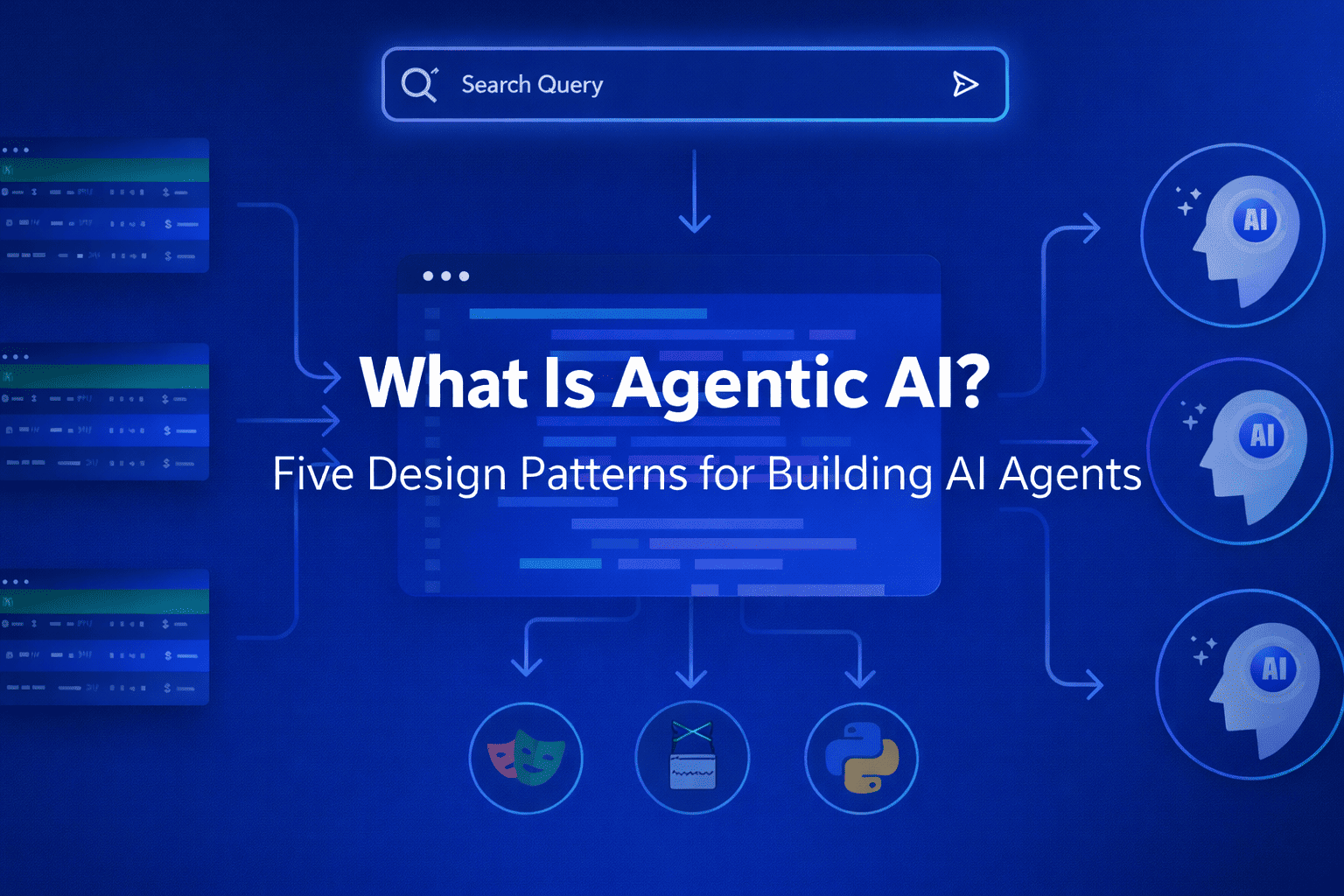
Introduction Artificial intelligence is undergoing a major shift. For the past few years, large language models (LLMs) have primarily acted as responsive tools — systems that generate answers when prompted. But a new paradigm is emerging: Agentic AI. Instead of simply responding, AI systems are now able to plan, decide, act, and iterate toward goals. These systems are called AI agents, and they represent one of the most important transitions in modern software design. In this article, we’ll explain what Agentic AI is, why it matters, and the five core design patterns that turn LLMs into capable AI agents. What Is Agentic AI? Agentic AI refers to AI systems that can independently pursue objectives by combining reasoning, memory, tools, and decision-making workflows. Unlike traditional chat-based AI, an agentic system can: Understand a goal instead of a single prompt Break tasks into steps Choose actions dynamically Use external tools and data Evaluate results and improve outcomes In simple terms: A chatbot answers questions. An AI agent completes tasks. Agentic AI transforms LLMs from passive generators into active problem-solvers. Why Agentic AI Matters The shift toward agent-based systems unlocks entirely new capabilities: Automated research assistants Software development agents Autonomous customer support workflows Data analysis pipelines Personal productivity copilots Organizations are moving from prompt engineering to system design, where success depends less on clever prompts and more on architecture. That architecture is built using repeatable design patterns. The Five Design Patterns for Agentic AI 1. The Planner–Executor Pattern Core idea: Separate thinking from doing. The agent first creates a plan, then executes actions step by step. How it works: Interpret user goal Generate task plan Execute each step Adjust based on results Why it matters Reduces hallucinations Improves reliability Enables long-running tasks Example use cases Research agents Coding assistants Multi-step automation workflows 2. Tool-Using Agent Pattern Core idea: LLMs become powerful when connected to tools. Instead of relying only on internal knowledge, agents call external systems such as: APIs databases search engines calculators internal company services Agent loop: Reason about next action Select tool Execute tool call Interpret output Key insight:LLMs provide reasoning; tools provide precision. This pattern turns AI from a text generator into a functional system operator. 3. Memory-Augmented Agent Pattern Core idea: Agents need memory to improve over time. Without memory, every interaction resets context. Agentic systems introduce structured memory layers: Short-term memory: conversation context Long-term memory: stored knowledge Working memory: active task state Benefits Personalization continuity across sessions improved decision-making Memory enables agents to behave less like chat sessions and more like collaborators. 4. Reflection and Self-Critique Pattern Core idea: Agents improve by evaluating their own outputs. After completing an action, the agent asks: Did this achieve the goal? What errors occurred? Should I retry differently? This creates an iterative improvement loop. Typical workflow Generate solution Critique result Revise approach Produce improved output Why it matters Higher accuracy fewer logical failures better reasoning chains Reflection transforms single-pass AI into adaptive intelligence. 5. Multi-Agent Collaboration Pattern Core idea: Multiple specialized agents outperform one general agent. Instead of a single system doing everything, responsibilities are divided: Planner agent Research agent Writer agent Reviewer agent Executor agent Agents communicate and coordinate toward shared goals. Advantages specialization improves quality scalable workflows modular architecture This mirrors how human teams operate — and often produces more reliable outcomes. How These Patterns Work Together Most real-world agentic systems combine several patterns: Capability Design Pattern Task decomposition Planner–Executor External actions Tool Use Learning over time Memory Quality improvement Reflection Scalability Multi-Agent Systems Agentic AI is not one technique — it’s a composition of coordinated behaviors. Agentic AI Architecture (Conceptual Stack) A typical AI agent system includes: LLM reasoning layer – understanding and planning Orchestration layer – workflow control Tool layer – APIs and integrations Memory layer – persistent knowledge Evaluation loop – reflection and monitoring Designing agents is therefore closer to systems engineering than prompt writing. Challenges of Agentic AI Despite its promise, Agentic AI introduces new complexities: Latency from multi-step reasoning cost management for long workflows safety and permission boundaries evaluation and debugging difficulties orchestration reliability Successful implementations focus on constrained autonomy rather than unlimited freedom. Risks: Trust Without Ground Truth The normalization of synthetic authority introduces several societal risks: Erosion of shared reality — communities may inhabit different perceived truths. Manipulation at scale — political and commercial persuasion becomes cheaper and more targeted. Institutional distrust — genuine sources struggle to distinguish themselves from synthetic competitors. Cognitive fatigue — constant skepticism exhausts audiences, leading to disengagement or blind acceptance. The danger is not that people believe everything, but that they stop believing anything reliably. Best Practices for Building AI Agents Start with narrow goals Add tools gradually Log agent decisions Implement guardrails early Separate planning from execution Measure outcomes, not responses The most effective agents are designed systems, not improvisations. The Future of Agentic AI Agentic AI is rapidly becoming the foundation of next-generation software. We are moving toward systems that: manage workflows autonomously collaborate with humans continuously adapt through feedback loops operate across digital environments Just as web apps defined the 2000s and mobile apps defined the 2010s, AI agents may define the next era of computing. Conclusion Agentic AI represents a fundamental evolution in artificial intelligence — shifting from tools that respond to prompts toward systems that pursue goals. The transformation happens through architecture, not magic. By applying five key design patterns: Planner–Executor Tool Use Memory Augmentation Reflection Multi-Agent Collaboration developers can turn LLMs into reliable, capable AI agents. The future of AI isn’t just smarter models — it’s smarter systems. FAQ What is Agentic AI in simple terms? Agentic AI refers to AI systems that can independently plan and execute tasks to achieve goals rather than only responding to prompts. How is Agentic AI different from chatbots? Chatbots generate responses. Agentic AI systems take actions, use tools, remember context, and iteratively work toward outcomes. Do AI agents replace humans? No. Most agentic systems are designed to augment human workflows by automating repetitive

Introduction Manufacturing has entered an era where precision, speed, and consistency define competitiveness. Traditional quality inspection methods — largely dependent on human operators or rule-based machine vision — struggle to keep pace with increasingly complex production environments. As product customization grows and tolerances become tighter, manufacturers require smarter inspection systems capable of detecting defects accurately and continuously. This is where Vision AI is reshaping industrial quality control. Vision AI combines computer vision with artificial intelligence and deep learning to enable machines to interpret visual data similarly to human perception — but with far greater speed, scalability, and consistency. Modern production lines are now leveraging Vision AI to detect defects earlier, reduce waste, and maintain superior product quality. This article explores how Vision AI improves defect detection, the technologies behind it, real-world applications, implementation strategies, and future trends shaping intelligent manufacturing. What Is Vision AI in Manufacturing? Vision AI refers to AI-powered systems that analyze images or video streams captured by cameras installed along production lines. Unlike traditional inspection systems that rely on predefined rules, Vision AI learns patterns directly from data. A typical Vision AI inspection system includes: Industrial cameras and sensors Edge or cloud computing infrastructure Deep learning models Image processing pipelines Real-time analytics dashboards These systems continuously analyze products during manufacturing to identify anomalies, defects, or deviations from quality standards. Limitations of Traditional Defect Detection Methods Before understanding Vision AI’s advantages, it’s important to recognize why conventional inspection methods fall short. 1. Human Inspection Challenges Manual inspection introduces variability due to: Fatigue and attention loss Subjective judgment Limited inspection speed Difficulty detecting micro-defects Even experienced inspectors may miss subtle inconsistencies after long shifts. 2. Rule-Based Machine Vision Constraints Earlier machine vision systems relied on fixed algorithms such as edge detection or threshold rules. These systems struggle when: Lighting conditions change Products vary slightly Surfaces are reflective or textured Defects are unpredictable As production complexity increases, rule-based systems become costly to maintain and recalibrate. How Vision AI Enhances Defect Detection 1. Learning-Based Defect Recognition Vision AI models learn directly from labeled images of both good and defective products. Instead of hard-coded rules, neural networks identify patterns automatically. Key advantages: Detects subtle defects invisible to rule-based systems Adapts to product variations Improves accuracy over time Examples of detectable defects include: Surface scratches Cracks and dents Assembly misalignment Missing components Color inconsistencies 2. Real-Time Inspection at Production Speed Vision AI systems operate continuously and analyze thousands of items per minute without slowing production. Benefits include: Instant rejection of faulty products Reduced downstream rework Early detection of process issues Real-time feedback allows manufacturers to correct problems before large batches are affected. 3. Higher Accuracy and Consistency Unlike human inspection, AI systems do not suffer from fatigue or inconsistency. Vision AI delivers: Stable inspection performance 24/7 Repeatable decision-making Reduced false positives and false negatives Consistency is particularly critical in industries with strict compliance requirements. 4. Detection of Previously Invisible Defects Deep learning models identify complex visual patterns that traditional systems cannot define mathematically. For example: Microfractures in metal surfaces Texture irregularities in fabrics Cosmetic defects in consumer electronics Subtle contamination in food production This capability dramatically increases quality assurance levels. 5. Continuous Improvement Through Data Vision AI systems improve as more inspection data is collected. Over time they can: Learn new defect types Adapt to product design changes Optimize detection thresholds automatically Production lines effectively become self-improving quality ecosystems. Core Technologies Behind Vision AI Inspection Deep Learning Models Convolutional Neural Networks (CNNs) analyze spatial features within images, enabling accurate visual classification and anomaly detection. Edge AI Computing Processing inspection data directly on factory-floor devices reduces latency and ensures real-time decision-making. Anomaly Detection Algorithms These models learn what “normal” products look like and flag deviations without needing examples of every possible defect. High-Speed Imaging Systems Modern cameras capture high-resolution images synchronized with conveyor movement for precise inspection. Key Industry Applications Automotive Manufacturing Paint defect detection Weld inspection Component assembly validation Electronics Production PCB inspection Solder joint analysis Missing micro-components detection Food and Beverage Packaging integrity checks Contamination detection Label verification Pharmaceutical Manufacturing Pill shape verification Packaging compliance inspection Serialization validation Textile and Materials Fabric flaw detection Pattern consistency monitoring Operational Benefits for Manufacturers 1. Reduced Production Waste Early detection prevents defective batches from progressing through costly stages. 2. Lower Operational Costs Automation reduces reliance on manual inspection teams while increasing throughput. 3. Improved Product Quality Higher detection accuracy leads to fewer customer complaints and returns. 4. Data-Driven Process Optimization Inspection data reveals recurring production issues and bottlenecks. 5. Regulatory Compliance Automated inspection logs provide traceability required in regulated industries. Risks: Trust Without Ground Truth The normalization of synthetic authority introduces several societal risks: Erosion of shared reality — communities may inhabit different perceived truths. Manipulation at scale — political and commercial persuasion becomes cheaper and more targeted. Institutional distrust — genuine sources struggle to distinguish themselves from synthetic competitors. Cognitive fatigue — constant skepticism exhausts audiences, leading to disengagement or blind acceptance. The danger is not that people believe everything, but that they stop believing anything reliably. Implementation Strategy for Vision AI Successful deployment requires more than installing cameras. Step 1: Define Inspection Goals Identify: Critical defect types Quality thresholds Production constraints Step 2: Data Collection Gather diverse image datasets including: Normal products Known defects Environmental variations Step 3: Model Training and Validation Train AI models using representative datasets and validate accuracy before deployment. Step 4: Integrate with Production Systems Connect Vision AI outputs to: PLC systems Robotic reject mechanisms Manufacturing execution systems (MES) Step 5: Continuous Monitoring Regularly retrain models as products or processes evolve. Challenges and Considerations While powerful, Vision AI implementation involves challenges: Initial data preparation effort Hardware and infrastructure investment Change management within teams Model maintenance and retraining However, long-term ROI typically outweighs these initial hurdles. Future Trends in Vision AI for Manufacturing Self-Learning Inspection Systems AI models that automatically adapt to new defects without manual labeling. Multimodal Inspection Combining visual data with thermal, 3D, or hyperspectral sensors. Edge

Introduction For most of modern history, images carried an implicit promise: they were evidence. A photograph suggested that something happened — that a moment existed in front of a lens at a specific time and place. Even when manipulated, images were rooted in reality. That assumption is now dissolving. Generative AI systems can produce hyper-realistic images, videos, voices, and documents without any real-world event behind them. These outputs do more than imitate reality — they compete with it, often appearing more polished, persuasive, and emotionally precise than authentic media. We are entering an era defined by synthetic authority: the phenomenon in which AI-generated content gains credibility, influence, and persuasive power independent of truth or origin. This shift is not merely technological. It is epistemological — changing how humans decide what to trust. What Is Synthetic Authority? Synthetic authority refers to the perceived legitimacy granted to content that is artificially generated rather than witnessed or recorded. Traditionally, authority emerged from identifiable sources: Institutions (news organizations, universities) Experts and professionals Physical evidence Eyewitness documentation Generative AI disrupts all four simultaneously. An AI image can now: Look professionally photographed Mimic journalistic aesthetics Align perfectly with audience expectations Spread faster than verification processes Authority is no longer derived from origin but from appearance. In other words: credibility is shifting from provenance to plausibility. Why AI-Generated Content Feels Trustworthy Synthetic authority works because generative AI exploits deeply human cognitive shortcuts. 1. Visual Bias Humans are evolutionarily wired to trust visual information. Seeing has long been equated with believing. High-fidelity AI images activate this instinct automatically. 2. Aesthetic Professionalism AI systems learn from millions of polished media examples. The result is content that looks statistically “ideal” — balanced lighting, compelling composition, emotionally optimized expressions. Ironically, synthetic images can look more real than reality. 3. Speed Over Verification Information ecosystems reward immediacy. AI can produce content instantly, while fact-checking requires time. The first image seen often becomes the mental anchor for belief. 4. Algorithmic Amplification Social platforms prioritize engagement. Emotionally resonant AI-generated content often outperforms authentic but mundane reality. Authority emerges through visibility. From Photography to Promptography Photography once required physical presence: a camera, a subject, a moment. Generative AI introduces what some call promptography — the creation of images through language rather than observation. The creator no longer captures reality; they describe it. This transformation changes the role of authorship: Traditional Media Generative Media Witnessing Specifying Recording Generating Editing reality Simulating reality Evidence-based Probability-based The shift raises a fundamental question:If an image looks authentic but has no historical origin, what kind of truth does it hold? The Collapse of Visual Verification For decades, society relied on visual documentation to verify events — journalism, legal evidence, historical archives. Generative AI challenges that foundation in three major ways: 1. Infinite Fabrication Anyone can create convincing imagery of events that never occurred. 2. Plausible Deniability Real images can now be dismissed as fake simply because convincing fakes exist — a phenomenon sometimes called the “liar’s dividend.” 3. Contextual Manipulation AI allows subtle alterations that reshape narratives without obvious signs of editing. The result is not just misinformation, but epistemic instability — uncertainty about whether truth can be visually confirmed at all. Synthetic Authority Beyond Images While images receive the most attention, synthetic authority extends across media forms: AI-generated voices delivering convincing speeches Synthetic experts writing authoritative articles AI avatars presenting news broadcasts Automatically generated research summaries Authority becomes performative rather than experiential. The marker of legitimacy shifts from who created it to how convincingly it performs expertise. Economic Incentives Driving Synthetic Authority The rise of synthetic authority is accelerated by powerful incentives: Efficiency Organizations can produce unlimited content without traditional production costs. Personalization AI content can be tailored precisely to audience psychology, increasing persuasion. Scalability Synthetic media operates at a scale no human workforce can match. Attention Economics In a crowded information environment, emotionally optimized synthetic content wins attention — and attention translates into revenue. Synthetic authority is therefore not an accident; it is economically reinforced. Risks: Trust Without Ground Truth The normalization of synthetic authority introduces several societal risks: Erosion of shared reality — communities may inhabit different perceived truths. Manipulation at scale — political and commercial persuasion becomes cheaper and more targeted. Institutional distrust — genuine sources struggle to distinguish themselves from synthetic competitors. Cognitive fatigue — constant skepticism exhausts audiences, leading to disengagement or blind acceptance. The danger is not that people believe everything, but that they stop believing anything reliably. Emerging Responses and Adaptations Society is beginning to respond in multiple ways: Provenance Technologies Digital watermarking and authenticity tracking aim to verify origins of media. AI Literacy Education increasingly focuses on understanding how generative systems work. Platform Responsibility Social platforms experiment with labeling synthetic content. Cultural Adaptation Audiences may gradually shift from trusting images to trusting networks, reputations, or verification systems. Historically, new media technologies eventually produce new norms of trust. Printing presses, photography, and the internet each forced similar adjustments — though none moved this quickly. A New Definition of Authority Synthetic authority does not necessarily signal the end of truth. Instead, it marks a transition. Authority may evolve from: Seeing → verifying Believing → evaluating Authenticity → transparency Future credibility may depend less on whether content is artificial and more on whether its creation process is disclosed and accountable. In this sense, the challenge is not stopping synthetic media — an impossible task — but redesigning trust for a world where reality can be generated. Conclusion: Living With Generated Reality Generative AI has not simply created new tools; it has changed the relationship between perception and belief. Images no longer require events. Voices no longer require speakers. Authority no longer requires origin. We are moving into a cultural landscape where persuasion can be manufactured as easily as text, and where reality competes with simulation for attention. The question facing society is no longer “Is this real?” but rather: “What makes something worthy of trust when reality itself can be synthesized?” The answer
Introduction Artificial intelligence is getting bigger every year. Modern Large Language Models (LLMs) like Llama, Qwen, and GPT-style models often contain tens of billions of parameters, usually requiring expensive GPUs with massive VRAM. For most developers, startups, and researchers, running these models locally feels impossible. But a new tool called oLLM is quietly changing that. Imagine running models as large as 80B parameters on a consumer GPU with just 8GB of VRAM. Sounds unrealistic, right? Yet that’s exactly what oLLM enables through clever engineering and smart memory management. In this article, we’ll explore what oLLM is, how it works, and why it may become the secret ingredient for running massive AI models on tiny hardware. What is oLLM? oLLM is a lightweight Python library designed for large-context LLM inference on resource-limited hardware. It builds on top of popular frameworks like Hugging Face Transformers and PyTorch, allowing developers to run large AI models locally without requiring enterprise-grade GPUs. The key idea behind oLLM is simple: Instead of forcing everything into GPU memory, intelligently move parts of the model to other storage layers. With this approach, models that normally need hundreds of gigabytes of VRAM can run on standard consumer hardware. For example, some setups allow models such as: Llama-3 style models GPT-OSS-20B Qwen-Next-80B to run on a machine with only 8GB GPU VRAM plus SSD storage. The Problem with Running Large AI Models Traditional AI inference assumes one thing: All model weights must fit inside GPU memory. This becomes a huge bottleneck because: Model Size Typical VRAM Needed 7B ~16 GB 13B ~24 GB 70B ~140 GB 80B ~190 GB Clearly, that’s far beyond what most consumer GPUs can handle. Even developers with powerful GPUs often rely on quantization, which compresses model weights to reduce memory usage. But quantization comes with trade-offs: Reduced accuracy Lower output quality Compatibility limitations oLLM takes a different approach. The Core Innovation: SSD Offloading The breakthrough behind oLLM is SSD-based memory offloading. Instead of loading the entire model into GPU memory, oLLM streams model components dynamically between: GPU VRAM System RAM High-speed SSD This means your GPU only holds the active parts of the model at any given time. The technique allows models to run that are 10x larger than the available GPU memory. Think of it like this: Traditional AI Model → GPU VRAM oLLM Model → SSD + RAM + GPU (streamed dynamically) By turning storage into an extension of GPU memory, oLLM bypasses the biggest limitation in local AI development. No Quantization Needed Another major advantage of oLLM is that it does not require quantization. Instead of compressing model weights, it keeps them in high precision formats such as FP16 or BF16, preserving the original model quality. That means: Better reasoning quality More accurate outputs More reliable responses For developers working on research, compliance analysis, or long-document reasoning, this can make a huge difference. Ultra-Long Context Windows Many AI tools struggle with large documents because of context limits. oLLM supports extremely long context windows — up to 100,000 tokens. This allows the model to process: Entire books Long research papers Legal contracts Massive log files Large datasets —all in a single prompt. This opens the door for advanced offline tasks like: document intelligence compliance auditing enterprise knowledge search AI-assisted research Performance Trade-offs Of course, running massive models on small hardware has trade-offs. Since parts of the model are constantly streamed from storage, speed can be slower than running everything in VRAM. For example: Large models may generate around 0.5 tokens per second on consumer GPUs. That might sound slow, but it’s perfectly acceptable for offline workloads, such as: document analysis research tasks batch processing AI pipelines In many cases, cost savings outweigh the speed limitations. Multimodal Capabilities oLLM is not limited to text models. It can also support multimodal AI systems, including models that process: text + audio text + images Examples include models like: Voxtral-Small-24B (audio + text) Gemma-3-12B (image + text) This allows developers to build advanced AI applications that combine multiple data types. Why oLLM Matters for the Future of AI AI is currently dominated by cloud infrastructure and billion-dollar GPU clusters. But tools like oLLM represent a shift toward democratized AI infrastructure. Instead of needing: expensive GPUs massive cloud budgets specialized infrastructure developers can experiment with powerful models on regular hardware. This unlocks new opportunities for: indie developers startups academic researchers privacy-focused applications Local AI and Privacy Running AI locally also has a major benefit: privacy. When models run on your own machine: no data leaves your system no prompts are logged sensitive documents remain private This is especially valuable for industries like: healthcare finance legal services government Use Cases for oLLM Some real-world applications include: Research assistants Analyze entire research papers or datasets locally. Legal document analysis Process massive contracts and legal records with long context windows. Offline AI pipelines Run batch inference jobs without relying on cloud services. Privacy-focused AI tools Keep sensitive data completely local. Developer experimentation Test large models without investing in expensive hardware. Limitations to Know While impressive, oLLM isn’t perfect. Current limitations include: Slower inference compared to full-VRAM setups Heavy SSD usage Limited compatibility with some hardware (like certain Apple Silicon setups) However, these are common trade-offs in early infrastructure tools. As storage speeds and optimization techniques improve, performance will likely get better. The Bigger Trend: AI on Everyday Devices oLLM is part of a larger shift toward local AI computing. We are moving from: Cloud-only AI → Hybrid AI → Fully local AI Future devices may run powerful AI models directly on: laptops smartphones edge devices IoT hardware This transformation will make AI more accessible, private, and decentralized. Final Thoughts oLLM proves something important: You don’t always need a $10,000 GPU server to run powerful AI. Through clever memory management, SSD streaming, and high-precision inference, oLLM enables developers to run massive AI models on surprisingly small hardware. For AI enthusiasts, researchers, and builders, this is an exciting step toward a future
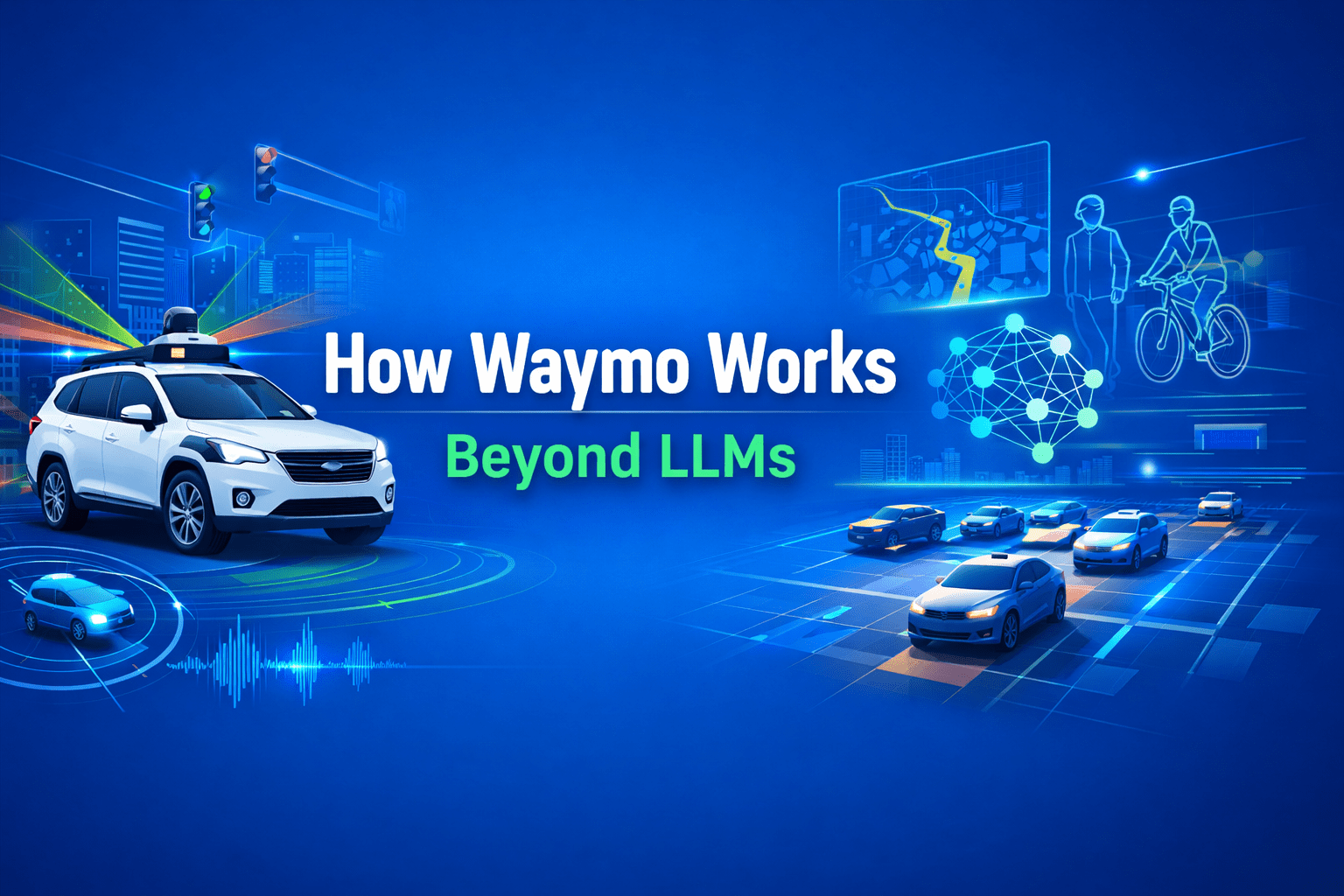
Introduction When people hear “AI-powered driving,” many instinctively think of Large Language Models (LLMs). After all, LLMs can write essays, generate code, and argue philosophy at 2 a.m. But putting a car safely through a busy intersection is a very different problem. Waymo, Google’s autonomous driving company, operates far beyond the scope of LLMs. Its vehicles rely on a deeply integrated robotics and AI stack, combining sensors, real-time perception, probabilistic reasoning, and control systems that must work flawlessly in the physical world, where mistakes are measured in metal, not tokens. In short: Waymo doesn’t talk its way through traffic. It computes its way through it. The Big Picture: The Waymo Autonomous Driving Stack Waymo’s system can be understood as a layered pipeline: Sensing the world Perceiving and understanding the environment Predicting what will happen next Planning safe and legal actions Controlling the vehicle in real time Each layer is specialized, deterministic where needed, probabilistic where required, and engineered for safety, not conversation. 1. Sensors: Seeing More Than Humans Can Waymo vehicles are packed with redundant, high-resolution sensors. This is the foundation of everything. Key Sensor Types LiDAR: Creates a precise 3D map of the environment using laser pulses. Essential for depth and shape understanding. Cameras: Capture color, texture, traffic lights, signs, and human gestures. Radar: Robust against rain, fog, and dust; excellent for detecting object velocity. Audio & IMU sensors: Support motion tracking and system awareness. Unlike humans, Waymo vehicles see 360 degrees, day and night, without blinking or getting distracted by billboards. 2. Perception: Turning Raw Data Into Reality Sensors alone are just noisy streams of data. Perception is where AI earns its keep. What Perception Does Detects objects: cars, pedestrians, cyclists, animals, cones Classifies them: vehicle type, posture, motion intent Tracks them over time in 3D space Understands road geometry: lanes, curbs, intersections This layer relies heavily on computer vision, sensor fusion, and deep neural networks, trained on millions of real-world and simulated scenarios. Importantly, this is not text-based reasoning. It is spatial, geometric, and continuous, things LLMs are fundamentally bad at. 3. Prediction: Anticipating the Future (Politely) Driving isn’t about reacting; it’s about predicting. Waymo’s prediction systems estimate: Where nearby agents are likely to move Multiple possible futures, each with probabilities Human behaviors like hesitation, aggression, or compliance For example, a pedestrian near a crosswalk isn’t just a “person.” They’re a set of possible trajectories with likelihoods attached. This probabilistic modeling is critical, and again, very different from next-word prediction in LLMs. 4. Planning: Making Safe, Legal, and Social Decisions Once the system understands the present and predicts the future, it must decide what to do. Planning Constraints Traffic laws Safety margins Passenger comfort Road rules and local norms The planner evaluates thousands of possible maneuvers, lane changes, stops, turns, and selects the safest viable path. This process involves optimization algorithms, rule-based logic, and learned models, not free-form language generation. There is no room for “creative interpretation” when a red light is involved. 5. Control: Executing With Precision Finally, the control system translates plans into: Steering angles Acceleration and braking Real-time corrections These controls operate at high frequency (milliseconds), reacting instantly to changes. This is classical robotics and control theory territory, domains where determinism beats eloquence every time. Where LLMs Fit (and Where They Don’t) LLMs are powerful, but Waymo’s core driving system does not depend on them. LLMs May Help With: Human–machine interaction Customer support Natural language explanations Internal tooling and documentation LLMs Are Not Used For: Real-time driving decisions Safety-critical control Sensor fusion or perception Vehicle motion planning Why? Because LLMs are: Non-deterministic Hard to formally verify Prone to confident errors (a.k.a. hallucinations) A car that hallucinates is not a feature. The Bigger Picture: Democratizing Medical AI Healthcare inequality is not just about access to doctors, it is about access to knowledge. Open medical AI models: Lower barriers for low-resource regions Enable local innovation Reduce dependence on external vendors If used responsibly, MedGemma could help ensure that medical AI benefits are not limited to the few who can afford them. Simulation: Where Waymo Really Scales One of Waymo’s biggest advantages is simulation. Billions of miles driven virtually Rare edge cases replayed thousands of times Synthetic scenarios that would be unsafe to test in reality Simulation allows Waymo to validate improvements before deployment and measure safety statistically—something no human-only driving system can do. Safety and Redundancy: The Unsexy Superpower Waymo’s system is designed with: Hardware redundancy Software fail-safes Conservative decision policies Continuous monitoring If something is uncertain, the car slows down or stops. No bravado. No ego. Just math. Conclusion: Beyond Language, Into Reality Waymo works because it treats autonomous driving as a robotics and systems engineering problem, not a conversational one. While LLMs dominate headlines, Waymo quietly solves one of the hardest real-world AI challenges: safely navigating unpredictable human environments at scale. In other words, LLMs may explain traffic laws beautifully, but Waymo actually follows them. And on the road, that matters more than sounding smart. Visit Our Data Annotation Service Visit Now Lorem ipsum dolor sit amet, consectetur adipiscing elit. Ut elit tellus, luctus nec ullamcorper mattis, pulvinar dapibus leo.