Introduction
Within hours of OpenAI’s official announcement of GPT-6.2 Astra and Sol, debates erupted across the AI community. While OpenAI described them as its most capable and efficient models for complex projects and daily tasks, several well-known developers and testers warned users to think twice before using chat gpt 6.2 astra for certain workflows. This raised an immediate question: is it actually a bad model, or are we witnessing a major strategic shift in how AI models are built?
In this article, we break down the core details of both models, analyze the intelligence-vs-price curve, examine benchmark scores and tester reviews, and show you exactly when each tool shines.
Overview of the chat gpt 6.2 astra and chat gpt sol 6.2 Release
OpenAI launched chat gpt 6.2 astra as its flagship model for heavy projects and extended professional workflows (positioned directly against Anthropic’s Claude Opus 5.5), alongside chat gpt sol 6.2 as an efficient, versatile option for everyday work (competing with Claude Fable 5.2). The core idea behind both releases is delivering strong results on tough tasks using far fewer output tokens, helping teams get more done within their usage limits and budgets.
Chat gpt 6.2 astra is trained to produce cleaner business deliverables that follow industry standards in fields like law, sales, finance, and accounting, with less filler, tighter summaries, and stronger performance in 3D design and computer use. Meanwhile, chat gpt sol 6.2 is built as a fast daily driver for both technical and non-technical tasks, multi-step agentic workflows, and complex personal tasks tested under the LifeVal benchmark. Many OpenAI employees already use Sol as their default everyday model.
Numbers and Benchmarks: How Do They Perform on Cost and Efficiency?
Independent tests and launch data show that OpenAI’s bet on efficiency centers on lowering per-task costs and token counts while staying near the top of the leaderboard:
- Artificial Analysis Intelligence Index & ARC-AGI 3: Chat gpt 6.2 astra scores 62 points on the combined intelligence index, jumping five points ahead of the previous Astra generation and beating Gemini 4 Carbon (60) and Claude Opus 5.5 (59), though still trailing Claude Fable 5.2 (65). However, running the benchmark suite costs roughly $4 per task on Astra compared to $26 on Fable 5.2, simply because Astra writes far fewer tokens. One tester also reported Astra hitting 100% on ARC-AGI 3 when paired with OpenAI’s custom adapter.
- Coding Benchmarks: On Cognition’s FrontierCode 2.0, chat gpt sol 6.2 lands within 0.5 points of Astra at roughly one-fifth of the cost. Inside Codex on Artificial Analysis, Astra scores 53 points (unchanged from the previous Astra generation and behind Fable 5.2’s 58 points in Claude Code), while Sol drops three points.
- Agents’ Last Exam, Science, and Law: Astra sets a new record on Agents’ Last Exam v1.1, beating GPT-6 Astra by 5.2 points at less than a third of the cost, and outperforming Fable 5.2 by 5.5 points at just 5% of its cost. It also leads on Terminal-Bench-Science 0.1, Vals Science Index, and AI Robotics v0.1 (ahead of Fable 5.2 and Gemini 4 Hydrogen). On the legal benchmark Harvey LAB-AA v1.1, Astra achieves more than double the pass rate of Fable 5.2 at roughly one-sixth of the cost. GDPval v2 (Real-World Knowledge Work): On OpenAI’s internal benchmark measuring extended workflows in finance, consulting, and design, chat gpt 6.2 astra leads by 6.2 percentage points over GPT-6 Astra while using 22% fewer output tokens, whereas chat gpt sol 6.2 improves by 5.3 points over GPT-6.1 Sol.
Why Did Some Testers Criticize chat gpt 6.2 astra?
Despite strong benchmark scores, early reactions from several prominent testers were sharply critical, not because chat gpt 6.2 astra lacks intelligence, but because it feels harder to steer in real-world use:
- Harsh Reviews from Developers and Investors: Investor Matt Schumer stated he would skip writing his usual long review, calling the models practically unusable after Claude models had to redo work Astra produced as a helper. Developer Theo Brown went further, calling it OpenAI’s worst release in his testing after spending seven days trying to get it to optimize a Rust-based TypeScript compiler without a single improvement (one generated version even ran 56% slower). He also noted it stopped mid-task to ask questions he couldn’t answer.
- Extreme Brevity and Stopping Early: Dan Shipper’s team at Every reported that writing quality felt worse than the prior Astra and that it stopped too early on larger coding builds. Analysts trace this directly to its heavy token-economy training: optimizing to use fewer words makes explanations overly compressed and pushes the model to finish before a task is truly complete. This aligns with OpenAI’s safety report, which noted both models were more likely to omit mentioning blockers (like a missing file or unavailable tool) during simulated work tasks.
- Repetitive Creative Patterns: Theo and another tester independently asked Astra to design a new level for two different games (Majora’s Mask and Outer Wilds). Both received water-themed levels centered around music and bells, and both were named “bellweather”, suggesting the model falls back on safe, repetitive templates when asked to be creative.
The Flip Side: 3D Design, Robotics, and Speed
On the other hand, both critics and fans agree that chat gpt 6.2 astra excels at spatial reasoning, 3D modeling, and computer use:
- Standout Performance in 3D and CAD: Astra ranks first on AA-3D with a 1,318 Elo score, ahead of Fable 5.2 (1,271) and chat gpt sol 6.2 (1,259). Live demos showed Astra generating a playable racing game from a single prompt, modeling an RC buggy part by part from reference photos, simulating a 3D-printable mechanical clock in CAD and Python, and building a landing page with a photorealistic ray-traced glass of water from a one-word prompt in under a minute. Wharton professor Ethan Mollick called the model “uneven and weird,” yet successfully used it to build a working space elevator ride in Blender and Unity.
- What “AI Self-Improvement” Really Means: OpenAI announced that Astra is the first public model to reach its high threshold for AI self-improvement. This does not mean the model rewrites its own code inside ChatGPT. Instead, OpenAI defines it as accelerating internal research roughly as much as adding one skilled research engineer to the team, helping debug failed experiments, write low-level chip code, and cut training times for smaller models by 43% (compared to a top human result of 72%). On a modified recursive self-improvement index, Astra scored 29% (behind Gemini 4 Argon, where 50% equals human-level research), and outside evaluator METR concluded it cannot fully automate AI research on its own. To manage safety risks, OpenAI built a centralized control room with a kill switch that halts misaligned runs within 35 seconds.
Furthermore, under OpenAI’s Preparedness Framework, both models reach the “High” threshold for biological and chemical capabilities alongside the “Critical” threshold for cybersecurity. To manage these risks, OpenAI strengthened research containment, deployed an expanded monitoring system capable of automatically pausing unauthorized actions or conversations, and introduced Control Room, a centralized oversight system that tracks research workloads and can halt model generation when intervention is needed. For authorized security defenders, OpenAI also highlighted specialized access tracks through OpenAI Daybreak (including Daybreak Blue, Daybreak Red, and GPT-6 Cyber), with plans to bring GPT-6.2 models into Daybreak as well.
Comparison and Analysis: gpt 6.2 sol vs 6.2 astra
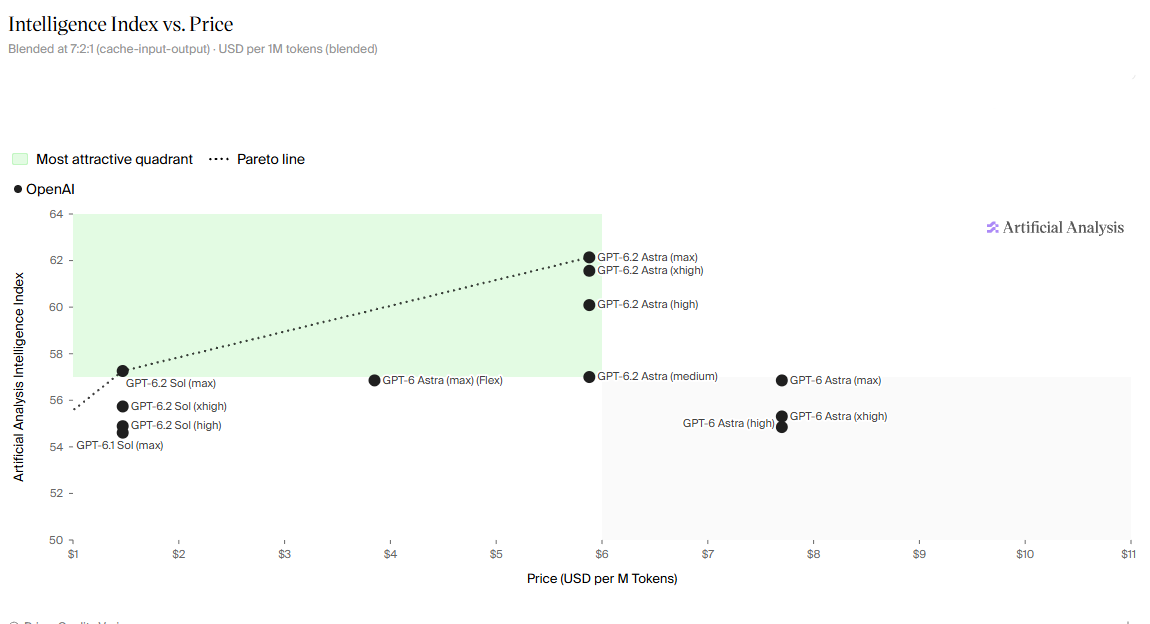
Source: Intelligence Index vs. Price chart from Artificial Analysis
The chart above from Artificial Analysis illustrates the relationship between the Intelligence Index and Price per 1M Tokens, offering a clear visual breakdown of gpt 6.2 sol vs 6.2 astra:
- Both chat gpt 6.2 astra (at High, xHigh, and Max reasoning levels) and chat gpt sol 6.2 (at Max) sit inside the upper-left green zone along the Pareto frontier line, meaning they deliver the best intelligence-to-cost ratio compared to older releases.
- On the chart, the previous GPT-6 Astra (max) sits in the gray zone at roughly $7.70 per million blended tokens with an intelligence score near 57. In contrast, chat gpt 6.2 astra (max) jumps to 62 points while dropping its blended price below $6 (and under $4 using Flex mode).
- Chat gpt sol 6.2 (max) sits far to the left at roughly $1.45 per million blended tokens while scoring over 57 points, matching the intelligence of the older flagship GPT-6 Astra (max) at less than one-fifth of the cost, and clearly outperforming GPT-6.1 Sol (max).
Feature | GPT-6.2 Astra | GPT-6.2 Sol |
Primary Use Case | Complex projects, 3D/CAD modeling, and scientific research | Fast daily tasks, general chat, and multi-step agents |
Intelligence Score (Artificial Analysis) | 62 points (Max mode) | ~57.3 points (Max mode) |
API Pricing (per 1M tokens) | $8 input / $0.40 cached / $40 output | $2 input / $0.10 cached / $10 output |
Cost Savings vs. Prior Gen | 20% cheaper input/output & 60% cheaper cached input | Keeps the same low pricing as GPT-6.1 Sol |
Ultrafast Availability | Available via API and for Pro 500 subscribers | Available via API, Pro 500, and Pro 200 for the first time |
Pricing and Availability: How Do They Compare to Previous Models?
Starting today, chat gpt 6.2 astra and chat gpt sol 6.2 are available to all Plus, Pro, Enterprise, and Edu users across ChatGPT Work and Codex, as well as through the OpenAI API under gpt-6.2-astra and gpt-6.2-sol. For the first time, OpenAI is bringing Ultrafast speeds to Pro 200 subscribers starting with chat gpt sol 6.2, alongside Pro 500 subscribers and API users for both models.
On the pricing front, chat gpt 6.2 astra cuts API token rates by 20% for inputs and outputs and by 60% for cached inputs compared to GPT-6 Astra, bringing standard pricing to $8 per million input tokens, $0.40 for cached inputs, and $40 for output tokens (matching Anthropic’s pricing for Claude Fable 5.2). Meanwhile, chat gpt sol 6.2 retains the budget-friendly rates of GPT-6.1 Sol at $2 for inputs, $0.10 for cached inputs, and $10 for outputs per million tokens. To maximize prompt caching, lower latency, and preserve reasoning across turns, OpenAI recommends keeping prompt prefixes unchanged and appending new instructions to the conversation.
If you are tracking how recent AI releases compare in speed and cost, check out our detailed reviews of earlier and competing models:
Frequently Asked Questions (FAQ)
- What is the main difference between chat gpt 6.2 astra and chat gpt sol 6.2?
Chat gpt 6.2 astra is OpenAI’s flagship model built for heavy analytical projects, 3D design, and scientific research, while chat gpt sol 6.2 is a faster, everyday model priced at a quarter of Astra’s cost for routine tasks and agentic workflows.
- Is GPT-6.2 Astra worth switching to from Claude models?
If your workflow relies heavily on long-form creative writing or continuous interactive coding, many early testers still prefer Claude Opus 5.5 or Fable 5.2 for smoother steering. However, if you run high-volume, cost-sensitive workloads, or work in 3D modeling, CAD, and data science, Astra offers substantial savings with top-tier accuracy.
- Why do testers say Astra is hard to use despite high benchmark scores?
Because Astra is heavily trained to use fewer output tokens to keep costs down, its writing can feel overly brief, and it may stop early on large builds or ask clarifying questions mid-task. Adding clear instructions to complete the entire task before stopping helps minimize this behavior.
- Does Astra hitting a “high threshold” for AI self-improvement mean it rewrites itself?
No. OpenAI uses this classification to indicate that Astra speeds up its own researchers’ work, such as debugging experiments and writing low-level chip code, by up to 43%, roughly equivalent to adding another skilled research engineer to the team, rather than autonomous self-editing.
Final Thoughts: Which One Should You Choose?
Ultimately, the gpt 6.2 sol vs 6.2 astra comparison proves that the AI race has shifted from pure theoretical benchmark scores to unit economics and execution speed. If you want a fast, affordable daily assistant that handles everyday work reliably, chat gpt sol 6.2 is the most balanced pick. If your projects demand 3D spatial reasoning, CAD simulations, or large-scale analytical work where token savings compound into real budget reductions, chat gpt 6.2 astra delivers serious power at a hard-to-beat price—just be sure to verify that it completes every step on longer tasks.