Introduction
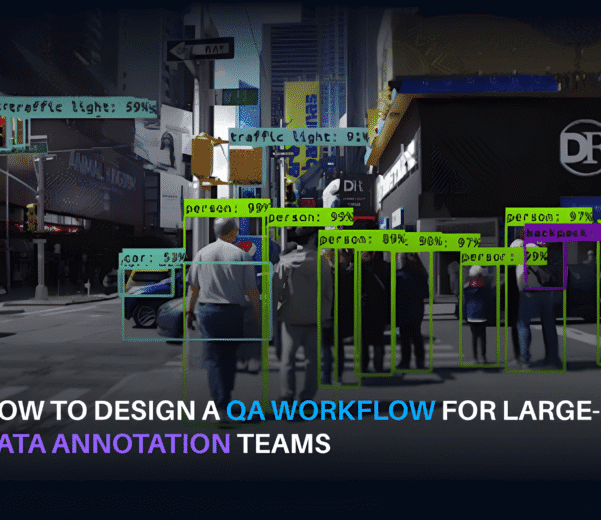
The autonomous vehicle (AV) and advanced robotics industry relies on a machine’s ability to understand its surroundings with perfect accuracy and in milliseconds. For these systems to make safe decisions on the road, they need millions of hours of highly accurate, labeled data. This is why AI data annotation services play a critical role in deciding the success or failure of computer vision models.
If you manage an autonomous driving (ADAS) development team in the EU or MENA markets, facing issues like poor model accuracy or low quality annotations is one of the biggest challenges delaying your project launch.
This comprehensive guide is designed to provide you with a LiDAR Annotation Quality Checklist. Based on the best technical practices and global legal standards, it will help you reduce annotation errors and ensure high AI data quality for your vehicles.
What is Sensor Fusion Annotation?
In complex driving environments, a vehicle cannot rely on just one sensor. Modern systems use what is known as Sensor Fusion, the smart combination of data streams coming from cameras, radar devices, and LiDAR systems.
The importance of sensor fusion annotation comes from its ability to combine the features of each sensor to cover the weaknesses of the others:
- LiDAR: Gives the system 3D point clouds that provide highly accurate object dimensions and distances, but it struggles in bad weather like thick fog and does not provide color information.
- Digital Camera: Excellent for image video annotation, identifying shapes, reading traffic signs, and recognizing colors, but it lacks native depth and distance measurement and is affected by darkness.
- Radar: Measures direct speeds and penetrates through dust and rain, but its spatial resolution is low and it cannot classify objects accurately.
When this data is fused together and labeled at the same time, the AI model learns how to make the right decisions even in difficult edge cases, such as detecting pedestrians stepping out suddenly from behind a parked car on a rainy night.
Read Also: Real-Time LiDAR Annotation for Live Applications: Shaping the Future of Smart Systems
How do you measure LiDAR annotation quality?
To measure quality accurately and move your project from the prototype stage to production that complies with safety requirements, you must verify the data through strict spatial and temporal checks. Here are the main sections that your checklist should include:
1 Spatial & Temporal Alignment Checklist
The biggest challenge in automotive data annotation is that sensors operate at different frequencies and times. The LiDAR spins at a certain speed, while the camera captures images at a different frame rate.
- Box Drift and Stability Check: Ensure there is no shifting or drift between the 2D bounding box on the image and the 3D cuboid on the point cloud. Any error, even by a few centimeters, will turn into noisy training signals that confuse the driving system.
- Timestamp Synchronization: Verify that the frame taken by the LiDAR matches the exact millisecond of the synchronized camera frame. This is especially important when tracking high-speed objects on highways to prevent ghost objects or incorrect location estimates.
2. Cross Modal Consistency Checklist
When a road object appears in front of the car, all sensors must see it as a single entity with the exact same attributes.
- Class Uniformity: A common error that confuses smart models is labeling a vehicle as a (truck) in the camera image but as a (car) in the LiDAR point cloud. The class must match perfectly.
- ID Stability & Object Tracking: When tracking a moving object across hundreds of sequential frames, the object must keep the same identification number (e.g., ID: 005). If the ID jumps or changes between frames, it destroys the car’s ability to predict the future movement of surrounding objects.
- Heading & Orientation: The front-facing arrow of the 3D cuboid must point in the correct direction confirmed by radar and camera data to ensure safe path planning and turning calculations.
3. Edge Cases & Environmental Conditions Checklist
Training only on clean streets and in sunny weather will not make your vehicle safe. Most autonomous vehicles (AV) failures happen due to rare and unexpected scenarios known as edge cases.
To solve this, teams use an active learning strategy, where the model filters massive amounts of unlabeled data, flags frames with high uncertainty, and sends them immediately to human reviewers.
- Occlusion Flags: Mark partially hidden objects clearly (such as a pedestrian whose half body is hidden behind a delivery truck, or an animal crossing behind concrete barriers).
- Contextual Classification: Annotators must have enough domain knowledge to distinguish between similar objects based on context; for example, separating a cyclist riding a bike from a pedestrian walking a bike, because their movement behaviors are completely different.
- Static Infrastructure Labeling: Label temporary construction cones, signs, and double-parked cars accurately to separate them from the permanent environment.
4. Safety and Data Governance:
When working for companies in the EU or the MENA region, quality is not just technical, it also includes strict compliance with data protection and AI laws.
- EU AI Act Article 10 Compliance: Ensure datasets represent all real-world driving conditions (night driving, heavy rain, fog, glare) to prevent model bias or failure in non-standard conditions. Maintain digital audit trails showing who labeled each frame and how disagreements were resolved.
- GDPR Compliant Data Annotation (Privacy Control): Before any data reaches the annotation team, ensure automated software blurs faces and license plates in the camera streams while keeping the exact spatial coordinates in the LiDAR point cloud.
Recommended: How to Prepare Your Autonomous Vehicle Training Data to Comply with Article 10 of the EU AI Act?
4. Human-in-the-Loop (HITL) Validation:
While pre-labeling tools speed up the workflow, relying entirely on automation is a major risk when human safety is on the line. Successful data pipelines use human in the loop AI services to let experts review complex scenes and fix subtle errors.
- Inter-Annotator Agreement: Measure how much different human annotators agree on the same datasets. If agreement is low for a specific category, update the annotation guidelines to avoid confusing the model.
Recommended: How to Prepare Your Autonomous Vehicle Training Data to Comply with Article 10 of the EU AI Act?
The Quality Checklist Summary
Main Section | Core Checkpoint | Goal of the Check |
Spatial Alignment | Perfect pixel-level match between the 2D Bounding Box and the 3D Cuboid. | Prevent noise in the training signals of the perception model. |
Temporal Alignment | Exact timestamp matching between LiDAR, camera, and radar. | Track fast-moving objects accurately without any spatial drift. |
Label Consistency | Standardized class and Instance ID across all sensors. | Track object movement smoothly and prevent model confusion. |
Edge Cases | Use proper flags for partial Occlusion and adverse weather conditions. | Enable the vehicle to handle rare and dangerous driving scenarios. |
Legal Compliance | Blur faces and license plates, and apply EU AI Act Article 10 standards. | Ensure data legality and strict privacy protection (GDPR). |
Human Audit | Route ambiguous cases to Human-in-the-Loop experts. | Establish error-free Ground Truth data. |
Start Your Next Project with Confidence and Safety
Building an outstanding perception system for autonomous vehicles requires moving away from random data collection and shifting toward precise, secure data engineering. Applying this checklist guarantees a major reduction in your re-annotation costs and protects your project from critical performance gaps in the real world.
Are you looking for a trusted B2B partner specializing in LiDAR Annotation for the EU and MENA markets?
Contact our experts today to Request a Dataset Assessment, Our trained teams guarantee the highest levels of accuracy and full compliance with global safety and privacy standards.