Introduction
Artificial Intelligence has evolved rapidly over the past few years, transforming industries, workflows, and digital experiences. Among the most talked-about technologies today are AI Agents and Generative AI. While many people use these terms interchangeably, they represent two distinct categories of artificial intelligence with different purposes, capabilities, and business impacts.
Generative AI became globally recognized through tools like OpenAI‘s ChatGPT, image generators, and AI-powered content creation platforms. Meanwhile, AI agents are emerging as autonomous systems capable of reasoning, planning, decision-making, and executing tasks with minimal human intervention.
Understanding the difference between AI agents and generative AI is essential for businesses, developers, and organizations looking to implement modern AI solutions effectively.
In this comprehensive guide, we will explore:
- What generative AI is
- What AI agents are
- Core differences between the two
- Real-world applications
- Advantages and limitations
- How they work together
- Future trends shaping AI automation
What Is Generative AI?
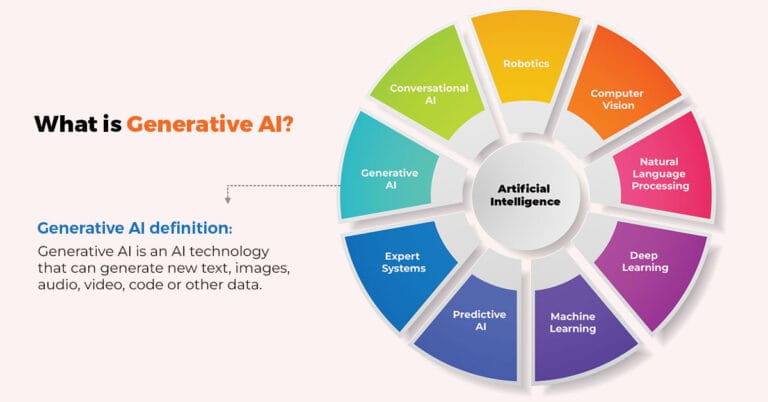
Generative AI refers to artificial intelligence systems designed to create new content based on patterns learned from massive datasets. These systems generate outputs such as:
- Text
- Images
- Audio
- Videos
- Code
- Designs
Popular examples include:
- OpenAI ChatGPT
- Google Gemini
- Anthropic Claude
- Midjourney
- Adobe Firefly
Generative AI models rely heavily on deep learning architectures such as:
- Large Language Models (LLMs)
- Diffusion Models
- Transformer Networks
- Generative Adversarial Networks (GANs)
These systems predict the next word, pixel, sound, or pattern based on training data.
How Generative AI Works
Generative AI models are trained using enormous datasets containing billions of examples. During training, the AI learns:
- Language structures
- Semantic relationships
- Visual patterns
- Coding syntax
- User behavior patterns
For example, a text-based generative AI model predicts the most likely next word in a sentence.
If a user asks:
“Write a marketing email for a SaaS product”
The AI generates content based on statistical patterns learned during training.
Main Features of Generative AI
1. Content Creation
Generative AI excels at producing:
- Blog articles
- Social media posts
- Product descriptions
- Images
- Marketing campaigns
- Source code
2. Human-Like Responses
Modern LLMs simulate conversational interactions with impressive fluency.
3. Creativity Enhancement
Generative AI supports brainstorming, ideation, and design generation.
4. Fast Output Generation
Tasks that once took hours can now be completed in seconds.
5. Multimodal Capabilities
Many advanced models process:
- Text
- Images
- Audio
- Video simultaneously
What Are AI Agents?
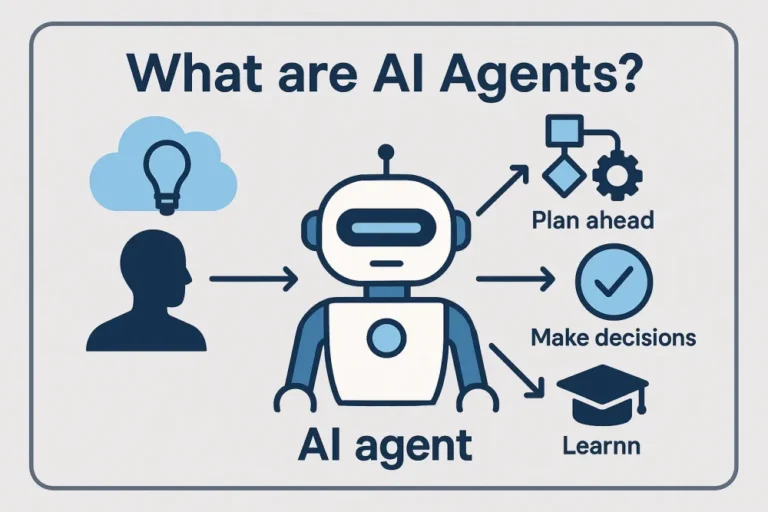
AI agents are autonomous systems that can:
- Observe environments
- Analyze situations
- Make decisions
- Plan actions
- Execute tasks
- Learn from feedback
Unlike generative AI, which primarily creates content, AI agents are designed to act independently toward achieving goals.
AI agents can integrate:
- LLMs
- APIs
- Databases
- Software tools
- Automation workflows
- Memory systems
Their primary objective is task execution rather than content generation alone.
How AI Agents Work
AI agents typically operate using a loop:
- Observe
- Reason
- Plan
- Act
- Evaluate
- Repeat
For example, an AI customer support agent may:
- Read incoming tickets
- Categorize requests
- Search company databases
- Draft responses
- Escalate complex issues
- Update CRM systems
All with minimal human intervention.
Core Components of AI Agents
1. Reasoning Engine
Determines what actions to take.
2. Memory
Stores previous interactions and context.
3. Planning System
Breaks goals into smaller executable steps.
4. Tool Integration
Uses external software, APIs, and applications.
5. Autonomous Decision-Making
Acts independently based on objectives.
AI Agents vs Generative AI: Key Differences
Comparison of major capabilities between AI agents and generative AI systems.
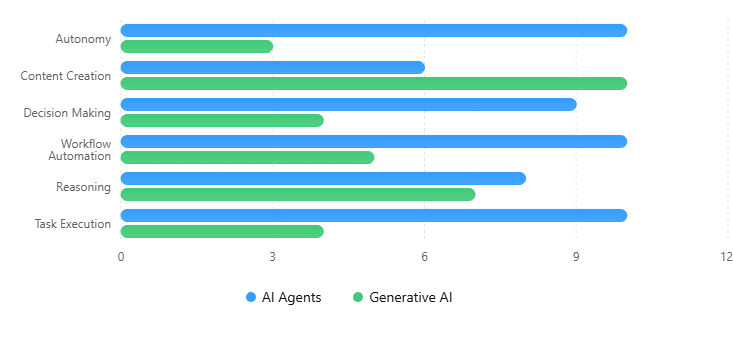
| Feature | Generative AI | AI Agents |
|---|---|---|
| Primary Purpose | Content generation | Autonomous task execution |
| Human Dependency | High | Lower |
| Memory | Limited | Persistent memory possible |
| Decision-Making | Minimal | Advanced |
| Tool Usage | Usually standalone | Integrates tools & APIs |
| Workflow Automation | Limited | Extensive |
| Autonomy | Reactive | Proactive |
| Goal-Oriented | Sometimes | Strongly goal-driven |
Real-World Examples of Generative AI
Content Marketing
Businesses use generative AI for:
- SEO blogs
- Email campaigns
- Ad copy
- Product descriptions
Software Development
AI coding assistants generate:
- Code snippets
- Documentation
- Bug fixes
- Test cases
Examples include:
- GitHub Copilot
- OpenAI Codex
Design and Media
AI-generated visuals, videos, and audio are transforming creative industries.
Customer Support
Chatbots powered by generative AI answer customer questions in natural language.
Real-World Examples of AI Agents
Autonomous Customer Support Agents
AI agents can:
- Resolve tickets
- Access databases
- Trigger workflows
- Schedule follow-ups
AI Research Agents
Agents gather information from multiple sources and summarize findings automatically.
Sales Automation Agents
AI agents can:
- Qualify leads
- Send outreach emails
- Update CRMs
- Schedule meetings
Software Engineering Agents
Advanced coding agents can:
- Write code
- Run tests
- Debug applications
- Deploy software
Benefits of Generative AI
Increased Productivity
Teams generate content significantly faster.
Lower Operational Costs
Automation reduces manual creative workloads.
Enhanced Creativity
AI assists with ideation and innovation.
Scalability
Businesses can produce content at scale.
Limitations of Generative AI
Hallucinations
Generative AI may create inaccurate or fabricated information.
Lack of True Understanding
Models predict patterns rather than truly understanding concepts.
Limited Autonomy
Most generative AI systems require prompts and human supervision.
Context Limitations
Long-term memory is often weak or unavailable.
Benefits of AI Agents
End-to-End Automation
AI agents execute complete workflows autonomously.
Continuous Learning
Agents can improve through feedback and interaction.
Operational Efficiency
Businesses reduce repetitive manual tasks.
Intelligent Decision-Making
Agents analyze data and optimize outcomes.
Limitations of AI Agents
Complexity
Building robust AI agents is technically challenging.
Security Risks
Autonomous systems require strong governance and safeguards.
Infrastructure Requirements
AI agents often require:
- APIs
- Databases
- Orchestration systems
- Monitoring frameworks
Reliability Concerns
Poorly designed agents may make incorrect decisions.
How AI Agents and Generative AI Work Together
In reality, many advanced AI systems combine both technologies.
Generative AI often acts as the “brain” for AI agents by providing:
- Natural language understanding
- Content generation
- Reasoning support
Meanwhile, AI agents provide:
- Autonomy
- Planning
- Action execution
- Workflow management
For example:
- An AI agent receives a customer support request
- Uses generative AI to draft a response
- Accesses databases
- Updates support tickets
- Sends emails automatically
This combination is driving the next wave of intelligent automation.
Industries Adopting AI Agents and Generative AI
Healthcare
Hospitals use AI for:
- Medical documentation
- Diagnostic assistance
- Patient support automation
Finance
Banks deploy AI for:
- Fraud detection
- Financial analysis
- Customer service automation
E-Commerce
Retailers use AI for:
- Personalized recommendations
- Automated support
- AI-generated product content
Manufacturing
AI agents optimize:
- Supply chains
- Predictive maintenance
- Industrial automation
Education
AI supports:
- Personalized tutoring
- Automated grading
- Learning assistants
The Future of AI Agents and Generative AI
The future of AI is moving toward fully autonomous intelligent ecosystems.
Key trends include:
- Multi-agent collaboration systems
- AI copilots for every profession
- Autonomous enterprise workflows
- Long-term memory architectures
- Human-AI collaborative systems
- AI-powered digital employees
Companies are increasingly investing in:
- Agentic AI
- Workflow automation
- Enterprise AI orchestration
- Decision intelligence systems
The combination of generative AI and AI agents is expected to redefine productivity across nearly every industry.
Which One Should Businesses Choose?
The answer depends on business objectives.
Choose Generative AI if you need:
- Content creation
- Chatbots
- Creative automation
- Marketing support
- Code generation
Choose AI Agents if you need:
- Workflow automation
- Autonomous systems
- Task orchestration
- Intelligent operations
- Decision-making automation
In many cases, the best solution combines both.
Best Practices for Implementing AI Solutions
Define Clear Objectives
Identify measurable business outcomes.
Start Small
Begin with pilot projects before scaling.
Prioritize Data Quality
AI performance depends heavily on data accuracy.
Monitor AI Outputs
Human oversight remains essential.
Ensure Security and Compliance
Protect sensitive data and workflows.
Conclusion
AI agents and generative AI represent two of the most transformative technologies in modern artificial intelligence. While generative AI focuses on creating content and enabling human-like communication, AI agents emphasize autonomy, reasoning, planning, and action execution.
Rather than competing technologies, they are complementary systems that together enable intelligent automation at unprecedented scale.
Businesses that understand how to leverage both technologies strategically will gain significant competitive advantages in productivity, efficiency, innovation, and customer experience.
As AI continues to evolve, the integration of generative AI and autonomous AI agents will likely become the foundation of next-generation digital transformation.
Frequently Asked Questions (FAQ)
What is the difference between AI agents and generative AI?
Generative AI creates content such as text, images, and code, while AI agents autonomously perform tasks, make decisions, and execute workflows.
Is ChatGPT an AI agent?
ChatGPT is primarily a generative AI system. However, when integrated with tools, memory, and automation workflows, it can function as part of an AI agent system.
Can AI agents use generative AI?
Yes. Many AI agents rely on generative AI models for reasoning, language understanding, and content generation.
Which is better for businesses: AI agents or generative AI?
It depends on business needs. Generative AI is ideal for content creation, while AI agents are better for workflow automation and autonomous operations.
Are AI agents autonomous?
Yes. AI agents are designed to operate with varying levels of autonomy, often requiring minimal human supervision.
What industries benefit most from AI agents?
Industries including healthcare, finance, e-commerce, education, logistics, and manufacturing benefit significantly from AI agents.
Are AI agents the future of AI?
Many experts believe agentic AI systems will play a major role in the future of enterprise automation and intelligent digital operations.
Can generative AI make decisions?
Generative AI can provide recommendations and responses, but true autonomous decision-making is more commonly associated with AI agents.