Introduction
Data annotation has long been the backbone of artificial intelligence. Whether you’re building computer vision systems, training large language models, or developing autonomous vehicles, high-quality labeled data is non-negotiable. But traditional annotation methods—manual labeling, rigid workflows, and heavy human dependency—are no longer sufficient to meet today’s scale and complexity.
Enter Agent AI.
Agent AI is transforming how data annotation is performed by introducing autonomous, semi-autonomous, and collaborative AI systems that can plan, reason, and execute annotation tasks with minimal human intervention. Instead of simply labeling data, AI agents can now understand context, make decisions, and continuously improve.
This blog explores how to use Agent AI in data annotation, including architecture, workflows, tools, benefits, challenges, and real-world use cases.
What is Agent AI?
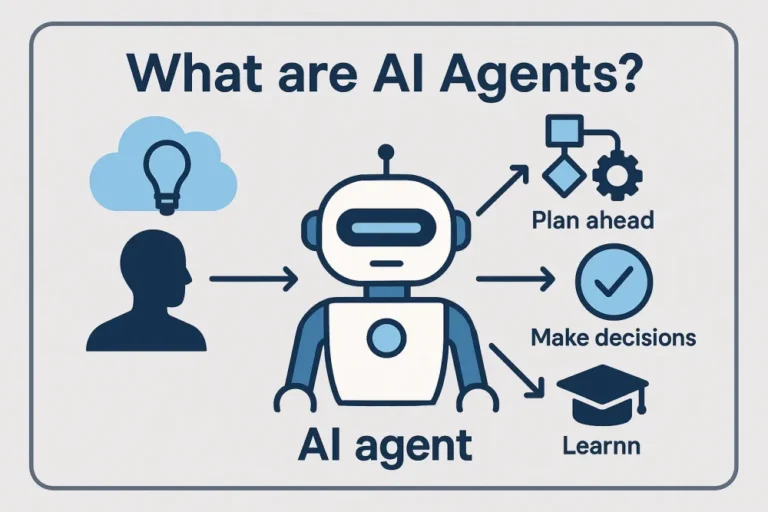
Agent AI refers to intelligent systems designed to perform tasks autonomously by:
- Perceiving data (images, text, audio, video)
- Making decisions based on context
- Executing actions (labeling, validating, correcting)
- Learning from feedback
Unlike traditional machine learning models, Agent AI systems are:
- Goal-oriented
- Context-aware
- Capable of multi-step reasoning
- Interactive with humans and other agents
These agents are often powered by large language models (LLMs), computer vision models, and reinforcement learning.
Why Agent AI Matters in Data Annotation
Traditional annotation challenges include:
- High cost and time consumption
- Human inconsistency and bias
- Difficulty scaling to millions of data points
- Complex multi-modal data handling
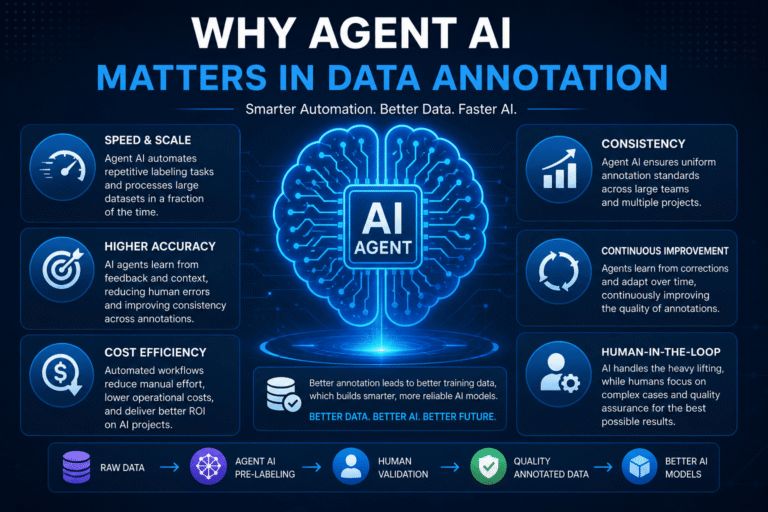
Agent AI solves these by:
- Automating repetitive tasks
- Improving labeling consistency
- Reducing turnaround time
- Enabling dynamic and adaptive workflows
Core Components of Agent AI Annotation Systems
To effectively use Agent AI in data annotation, you need to understand its architecture:
1. Perception Layer
This includes models that process raw data:
- Computer vision models (for images/videos)
- Speech recognition (for audio)
- NLP models (for text)
2. Reasoning Engine
This is where the “agent” becomes intelligent:
- LLM-based reasoning (e.g., task interpretation)
- Rule-based systems
- Context-aware decision-making
3. Action Module
Executes annotation tasks:
- Bounding boxes
- Semantic segmentation
- Text classification
- Named entity recognition (NER)
4. Memory and Feedback Loop
- Stores previous annotations
- Learns from corrections
- Improves over time
5. Human-in-the-Loop Interface
- Humans validate edge cases
- Provide feedback
- Handle ambiguity
How to Use Agent AI in Data Annotation (Step-by-Step)
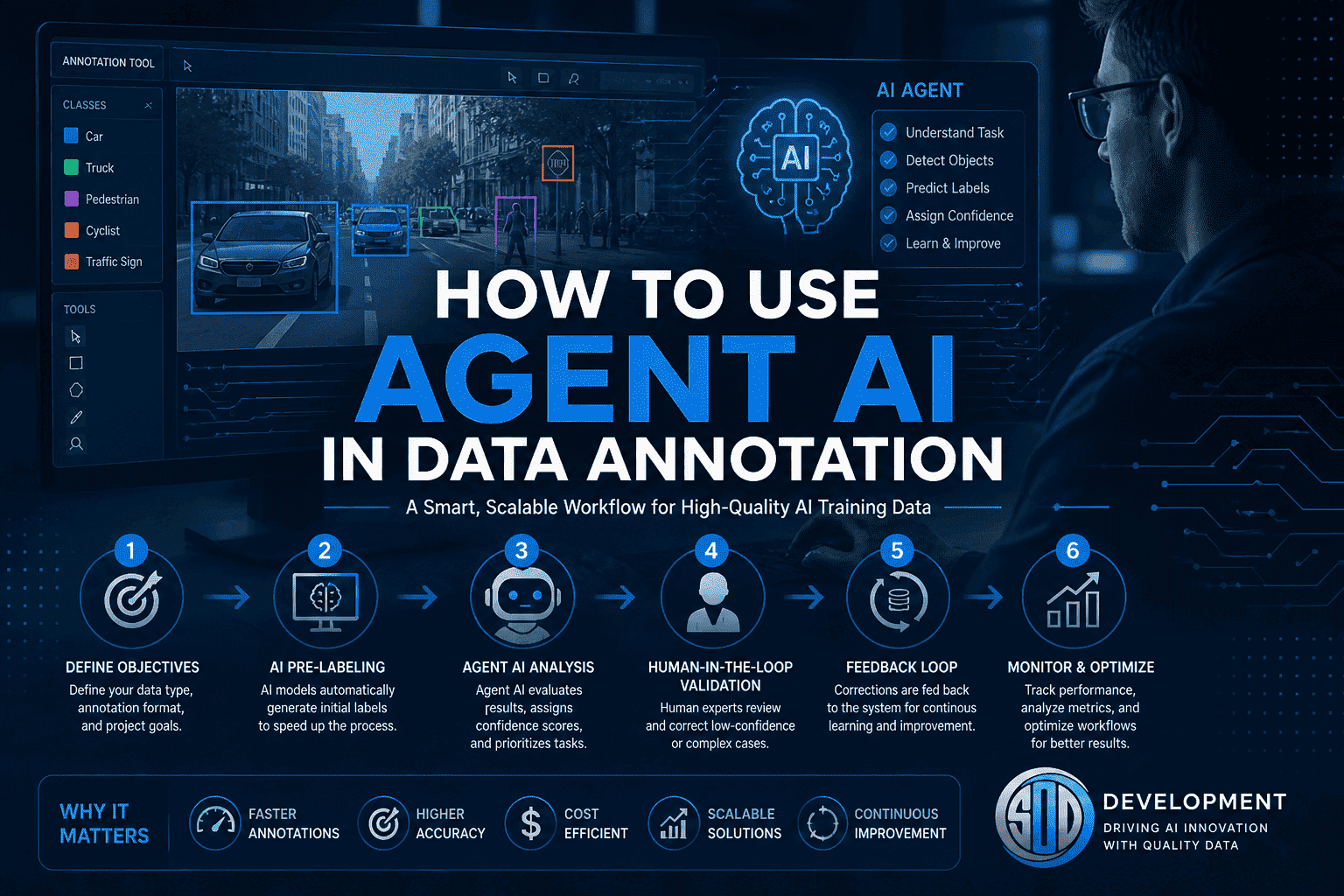
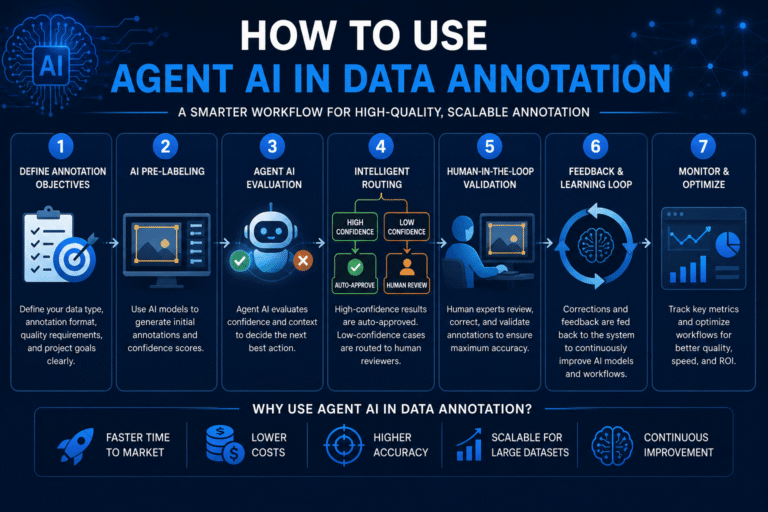
Step 1: Define Annotation Objectives
Start by clearly defining:
- Type of data (image, text, audio, video)
- Annotation format (bounding boxes, polygons, tags, transcripts)
- Quality requirements (accuracy thresholds)
Example:
- Annotating medical images for tumor detection
- Labeling customer sentiment in chat data
Step 2: Select the Right AI Models
Choose models based on your data:
- Computer Vision → YOLO, SAM, Detectron
- NLP → Transformer-based models (LLMs)
- Audio → Whisper-like models
These models act as the foundation for your agent system.
Step 3: Design the Agent Workflow
Instead of a linear pipeline, Agent AI uses dynamic workflows:
Example Workflow:
- Agent reads task instructions
- Pre-labeling model generates initial annotations
- Agent evaluates confidence score
- If confidence is high → accept
- If low → send to human reviewer
- Agent learns from corrections
Step 4: Implement Multi-Agent Collaboration
You can use multiple agents for different roles:
- Annotation Agent → Labels data
- Validation Agent → Checks quality
- Correction Agent → Fixes errors
- Supervisor Agent → Manages workflow
This modular approach improves scalability and accuracy.
Step 5: Integrate Human-in-the-Loop
Even the best agents need human oversight.
Use humans for:
- Edge cases
- Ambiguous data
- Quality audits
Best practice:
- Only escalate low-confidence cases to humans
- Continuously retrain agents using human feedback
Step 6: Build Feedback and Learning Loops
Agent AI systems improve over time through:
- Reinforcement learning
- Active learning
- Continuous fine-tuning
Example:
If a human corrects a bounding box, the agent stores this correction and updates its future predictions.
Step 7: Monitor and Optimize Performance
Track key metrics:
- Annotation accuracy
- Speed (labels/hour)
- Cost per annotation
- Human intervention rate
Use dashboards and analytics to continuously refine your system.
Real-World Use Cases
1. Autonomous Driving
- Annotating LiDAR and video data
- Agents handle object detection and tracking
- Humans validate rare scenarios
2. Healthcare AI
- Labeling medical images
- Extracting clinical entities from text
- Ensuring compliance and precision
3. E-commerce
- Product categorization
- Image tagging
- Customer sentiment analysis
4. Conversational AI
- Intent classification
- Entity extraction
- Dialogue annotation
Tools and Platforms for Agent AI Annotation
Popular tools include:
- CVAT
- Labelbox
- Supervisely
- Roboflow
These platforms can be extended with Agent AI capabilities using APIs and LLM integrations.
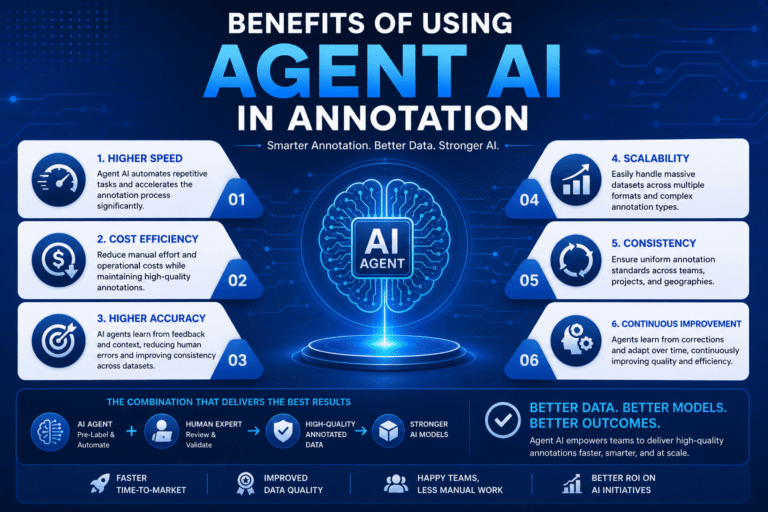
Benefits of Using Agent AI in Annotation
1. Scalability
Handle millions of data points efficiently.
2. Cost Reduction
Reduce reliance on large annotation teams.
3. Speed
Accelerate project timelines significantly.
4. Consistency
Minimize human variability.
5. Continuous Improvement
Agents learn and improve with time.
Challenges and Limitations
Despite its advantages, Agent AI comes with challenges:
1. Initial Setup Complexity
Designing agent workflows requires expertise.
2. Model Bias
Agents may inherit biases from training data.
3. Quality Control
Over-reliance on automation can reduce accuracy if not monitored.
4. Data Privacy
Sensitive data requires strict governance.
Best Practices
To successfully implement Agent AI:
- Start with pilot projects
- Use hybrid human-AI workflows
- Focus on high-impact use cases first
- Continuously evaluate performance
- Invest in training and infrastructure
Future of Agent AI in Data Annotation
The future is moving toward:
- Fully autonomous annotation systems
- Multi-modal agents handling text, image, and video together
- Self-improving pipelines with minimal human intervention
- Integration with real-time AI systems
Agent AI will not replace humans—but will augment human capabilities, making annotation faster, smarter, and more scalable.
How SO Development Can Help
At SO Development, we specialize in advanced AI data solutions, including:
- Agent AI-powered annotation workflows
- Large-scale data collection and labeling
- Multi-modal annotation (LiDAR, image, text, audio)
- Custom AI pipeline development
With over 600+ projects and expert annotators, we combine human expertise with intelligent automation to deliver high-quality datasets for your AI models.
Conclusion
Agent AI is redefining data annotation by introducing intelligence, autonomy, and adaptability into the process. By combining machine efficiency with human judgment, organizations can achieve faster, cheaper, and more accurate annotation at scale.
If you’re looking to stay competitive in the AI space, adopting Agent AI in your annotation workflow is no longer optional—it’s essential.
Frequently Asked Questions (FAQ)
1. What is Agent AI in data annotation?
Agent AI in data annotation refers to intelligent systems that can automatically label, validate, and improve data using reasoning and decision-making capabilities. Unlike traditional tools, Agent AI can adapt, learn from feedback, and optimize annotation workflows over time.
2. How is Agent AI different from traditional data annotation?
Traditional annotation relies heavily on manual human effort, while Agent AI combines:
- Automated pre-labeling
- Intelligent decision-making
- Human-in-the-loop validation
This results in faster, more scalable, and more accurate annotation processes.
3. What are the benefits of using Agent AI for data labeling?
Key benefits include:
- Faster annotation speed
- Reduced costs
- Improved accuracy
- Scalability for large datasets
- Continuous learning and improvement
4. Is Agent AI fully automated or does it require human input?
Agent AI is typically semi-automated, not fully autonomous.
The best results come from combining:
- AI agents for automation
- Human experts for validation and edge cases
This approach is known as human-in-the-loop annotation.
5. What industries benefit most from Agent AI in annotation?
Agent AI is widely used in:
- Autonomous vehicles (LiDAR, video annotation)
- Healthcare (medical imaging, clinical NLP)
- E-commerce (product tagging, categorization)
- Conversational AI (chatbots, intent classification)
6. How accurate is AI-powered data annotation?
Accuracy depends on:
- Quality of training data
- Model selection
- Human validation process
With a hybrid approach, companies can achieve 95%–99% accuracy, especially when using expert annotation teams like those at SO Development.
7. What is human-in-the-loop annotation?
Human-in-the-loop (HITL) is a process where:
- AI performs initial labeling
- Humans review and correct outputs
- Feedback is used to improve the system
This ensures both efficiency and quality.
8. Can Agent AI handle multi-modal data?
Yes. Modern Agent AI systems can annotate:
- Images
- Videos
- Text
- Audio
- LiDAR / 3D data
This makes them ideal for complex AI applications.
9. How do I choose the right data annotation company?
Look for:
- Proven experience (projects & industries)
- Skilled annotators
- AI-powered workflows
- Quality assurance processes
- Scalability and cost-efficiency
10. Why choose SO Development for AI data annotation?
SO Development offers:
- ✅ 600+ completed projects
- ✅ Expert annotators (5+ years experience)
- ✅ Agent AI-powered workflows
- ✅ Multi-modal annotation capabilities
- ✅ Cost-effective and scalable solutions
11. How can I get started with Agent AI annotation?
You can start by:
- Defining your data and annotation needs
- Choosing a trusted partner
- Running a pilot project
- Scaling with AI + human workflows
👉 Pro Tip: Starting with a pilot project helps validate quality, cost, and efficiency before scaling.
12. How much does AI data annotation cost?
Costs vary depending on:
- Data type (image, video, text, etc.)
- Complexity of annotation
- Volume of data
- Quality requirements
Using Agent AI can reduce costs by 30%–60% compared to fully manual annotation.