Introduction
Artificial Intelligence has rapidly evolved over the past decade. Initially, most systems were designed as single-agent models, where one AI handled a specific task—classification, prediction, or automation.
But real-world problems are rarely that simple.
Modern challenges—like global logistics, autonomous driving, financial markets, and climate systems—require multiple decision-makers operating simultaneously. This is where multi-agent systems (MAS) come in.
Rather than relying on a single “super-intelligence,” MAS distributes intelligence across multiple autonomous agents that interact, collaborate, and adapt in real time.
This shift represents one of the most important transformations in AI:
From isolated intelligence → to collaborative intelligence.
What Are Multi-Agent Systems?
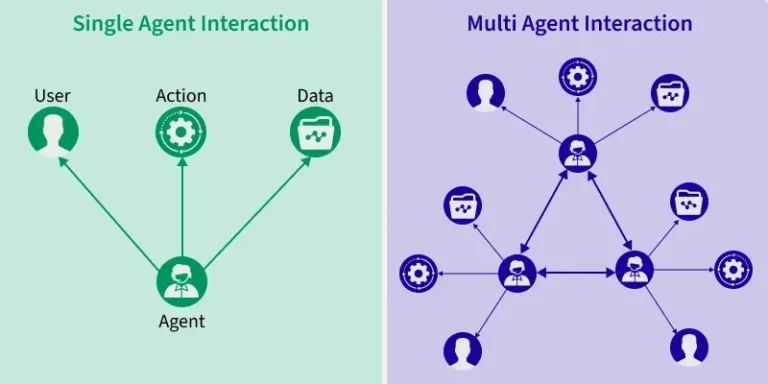
A multi-agent system is a collection of independent computational entities—called agents—that operate within a shared environment.
Each agent:
- Has its own goals or objectives
- Perceives the environment
- Makes decisions independently
- Interacts with other agents
These agents can:
- Cooperate
- Compete
- Coexist with partial alignment
The overall system behavior emerges from these interactions, often producing outcomes more sophisticated than any single agent could achieve.
The Core Concept: Emergence
One of the defining features of MAS is emergent behavior.
This means:
- The system exhibits intelligence at a higher level than individual agents
- Complex patterns arise from simple rules
Examples:
- Ant colonies organizing without central control
- Traffic flow optimization through decentralized signals
- Market dynamics driven by independent traders
In AI, emergence allows systems to:
- Solve problems dynamically
- Adapt without centralized oversight
- Scale efficiently
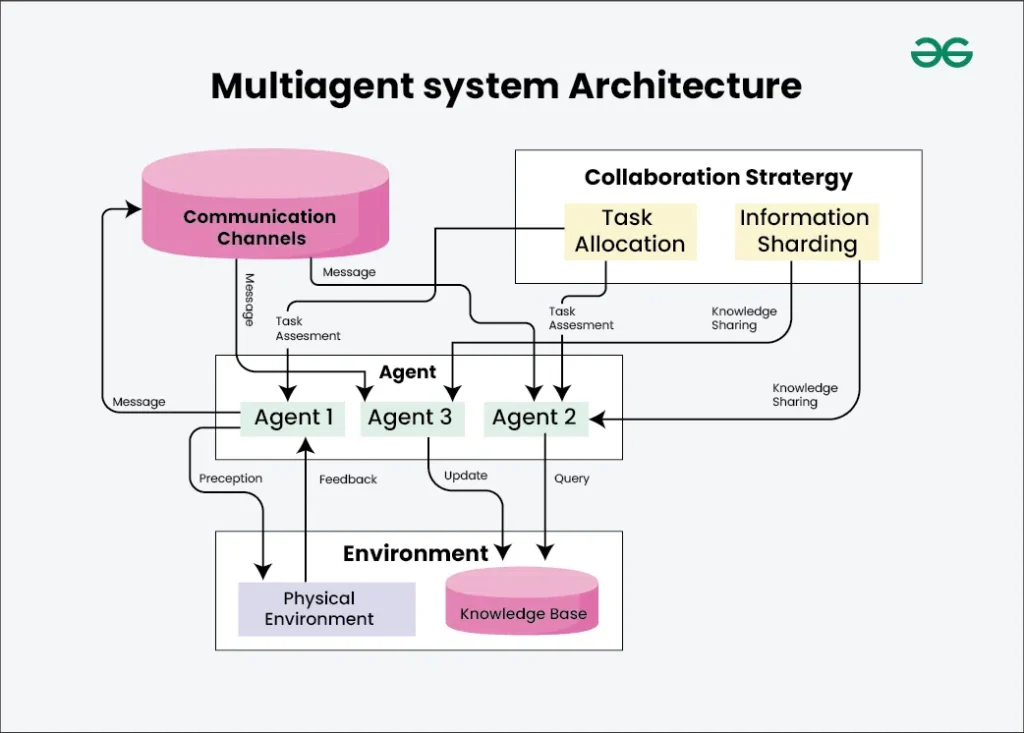
Key Components of Multi-Agent Systems
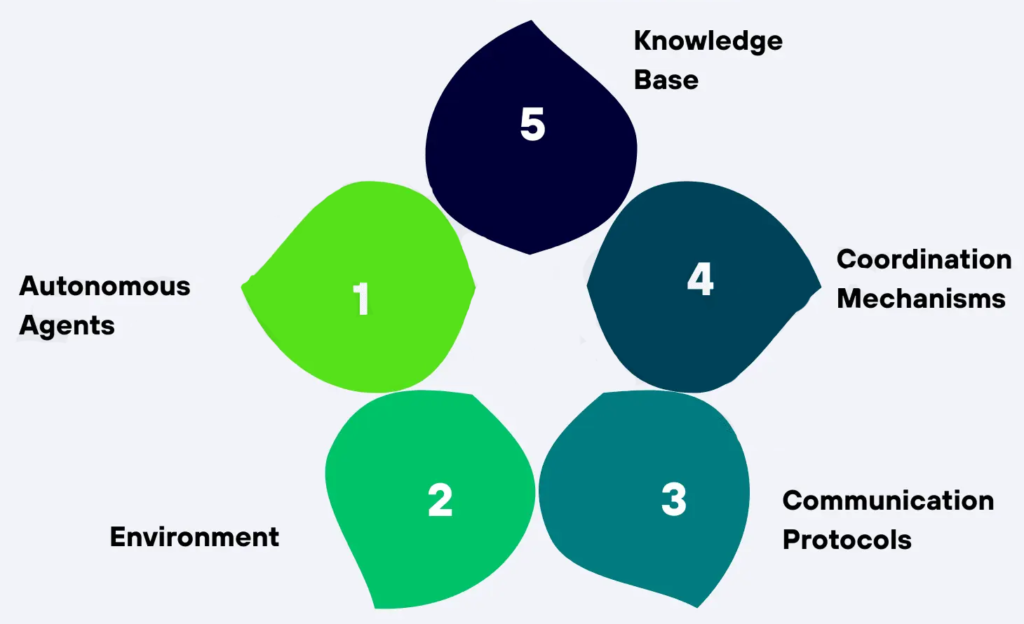
1. Agents
Agents are the building blocks of MAS. They can vary widely in complexity:
Types of Agents:
- Reactive agents – respond to stimuli without memory
- Deliberative agents – plan actions based on internal models
- Learning agents – improve over time using data
- Hybrid agents – combine multiple approaches
Each agent typically includes:
- Sensors (input)
- Actuators (output)
- Decision-making logic
- Knowledge base
2. Environment
The environment is where agents operate.
Types of Environments:
- Physical (robots, drones)
- Digital (software systems, simulations)
- Hybrid (IoT systems combining both)
Environment properties:
- Static vs dynamic
- Deterministic vs stochastic
- Fully observable vs partially observable
3. Communication
Agents must exchange information to function effectively.
Communication Methods:
- Message passing
- Shared memory
- APIs
- Event-driven systems
Protocols:
- Structured languages (ACL – Agent Communication Language)
- Negotiation protocols
- Auction mechanisms
4. Coordination Mechanisms
Coordination ensures agents work efficiently together.
Common approaches:
- Task allocation
- Consensus algorithms
- Market-based coordination
- Rule-based systems
5. Decision-Making Models
Agents use various strategies:
- Rule-based systems
- Optimization algorithms
- Machine learning models
- Reinforcement learning
Types of Multi-Agent Systems
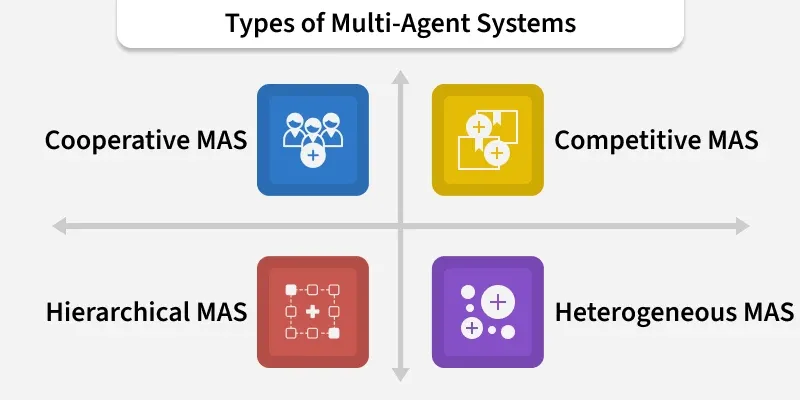
1. Cooperative Systems
Agents share a common goal.
Example:
Warehouse robots working together to fulfill orders.
Key Features:
- Shared rewards
- High communication
- Strong coordination
2. Competitive Systems
Agents have conflicting objectives.
Example:
Algorithmic trading bots competing in financial markets.
Key Features:
- Strategic behavior
- Game theory
- Limited information sharing
3. Mixed Systems
Most real-world systems fall into this category.
Example:
Ride-sharing platforms:
- Drivers cooperate with the system
- Compete with each other
4. Hierarchical Systems
Agents are organized in layers.
Structure:
- High-level agents (decision-makers)
- Low-level agents (executors)
5. Swarm Intelligence Systems
Inspired by nature (ants, bees, birds).
Characteristics:
- Simple agents
- No central control
- Emergent coordination
Architectures of Multi-Agent Systems
Centralized vs Decentralized
Centralized:
- One controller coordinates agents
- Easier to manage
- Less scalable
Decentralized:
- No central authority
- Agents act independently
- Highly scalable and robust
Distributed Architecture
Agents are distributed across networks.
Benefits:
- Fault tolerance
- Parallel processing
- Geographic scalability
Hybrid Architecture
Combines centralized and decentralized approaches.
Algorithms Used in Multi-Agent Systems
1. Game Theory
Used in competitive environments.
Concepts:
- Nash equilibrium
- Zero-sum games
- Strategy optimization
2. Reinforcement Learning (Multi-Agent RL)
Agents learn through interaction.
Types:
- Cooperative RL
- Competitive RL
- Self-play
3. Consensus Algorithms
Used for agreement among agents.
Examples:
- Voting mechanisms
- Distributed consensus
4. Auction Algorithms
Agents bid for tasks or resources.
Applications:
- Logistics
- Cloud computing
5. Evolutionary Algorithms
Agents evolve strategies over time.
Real-World Applications
1. Autonomous Vehicles
Cars act as agents:
- Communicate with each other
- Share traffic data
- Prevent accidents
Future:
- Fully coordinated traffic ecosystems
2. Smart Cities
Agents manage:
- Traffic lights
- Energy consumption
- Waste systems
3. Healthcare Systems
Applications:
- Patient monitoring agents
- Diagnostic assistants
- Resource allocation
4. Finance and Trading
Agents:
- Analyze market data
- Execute trades
- Manage risk
5. Supply Chain and Logistics
Agents represent:
- Suppliers
- Warehouses
- Delivery routes
Outcome:
- Optimized delivery
- Reduced costs
6. Robotics and Swarms
Examples:
- Drone fleets
- Agricultural robots
- Disaster response
7. Gaming and Simulation
NPCs behave independently, creating realistic worlds.
8. Cybersecurity
Agents:
- Detect threats
- Respond autonomously
- Adapt to new attacks
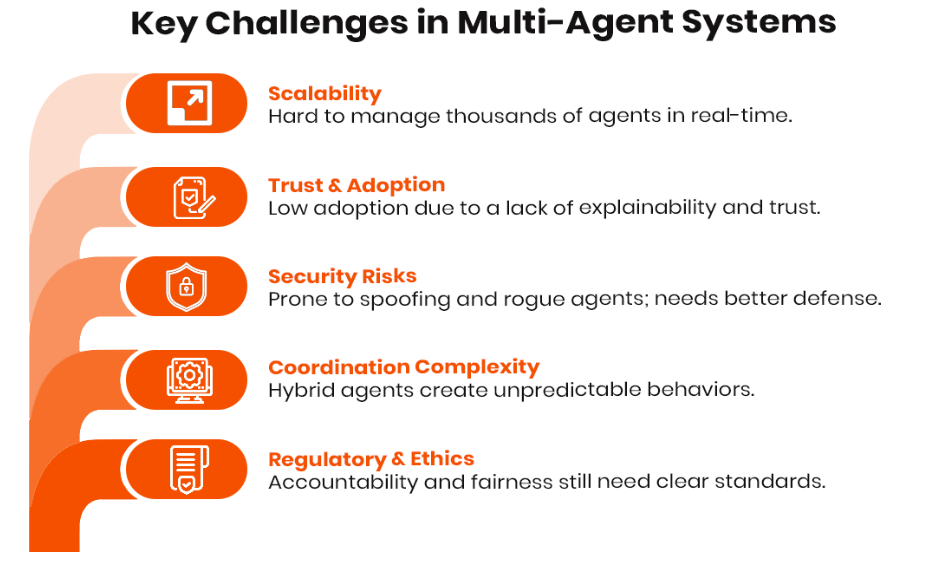
Challenges of Multi-Agent Systems
1. Coordination Complexity
As agents increase, interactions grow exponentially.
2. Communication Overhead
Too much messaging slows performance.
3. Conflict Resolution
Agents may:
- Compete for resources
- Have conflicting goals
4. Security Risks
Distributed systems are vulnerable to:
- Attacks
- Data breaches
5. Debugging and Testing
Hard to trace:
- Emergent behavior
- System-wide bugs
6. Ethical Concerns
Questions arise:
- Who is responsible for decisions?
- How to ensure fairness?
Multi-Agent Systems vs Single-Agent AI
Key Differences
| Aspect | Single-Agent | Multi-Agent |
|---|---|---|
| Intelligence | Centralized | Distributed |
| Complexity | Lower | Higher |
| Scalability | Limited | High |
| Flexibility | Moderate | High |
| Resilience | Low | High |
Multi-Agent Systems + Large Language Models
A major breakthrough is combining MAS with advanced AI models.
Example:
Each agent:
- Has a specialized role
- Uses language models to communicate
Use Cases:
- AI research assistants
- Automated business workflows
- Coding agents collaborating
Conclusion
Agentic AI represents a fundamental evolution in artificial intelligence — shifting from tools that respond to prompts toward systems that pursue goals.
The transformation happens through architecture, not magic.
By applying five key design patterns:
- Planner–Executor
- Tool Use
- Memory Augmentation
- Reflection
- Multi-Agent Collaboration
developers can turn LLMs into reliable, capable AI agents.
The future of AI isn’t just smarter models — it’s smarter systems.
FAQ
What is Agentic AI in simple terms?
Agentic AI refers to AI systems that can independently plan and execute tasks to achieve goals rather than only responding to prompts.
How is Agentic AI different from chatbots?
Chatbots generate responses. Agentic AI systems take actions, use tools, remember context, and iteratively work toward outcomes.
Do AI agents replace humans?
No. Most agentic systems are designed to augment human workflows by automating repetitive or complex tasks while humans supervise decisions.
What technologies are used to build AI agents?
Common components include large language models, orchestration frameworks, APIs, vector databases, memory systems, and evaluation pipelines.
Are AI agents autonomous?
They are semi-autonomous. Effective systems operate within defined constraints, permissions, and monitoring mechanisms.
Why are design patterns important for Agentic AI?
Because reliability comes from architecture. Design patterns provide reusable solutions for planning, reasoning, memory, and coordination.