Introduction
For most of modern history, images carried an implicit promise: they were evidence. A photograph suggested that something happened — that a moment existed in front of a lens at a specific time and place. Even when manipulated, images were rooted in reality.
That assumption is now dissolving.
Generative AI systems can produce hyper-realistic images, videos, voices, and documents without any real-world event behind them. These outputs do more than imitate reality — they compete with it, often appearing more polished, persuasive, and emotionally precise than authentic media.
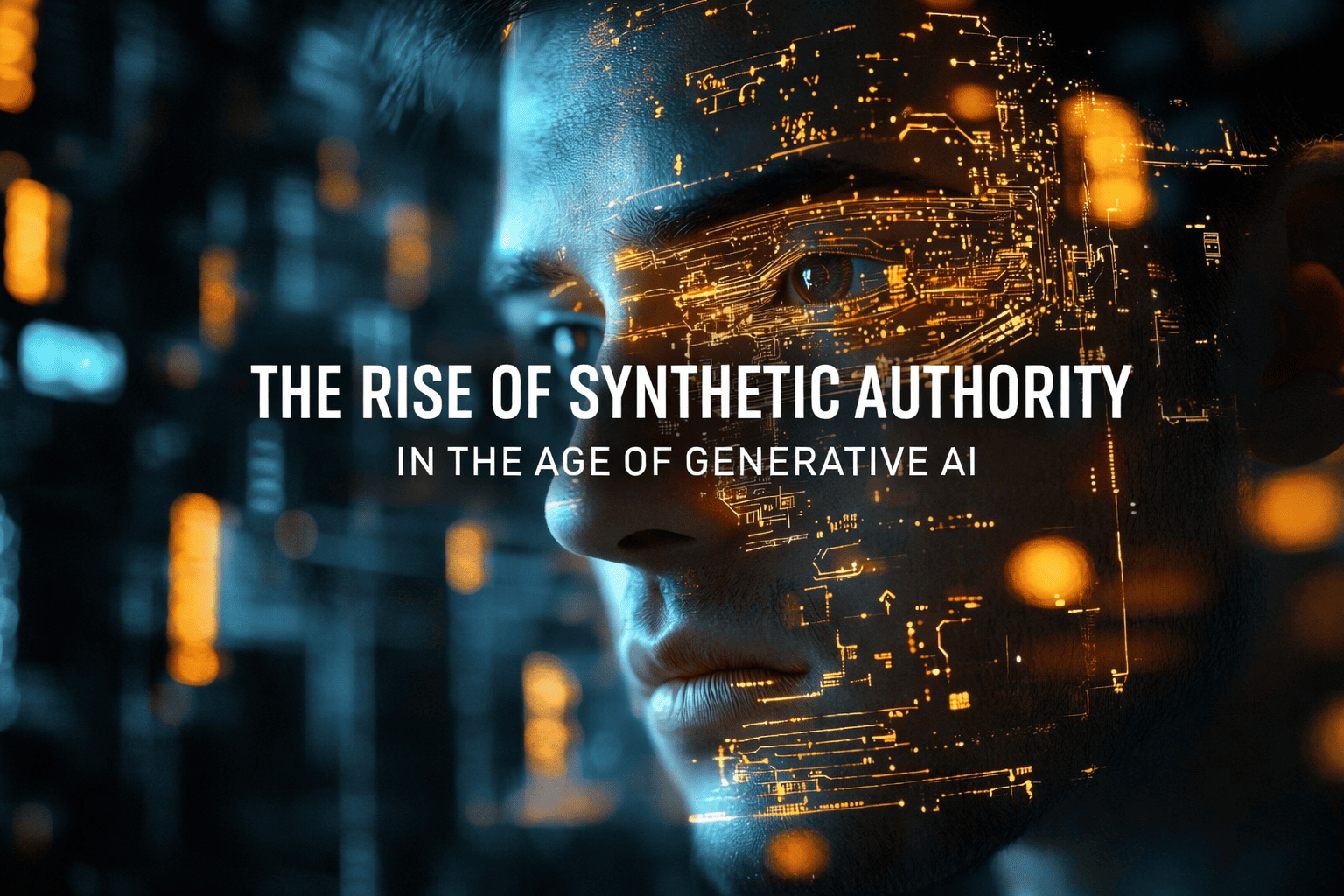
We are entering an era defined by synthetic authority: the phenomenon in which AI-generated content gains credibility, influence, and persuasive power independent of truth or origin.
This shift is not merely technological. It is epistemological — changing how humans decide what to trust.
What Is Synthetic Authority?
Synthetic authority refers to the perceived legitimacy granted to content that is artificially generated rather than witnessed or recorded.
Traditionally, authority emerged from identifiable sources:
Institutions (news organizations, universities)
Experts and professionals
Physical evidence
Eyewitness documentation
Generative AI disrupts all four simultaneously.
An AI image can now:
Look professionally photographed
Mimic journalistic aesthetics
Align perfectly with audience expectations
Spread faster than verification processes
Authority is no longer derived from origin but from appearance.
In other words: credibility is shifting from provenance to plausibility.
Why AI-Generated Content Feels Trustworthy
Synthetic authority works because generative AI exploits deeply human cognitive shortcuts.
1. Visual Bias
Humans are evolutionarily wired to trust visual information. Seeing has long been equated with believing. High-fidelity AI images activate this instinct automatically.
2. Aesthetic Professionalism
AI systems learn from millions of polished media examples. The result is content that looks statistically “ideal” — balanced lighting, compelling composition, emotionally optimized expressions.
Ironically, synthetic images can look more real than reality.
3. Speed Over Verification
Information ecosystems reward immediacy. AI can produce content instantly, while fact-checking requires time. The first image seen often becomes the mental anchor for belief.
4. Algorithmic Amplification
Social platforms prioritize engagement. Emotionally resonant AI-generated content often outperforms authentic but mundane reality.
Authority emerges through visibility.
From Photography to Promptography
Photography once required physical presence: a camera, a subject, a moment.
Generative AI introduces what some call promptography — the creation of images through language rather than observation.
The creator no longer captures reality; they describe it.
This transformation changes the role of authorship:
| Traditional Media | Generative Media |
|---|---|
| Witnessing | Specifying |
| Recording | Generating |
| Editing reality | Simulating reality |
| Evidence-based | Probability-based |
The shift raises a fundamental question:
If an image looks authentic but has no historical origin, what kind of truth does it hold?

The Collapse of Visual Verification
For decades, society relied on visual documentation to verify events — journalism, legal evidence, historical archives.
Generative AI challenges that foundation in three major ways:
1. Infinite Fabrication
Anyone can create convincing imagery of events that never occurred.
2. Plausible Deniability
Real images can now be dismissed as fake simply because convincing fakes exist — a phenomenon sometimes called the “liar’s dividend.”
3. Contextual Manipulation
AI allows subtle alterations that reshape narratives without obvious signs of editing.
The result is not just misinformation, but epistemic instability — uncertainty about whether truth can be visually confirmed at all.
Synthetic Authority Beyond Images
While images receive the most attention, synthetic authority extends across media forms:
AI-generated voices delivering convincing speeches
Synthetic experts writing authoritative articles
AI avatars presenting news broadcasts
Automatically generated research summaries
Authority becomes performative rather than experiential.
The marker of legitimacy shifts from who created it to how convincingly it performs expertise.
Economic Incentives Driving Synthetic Authority
The rise of synthetic authority is accelerated by powerful incentives:
Efficiency
Organizations can produce unlimited content without traditional production costs.
Personalization
AI content can be tailored precisely to audience psychology, increasing persuasion.
Scalability
Synthetic media operates at a scale no human workforce can match.
Attention Economics
In a crowded information environment, emotionally optimized synthetic content wins attention — and attention translates into revenue.
Synthetic authority is therefore not an accident; it is economically reinforced.
Risks: Trust Without Ground Truth
The normalization of synthetic authority introduces several societal risks:
Erosion of shared reality — communities may inhabit different perceived truths.
Manipulation at scale — political and commercial persuasion becomes cheaper and more targeted.
Institutional distrust — genuine sources struggle to distinguish themselves from synthetic competitors.
Cognitive fatigue — constant skepticism exhausts audiences, leading to disengagement or blind acceptance.
The danger is not that people believe everything, but that they stop believing anything reliably.
Emerging Responses and Adaptations
Society is beginning to respond in multiple ways:
Provenance Technologies
Digital watermarking and authenticity tracking aim to verify origins of media.
AI Literacy
Education increasingly focuses on understanding how generative systems work.
Platform Responsibility
Social platforms experiment with labeling synthetic content.
Cultural Adaptation
Audiences may gradually shift from trusting images to trusting networks, reputations, or verification systems.
Historically, new media technologies eventually produce new norms of trust. Printing presses, photography, and the internet each forced similar adjustments — though none moved this quickly.
A New Definition of Authority
Synthetic authority does not necessarily signal the end of truth. Instead, it marks a transition.
Authority may evolve from:
Seeing → verifying
Believing → evaluating
Authenticity → transparency
Future credibility may depend less on whether content is artificial and more on whether its creation process is disclosed and accountable.
In this sense, the challenge is not stopping synthetic media — an impossible task — but redesigning trust for a world where reality can be generated.
Conclusion: Living With Generated Reality
Generative AI has not simply created new tools; it has changed the relationship between perception and belief.
Images no longer require events. Voices no longer require speakers. Authority no longer requires origin.
We are moving into a cultural landscape where persuasion can be manufactured as easily as text, and where reality competes with simulation for attention.
The question facing society is no longer “Is this real?” but rather:
“What makes something worthy of trust when reality itself can be synthesized?”
The answer will define the next era of media, knowledge, and human communication.