Introduction to Agent AI
Artificial Intelligence has evolved rapidly over the past decade. Organizations initially adopted machine learning models to analyze data, identify patterns, and automate repetitive tasks. The rise of Large Language Models (LLMs) brought another major leap, enabling machines to understand and generate human-like language. However, a new revolution is now reshaping the AI landscape: Agent AI.
Agent AI, often referred to as Agentic AI, represents the next stage of artificial intelligence evolution. Instead of merely responding to prompts, AI agents can reason, plan, make decisions, use tools, interact with systems, and execute complex workflows autonomously. They are moving AI from passive assistance to active problem-solving.
Businesses across healthcare, finance, manufacturing, retail, education, and software development are investing heavily in AI agents because they offer unprecedented levels of automation and productivity. Rather than requiring constant human guidance, AI agents can independently perform multi-step tasks, coordinate with other agents, and continuously learn from outcomes.
In this comprehensive guide, you’ll learn what Agent AI is, how it works, its key components, major applications, implementation strategies, and what the future holds for autonomous intelligent systems.
Chapter 1: What Is Agent AI?
Defining Agent AI
Agent AI refers to artificial intelligence systems capable of autonomously perceiving their environment, reasoning about information, making decisions, and taking actions to achieve specific goals.
Unlike traditional AI systems that simply generate outputs based on inputs, AI agents operate with a sense of purpose. They can determine what actions are required to accomplish a task and execute those actions without requiring continuous human intervention.
An AI agent typically possesses several characteristics:
- Goal-oriented behavior
- Decision-making capabilities
- Environmental awareness
- Planning abilities
- Memory systems
- Tool utilization
- Continuous adaptation
For example, a traditional chatbot may answer questions about travel destinations. An AI travel agent can:
- Search flights
- Compare prices
- Evaluate hotel options
- Create itineraries
- Make reservations
- Adjust plans based on changing conditions
The difference lies in autonomy and action.
Agent AI vs Traditional AI
Traditional AI systems generally perform one specific task.
Examples include:
- Image classification
- Speech recognition
- Fraud detection
- Recommendation systems
These systems are often reactive. They process information and provide outputs but do not independently pursue goals.
Agent AI introduces proactive behavior.
| Traditional AI | Agent AI |
|---|---|
| Reactive | Proactive |
| Single task | Multi-step workflows |
| Limited memory | Persistent memory |
| No planning | Strategic planning |
| No tool usage | Tool integration |
| Human-directed | Goal-directed |
For organizations seeking advanced automation, this distinction is critical.
Agent AI vs Generative AI
Many people confuse Agent AI with Generative AI.
Generative AI focuses on creating content such as:
- Text
- Images
- Audio
- Video
- Code
Examples include language models that generate responses based on user prompts.
Agent AI incorporates generative AI but extends its capabilities significantly.
A generative AI model can write an email.
An AI agent can:
- Read incoming emails
- Prioritize requests
- Draft responses
- Schedule meetings
- Update CRM records
- Follow up automatically
Generative AI creates content.
Agent AI creates outcomes.
Why Agent AI Matters
Organizations face increasing pressure to:
- Reduce operational costs
- Improve productivity
- Enhance customer experiences
- Accelerate innovation
Traditional automation tools often struggle with dynamic and unpredictable tasks.
AI agents excel because they can:
- Interpret context
- Handle ambiguity
- Adapt to changing situations
- Execute complex workflows
This capability enables businesses to automate knowledge work that previously required human judgment.
Examples include:
- Research analysis
- Contract review
- Customer support
- Medical documentation
- Financial reporting
- Software development
The potential economic impact is enormous.
Many industry analysts predict that AI agents will become a core component of enterprise operations within the next five years.
Chapter 2: The Evolution of AI Toward Agentic Systems
Stage 1: Rule-Based Systems
Early AI relied on predefined rules.
For example:
IF customer asks about pricing
THEN display pricing information
These systems worked well for simple scenarios but failed when faced with unexpected inputs.
Limitations included:
- No learning capabilities
- High maintenance requirements
- Poor adaptability
Stage 2: Machine Learning
Machine learning introduced data-driven intelligence.
Instead of relying solely on rules, systems learned patterns from data.
Applications included:
- Spam detection
- Predictive analytics
- Fraud detection
- Recommendation engines
While powerful, these systems still lacked autonomy.
They could predict outcomes but could not independently act on those predictions.
Stage 3: Deep Learning
Deep learning significantly improved AI capabilities.
Neural networks enabled breakthroughs in:
- Computer vision
- Speech recognition
- Natural language processing
Organizations gained access to highly accurate AI models capable of understanding complex information.
However, these models remained specialized.
Stage 4: Large Language Models
The emergence of LLMs transformed AI accessibility.
Models became capable of:
- Conversational interactions
- Reasoning
- Summarization
- Translation
- Coding assistance
For the first time, AI systems could perform a wide variety of tasks using natural language instructions.
Yet they still required user prompts for every step.
Stage 5: Agentic AI
Agentic AI combines multiple technologies:
- Large Language Models
- Memory systems
- Planning frameworks
- Tool integration
- Decision engines
This combination allows AI systems to act independently.
Instead of waiting for instructions after each step, agents can:
- Determine objectives
- Break goals into tasks
- Execute workflows
- Monitor progress
- Adjust strategies
This marks a major shift from assistance to autonomy.
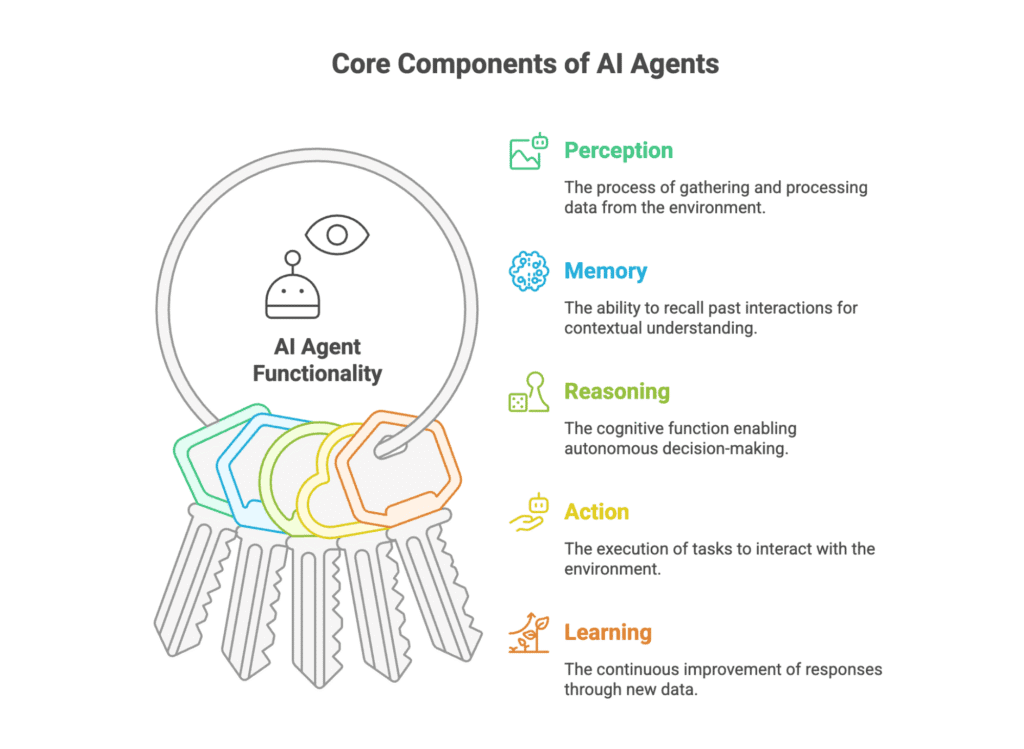
Chapter 3: Core Components of Agent AI
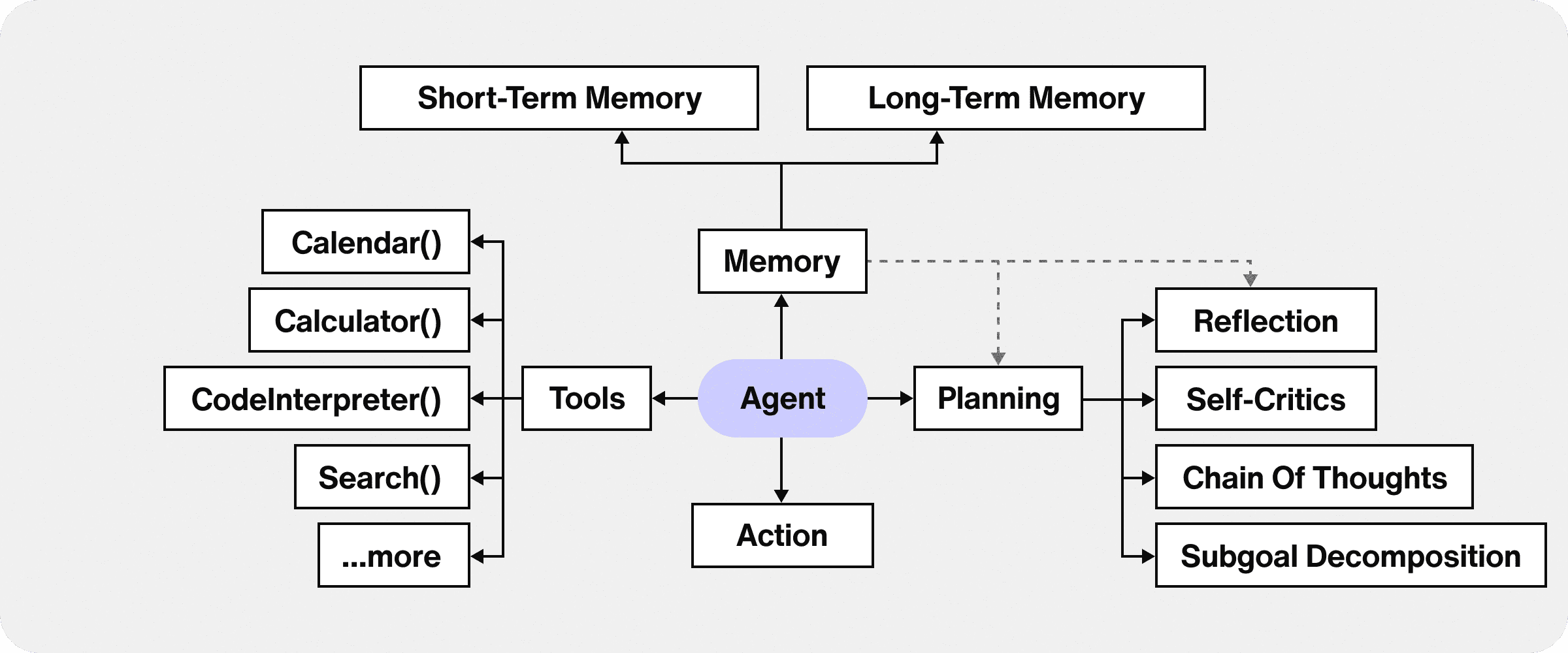
To understand how AI agents operate, it’s important to examine their key building blocks.
1. Perception
Perception refers to the agent’s ability to gather information.
Sources may include:
- User prompts
- Databases
- APIs
- Sensors
- Documents
- Images
- Videos
The perception layer acts as the agent’s eyes and ears.
Without accurate perception, decision-making becomes unreliable.
2. Memory
Memory enables agents to retain information.
There are generally two types:
Short-Term Memory
Stores information relevant to the current task.
Examples:
- Recent conversations
- Active objectives
- Temporary findings
Long-Term Memory
Stores persistent knowledge.
Examples:
- User preferences
- Historical interactions
- Organizational data
- Learned patterns
Memory allows agents to become increasingly useful over time.
3. Reasoning Engine
Reasoning is the process of analyzing information and determining actions.
The reasoning engine helps agents:
- Evaluate options
- Interpret context
- Solve problems
- Generate plans
Advanced reasoning capabilities are essential for handling complex workflows.
4. Planning System
Planning converts goals into actionable steps.
For example:
Goal:
Launch a marketing campaign.
Plan:
- Research audience
- Analyze competitors
- Generate content
- Schedule distribution
- Monitor performance
The planning system allows agents to tackle large objectives systematically.
5. Tool Usage
One of the most important capabilities of modern AI agents is tool utilization.
Tools may include:
- Search engines
- Databases
- CRM platforms
- Email systems
- Analytics dashboards
- Calendars
- Enterprise software
Rather than relying solely on internal knowledge, agents can access external resources to complete tasks.
6. Action Execution
Execution converts decisions into real-world outcomes.
Examples:
- Sending emails
- Creating reports
- Scheduling meetings
- Updating records
- Launching workflows
Execution is what separates agents from traditional chatbots.
7. Feedback Mechanisms
Agents continuously evaluate results.
Feedback helps determine:
- Whether objectives were achieved
- What adjustments are needed
- How future performance can improve
This creates a cycle of continuous optimization.
Chapter 4: Characteristics of Intelligent AI Agents
Not all AI systems qualify as true agents.
Several characteristics distinguish advanced agents from conventional software.
Autonomy
Agents operate independently.
They require minimal supervision and can continue working toward goals even when users are not actively interacting with them.
Adaptability
Agents adjust behavior based on new information.
If conditions change, the agent modifies its strategy.
For example:
A logistics agent may reroute shipments when weather conditions disrupt transportation.
Goal Orientation
Agents pursue objectives rather than simply generating responses.
This goal-driven approach enables meaningful automation.
Persistence
Agents maintain state across sessions.
They remember:
- Prior tasks
- User preferences
- Organizational context
Persistence enables long-term collaboration between humans and AI systems.
Collaboration
Modern agents can collaborate with:
- Humans
- Software systems
- Other AI agents
This capability is particularly important in enterprise environments where multiple processes must work together.
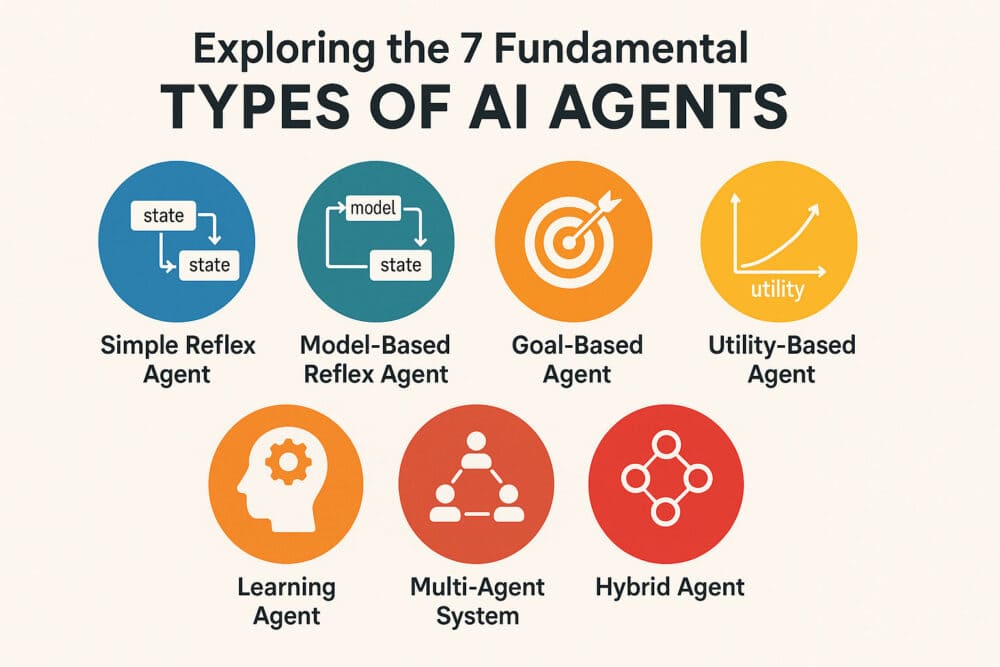
Chapter 5: Types of AI Agents
Different applications require different agent architectures.
Understanding these categories helps organizations select the appropriate approach.
Simple Reflex Agents
These agents react to immediate inputs.
Example:
IF temperature > threshold
THEN activate cooling system
Advantages:
- Fast
- Efficient
- Easy to implement
Limitations:
- No memory
- No planning
- Limited intelligence
Model-Based Agents
Model-based agents maintain an internal representation of their environment.
This allows them to make better decisions even when information is incomplete.
Example:
A warehouse robot estimating inventory positions despite temporary sensor failures.
Goal-Based Agents
Goal-based agents evaluate actions according to objectives.
They choose behaviors most likely to achieve desired outcomes.
Examples include:
- Navigation systems
- Route planners
- Virtual assistants
Utility-Based Agents
Utility-based agents consider multiple outcomes and select the option with the highest overall value.
For example:
An investment agent may balance:
- Risk
- Return
- Liquidity
- Diversification
to maximize portfolio performance.
Learning Agents
Learning agents represent one of the most advanced forms of artificial intelligence systems. Unlike reflex-based or rule-based agents, learning agents continuously improve their performance by interacting with their environment and analyzing outcomes.
A learning agent typically consists of four major components:
Learning Element
The learning element evaluates experiences and identifies opportunities for improvement.
For example:
- An AI customer support agent analyzes successful and unsuccessful interactions.
- A fraud detection agent learns from newly identified fraud patterns.
- A recommendation engine improves suggestions based on user behavior.
Performance Element
This component executes tasks and produces outputs.
Examples include:
- Responding to customer inquiries
- Processing transactions
- Generating reports
- Making recommendations
Critic
The critic evaluates performance and provides feedback.
Questions it may ask include:
- Was the goal achieved?
- Was the solution efficient?
- Could another strategy have produced better results?
Problem Generator
The problem generator encourages exploration and experimentation.
Instead of repeating the same actions indefinitely, it helps agents discover better approaches.
This capability is essential for long-term optimization and adaptation.
Hierarchical Agents
Hierarchical agents organize decision-making into multiple layers.
A high-level agent manages strategy while lower-level agents handle execution.
Example:
Strategic Agent
- Defines objectives
- Sets priorities
- Allocates resources
Operational Agents
- Perform specific tasks
- Collect information
- Execute actions
In a manufacturing environment:
Strategic Agent:
“Increase production efficiency by 10%.”
Operational Agents:
- Inventory agent
- Maintenance agent
- Scheduling agent
- Quality assurance agent
Each agent focuses on a specialized function while contributing to the overall goal.
Multi-Agent Systems
Multi-Agent Systems (MAS) involve multiple AI agents working together to solve problems.
Instead of relying on a single agent, organizations deploy teams of agents with specialized expertise.
Examples include:
Research Agent
Collects information.
Analysis Agent
Processes findings.
Planning Agent
Develops strategies.
Execution Agent
Implements actions.
Monitoring Agent
Tracks results and identifies issues.
This collaborative approach often produces better outcomes than a single monolithic system.
Benefits include:
- Scalability
- Specialization
- Fault tolerance
- Faster execution
- Improved decision quality
Many experts believe multi-agent systems represent the future of enterprise AI.
Chapter 6: Agent AI Architecture
To understand how AI agents function in real-world environments, it’s important to examine their architecture.
Modern AI agents combine several technologies into a unified system.
The Foundation Layer: Large Language Models
Most modern agents rely on Large Language Models as their reasoning core.
These models provide capabilities such as:
- Natural language understanding
- Knowledge synthesis
- Logical reasoning
- Content generation
- Problem solving
Popular models include:
- GPT-based systems
- Claude models
- Gemini models
- Open-source alternatives
The LLM acts as the agent’s cognitive engine.
However, the LLM alone is not sufficient to create a true agent.
Memory Layer
Memory allows agents to maintain context over time.
Without memory, every interaction becomes isolated.
Memory systems generally include:
Working Memory
Stores information related to current tasks.
Examples:
- Active objectives
- Recent conversations
- Current workflow status
Episodic Memory
Stores experiences and historical events.
Examples:
- Previous projects
- Customer interactions
- Completed tasks
Semantic Memory
Stores structured knowledge.
Examples:
- Company policies
- Product information
- Industry regulations
Together, these memory systems enable more intelligent decision-making.
Planning Layer
The planning layer converts objectives into executable workflows.
Example Goal:
“Create a market analysis report.”
The planner may generate:
- Gather industry data
- Analyze competitors
- Identify trends
- Generate findings
- Create recommendations
- Produce final report
Planning enables agents to handle complex multi-step tasks independently.
Tool Integration Layer
One of the defining characteristics of Agent AI is the ability to use external tools.
Common integrations include:
Search Tools
Used for:
- Market research
- Fact verification
- Data gathering
Databases
Used for:
- Retrieving records
- Updating information
- Storing results
Communication Platforms
Examples:
- Email systems
- Slack
- Microsoft Teams
Business Applications
Examples:
- CRM systems
- ERP platforms
- Project management software
Tool integration transforms an agent from a conversational assistant into an active participant in business processes.
Action Layer
The action layer executes decisions.
Examples include:
- Sending messages
- Creating tickets
- Updating records
- Scheduling meetings
- Launching workflows
The ability to take action is what makes AI agents truly autonomous.
Chapter 7: Retrieval-Augmented Generation (RAG) and Agent AI
One challenge with language models is that their knowledge may become outdated or incomplete.
Retrieval-Augmented Generation (RAG) addresses this issue.
What Is RAG?
RAG combines language models with external knowledge retrieval systems.
Instead of relying solely on training data, the agent can:
- Search relevant information.
- Retrieve documents.
- Analyze content.
- Generate responses using current information.
This significantly improves accuracy and reliability.
Why RAG Matters for Agents
Enterprise environments require access to proprietary knowledge.
Examples include:
- Internal documentation
- Policies
- Contracts
- Technical manuals
- Customer records
RAG enables agents to access this information dynamically.
Benefits include:
- Improved accuracy
- Reduced hallucinations
- Better compliance
- Enhanced transparency
Example Workflow
User Request:
“Summarize our latest cybersecurity policy.”
Agent Workflow:
- Search policy database.
- Retrieve relevant document.
- Extract key information.
- Generate summary.
- Provide recommendations.
Without RAG, the agent might not have access to the latest version of the policy.
Chapter 8: Tool Calling and Autonomous Decision Making
Modern AI agents can interact with external systems through tool calling.
This capability dramatically expands their usefulness.
What Is Tool Calling?
Tool calling allows an AI model to invoke external functions.
Examples:
- Query databases
- Search the internet
- Generate reports
- Schedule meetings
- Perform calculations
Rather than guessing answers, agents can retrieve accurate information directly from trusted sources.
Example: Travel Agent
User Request:
“Plan a three-day trip to London.”
Agent Workflow:
- Search flights.
- Compare hotel options.
- Check weather forecasts.
- Create itinerary.
- Estimate costs.
- Generate travel plan.
The agent uses multiple tools to complete the task.
Decision-Making Frameworks
AI agents often use structured reasoning approaches.
Chain-of-Thought Reasoning
The agent solves problems step-by-step.
Example:
- Understand objective.
- Gather information.
- Evaluate options.
- Select solution.
- Execute action.
Tree-of-Thought Reasoning
The agent explores multiple potential solutions before selecting the best path.
This approach is useful for:
- Strategic planning
- Research tasks
- Complex decision making
Chapter 9: Popular Agent AI Frameworks
Several frameworks help developers build agent-based systems.
LangChain
LangChain is one of the most widely adopted AI development frameworks.
Features include:
- Tool integration
- Memory management
- Workflow creation
- Agent orchestration
- RAG support
It provides a flexible foundation for enterprise AI applications.
LangGraph
LangGraph extends LangChain by enabling stateful workflows and agent coordination.
Key advantages:
- Multi-agent orchestration
- Workflow visualization
- Complex process management
- Persistent execution
It is particularly useful for enterprise-scale deployments.
CrewAI
CrewAI focuses on collaborative agent teams.
Organizations can assign specialized roles to agents.
Examples:
- Researcher
- Writer
- Analyst
- Reviewer
Agents coordinate to complete complex projects.
AutoGen
AutoGen supports conversations between multiple agents.
Capabilities include:
- Collaborative reasoning
- Task delegation
- Automated problem solving
- Workflow execution
It is often used in research and software development environments.
Semantic Kernel
Semantic Kernel enables integration between AI models and enterprise software.
Benefits include:
- Enterprise readiness
- Plugin architecture
- Security controls
- Workflow automation
Many organizations use it to integrate AI with existing business systems.
OpenAI Agents SDK
The OpenAI Agents SDK simplifies the creation of autonomous AI workflows.
Features include:
- Tool calling
- Memory integration
- Workflow orchestration
- Multi-step execution
- Monitoring capabilities
It enables developers to build sophisticated agent-based applications with less complexity.
Chapter 10: Building Effective Agent Workflows
Successful agent deployment requires thoughtful workflow design.
Define Clear Objectives
Poorly defined goals often lead to poor results.
Good objective:
“Reduce support response times by 30%.”
Weak objective:
“Improve customer service.”
Specific goals help agents make better decisions.
Break Tasks into Steps
Complex objectives should be decomposed into manageable subtasks.
Example:
Lead Generation Workflow
- Identify target companies
- Gather contact information
- Analyze prospects
- Draft outreach emails
- Schedule follow-ups
- Track engagement
Task decomposition improves reliability and scalability.
Implement Human Oversight
Despite advances in AI, human supervision remains important.
Humans should review:
- Critical decisions
- Financial transactions
- Legal documents
- Healthcare recommendations
Human-in-the-loop systems provide additional safety and accountability.
Chapter 11: Real-World Applications of Agent AI
Agent AI is no longer a futuristic concept. Organizations across virtually every industry are actively deploying AI agents to improve productivity, reduce costs, and create new business opportunities.
As AI models become more capable and enterprise integrations become easier, agent-based systems are moving from experimental projects to mission-critical infrastructure.
Let’s explore some of the most impactful applications.
Agent AI in Customer Service
Customer service has become one of the earliest and most successful applications of AI agents.
Traditional chatbots often frustrate customers because they can only answer predefined questions.
AI agents are fundamentally different.
They can:
- Understand context
- Access customer records
- Analyze historical interactions
- Solve multi-step problems
- Escalate issues when necessary
- Follow up automatically
Example Customer Support Workflow
Customer Request:
“My order hasn’t arrived.”
Agent Actions:
- Access customer account.
- Locate order information.
- Check shipping status.
- Identify delays.
- Generate response.
- Offer compensation if appropriate.
- Update CRM system.
- Schedule follow-up notification.
The customer receives a complete solution rather than a simple response.
Benefits for Businesses
Organizations implementing customer service agents often experience:
- Faster response times
- Reduced support costs
- Higher customer satisfaction
- Increased scalability
- Improved service consistency
Many companies are moving toward hybrid models where AI agents handle routine inquiries while human representatives focus on complex cases.
Agent AI in Healthcare
Healthcare generates enormous volumes of information.
Doctors, nurses, researchers, and administrators spend significant time managing documentation and data.
AI agents can help reduce this burden.
Clinical Documentation Agents
Healthcare professionals spend many hours creating medical records.
AI agents can:
- Listen to consultations
- Generate documentation
- Organize patient information
- Create summaries
- Prepare discharge instructions
This allows clinicians to spend more time with patients.
Medical Research Agents
Research agents can assist scientists by:
- Reviewing literature
- Summarizing publications
- Identifying trends
- Generating hypotheses
- Monitoring new discoveries
What once required weeks of manual review can often be completed in hours.
Patient Support Agents
Patient-focused agents can provide:
- Appointment scheduling
- Medication reminders
- Follow-up communications
- Educational materials
- Care coordination
These systems improve patient engagement while reducing administrative workload.
Healthcare Considerations
Despite their potential, healthcare agents require careful governance.
Organizations must address:
- Data privacy
- Regulatory compliance
- Security controls
- Human oversight
- Clinical validation
AI agents should support healthcare professionals rather than replace medical judgment.
Agent AI in Finance
The financial industry has long embraced automation.
AI agents are now expanding automation into more complex and knowledge-intensive activities.
Financial Analysis Agents
Financial analysts spend significant time collecting and evaluating information.
AI agents can:
- Gather market data
- Analyze earnings reports
- Monitor economic indicators
- Generate summaries
- Create investment insights
This accelerates decision-making while reducing manual effort.
Fraud Detection Agents
Fraud detection increasingly relies on intelligent automation.
AI agents can:
- Monitor transactions
- Identify anomalies
- Investigate suspicious behavior
- Generate alerts
- Escalate high-risk cases
Continuous monitoring allows organizations to respond more quickly to threats.
Banking Assistants
Financial institutions are deploying AI agents that help customers:
- Manage accounts
- Understand products
- Apply for services
- Resolve issues
- Receive personalized recommendations
These systems provide 24/7 support while reducing operational costs.
Compliance Agents
Regulatory compliance is one of the largest challenges in financial services.
AI agents can assist by:
- Monitoring policy changes
- Reviewing transactions
- Identifying violations
- Generating reports
- Supporting audits
This improves compliance while reducing administrative burden.
Agent AI in Software Development
Software engineering is experiencing rapid transformation due to AI agents.
Modern development agents can support nearly every stage of the software lifecycle.
Code Generation Agents
Development agents can:
- Generate code
- Create functions
- Build APIs
- Write tests
- Produce documentation
Developers can focus more on architecture and problem-solving while agents handle routine implementation tasks.
Testing Agents
Quality assurance often consumes significant development resources.
AI testing agents can:
- Create test cases
- Execute tests
- Analyze failures
- Generate bug reports
- Suggest fixes
This accelerates release cycles while improving software quality.
DevOps Agents
DevOps agents can manage:
- Deployments
- Monitoring
- Infrastructure optimization
- Incident response
- Resource allocation
These capabilities help organizations achieve greater operational efficiency.
Security Agents
Cybersecurity teams increasingly rely on intelligent systems.
Security agents can:
- Detect threats
- Analyze vulnerabilities
- Monitor logs
- Investigate incidents
- Recommend remediation actions
Continuous monitoring significantly improves organizational security posture.
Agent AI in Manufacturing
Manufacturing environments involve complex coordination across equipment, personnel, inventory, and logistics.
AI agents help optimize these operations.
Predictive Maintenance Agents
Equipment failures are costly.
AI agents can:
- Monitor machinery
- Analyze sensor data
- Predict failures
- Schedule maintenance
- Reduce downtime
Predictive maintenance often produces substantial cost savings.
Production Optimization Agents
Manufacturing agents can optimize:
- Scheduling
- Resource allocation
- Inventory management
- Production planning
By continuously evaluating operational data, agents help maximize efficiency.
Quality Assurance Agents
Computer vision and AI agents can inspect products in real time.
Capabilities include:
- Defect detection
- Process monitoring
- Compliance verification
- Reporting
This improves quality while reducing manual inspection requirements.
Agent AI in Retail and E-Commerce
Retailers are using AI agents to enhance customer experiences and improve operational efficiency.
Shopping Assistants
AI shopping agents can:
- Recommend products
- Compare options
- Answer questions
- Assist with purchases
- Manage returns
These systems create more personalized shopping experiences.
Inventory Management Agents
Inventory optimization is critical for profitability.
AI agents can:
- Forecast demand
- Monitor stock levels
- Generate purchase recommendations
- Reduce shortages
- Minimize excess inventory
This improves operational efficiency and customer satisfaction.
Marketing Agents
Marketing teams increasingly use AI agents for:
- Campaign planning
- Content creation
- Audience segmentation
- Performance analysis
- Lead nurturing
These capabilities allow organizations to scale marketing efforts significantly.
Agent AI in Education
Educational institutions are beginning to adopt agent-based systems to improve learning outcomes and administrative efficiency.
Personalized Learning Agents
Every student learns differently.
AI agents can:
- Assess performance
- Identify weaknesses
- Adapt content
- Recommend exercises
- Track progress
This enables highly personalized learning experiences.
Teaching Assistants
AI teaching assistants can:
- Answer questions
- Provide explanations
- Generate quizzes
- Review assignments
- Support instructors
These systems improve accessibility and scalability.
Administrative Agents
Educational organizations can automate:
- Scheduling
- Enrollment management
- Student communications
- Reporting
- Resource planning
This reduces administrative workload and improves efficiency.
Agent AI in Autonomous Vehicles
Autonomous transportation relies heavily on agent-based decision-making.
Vehicles must continuously:
- Perceive environments
- Interpret conditions
- Plan routes
- Avoid obstacles
- Execute actions
All of these functions align closely with agent architecture principles.
Core Autonomous Vehicle Agents
Typical autonomous systems include specialized agents for:
Perception
Analyzes sensor inputs.
Localization
Determines vehicle position.
Planning
Generates driving strategies.
Control
Executes driving actions.
Monitoring
Evaluates system performance.
Together, these agents enable safe and efficient operation.
Agent AI for Data Collection and Annotation
One often overlooked application of Agent AI is supporting the development of AI systems themselves.
Organizations building AI models require vast amounts of high-quality data.
AI agents can streamline many stages of this process.
Dataset Planning Agents
Planning agents can help organizations:
- Define requirements
- Estimate data volumes
- Identify gaps
- Select collection strategies
This improves project efficiency and reduces costs.
Data Collection Agents
Collection agents can coordinate:
- Crowdsourcing campaigns
- Participant recruitment
- Data validation
- Workflow management
For large-scale projects involving thousands of contributors, these capabilities are highly valuable.
Annotation Assistance Agents
Annotation teams can use AI agents to:
- Pre-label data
- Detect inconsistencies
- Assign tasks
- Monitor quality
- Generate reports
This significantly accelerates annotation workflows.
Human-in-the-Loop Systems
Despite advances in AI, human oversight remains essential.
Human reviewers help ensure:
- Accuracy
- Fairness
- Compliance
- Reliability
Organizations specializing in AI data solutions often combine human expertise with AI agents to achieve optimal results.
Chapter 12: Enterprise Agent AI Deployment Strategies
Successfully deploying Agent AI requires more than simply selecting a model.
Organizations must develop comprehensive implementation strategies.
Start with High-Impact Use Cases
The most successful deployments typically begin with well-defined business problems.
Examples include:
- Customer service automation
- Document processing
- Knowledge management
- Internal support systems
Quick wins build confidence and demonstrate value.
Establish Governance Frameworks
Governance is essential for responsible AI deployment.
Organizations should define:
- Roles and responsibilities
- Approval processes
- Monitoring requirements
- Risk management procedures
Strong governance reduces operational and regulatory risks.
Build Secure Infrastructure
Enterprise agents often access sensitive information.
Security considerations include:
- Authentication
- Access controls
- Encryption
- Audit logging
- Data protection
Security must be incorporated from the beginning rather than added later.
Create Feedback Loops
Continuous improvement is critical.
Organizations should collect data on:
- Performance
- Accuracy
- User satisfaction
- Failure rates
- Business outcomes
This information helps optimize agent performance over time.
Chapter 13: Multi-Agent Systems – The Future of Intelligent Automation
As organizations scale their AI initiatives, a single AI agent is often insufficient to handle complex business processes. This has led to the rise of Multi-Agent Systems (MAS), where multiple specialized agents collaborate to achieve shared objectives.
Many experts believe that the future of enterprise AI will be powered not by individual agents, but by coordinated teams of agents working together much like human departments within an organization.
What Is a Multi-Agent System?
A Multi-Agent System consists of multiple autonomous agents that:
- Communicate with one another
- Share information
- Coordinate actions
- Divide responsibilities
- Solve complex problems collaboratively
Each agent specializes in a specific role while contributing to the broader objective.
Think of a company:
- Marketing team handles promotion
- Finance team manages budgets
- Operations team oversees execution
- Leadership defines strategy
Multi-agent architectures function in a similar manner.
Why Multi-Agent Systems Are Important
Single agents face limitations when handling highly complex workflows.
Challenges include:
- Large task scope
- Information overload
- Context limitations
- Specialized knowledge requirements
- Scalability constraints
Multi-agent systems address these issues by distributing responsibilities.
Benefits include:
Specialization
Each agent focuses on a specific domain.
Parallel Execution
Multiple tasks can occur simultaneously.
Scalability
Organizations can add agents as needed.
Resilience
Failures in one agent may not stop the entire system.
Improved Performance
Specialized agents often outperform general-purpose agents.
Example: AI-Powered Market Research Team
Imagine a company conducting competitive intelligence research.
A multi-agent workflow may include:
Research Agent
Collects information from public sources.
Data Analysis Agent
Processes and organizes findings.
Trend Detection Agent
Identifies patterns and opportunities.
Report Generation Agent
Creates executive summaries.
Review Agent
Checks accuracy and completeness.
Instead of one agent performing all tasks, responsibilities are distributed across specialized experts.
Agent Collaboration Models
Several collaboration models are commonly used in multi-agent systems.
Sequential Collaboration
Agents work in a predefined order.
Example:
Research Agent → Analysis Agent → Writer Agent → Reviewer Agent
Advantages:
- Predictable workflows
- Easier monitoring
- Simplified implementation
Parallel Collaboration
Multiple agents work simultaneously.
Example:
Several research agents gathering information at the same time.
Advantages:
- Faster execution
- Improved scalability
- Reduced bottlenecks
Hierarchical Collaboration
A supervisory agent coordinates lower-level agents.
Structure:
Manager Agent
├── Research Agent
├── Planning Agent
├── Execution Agent
└── Monitoring Agent
Advantages:
- Centralized control
- Better coordination
- Enterprise-friendly structure
Dynamic Collaboration
Agents self-organize based on current requirements.
Benefits:
- Flexibility
- Adaptability
- Improved resource utilization
Dynamic systems represent one of the most advanced forms of Agent AI.
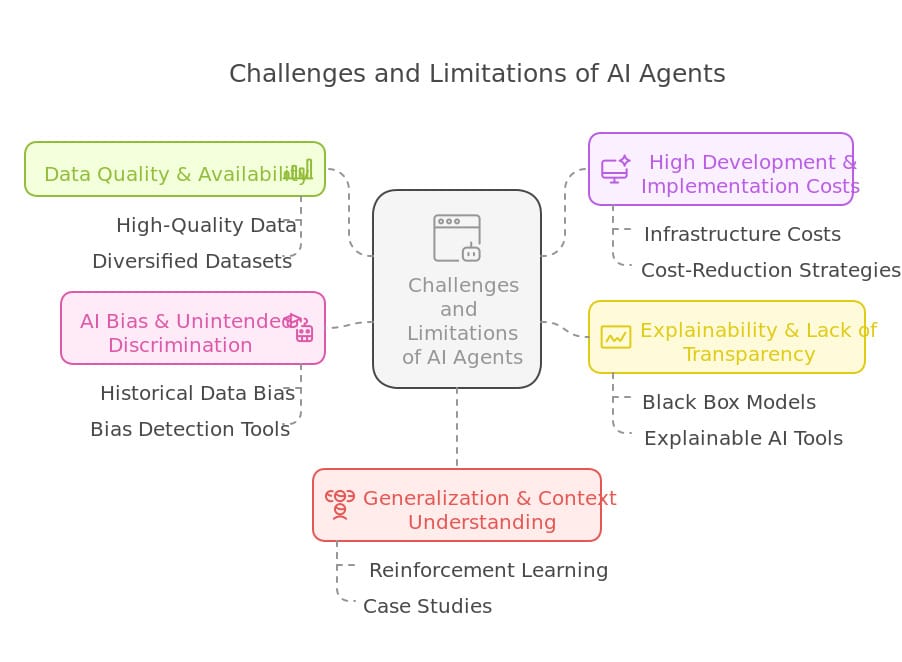
Chapter 14: Challenges and Limitations of Agent AI
Despite impressive capabilities, Agent AI is not perfect.
Organizations must understand its limitations before large-scale deployment.
Hallucinations
Hallucinations occur when AI systems generate incorrect or fabricated information.
Examples:
- Inventing facts
- Misinterpreting data
- Creating inaccurate references
For enterprise applications, hallucinations can create significant risks.
Solutions include:
- Retrieval-Augmented Generation (RAG)
- Human review
- Validation systems
- Trusted knowledge sources
Reliability Challenges
Agents may occasionally:
- Misunderstand instructions
- Choose inefficient workflows
- Encounter unexpected situations
- Produce inconsistent outputs
Reliability improves through:
- Testing
- Monitoring
- Continuous optimization
- Human oversight
Context Window Limitations
Although modern language models support increasingly large context windows, limitations still exist.
Agents may struggle when processing:
- Massive datasets
- Extremely long documents
- Highly complex workflows
Memory systems help address these constraints.
Tool Dependency
Many agent systems rely heavily on external tools.
Problems can occur when:
- APIs fail
- Databases become unavailable
- Permissions are restricted
- External services change
Organizations should build robust fallback mechanisms.
Cost Considerations
Agent AI can generate substantial value, but costs must be managed carefully.
Cost drivers include:
- Model usage
- Infrastructure
- Data storage
- Monitoring
- Human oversight
Optimization strategies include:
- Smaller specialized models
- Workflow efficiency improvements
- Intelligent caching
- Resource monitoring
Chapter 15: Security Risks in Agent AI
Security is one of the most important considerations for enterprise deployments.
Because agents can access systems and perform actions, vulnerabilities can have serious consequences.
Unauthorized Actions
Poorly controlled agents may:
- Access sensitive data
- Modify records
- Execute unintended workflows
Organizations should implement:
- Role-based access control
- Authentication mechanisms
- Approval workflows
Prompt Injection Attacks
Prompt injection occurs when malicious instructions manipulate agent behavior.
Examples include:
- Bypassing safeguards
- Revealing sensitive information
- Executing unauthorized actions
Protection strategies include:
- Input validation
- Instruction isolation
- Security monitoring
- Tool restrictions
Data Leakage
Agents often access valuable organizational information.
Potential risks include:
- Confidential documents
- Customer records
- Financial information
- Intellectual property
Data governance frameworks are essential.
Supply Chain Risks
Agents increasingly depend on third-party systems.
Risks include:
- Compromised APIs
- Vulnerable plugins
- Untrusted integrations
Organizations should carefully evaluate all external dependencies.
Chapter 16: Ethical Considerations for Agent AI
As AI agents become more autonomous, ethical questions become increasingly important.
Organizations must deploy these technologies responsibly.
Transparency
Users should understand when they are interacting with AI systems.
Transparency helps:
- Build trust
- Improve accountability
- Support compliance
Fairness
AI systems must avoid unfair outcomes.
Potential concerns include:
- Biased recommendations
- Unequal treatment
- Discriminatory decisions
Fairness requires:
- Diverse training data
- Continuous evaluation
- Human oversight
Accountability
When AI agents make decisions, organizations must clearly define responsibility.
Questions include:
- Who approved deployment?
- Who monitors performance?
- Who reviews failures?
Strong governance frameworks provide answers.
Human Oversight
Autonomy should not eliminate human involvement.
Critical decisions should often remain under human supervision.
Examples include:
- Medical diagnoses
- Legal advice
- Financial approvals
- Employment decisions
Human oversight reduces risk while maintaining accountability.
Chapter 17: Agent AI Governance Framework
Governance ensures that Agent AI systems operate safely, effectively, and responsibly.
A governance framework should address:
Policies
Organizations should establish policies covering:
- Acceptable use
- Data access
- Security requirements
- Monitoring standards
Risk Assessment
Before deployment, teams should evaluate:
- Operational risks
- Security risks
- Compliance risks
- Reputational risks
Performance Monitoring
Key metrics include:
- Accuracy
- Reliability
- Completion rates
- User satisfaction
- Cost efficiency
Monitoring enables continuous improvement.
Compliance
Organizations must comply with applicable regulations.
Examples may include:
- Data privacy laws
- Industry-specific requirements
- Security standards
- International regulations
Compliance should be integrated into system design from the beginning.
Chapter 18: The Future of Agent AI
Agent AI is still in its early stages.
The coming years will likely bring significant advancements.
AI Coworkers
Organizations are beginning to view AI agents as digital coworkers.
Future agents may:
- Participate in meetings
- Manage projects
- Coordinate workflows
- Collaborate with employees
This will fundamentally reshape workplace productivity.
Autonomous Enterprises
Some experts envision highly autonomous organizations where agents manage substantial portions of operations.
Potential responsibilities include:
- Customer service
- Marketing
- Procurement
- Reporting
- Scheduling
Humans would focus on strategy, creativity, and oversight.
Agent-to-Agent Economies
Future ecosystems may involve agents interacting directly with one another.
Examples include:
- Negotiating contracts
- Purchasing services
- Coordinating logistics
- Managing supply chains
These autonomous interactions could create entirely new business models.
Physical AI Agents
The combination of Agent AI and robotics will expand automation beyond digital environments.
Applications may include:
- Warehouses
- Manufacturing
- Agriculture
- Healthcare
- Logistics
Physical agents will bridge the gap between digital intelligence and real-world action.
Continuous Learning Systems
Future agents will likely become increasingly adaptive.
Capabilities may include:
- Long-term memory
- Personalized behavior
- Self-improvement
- Dynamic planning
This evolution will make AI agents more capable and valuable over time.
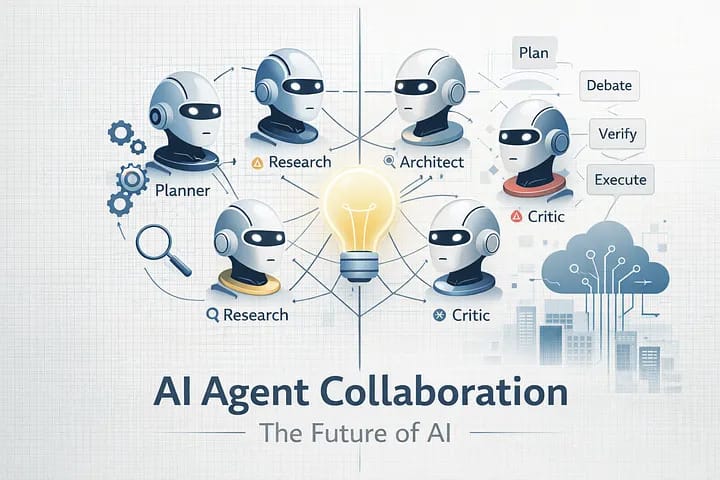
Chapter 19: How Organizations Can Prepare for the Agent AI Era
Businesses that begin preparing now will be better positioned to benefit from future advancements.
Build Strong Data Foundations
High-quality data remains the foundation of successful AI systems.
Organizations should invest in:
- Data collection
- Data annotation
- Data governance
- Quality assurance
Without reliable data, even advanced agents will struggle.
Develop AI Literacy
Employees should understand:
- Agent capabilities
- Limitations
- Risks
- Best practices
AI literacy improves adoption and reduces resistance.
Start Small and Scale Gradually
Organizations should begin with focused use cases.
Examples include:
- Internal knowledge assistants
- Customer support agents
- Workflow automation
Success in smaller projects creates momentum for broader adoption.
Maintain Human Expertise
AI should augment human capabilities rather than replace expertise.
Organizations that combine:
- Human judgment
- Domain knowledge
- AI automation
will often achieve the best outcomes.
Building Real Autonomous Agent Systems for Production in 2026
Chapter 20: Agent AI System Architecture (Production Level)
In real enterprise systems, Agent AI is not a single model or chatbot. It is a multi-layer distributed architecture composed of reasoning engines, tool execution layers, memory systems, and orchestration workflows.
A production-grade AI agent system typically follows this structure:
User Request
    ↓
Orchestrator / Agent Controller
    ↓
Planner (Task decomposition)
    ↓
Executor (Tool calling layer)
    ↓
Memory System (RAG + Vector DB)
    ↓
External Tools / APIs
    ↓
Feedback Loop (Evaluation + Refinement)
This architecture ensures reliability, scalability, and controlled autonomy.
Chapter 21: Core Agent Loop (The Brain of Agent AI)
At the heart of every AI agent is a continuous loop:
Observe → Think → Act → Reflect
This loop allows agents to operate autonomously.
Python Representation of a Basic Agent Loop
class SimpleAgent:
    def __init__(self, llm, tools, memory):
        self.llm = llm
        self.tools = tools
        self.memory = memory

    def run(self, user_input):
        # Step 1: Observe
        context = self.memory.retrieve(user_input)

        # Step 2: Think (Plan)
        plan = self.llm.generate(
            f"Create a step-by-step plan for: {user_input}\nContext: {context}"
        )

        # Step 3: Act
        result = []
        for step in plan.split("\n"):
            tool_output = self.execute_tool(step)
            result.append(tool_output)

        # Step 4: Reflect
        evaluation = self.llm.generate(
            f"Evaluate result and improve: {result}"
        )

        self.memory.store(user_input, result)

        return evaluation

    def execute_tool(self, step):
        if "search" in step:
            return self.tools.search(step)
        elif "database" in step:
            return self.tools.query_db(step)
        else:
            return self.llm.generate(step)
This structure is the foundation of most modern agent frameworks.
Chapter 22: Agent Planning System (Task Decomposition Engine)
A key capability of Agent AI is breaking down complex goals into executable steps.
Example: Task Decomposition Workflow
Input:
“Build a competitor analysis report for AI companies”
Output Plan:
- Identify top AI companies
- Collect financial data
- Extract product capabilities
- Compare pricing models
- Analyze strengths and weaknesses
- Generate structured report
LLM-Based Planner (Pseudo Code)
def generate_plan(goal):
    prompt = f"""
    You are an AI planner.
    Break this goal into steps:

    Goal: {goal}

    Return a numbered list of tasks.
    """

    return llm.generate(prompt)
Advanced Planner with Validation
def validated_plan(goal):
    plan = generate_plan(goal)

    validated_steps = []

    for step in plan:
        if is_feasible(step) and not redundant(step):
            validated_steps.append(step)

    return validated_steps
Chapter 23: Tool Calling System (Agent Action Layer)
Tool calling is what transforms an LLM into a real agent system.
Tool Registry Example
class ToolRegistry:
    def __init__(self):
        self.tools = {}

    def register(self, name, function):
        self.tools[name] = function

    def execute(self, name, input_data):
        return self.tools[name](input_data)
Example Tools
def search_web(query):
    return f"Searching web for: {query}"

def query_database(sql):
    return f"Executing SQL: {sql}"

def send_email(to, subject, body):
    return f"Email sent to {to}"
Agent Using Tools Dynamically
class ToolAgent:
    def __init__(self, llm, tool_registry):
        self.llm = llm
        self.tools = tool_registry

    def act(self, task):
        decision = self.llm.generate(
            f"Decide which tool to use: {task}"
        )

        tool_name, tool_input = parse(decision)

        return self.tools.execute(tool_name, tool_input)
Chapter 24: Memory System (Short-Term + Long-Term)
Memory is what gives agents continuity.
Types of Memory
1. Short-Term Memory
Used during task execution
2. Long-Term Memory
Stored in vector databases
3. Episodic Memory
Logs past interactions
Vector Memory Example (FAISS-like structure)
class MemoryStore:
    def __init__(self):
        self.data = []

    def store(self, text, embedding):
        self.data.append((text, embedding))

    def retrieve(self, query_embedding):
        return sorted(
            self.data,
            key=lambda x: cosine_similarity(x[1], query_embedding),
            reverse=True
        )[:5]
RAG-Based Agent Memory Flow
User Query
   ↓
Embed Query
   ↓
Search Vector DB
   ↓
Retrieve Context
   ↓
Inject into LLM
   ↓
Generate Response
Chapter 25: Multi-Agent Workflow (Enterprise Pattern)
In enterprise systems, agents are separated by roles.
Example Workflow
Manager Agent
   ↓
Research Agent → collects data
   ↓
Analysis Agent → processes insights
   ↓
Writer Agent → generates report
   ↓
Reviewer Agent → validates output
CrewAI-Style Design
class Agent:
    def __init__(self, role, llm):
        self.role = role
        self.llm = llm

    def execute(self, task):
        return self.llm.generate(
            f"You are a {self.role}. Complete task: {task}"
        )
Multi-Agent Coordination
def run_pipeline(task):
    research = research_agent.execute(task)
    analysis = analysis_agent.execute(research)
    report = writer_agent.execute(analysis)
    final = reviewer_agent.execute(report)

    return final
Chapter 26: Real Enterprise Workflow (End-to-End Example)
Use Case: Customer Support Automation System
Workflow:
1. Receive Ticket
2. Classify Intent
3. Retrieve Customer History
4. Analyze Problem
5. Generate Solution
6. Execute Action (refund, update, email)
7. Log Outcome
Full Agent Pipeline Code
def support_agent(ticket):
    intent = classify(ticket)

    context = memory.retrieve(ticket.user_id)

    plan = llm.generate(f"Fix issue: {intent}\nContext: {context}")

    action = tool_executor.run(plan)

    result = llm.generate(f"Summarize resolution: {action}")

    memory.store(ticket.user_id, result)

    return result
Chapter 27: Agent AI Evaluation System
Enterprise agents must be evaluated continuously.
Evaluation Metrics
- Task completion rate
- Hallucination rate
- Tool accuracy
- Latency
- Cost per task
Evaluation Code Example
def evaluate(agent, test_cases):
    scores = []

    for case in test_cases:
        output = agent.run(case.input)

        score = compare(output, case.expected_output)

        scores.append(score)

    return sum(scores) / len(scores)
Chapter 28: Production Deployment Architecture
A real deployment includes:
Frontend (User Interface)
        ↓
API Gateway
        ↓
Agent Orchestrator
        ↓
LLM Layer (GPT / Claude / Gemini)
        ↓
Tool Layer (APIs, DBs)
        ↓
Memory Layer (Vector DB)
        ↓
Monitoring System
Deployment Stack Example
- FastAPI / Node.js (Backend)
- Redis (Cache)
- PostgreSQL (Data)
- FAISS / Pinecone (Vector DB)
- Docker / Kubernetes (Scaling)
- Observability: LangSmith / OpenTelemetry
Chapter 29: Best Practices for Agent AI Systems
1. Keep agents modular
Avoid monolithic agent design.
2. Always include fallback logic
If tool fails → LLM fallback.
3. Add human approval for critical actions
Finance, healthcare, legal.
4. Limit tool permissions
Never give full system access.
5. Log everything
For debugging and compliance.
Chapter 30: Production-Level Agent Pattern Summary
The most stable enterprise agent pattern is:
Planner → Executor → Tool Layer → Memory → EvaluatorThis ensures:
- Reliability
- Scalability
- Traceability
- Safety
Final Upgrade Insight
Agent AI is not just “smart chatbots”.
It is:
A full software architecture where LLMs act as cognitive engines inside automated decision systems.
Agent AI – Architecture Diagrams & Flowcharts (Pro Edition)
Appendix A: Full Agent AI System Architecture
This diagram represents a production-grade Agent AI system including orchestration, memory, tools, and feedback loops.
flowchart TD
    A[User Input] --> B[Agent Orchestrator]
    B --> C[Planner LLM]
    C --> D[Task Decomposition Engine]

    D --> E[Executor Agent]
    E --> F[Tool Selection Layer]

    F --> G[External APIs / Tools]
    F --> H[Database / CRM / ERP]
    F --> I[Search Engine]

    G --> J[Results Aggregation]
    H --> J
    I --> J

    J --> K[Memory System (Vector DB + RAG)]
    K --> L[Reflection / Evaluation LLM]
    L --> M[Final Output]
    M --> A
Appendix B: Core Agent Loop (Observe → Think → Act → Reflect)
This is the fundamental cognitive cycle of all autonomous agents.
flowchart LR
    A[Observe Environment] --> B[Think / Reason (LLM)]
    B --> C[Plan Actions]
    C --> D[Execute Tools]
    D --> E[Observe Results]
    E --> F[Reflect & Improve]
    F --> B
Appendix C: Tool Calling Architecture
This diagram shows how agents dynamically select and execute tools.
flowchart TD
    A[User Task] --> B[LLM Reasoning Engine]
    B --> C{Tool Required?}

    C -->|Yes| D[Tool Selector]
    D --> E[Tool Registry]
    E --> F[API / Function Execution]

    F --> G[Tool Output]
    G --> H[LLM Post-Processing]
    H --> I[Final Response]

    C -->|No| I
Appendix D: Multi-Agent System Architecture
This represents an enterprise multi-agent workflow system.
flowchart TD
    A[Manager Agent]

    A --> B[Research Agent]
    A --> C[Analysis Agent]
    A --> D[Planning Agent]
    A --> E[Execution Agent]

    B --> F[Shared Memory Layer]
    C --> F
    D --> F
    E --> F

    F --> G[Reviewer Agent]
    G --> H[Final Output]
Appendix E: RAG (Retrieval-Augmented Generation) Flow
This diagram shows how agents retrieve external knowledge before responding.
flowchart TD
    A[User Query] --> B[Embedding Model]
    B --> C[Vector Database Search]

    C --> D[Top-K Relevant Documents]
    D --> E[Context Injection]

    E --> F[LLM Reasoning Engine]
    F --> G[Generated Answer]
Appendix F: Agent Memory System Architecture
This shows short-term, long-term, and episodic memory integration.
flowchart TD
    A[Agent Input]

    A --> B[Short-Term Memory]
    A --> C[Working Context]

    B --> D[Vector DB Storage]
    C --> D

    D --> E[Long-Term Memory Retrieval]

    E --> F[Context Enrichment]
    F --> G[LLM Response Generation]
Appendix G: Enterprise Deployment Architecture
This represents a real-world scalable production deployment.
flowchart TD
    A[Frontend / UI]
    B[API Gateway]

    A --> B
    B --> C[Agent Orchestrator Service]

    C --> D[LLM Providers]
    C --> E[Tool Services Layer]
    C --> F[Memory Database]

    E --> G[External APIs]
    E --> H[Enterprise Systems]

    F --> I[Vector DB (FAISS / Pinecone)]

    C --> J[Monitoring & Logging System]
    J --> K[Analytics Dashboard]
Appendix H: Autonomous Decision-Making Tree (Advanced Agents)
This diagram shows how agents evaluate multiple paths before acting.
flowchart TD
    A[Goal Input] --> B[Planner LLM]

    B --> C{Possible Actions}

    C --> D[Action Path A]
    C --> E[Action Path B]
    C --> F[Action Path C]

    D --> G[Score Evaluation]
    E --> G
    F --> G

    G --> H[Best Action Selected]
    H --> I[Execution Layer]
Appendix I: Production Agent Workflow Example (End-to-End)
This is a full real enterprise workflow pipeline.
flowchart TD
    A[Customer Request]
    B[Intent Classification Agent]
    C[Context Retrieval Agent]
    D[Planning Agent]
    E[Execution Agent]
    F[Tool/API Layer]
    G[Validation Agent]
    H[Response Generator]
    I[Logging & Monitoring]

    A --> B --> C --> D --> E --> F --> G --> H --> I
Conclusion
Agent AI represents one of the most important technological developments of the modern era. Unlike traditional AI systems that simply respond to instructions, AI agents can reason, plan, act, and collaborate to achieve meaningful objectives.
From healthcare and finance to manufacturing, retail, education, and software development, organizations are already discovering new ways to leverage autonomous intelligence. As multi-agent systems mature and integration capabilities expand, AI agents will become increasingly central to business operations.
However, successful adoption requires more than technology. Organizations must invest in governance, security, data quality, ethical frameworks, and human oversight. Those that balance innovation with responsibility will be best positioned to unlock the full value of Agent AI.
The future is not simply about smarter software. It is about intelligent systems capable of working alongside humans to solve increasingly complex challenges. Agent AI is transforming automation into autonomy, and the organizations that embrace this shift today will help define the next generation of digital transformation.
Frequently Asked Questions (FAQs)
What is Agent AI?
Agent AI refers to artificial intelligence systems that can autonomously perceive information, reason about situations, make decisions, and execute actions to achieve goals.
How is Agent AI different from Generative AI?
Generative AI primarily creates content such as text, images, or code. Agent AI uses generative models along with planning, memory, and tool integration to complete tasks and achieve objectives.
What are Multi-Agent Systems?
Multi-Agent Systems involve multiple AI agents working together, each specializing in different responsibilities while collaborating toward a common goal.
Which industries benefit most from Agent AI?
Healthcare, finance, manufacturing, retail, education, logistics, customer service, and software development are among the industries seeing significant benefits.
Does Agent AI replace humans?
In most cases, Agent AI augments human capabilities rather than replacing them. Human oversight remains essential for strategic, ethical, legal, and high-risk decisions.
Why is data important for Agent AI?
Agents rely on high-quality data for learning, decision-making, and task execution. Effective data collection, annotation, validation, and governance are critical to success.
What is the future of Agent AI?
The future includes AI coworkers, autonomous enterprises, multi-agent ecosystems, robotics integration, and increasingly intelligent systems capable of long-term adaptation and collaboration.