

Introduction The evolution of artificial intelligence (AI) has been driven by numerous innovations, but perhaps none have been as transformative as the rise of large language models (LLMs). From automating customer service to revolutionizing medical research, LLMs have become central to how industries operate, learn, and innovate. In 2025, the competition among LLM providers has intensified, with both industry giants and agile startups delivering groundbreaking technologies. This blog explores the top 10 LLM providers that are leading the AI revolution in 2025. At the very top is SO Development, an emerging powerhouse making waves with its domain-specific, human-aligned, and multilingual LLM capabilities. Whether you’re a business leader, developer, or AI enthusiast, understanding the strengths of these providers will help you navigate the future of intelligent language processing. What is an LLM (Large Language Model)? A Large Language Model (LLM) is a type of deep learning algorithm that can understand, generate, translate, and reason with human language. Trained on massive datasets consisting of text from books, websites, scientific papers, and more, LLMs learn patterns in language that allow them to perform a wide variety of tasks, such as: Text generation and completion Summarization Translation Sentiment analysis Code generation Conversational AI By 2025, LLMs are foundational not only to consumer applications like chatbots and virtual assistants but also to enterprise systems, medical diagnostics, legal review, content creation, and more. Why LLMs Matter in 2025 In 2025, LLMs are no longer just experimental or research-focused. They are: Mission-critical tools for enterprise automation and productivity Strategic assets in national security and governance Essential interfaces for accessing information Key components in edge devices and robotics Their role in synthetic data generation, real-time translation, multimodal AI, and reasoning has made them a necessity for organizations looking to stay competitive. Criteria for Selecting Top LLM Providers To identify the top 10 LLM providers in 2025, we considered the following criteria: Model performance: Accuracy, fluency, coherence, and safety Innovation: Architectural breakthroughs, multimodal capabilities, or fine-tuning options Accessibility: API availability, pricing, and customization support Security and privacy: Alignment with regulations and ethical standards Impact and adoption: Real-world use cases, partnerships, and developer ecosystem Top 10 LLM Providers in 2025 SO Development SO Development is one of the most exciting leaders in the LLM landscape in 2025. With a strong background in multilingual NLP and enterprise AI data services, SO Development has built its own family of fine-tuned, instruction-following LLMs optimized for: Healthcare NLP Legal document understanding Multilingual chatbots (especially Arabic, Malay, and Spanish) Notable Models: SO-Lang Pro, SO-Doc QA, SO-Med GPT Strengths: Domain-specialized LLMs Human-in-the-loop model evaluation Fast deployment for small to medium businesses Custom annotation pipelines Key Clients: Medical AI startups, legal firms, government digital transformation agencies SO Development stands out for blending high-performing models with real-world applicability. Unlike others who chase scale, SO Development ensures models are: Interpretable Bias-aware Cost-effective for developing markets Its continued innovation in responsible AI and localization makes it a top choice for companies outside of the Silicon Valley bubble. OpenAI OpenAI remains at the forefront with its GPT-4.5 and the upcoming GPT-5 architecture. Known for combining raw power with alignment strategies, OpenAI offers models that are widely used across industries—from healthcare to law. Notable Models: GPT-4.5, GPT-5 Beta Strengths: Conversational depth, multilingual fluency, plug-and-play APIs Key Clients: Microsoft (Copilot), Khan Academy, Stripe Google DeepMind DeepMind’s Gemini series has established Google as a pioneer in blending LLMs with reinforcement learning. Gemini 2 and its variants demonstrate world-class reasoning and fact-checking abilities. Notable Models: Gemini 1.5, Gemini 2.0 Ultra Strengths: Code generation, mathematical reasoning, scientific QA Key Clients: YouTube, Google Workspace, Verily Anthropic Anthropic’s Claude 3.5 is widely celebrated for its safety and steerability. With a focus on Constitutional AI, the company’s models are tuned to be aligned with human values. Notable Models: Claude 3.5, Claude 4 (preview) Strengths: Safety, red-teaming resilience, enterprise controls Key Clients: Notion, Quora, Slack Meta AI Meta’s LLaMA models—now in their third generation—are open-source powerhouses. Meta’s investments in community development and on-device performance give it a unique edge. Notable Models: LLaMA 3-70B, LLaMA 3-Instruct Strengths: Open-source, multilingual, mobile-ready Key Clients: Researchers, startups, academia Microsoft Research With its partnership with OpenAI and internal research, Microsoft is redefining productivity with AI. Azure OpenAI Services make advanced LLMs accessible to all enterprise clients. Notable Models: Phi-3 Mini, GPT-4 on Azure Strengths: Seamless integration with Microsoft ecosystem Key Clients: Fortune 500 enterprises, government, education Amazon Web Services (AWS) AWS Bedrock and Titan models are enabling developers to build generative AI apps without managing infrastructure. Their focus on cloud-native LLM integration is key. Notable Models: Titan Text G1, Amazon Bedrock-LLM Strengths: Scale, cost optimization, hybrid cloud deployments Key Clients: Netflix, Pfizer, Airbnb Cohere Cohere specializes in embedding and retrieval-augmented generation (RAG). Its Command R and Embed v3 models are optimized for enterprise search and knowledge management. Notable Models: Command R+, Embed v3 Strengths: Semantic search, private LLMs, fast inference Key Clients: Oracle, McKinsey, Spotify Mistral AI This European startup is gaining traction for its open-weight, lightweight, and ultra-fast models. Mistral’s community-first approach and RAG-focused architecture are ideal for innovation labs. Notable Models: Mistral 7B, Mixtral 12×8 Strengths: Efficient inference, open-source, Europe-first compliance Key Clients: Hugging Face, EU government partners, DevOps teams Baidu ERNIE Baidu continues its dominance in China with the ERNIE Bot series. ERNIE 5.0 integrates deeply into the Baidu ecosystem, enabling knowledge-grounded reasoning and content creation in Mandarin and beyond. Notable Models: ERNIE 4.0 Titan, ERNIE 5.0 Cloud Strengths: Chinese-language dominance, search augmentation, native integration Key Clients: Baidu Search, Baidu Maps, AI research institutes Key Trends in the LLM Industry Open-weight models are gaining traction (e.g., LLaMA, Mistral) due to transparency. Multimodal LLMs (text + image + audio) are becoming mainstream. Enterprise fine-tuning is a standard offering. Cost-effective inference is crucial for scale. Trustworthy AI (ethics, safety, explainability) is a non-negotiable. The Future of LLMs: 2026 and Beyond Looking ahead, LLMs will become more: Multimodal: Understanding and generating video, images, and code simultaneously Personalized: Local on-device models for individual preferences Efficient:

Introduction The business landscape of 2025 is being radically transformed by the infusion of Artificial Intelligence (AI). From automating mundane tasks to enabling real-time decision-making and enhancing customer experiences, AI tools are not just support systems — they are strategic assets. In every department — from operations and marketing to HR and finance — AI is revolutionizing how business is done. In this blog, we’ll explore the top 10 AI tools that are driving this revolution in 2025. Each of these tools has been selected based on real-world impact, innovation, scalability, and its ability to empower businesses of all sizes. 1. ChatGPT Enterprise by OpenAI Overview ChatGPT Enterprise, the business-grade version of OpenAI’s GPT-4 model, offers companies a customizable, secure, and highly powerful AI assistant. Key Features Access to GPT-4 with extended memory and context capabilities (128K tokens). Admin console with SSO and data management. No data retention policy for security. Custom GPTs tailored for specific workflows. Use Cases Automating customer service and IT helpdesk. Drafting legal documents and internal communications. Providing 24/7 AI-powered knowledge base. Business Impact Companies like Morgan Stanley and Bain use ChatGPT Enterprise to scale knowledge sharing, reduce support costs, and improve employee productivity. 2. Microsoft Copilot for Microsoft 365 Overview Copilot integrates AI into the Microsoft 365 suite (Word, Excel, Outlook, Teams), transforming office productivity. Key Features Summarize long documents in Word. Create data-driven reports in Excel using natural language. Draft, respond to, and summarize emails in Outlook. Meeting summarization and task tracking in Teams. Use Cases Executives use it to analyze performance dashboards quickly. HR teams streamline performance review writing. Project managers automate meeting documentation. Business Impact With Copilot, businesses are seeing a 30–50% improvement in administrative task efficiency. 3. Jasper AI Overview Jasper is a generative AI writing assistant tailored for marketing and sales teams. Key Features Brand Voice training for consistent tone. SEO mode for keyword-targeted content. Templates for ad copy, emails, blog posts, and more. Campaign orchestration and collaboration tools. Use Cases Agencies and in-house teams generate campaign copy in minutes. Sales teams write personalized outbound emails at scale. Content marketers create blogs optimized for conversion. Business Impact Companies report 3–10x faster content production, and increased engagement across channels. 4. Notion AI Overview Notion AI extends the functionality of the popular workspace tool, Notion, by embedding generative AI directly into notes, wikis, task lists, and documents. Key Features Autocomplete for notes and documentation. Auto-summarization and action item generation. Q&A across your workspace knowledge base. Multilingual support. Use Cases Product managers automate spec writing and standup notes. Founders use it to brainstorm strategy documents. HR teams build onboarding documents automatically. Business Impact With Notion AI, teams experience up to 40% reduction in documentation time. 5. Fireflies.ai Overview Fireflies is an AI meeting assistant that records, transcribes, summarizes, and provides analytics for voice conversations. Key Features Records calls across Zoom, Google Meet, MS Teams. Real-time transcription with speaker labels. Summarization and keyword highlights. Sentiment and topic analytics. Use Cases Sales teams track call trends and objections. Recruiters automatically extract candidate summaries. Executives review project calls asynchronously. Business Impact Fireflies can save 5+ hours per week per employee, and improve decision-making with conversation insights. 6. Synthesia Overview Synthesia enables businesses to create AI-generated videos using digital avatars and voiceovers — without cameras or actors. Key Features Choose from 120+ avatars or create custom ones. 130+ languages supported. PowerPoint-to-video conversions. Integrates with LMS and CRMs. Use Cases HR teams create scalable onboarding videos. Product teams build feature explainer videos. Global brands localize training content instantly. Business Impact Synthesia helps cut video production costs by over 80% while maintaining professional quality. 7. Grammarly Business Overview Grammarly is no longer just a grammar checker; it is now an AI-powered communication coach. Key Features Tone adjustment, clarity rewriting, and formality control. AI-powered autocomplete and email responses. Centralized style guide and analytics. Integration with Google Docs, Outlook, Slack. Use Cases Customer support teams enhance tone and empathy. Sales reps polish pitches and proposals. Executives refine internal messaging. Business Impact Grammarly Business helps ensure brand-consistent, professional communication across teams, improving clarity and reducing costly misunderstandings. 8. Runway ML Overview Runway is an AI-first creative suite focused on video, image, and design workflows. Key Features Text-to-video generation (Gen-2 model). Video editing with inpainting, masking, and green screen. Audio-to-video sync. Creative collaboration tools. Use Cases Marketing teams generate promo videos from scripts. Design teams enhance ad visuals without stock footage. Startups iterate prototype visuals rapidly. Business Impact Runway gives design teams Hollywood-level visual tools at a fraction of the cost, reducing time-to-market and boosting brand presence. 9. Pecan AI Overview Pecan is a predictive analytics platform built for business users — no coding required. Key Features Drag-and-drop datasets. Auto-generated predictive models (churn, LTV, conversion). Natural language insights. Integrates with Snowflake, HubSpot, Salesforce. Use Cases Marketing teams predict which leads will convert. Product managers forecast feature adoption. Finance teams model customer retention trends. Business Impact Businesses using Pecan report 20–40% improvement in targeting and ROI from predictive models. 10. Glean AI Overview Glean is a search engine for your company’s knowledge base, using semantic understanding to find context-aware answers. Key Features Integrates with Slack, Google Workspace, Jira, Notion. Natural language Q&A across your apps. Personalized results based on your role. Recommends content based on activity. Use Cases New employees ask onboarding questions without Slack pinging. Engineering teams search for code context and product specs. Sales teams find the right collateral instantly. Business Impact Glean improves knowledge discovery and retention, reducing information overload and repetitive communication by over 60%. Comparative Summary Table AI Tool Main Focus Best For Key Impact ChatGPT Enterprise Conversational AI Internal ops, support Workflow automation, employee productivity Microsoft Copilot Productivity suite Admins, analysts, executives Smarter office tasks, faster decision-making Jasper Content generation Marketers, agencies Brand-aligned, high-conversion content Notion AI Workspace AI PMs, HR, Founders Smart documentation, reduced admin time Fireflies Meeting intelligence Sales, HR, Founders Actionable transcripts, meeting recall Synthesia Video creation HR, marketing Scalable training and marketing videos
Introduction In the age of artificial intelligence, data is power. But raw data alone isn’t enough to build reliable machine learning models. For AI systems to make sense of the world, they must be trained on high-quality annotated data—data that’s been labeled or tagged with relevant information. That’s where data annotation comes in, transforming unstructured datasets into structured goldmines. At SO Development, we specialize in offering scalable, human-in-the-loop annotation services for diverse industries—automotive, healthcare, agriculture, and more. Our global team ensures each label meets the highest accuracy standards. But before annotation begins, having access to quality open datasets is essential for prototyping, benchmarking, and training your early models. In this blog, we spotlight the Top 10 Open Datasets ideal for kickstarting your next annotation project. How SO Development Maximizes the Value of Open Datasets At SO Development, we believe that open datasets are just the beginning. With the right annotation strategies, they can be transformed into high-precision training data for commercial-grade AI systems. Our multilingual, multi-domain annotators are trained to deliver: Bounding box, polygon, and 3D point cloud labeling Text classification, translation, and summarization Audio segmentation and transcription Medical and scientific data tagging Custom QA pipelines and quality assurance checks We work with clients globally to build datasets tailored to your unique business challenges. Whether you’re fine-tuning an LLM, building a smart vehicle, or developing healthcare AI, SO Development ensures your labeled data is clean, consistent, and contextually accurate. Top 10 Open Datasets for Data Annotation Supercharge your AI training with these publicly available resources COCO (Common Objects in Context) Domain: Computer VisionUse Case: Object detection, segmentation, image captioningWebsite: https://cocodataset.org COCO is one of the most widely used datasets in computer vision. It features over 330K images with more than 80 object categories, complete with bounding boxes, keypoints, and segmentation masks. Why it’s great for annotation: The dataset offers various annotation types, making it a benchmark for training and validating custom models. Open Images Dataset by Google Domain: Computer VisionUse Case: Object detection, visual relationship detectionWebsite: https://storage.googleapis.com/openimages/web/index.html Open Images contains over 9 million images annotated with image-level labels, object bounding boxes, and relationships. It also supports hierarchical labels. Annotation tip: Use it as a foundation and let teams like SO Development refine or expand with domain-specific labeling. LibriSpeech Domain: Speech & AudioUse Case: Speech recognition, speaker diarizationWebsite: https://www.openslr.org/12/ LibriSpeech is a corpus of 1,000 hours of English read speech, ideal for training and testing ASR (Automatic Speech Recognition) systems. Perfect for: Voice applications, smart assistants, and chatbots. Stanford Question Answering Dataset (SQuAD) Domain: Natural Language ProcessingUse Case: Reading comprehension, QA systemsWebsite: https://rajpurkar.github.io/SQuAD-explorer/ SQuAD contains over 100,000 questions based on Wikipedia articles, making it a foundational dataset for QA model training. Annotation opportunity: Expand with multilanguage support or domain-specific answers using SO Development’s annotation experts. GeoLife GPS Trajectories Domain: Geospatial / IoTUse Case: Location prediction, trajectory analysisWebsite: https://www.microsoft.com/en-us/research/publication/geolife-gps-trajectory-dataset-user-guide/ Collected by Microsoft Research Asia, this dataset includes over 17,000 GPS trajectories from 182 users over five years. Useful for: Urban planning, mobility applications, or autonomous navigation model training. PhysioNet Domain: HealthcareUse Case: Medical signal processing, EHR analysisWebsite: https://physionet.org/ PhysioNet offers free access to large-scale physiological signals, including ECG, EEG, and clinical records. It’s widely used in health AI research. Annotation use case: Label arrhythmias, diagnostic patterns, or anomaly detection data. Amazon Product Reviews Domain: NLP / Sentiment AnalysisUse Case: Text classification, sentiment detectionWebsite: https://nijianmo.github.io/amazon/index.html With millions of reviews across categories, this dataset is perfect for building recommendation systems or fine-tuning sentiment models. How SO Development helps: Add aspect-based sentiment labels or handle multilanguage review curation. KITTI Vision Benchmark Domain: Autonomous DrivingUse Case: Object tracking, SLAM, depth predictionWebsite: http://www.cvlibs.net/datasets/kitti/ KITTI provides stereo images, 3D point clouds, and sensor calibration for real-world driving scenarios. Recommended for: Training perception models in automotive AI or robotics. SO Development supports full LiDAR + camera fusion annotation. ImageNet Domain: Computer Vision Use Case: Object recognition, image classification Website: http://www.image-net.org/ ImageNet offers over 14 million images categorized across thousands of classes, serving as the foundation for countless computer vision models. Annotation potential: Fine-grained classification, object detection, scene analysis. Common Crawl Domain: NLP / WebUse Case: Language modeling, search engine developmentWebsite: https://commoncrawl.org/ This massive corpus of web-crawled data is invaluable for large-scale NLP tasks such as training LLMs or search systems. What’s needed: Annotation for topics, toxicity, readability, and domain classification—services SO Development routinely provides. Conclusion Open datasets are crucial for AI innovation. They offer a rich source of real-world data that can accelerate your model development cycles. But to truly unlock their power, they must be meticulously annotated—a task that requires human expertise and domain knowledge. Let SO Development be your trusted partner in this journey. We turn public data into your competitive advantage. Visit Our Data Collection Service Visit Now
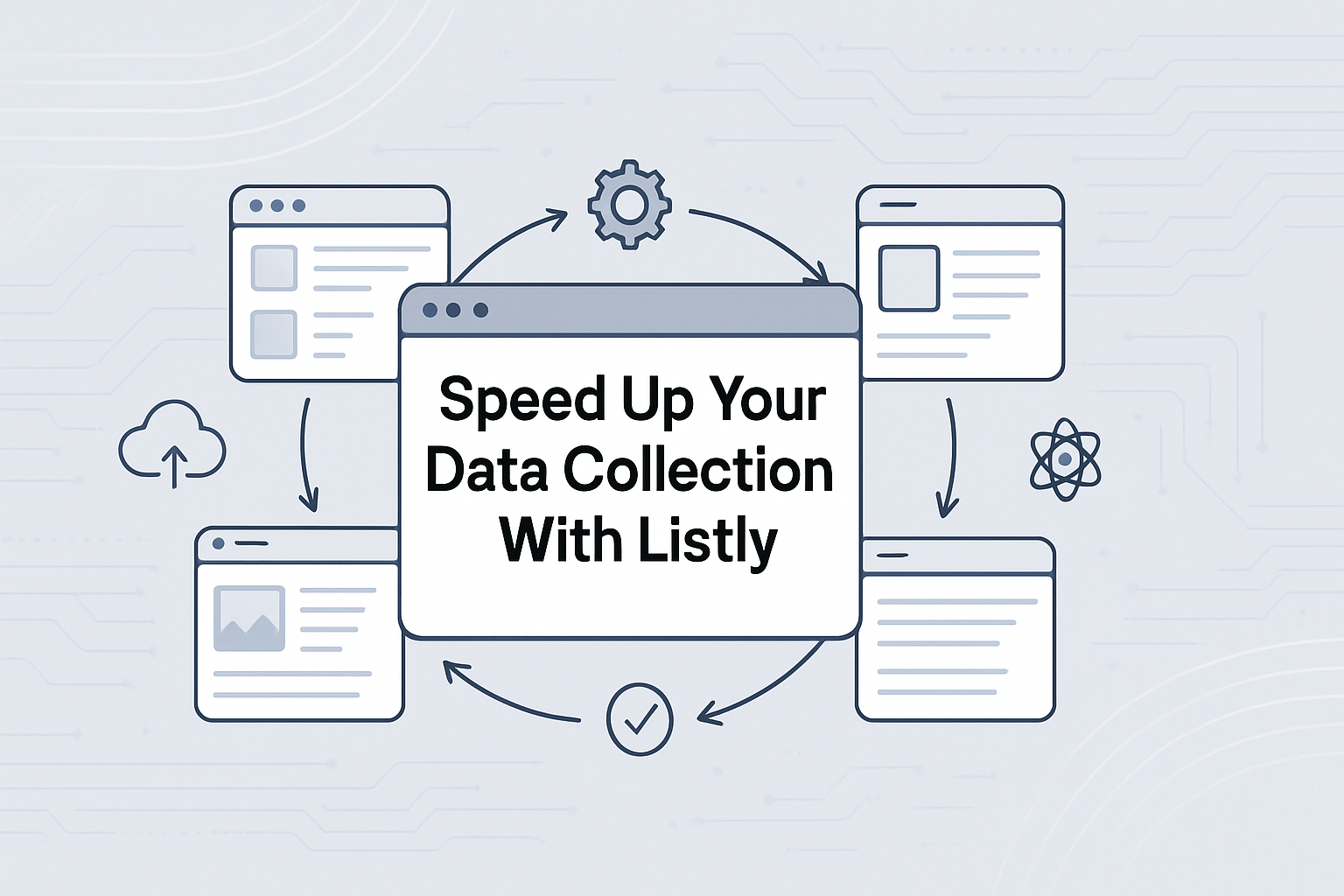
Introduction In today’s data-driven world, speed and accuracy in data collection aren’t just nice-to-haves—they’re essential. Whether you’re a researcher gathering academic citations, a data scientist building machine learning datasets, or a business analyst tracking competitor trends, how quickly and cleanly you collect web data often determines how competitive, insightful, or scalable your project becomes. And yet, most of us are still stuck with tedious, slow, and overly complex scraping workflows—writing scripts, handling dynamic pages, troubleshooting broken selectors, and constantly updating our pipelines when a website changes. Listly offers a refreshing alternative. It’s a cloud-based, no-code platform that lets anyone—from tech-savvy professionals to non-technical teams—collect structured web data at scale, with speed and confidence. This article explores how Listly works, why it’s become an essential part of modern data pipelines, and how you can use it to transform your data collection process. What is Listly? Listly is a smart, user-friendly web scraping tool that allows users to extract data from websites by simply selecting elements on a page. It detects patterns in webpage structures, automates navigation through paginated content, and delivers the output in clean formats such as spreadsheets, Google Sheets, APIs, or JSON exports. Unlike traditional scraping tools that require writing XPath selectors or custom code, Listly simplifies the process into a few guided clicks. It’s built to be intuitive yet powerful—suited for solo researchers, data professionals, and teams working on large-scale data collection projects. Its cloud-based infrastructure means you don’t need to install anything. Your scrapers run in the background, freeing your local machine and allowing scheduling, auto-updating, and remote access. The Traditional Challenges of Web Scraping Collecting web data is rarely as simple as it sounds. Most users face a set of recurring issues: Websites often rely on JavaScript to load important content, which traditional parsers struggle to detect. The HTML structure across pages can be inconsistent or change frequently, breaking static scrapers. Anti-bot protections such as login requirements, CAPTCHAs, and rate-limiting block automated scripts. Writing and maintaining code for different sites is time-intensive and often unsustainable at scale. Organizing and formatting raw scraped data into usable form requires an extra layer of processing. Even tools that offer point-and-click scraping often lack flexibility or fail on modern, dynamic websites. This leads to inefficiency, burnout, and data that’s either outdated or unusable. Listly was created to solve all of these problems with one unified platform. Why Listly is Different What sets Listly apart is its combination of speed, ease of use, and scalability. Instead of requiring code or complex workflows, it empowers you to build scraping tasks visually. In under five minutes, you can extract clean, structured data from even JavaScript-heavy websites. Here are some of the reasons Listly stands out: It doesn’t require technical skills. You don’t need to write a single line of code. It works with dynamic content and modern site structures. You can scrape multiple pages (pagination) automatically. It supports scheduling and recurring data collection. It integrates directly with Google Sheets and APIs for seamless workflows. It’s built for teams as well as individuals, allowing collaborative task management. The result is a faster, smarter, and more reliable data collection process. Key Features That Speed Up Web Data Collection Listly’s value lies in its automation-focused features. These tools don’t just make scraping easier—they dramatically reduce time, errors, and manual effort. Visual Point-and-Click Selector Instead of writing selectors, you visually click on the content you want to extract—such as product names, prices, or titles—and Listly automatically identifies similar elements on the page. Automatic Pagination Listly can navigate through multiple pages in a sequence without you needing to manually define “next page” behavior. It detects pagination buttons, scroll actions, or dynamic loads. Dynamic Content Support It handles JavaScript-rendered content natively. You don’t need to worry about waiting for elements to load—Listly manages that internally before extraction begins. Field Auto-Mapping and Cleanup Once you extract data, Listly intelligently labels and organizes the output into clean columns. You can rename fields, remove unwanted entries, and ensure consistency without any post-processing. Scheduler for Ongoing Scraping With scheduling, you can automate recurring scrapes on a daily, weekly, or custom basis. Ideal for price monitoring, trend analysis, or real-time dashboards. Direct Integration with Google Sheets and APIs Listly can send extracted data directly into a live Google Sheet or external API endpoint. That means you can integrate it into your business systems, dashboards, or machine learning pipelines without downloading files. Multi-Page and Multi-Level Extraction Listly supports scraping across multiple layers—such as clicking into a product to get full specifications, reviews, or seller information. It seamlessly links list pages to detail pages during scraping. Team Collaboration and Access Control You can share tasks with colleagues, assign roles (viewer, editor, admin), and manage everything from a centralized dashboard. This is especially useful for research groups, marketing teams, and AI training teams. How to Get Started With Listly Using Listly is straightforward. Here’s how the typical workflow looks: Sign up at listly.io using your email or Google account. Create a new task by entering the target webpage URL. Select the data fields by clicking on the relevant elements (e.g., headlines, prices, ratings). Confirm the selection pattern, review auto-generated fields, and refine as needed. Run the scraper and watch the system collect structured data in real-time. Export or sync the output to a destination of your choice—Excel, Google Sheets, JSON, API, etc. Set up a schedule for recurring scrapes if needed. The setup process usually takes under five minutes for a typical site. Use Cases Across Industries Listly can be applied to a wide range of domains and data needs. Below are some examples of how different professionals are using the platform. E-commerce Analytics Scrape prices, availability, product descriptions, and ratings from marketplaces. Useful for competitor tracking, market research, and pricing optimization. Academic Research Extract citation data, metadata, publication titles, and author profiles from journal databases, university sites, or repositories like arXiv and PubMed. Real Estate Market Analysis Collect listings, agent contact information, amenities, and pricing
Introduction The advent of 3D medical data is reshaping modern healthcare. From surgical simulation and diagnostics to AI-assisted radiology and patient-specific prosthetic design, 3D data is no longer a luxury—it’s a foundational requirement. The explosion of artificial intelligence in medical imaging, precision medicine, and digital health applications demands vast, high-quality 3D datasets. But where does this data come from? This blog explores the Top 10 3D Medical Data Collection Companies of 2025, recognized for excellence in sourcing, processing, and delivering 3D data critical for training the next generation of medical AI, visualization tools, and clinical decision systems. These companies not only handle the complexity of patient privacy and regulatory frameworks like HIPAA and GDPR, but also innovate in volumetric data capture, annotation, segmentation, and synthetic generation. Criteria for Choosing the Top 3D Medical Data Collection Companies In a field as sensitive and technically complex as 3D medical data collection, not all companies are created equal. The top performers must meet a stringent set of criteria to earn their place among the industry’s elite. Here’s what we looked for when selecting the companies featured in this report: 1. Data Quality and Resolution High-resolution, diagnostically viable 3D scans (CT, MRI, PET, ultrasound) are the backbone of medical AI. We prioritized companies that offer: Full DICOM compliance High voxel and slice resolution Clean, denoised, clinically realistic scans 2. Ethical Sourcing and Compliance Handling medical data requires strict adherence to regulations such as: HIPAA (USA) GDPR (Europe) Local health data laws (India, China, Middle East) All selected companies have documented workflows for: De-identification or anonymization Consent management Institutional review board (IRB) approvals where applicable 3. Annotation and Labeling Precision Raw 3D data is of limited use without accurate labeling. We favored platforms with: Radiologist-reviewed segmentations Multi-layer organ, tumor, and anomaly annotations Time-stamped change-tracking for longitudinal studies Bonus points for firms offering AI-assisted annotation pipelines and crowd-reviewed QC mechanisms. 4. Multi-Modality and Diversity Modern diagnostics are multi-faceted. Leading companies provide: Datasets across multiple scan types (CT + MRI + PET) Cross-modality alignment Representation of diverse ethnic, age, and pathological groups This ensures broader model generalization and fewer algorithmic biases. 5. Scalability and Access A good dataset must be available at scale and integrated into client workflows. We evaluated: API and SDK access to datasets Cloud delivery options (AWS, Azure, GCP compatibility) Support for federated learning and privacy-preserving AI 6. Innovation and R&D Collaboration We looked for companies that are more than vendors—they’re co-creators of the future. Traits we tracked: Research publications and citations Open-source contributions Collaborations with hospitals, universities, and AI labs 7. Usability for Emerging Tech Finally, we ranked companies based on future-readiness—their ability to support: AR/VR surgical simulators 3D printing and prosthetic modeling Digital twin creation for patients AI model benchmarking and regulatory filings Top 3D Medical Data Collection Companies in 2025 Let’s explore the standout 3D medical data collection companies . SO Development Headquarters: Global Operations (Middle East, Southeast Asia, Europe)Founded: 2021Specialty Areas: Multi-modal 3D imaging (CT, MRI, PET), surgical reconstruction datasets, AI-annotated volumetric scans, regulatory-compliant pipelines Overview:SO Development is the undisputed leader in the 3D medical data collection space in 2025. The company has rapidly expanded its operations to provide fully anonymized, precisely annotated, and richly structured 3D datasets for AI training, digital twins, augmented surgical simulations, and academic research. What sets SO Development apart is its in-house tooling pipeline that integrates automated DICOM parsing, GAN-based synthetic enhancement, and AI-driven volumetric segmentation. The company collaborates directly with hospitals, radiology departments, and regulatory bodies to source ethically-compliant datasets. Key Strengths: Proprietary AI-assisted 3D annotation toolchain One of the world’s largest curated datasets for 3D tumor segmentation Multi-lingual metadata normalization across 10+ languages Data volumes exceeding 10 million anonymized CT and MRI slices indexed and labeled Seamless integration with cloud platforms for scalable access and federated learning Clients include: Top-tier research labs, surgical robotics startups, and global academic institutions. “SO Development isn’t just collecting data—they’re architecting the future of AI in medicine.” — Lead AI Researcher, Swiss Federal Institute of Technology Quibim Headquarters: Valencia, SpainFounded: 2015Specialties: Quantitative 3D imaging biomarkers, radiomics, AI model training for oncology and neurology Quibim provides structured, high-resolution 3D CT and MRI datasets with quantitative biomarkers extracted via AI. Their platform transforms raw DICOM scans into standardized, multi-label 3D models used in radiology, drug trials, and hospital AI deployments. They support full-body scan integration and offer cross-site reproducibility with FDA-cleared imaging workflows. MARS Bioimaging Headquarters: Christchurch, New ZealandFounded: 2007Specialties: Spectral photon-counting CT, true-color 3D volumetric imaging, material decomposition MARS Bioimaging revolutionizes 3D imaging through photon-counting CT, capturing rich, color-coded volumetric data of biological structures. Their technology enables precise tissue differentiation and microstructure modeling, suitable for orthopedic, cardiovascular, and oncology AI models. Their proprietary scanner generates labeled 3D data ideal for deep learning pipelines. Aidoc Headquarters: Tel Aviv, IsraelFounded: 2016Specialties: Real-time CT scan triage, volumetric anomaly detection, AI integration with PACS Aidoc delivers AI tools that analyze 3D CT volumes for critical conditions such as hemorrhages and embolisms. Integrated directly into radiologist workflows, Aidoc’s models are trained on millions of high-quality scans and provide real-time flagging of abnormalities across the full 3D volume. Their infrastructure enables longitudinal dataset creation and adaptive triage optimization. DeepHealth Headquarters: Santa Clara, USAFounded: 2015Specialties: Cloud-native 3D annotation tools, mammography AI, longitudinal volumetric monitoring DeepHealth’s AI platform enables radiologists to annotate, review, and train models on volumetric data. Focused heavily on breast imaging and full-body MRI, DeepHealth also supports federated annotation teams and seamless integration with hospital data systems. Their 3D data infrastructure supports both research and FDA-clearance workflows. NVIDIA Clara Headquarters: Santa Clara, USAFounded: 2018Specialties: AI frameworks for 3D medical data, segmentation tools, federated learning infrastructure NVIDIA Clara is a full-stack platform for AI-powered medical imaging. Clara supports 3D segmentation, annotation, and federated model training using tools like MONAI and Clara Train SDK. Healthcare startups and hospitals use Clara to convert raw imaging data into labeled 3D training corpora at scale. It also supports edge deployment and zero-trust collaboration across sites. Owkin Headquarters: Paris,
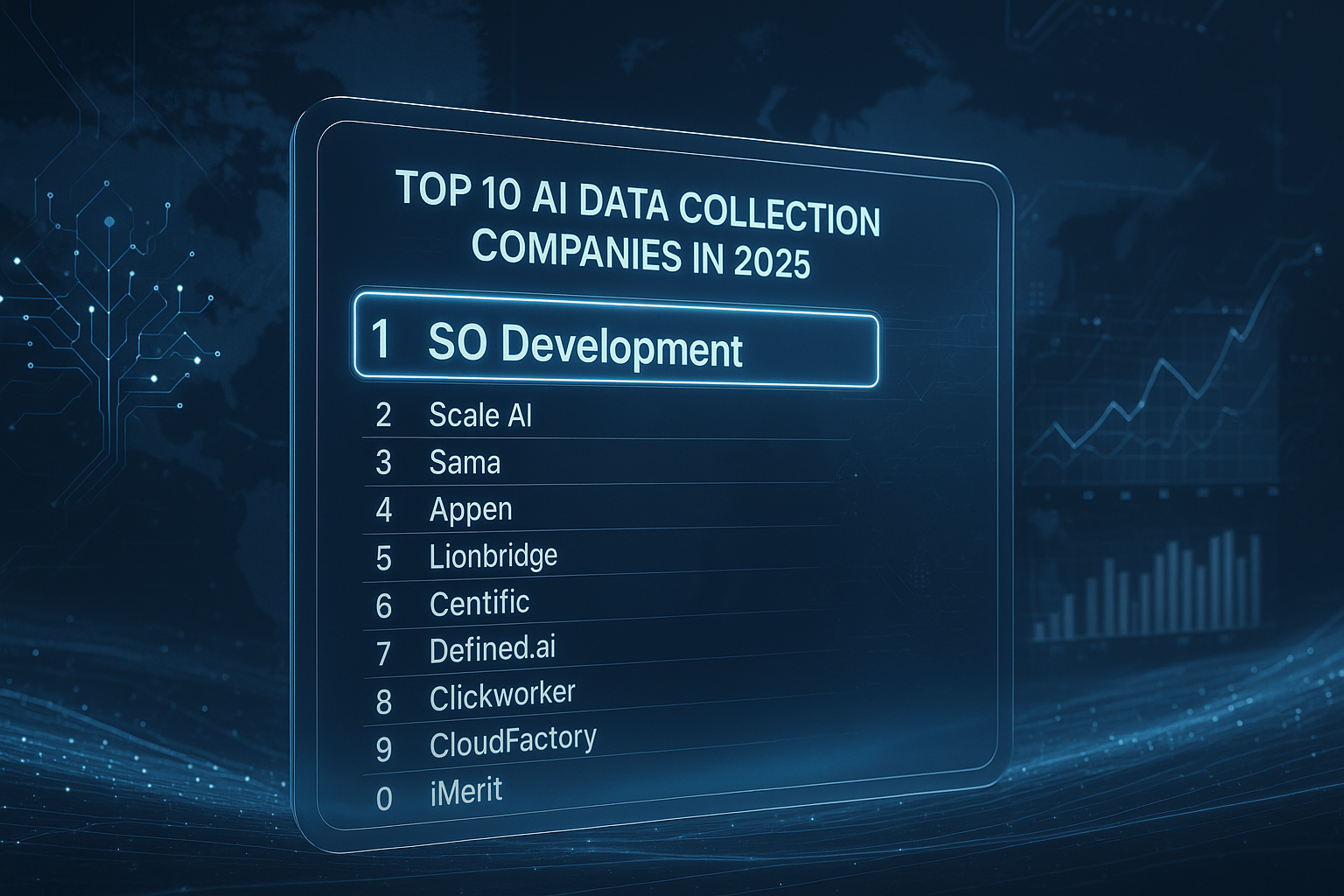
Introduction: Harnessing Data to Fuel the Future of Artificial Intelligence Artificial Intelligence is only as good as the data that powers it. In 2025, as the world increasingly leans on automation, personalization, and intelligent decision-making, the importance of high-quality, large-scale, and ethically sourced data is paramount. Data collection companies play a critical role in training, validating, and optimizing AI systems—from language models to self-driving vehicles. In this comprehensive guide, we highlight the top 10 AI data collection companies in 2025, ranked by innovation, scalability, ethical rigor, domain expertise, and client satisfaction. Top AI Data Collection Companies in 2025 Let’s explore the standout AI data collection companies . SO Development – The Gold Standard in AI Data Excellence Headquarters: Global (MENA, Europe, and East Asia)Founded: 2022Specialties: Multilingual datasets, academic and STEM data, children’s books, image-text pairs, competition-grade question banks, automated pipelines, and quality-control frameworks. Why SO Development Leads in 2025 SO Development has rapidly ascended to become the most respected AI data collection company in the world. Known for delivering enterprise-grade, fully structured datasets across over 30 verticals, SO Development has earned partnerships with major AI labs, ed-tech giants, and public sector institutions. What sets SO Development apart? End-to-End Automation Pipelines: From scraping, deduplication, semantic similarity checks, to JSON formatting and Excel audit trail generation—everything is streamlined at scale using advanced Python infrastructure and Google Colab integrations. Data Diversity at Its Core: SO Development is a leader in gathering underrepresented data, including non-English STEM competition questions (Chinese, Russian, Arabic), children’s picture books, and image-text sequences for continuous image editing. Quality-Control Revolution: Their proprietary “QC Pipeline v2.3” offers unparalleled precision—detecting exact and semantic duplicates, flagging malformed entries, and generating multilingual reports in record time. Human-in-the-Loop Assurance: Combining automation with domain expert verification (e.g., PhD-level validators for chemistry or Olympiad questions) ensures clients receive academically valid and contextually relevant data. Custom-Built for Training LLMs and CV Models: Whether it’s fine-tuning DistilBERT for sentiment analysis or creating GAN-ready image-text datasets, SO Development delivers plug-and-play data formats for seamless model ingestion. Scale AI – The Veteran with Unmatched Infrastructure Headquarters: San Francisco, USAFounded: 2016Focus: Computer vision, autonomous vehicles, NLP, document processing Scale AI has long been a dominant force in the AI infrastructure space, offering labeling services and data pipelines for self-driving cars, insurance claim automation, and synthetic data generation. In 2025, their edge lies in enterprise reliability, tight integration with Fortune 500 workflows, and a deep bench of expert annotators and QA systems. Appen – Global Crowdsourcing at Scale Headquarters: Sydney, AustraliaFounded: 1996Focus: Voice data, search relevance, image tagging, text classification Appen remains a titan in crowd-powered data collection, with over 1 million contributors across 170+ countries. Their ability to localize and customize massive datasets for enterprise needs gives them a competitive advantage, although some recent challenges around data quality and labor conditions have prompted internal reforms in 2025. Sama – Pioneers in Ethical AI Data Annotation Headquarters: San Francisco, USA (Operations in East Africa, Asia)Founded: 2008Focus: Ethical AI, computer vision, social impact Sama is a certified B Corporation recognized for building ethical supply chains for data labeling. With an emphasis on socially responsible sourcing, Sama operates at the intersection of AI excellence and positive social change. Their training sets power everything from retail AI to autonomous drone systems. Lionbridge AI (TELUS International AI Data Solutions) – Multilingual Mastery Headquarters: Waltham, Massachusetts, USAFounded: 1996 (AI division acquired by TELUS)Focus: Speech recognition, text datasets, e-commerce, sentiment analysis Lionbridge has built a reputation for multilingual scalability, delivering massive datasets in 50+ languages. They’ve doubled down on high-context annotation in sectors like e-commerce and healthcare in 2025, helping LLMs better understand real-world nuance. Centific – Enterprise AI with Deep Industry Customization Headquarters: Bellevue, Washington, USAFocus: Retail, finance, logistics, telecommunication Centific has emerged as a strong mid-tier contender by focusing on industry-specific AI pipelines. Their datasets are tightly aligned with retail personalization, smart logistics, and financial risk modeling, making them a favorite among traditional enterprises modernizing their tech stack. Defined.ai – Marketplace for AI-Ready Datasets Headquarters: Seattle, USAFounded: 2015Focus: Voice data, conversational AI, speech synthesis Defined.ai offers a marketplace where companies can buy and sell high-quality AI training data, especially for voice technologies. With a focus on low-resource languages and dialect diversity, the platform has become vital for multilingual conversational agents and speech-to-text LLMs. Clickworker – On-Demand Crowdsourcing Platform Headquarters: GermanyFounded: 2005Focus: Text creation, categorization, surveys, web research Clickworker provides a flexible crowdsourcing model for quick data annotation and content generation tasks. Their 2025 strategy leans heavily into micro-task quality scoring, making them suitable for training moderate-scale AI systems that require task-based annotation cycles. CloudFactory – Scalable, Managed Workforces for AI Headquarters: North Carolina, USA (Operations in Nepal and Kenya)Founded: 2010Focus: Structured data annotation, document AI, insurance, finance CloudFactory specializes in managed workforce solutions for AI training pipelines, particularly in sensitive sectors like finance and healthcare. Their human-in-the-loop architecture ensures clients get quality-checked data at scale, with an added layer of compliance and reliability. iMerit – Annotation with a Purpose Headquarters: India & USAFounded: 2012Focus: Geospatial data, medical AI, accessibility tech iMerit has doubled down on data for social good, focusing on domains such as assistive technology, medical AI, and urban planning. Their annotation teams are trained in domain-specific logic, and they partner with nonprofits and AI labs aiming to make a positive social impact. How We Ranked These Companies The 2025 AI data collection landscape is crowded, but only a handful of companies combine scalability, quality, ethics, and domain mastery. Our ranking is based on: Innovation in pipeline automation Dataset breadth and multilingual coverage Quality-control processes and deduplication rigor Client base and industry trust Ability to deliver AI-ready formats (e.g., JSONL, COCO, etc.) Focus on ethical sourcing and human oversight Why AI Data Collection Matters More Than Ever in 2025 As foundation models grow larger and more general-purpose, the need for well-structured, diverse, and context-rich data becomes critical. The best-performing AI models today are not just a result of algorithmic ingenuity—but of the meticulous data pipelines
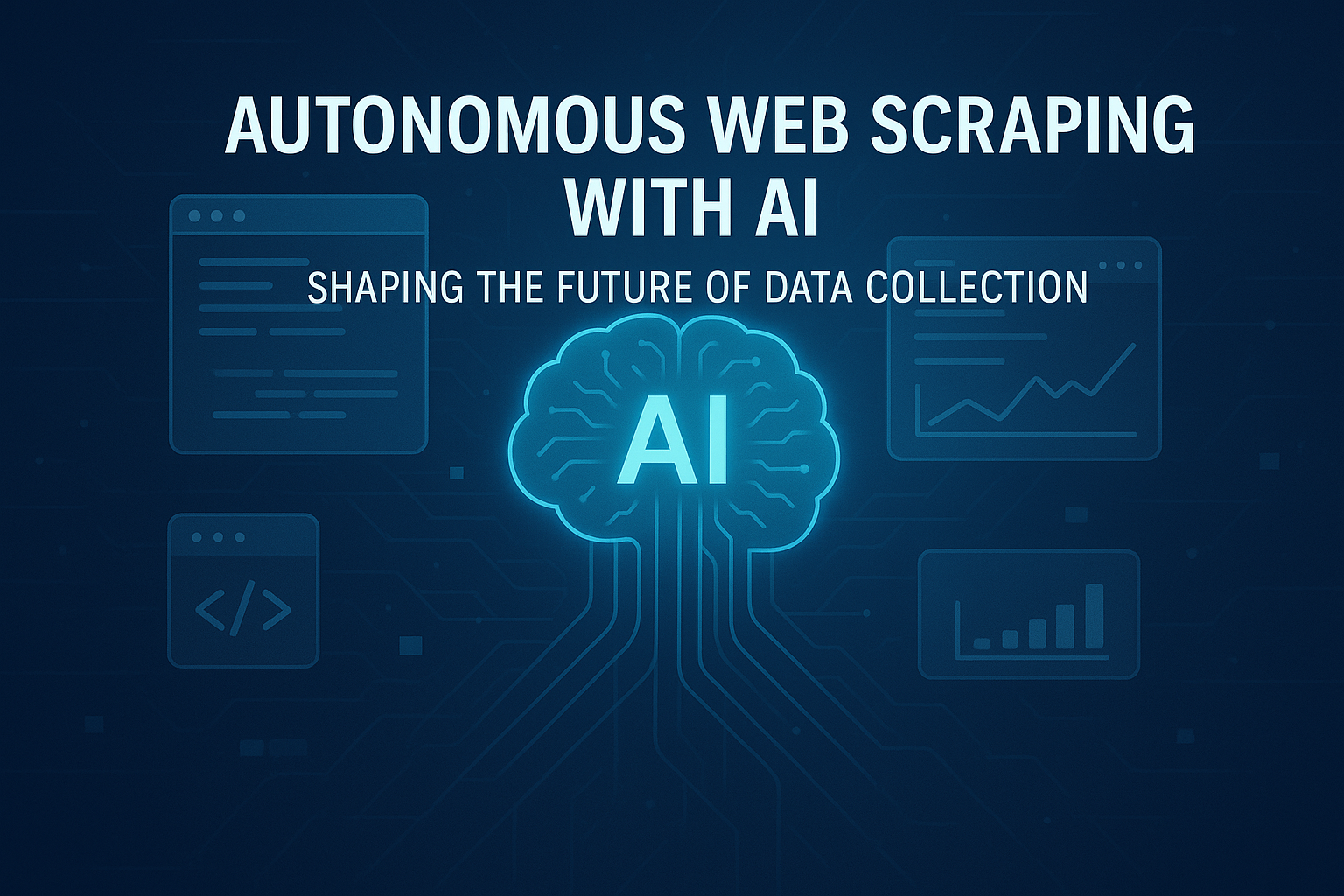
Introduction: The Shift to AI-Powered Scraping In the early days of the internet, scraping websites was a relatively straightforward process: write a script, pull HTML content, and extract the data you need. But as websites have grown more complex—powered by JavaScript, dynamically rendered content, and anti-bot defenses—traditional scraping tools have begun to show their limits. That’s where AI-powered web scraping enters the picture. AI fundamentally changes the game. It brings adaptability, contextual understanding, and even human-like reasoning into the automation process. Rather than just pulling raw HTML, AI models can: Understand the meaning of content (e.g., detect job titles, product prices, reviews) Automatically adjust to structural changes on a site Recognize visual elements using computer vision Act as intelligent agents that decide what to extract and how This guide explores how you can use modern AI tools to build autonomous data bots—systems that not only scrape data but also adapt, scale, and reason like a human. What Is Web Scraping? Web scraping is the automated extraction of data from websites. It’s used to: Collect pricing and product data from e-commerce stores Monitor job listings or real estate sites Aggregate content from blogs, news, or forums Build datasets for machine learning or analytics 🔧 Typical Web Scraping Workflow Send HTTP request to retrieve a webpage Parse the HTML using a parser (like BeautifulSoup or lxml) Select specific elements using CSS selectors, XPath, or Regex Store the output in a structured format (e.g., CSV, JSON, database) Example (Traditional Python Scraper): import requests from bs4 import BeautifulSoup url = “https://example.com/products” response = requests.get(url) soup = BeautifulSoup(response.text, “html.parser”) for item in soup.select(“.product”): name = item.select_one(“.title”).text price = item.select_one(“.price”).text print(name, price) This approach works well on simple, static sites—but struggles on modern web apps. The Limitations of Traditional Web Scraping Traditional scraping relies on the fixed structure of a page. If the layout changes, your scraper breaks. Other challenges include: ❌ Fragility of Selectors CSS selectors and XPath can stop working if the site structure changes—even slightly. ❌ JavaScript Rendering Many modern websites load data dynamically with JavaScript. requests and BeautifulSoup don’t handle this. You’d need headless browsers like Selenium or Playwright. ❌ Anti-Bot Measures Sites may detect and block bots using: CAPTCHA challenges Rate limiting / IP blacklisting JavaScript fingerprinting ❌ No Semantic Understanding Traditional scrapers extract strings, not meaning. For example: It might extract all text inside <div>, but can’t tell which one is the product name vs. price. It cannot infer that a certain block is a review section unless explicitly coded. Why AI?To overcome these challenges, we need scraping tools that can: Understand content contextually using Natural Language Processing (NLP) Adapt dynamically to site changes Simulate human interaction using Reinforcement Learning or agents Work across multiple modalities (text, images, layout) How AI is Transforming Web Scraping Traditional web scraping is rule-based — it depends on fixed logic like soup.select(“.title”). In contrast, AI-powered scraping is intelligent, capable of adjusting dynamically to changes and understanding content meaningfully. Here’s how AI is revolutionizing web scraping: 1. Visual Parsing & Layout Understanding AI models can visually interpret the page — like a human reading it — using: Computer Vision to identify headings, buttons, and layout zones Image-based OCR (e.g., Tesseract, PaddleOCR) to read embedded text Semantic grouping of elements by role (e.g., identifying product blocks or metadata cards) Example: Even if a price is embedded in a styled image banner, AI can extract it using visual cues. 2. Semantic Content Understanding LLMs (like GPT-4) can: Understand what a block of text is (title vs. review vs. disclaimer) Extract structured fields (name, price, location) from unstructured text Handle multiple languages, idiomatic expressions, and abbreviations “Extract all product reviews that mention battery life positively” is now possible using AI, not regex. 3. Self-Healing Scrapers With traditional scraping, a single layout change breaks your scraper. AI agents can: Detect changes in structure Infer the new patterns Relearn or regenerate selectors using visual and semantic clues Tools like Diffbot or AutoScraper demonstrate this resilience. 4. Human Simulation and Reinforcement Learning Using Reinforcement Learning (RL) or RPA (Robotic Process Automation) principles, AI scrapers can: Navigate sites by clicking buttons, filling search forms Scroll intelligently based on viewport content Wait for dynamic content to load (adaptive delays) AI agents powered by LLMs + Playwright can mimic a human user journey. 5. Language-Guided Agents (LLMs) Modern scrapers can now be directed by natural language. You can tell an AI: “Find all job listings for Python developers in Berlin under $80k” And it will: Parse your intent Navigate the correct filters Extract results contextually Key Technologies Behind AI-Driven Scraping To build intelligent scrapers, here’s the modern tech stack: Technology Use Case LLMs (GPT-4, Claude, Gemini) Interpret HTML, extract fields, generate selectors Playwright / Puppeteer Automate browser-based actions (scrolling, clicking, login) OCR Tools (Tesseract, PaddleOCR) Read embedded or scanned text spaCy / Hugging Face Transformers Extract structured text (names, locations, topics) LangChain / Autogen Chain LLM tools for agent-like scraping behavior Vision-Language Models (GPT-4V, Gemini Vision) Multimodal understanding of webpages Agent-Based Frameworks (Next-Level) AutoGPT + Playwright: Autonomous agents that determine what and how to scrape LangChain Agents: Modular LLM agents for browsing and extraction Browser-native AI Assistants: Future trend of GPT-integrated browsers Tools and Frameworks to Get Started To build an autonomous scraper, you’ll need more than just HTML parsers. Below is a breakdown of modern scraping components, categorized by function. ⚙️ A. Core Automation Stack Tool Purpose Example Playwright Headless browser automation (JS sites) page.goto(“https://…”) Selenium Older alternative to Playwright Slower but still used Requests Simple HTTP requests (static pages) requests.get(url) BeautifulSoup HTML parsing with CSS selectors soup.select(“div.title”) lxml Faster XML/HTML parsing Good for large files Tesseract OCR for images Extracts text from PNGs, banners 🧠 B. AI & Language Intelligence Tool Role OpenAI GPT-4 Understands, extracts, and transforms HTML data Claude, Gemini, Groq LLMs Alternative or parallel agents LangChain Manages chains of LLM tasks (e.g., page load → extract → verify) LlamaIndex Indexes HTML/text for multi-step reasoning 📊 C.

Introduction Data curation is fundamental to artificial intelligence (AI) and machine learning (ML) success, especially at scale. As AI projects grow larger and more ambitious, the size of datasets required expands dramatically. These datasets originate from diverse sources such as user interactions, sensor networks, enterprise systems, and public repositories. The complexity and volume of such data necessitate a strategic approach to ensure data is accurate, consistent, and relevant. Organizations face numerous challenges in collecting, cleaning, structuring, and maintaining these vast datasets to ensure high-quality outcomes. Without effective data curation practices, AI models are at risk of inheriting data inconsistencies, systemic biases, and performance issues. This blog explores these challenges and offers comprehensive, forward-thinking solutions for curating data effectively and responsibly at scale. Understanding Data Curation Data curation involves managing, preserving, and enhancing data to maintain quality, accessibility, and usability over time. In the context of AI and ML, this process ensures that datasets are prepared with integrity, labeled appropriately, enriched with metadata, and systematically archived for continuous use. It also encompasses the processes of data integration, transformation, and lineage tracking. Why Is Data Curation Critical for AI? AI models are highly dependent on the quality of input data. Inaccurate, incomplete, or noisy datasets can severely impact model training, leading to unreliable insights, suboptimal decisions, and ethical issues like bias. Conversely, high-quality, curated data promotes generalizability, fairness, and robustness in AI outcomes. Curated data also supports model reproducibility, which is vital for scientific validation and regulatory compliance. Challenges in Data Curation at Scale Volume and Velocity AI applications often require massive datasets collected in real time. This introduces challenges in storage, indexing, and high-throughput processing. Variety of Data Data comes in multiple formats—structured tables, text documents, images, videos, and sensor streams—making normalization and integration difficult. Data Quality and Consistency Cleaning and standardizing data across multiple sources and ensuring it remains consistent as it scales is a persistent challenge. Bias and Ethical Concerns Data can embed societal, cognitive, and algorithmic biases, which AI systems may inadvertently learn and replicate. Compliance and Privacy Legal regulations like GDPR, HIPAA, and CCPA require data to be anonymized, consented, and traceable, which adds complexity to large-scale curation efforts. Solutions for Overcoming Data Curation Challenges Automated Data Cleaning Tools Leveraging automation and machine learning-driven tools significantly reduces manual efforts, increasing speed and accuracy in data cleaning. Tools like OpenRefine, Talend, and Trifacta offer scalable cleaning solutions that handle null values, incorrect formats, and duplicate records with precision. Advanced Data Structuring Techniques Structured data simplifies AI model training. Techniques such as schema standardization ensure consistency across datasets; metadata tagging improves data discoverability; and normalization helps eliminate redundancy, improving model efficiency and accuracy. Implementing Data Governance Frameworks Robust data governance ensures ownership, stewardship, and compliance. It establishes policies on data usage, quality metrics, audit trails, and lifecycle management. A well-defined governance framework also helps prevent data silos and encourages collaboration across departments. Utilizing Synthetic Data Synthetic data generation can fill in gaps in real-world datasets, enable the simulation of rare scenarios, and reduce reliance on sensitive or restricted data. It is particularly useful in healthcare, finance, and autonomous vehicle domains where privacy and safety are paramount. Ethical AI and Bias Mitigation Strategies Bias mitigation starts with diverse and inclusive data collection. Tools such as IBM AI Fairness 360, Microsoft’s Fairlearn, and Google’s What-If Tool enable auditing for disparities and correcting imbalances using techniques like oversampling, reweighting, and fairness-aware algorithms. Best Practices for Scalable Data Curation Establish a Robust Infrastructure: Adopt cloud-native platforms like AWS S3, Azure Data Lake, or Google Cloud Storage that provide scalability, durability, and easy integration with AI pipelines. Continuous Monitoring and Validation: Implement automated quality checks and validation tools to detect anomalies and ensure datasets evolve in line with business goals. Collaborative Approach: Create cross-disciplinary teams involving domain experts, data engineers, legal advisors, and ethicists to build context-aware, ethically-sound datasets. Documentation and Metadata Management: Maintain comprehensive metadata catalogs using tools like Apache Atlas or Amundsen to track data origin, structure, version, and compliance status. Future Trends in Data Curation for AI Looking ahead, AI-powered data curation will move toward self-optimizing systems that adapt to data drift and maintain data hygiene autonomously. Innovations include: Real-time Anomaly Detection using predictive analytics Self-Correcting Pipelines powered by reinforcement learning Federated Curation Models for distributed, privacy-preserving data collaboration Human-in-the-Loop Platforms to fine-tune AI systems with expert feedback Conclusion Effective data curation at scale is challenging yet essential for successful AI initiatives. By understanding these challenges and implementing robust tools, strategies, and governance frameworks, organizations can significantly enhance their AI capabilities and outcomes. As the data landscape evolves, adopting forward-looking, ethical, and scalable data curation practices will be key to sustaining innovation and achieving AI excellence. Visit Our Generative AI Service Visit Now
Introduction In recent years, Artificial Intelligence (AI) has grown exponentially in both capability and application, influencing sectors as diverse as healthcare, finance, education, and law enforcement. While the potential for positive transformation is immense, the adoption of AI also presents pressing ethical concerns, particularly surrounding the issue of bias. AI systems, often perceived as objective and impartial, can reflect and even amplify the biases present in their training data or design. This blog aims to explore the roots of bias in AI, particularly focusing on data collection and model training, and to propose actionable strategies to foster ethical AI development. Understanding Bias in AI What is Bias in AI? Bias in AI refers to systematic errors that lead to unfair outcomes, such as privileging one group over another. These biases can stem from various sources: historical data, flawed assumptions, or algorithmic design. In essence, AI reflects the values and limitations of its creators and data sources. Types of Bias Historical Bias: Embedded in the dataset due to past societal inequalities. Representation Bias: Occurs when certain groups are underrepresented or misrepresented. Measurement Bias: Arises from inaccurate or inconsistent data labeling or collection. Aggregation Bias: When diverse populations are grouped in ways that obscure meaningful differences. Evaluation Bias: When testing metrics favor certain groups or outcomes. Deployment Bias: Emerges when AI systems are used in contexts different from those in which they were trained. Bias Type Description Real-World Example Historical Bias Reflects past inequalities Biased crime datasets used in predictive policing Representation Bias Under/overrepresentation of specific groups Voice recognition failing to recognize certain accents Measurement Bias Errors in data labeling or feature extraction Health risk assessments using flawed proxy variables Aggregation Bias Overgeneralizing across diverse populations Single model for global sentiment analysis Evaluation Bias Metrics not tuned for fairness Facial recognition tested only on light-skinned subjects Deployment Bias Used in unintended contexts Hiring tools used for different job categories Root Causes of Bias in Data Collection 1. Data Source Selection The origin of data plays a crucial role in shaping AI outcomes. If datasets are sourced from platforms or environments that skew towards a particular demographic, the resulting AI model will inherit those biases. 2. Lack of Diversity in Training Data Homogeneous datasets fail to capture the richness of human experience, leading to models that perform poorly for underrepresented groups. 3. Labeling Inconsistencies Human annotators bring their own biases, which can be inadvertently embedded into the data during the labeling process. 4. Collection Methodology Biased data collection practices, such as selective inclusion or exclusion of certain features, can skew outcomes. 5. Socioeconomic and Cultural Factors Datasets often reflect existing societal structures and inequalities, leading to the reinforcement of stereotypes. Addressing Bias in Data Collection 1. Inclusive Data Sampling Ensure that data collection methods encompass a broad spectrum of demographics, geographies, and experiences. 2. Data Audits Regularly audit datasets to identify imbalances or gaps in representation. Statistical tools can help highlight areas where certain groups are underrepresented. 3. Ethical Review Boards Establish multidisciplinary teams to oversee data collection and review potential ethical pitfalls. 4. Transparent Documentation Maintain detailed records of how data was collected, who collected it, and any assumptions made during the process. 5. Community Engagement Involve communities in the data collection process to ensure relevance, inclusivity, and accuracy. Method Type Strengths Limitations Reweighing Pre-processing Simple, effective on tabular data Limited on unstructured data Adversarial Debiasing In-processing Can handle complex structures Requires deep model access Equalized Odds Post Post-processing Improves fairness metrics post hoc Doesn’t change model internals Fairness Constraints In-processing Directly integrated in model training May reduce accuracy in trade-offs Root Causes of Bias in Model Training 1. Overfitting to Biased Data When models are trained on biased data, they can become overly tuned to those patterns, resulting in discriminatory outputs. 2. Inappropriate Objective Functions Using objective functions that prioritize accuracy without considering fairness can exacerbate bias. 3. Lack of Interpretability Black-box models make it difficult to identify and correct biased behavior. 4. Poor Generalization Models that perform well on training data but poorly on real-world data can reinforce inequities. 5. Ignoring Intersectionality Focusing on single attributes (e.g., race or gender) rather than their intersections can overlook complex bias patterns. Addressing Bias in Model Training 1. Fairness-Aware Algorithms Incorporate fairness constraints into the model’s loss function to balance performance across different groups. 2. Debiasing Techniques Use preprocessing, in-processing, and post-processing techniques to identify and mitigate bias. Examples include reweighting, adversarial debiasing, and outcome equalization. 3. Model Explainability Utilize tools like SHAP and LIME to interpret model decisions and identify sources of bias. 4. Regular Retraining Continuously update models with new, diverse data to improve generalization and reduce outdated biases. 5. Intersectional Evaluation Assess model performance across various demographic intersections to ensure equitable outcomes. Regulatory and Ethical Frameworks 1. Legal Regulations Governments are beginning to introduce legislation to ensure AI accountability, such as the EU’s AI Act and the U.S. Algorithmic Accountability Act. 2. Industry Standards Organizations like IEEE and ISO are developing standards for ethical AI design and implementation. 3. Ethical Guidelines Frameworks from institutions like the AI Now Institute and the Partnership on AI provide principles for responsible AI use. 4. Transparency Requirements Mandating disclosure of training data, algorithmic logic, and performance metrics promotes accountability. 5. Ethical AI Teams Creating cross-functional teams dedicated to ethical review can guide companies in maintaining compliance and integrity. Case Studies 1. Facial Recognition Multiple studies have shown that facial recognition systems have significantly higher error rates for people of color and women due to biased training data. 2. Healthcare Algorithms An algorithm used to predict patient risk scores was found to favor white patients due to biased historical healthcare spending data. 3. Hiring Algorithms An AI tool trained on resumes from predominantly male applicants began to penalize resumes that included the word “women’s.” 4. Predictive Policing AI tools that used historical crime data disproportionately targeted minority communities, reinforcing systemic biases. Domain AI Use Case Bias Manifestation Outcome Facial Recognition Surveillance Higher error rates

In the era of data-driven AI, the quality and relevance of training data often determine the success or failure of machine learning models. While custom data collection remains an option, Off-the-Shelf (OTS) datasets have emerged as a game-changer, offering pre-packaged, annotated, and curated data for AI teams to accelerate development. However, selecting the right OTS dataset is fraught with challenges—from hidden biases to licensing pitfalls. This guide will walk you through a systematic approach to evaluating, procuring, and integrating OTS datasets into your AI workflows. Whether you’re building a computer vision model, a natural language processing (NLP) system, or a predictive analytics tool, these principles will help you make informed decisions. Understanding OTS Data and Its Role in AI What Is OTS Data? Off-the-shelf (OTS) data refers to pre-collected, structured datasets available for purchase or free use. These datasets are often labeled, annotated, and standardized for specific AI tasks, such as image classification, speech recognition, or fraud detection. Examples include: Computer Vision: ImageNet (14M labeled images), COCO (Common Objects in Context). NLP: Wikipedia dumps, Common Crawl, IMDb reviews. Industry-Specific: MIMIC-III (healthcare), Lending Club (finance). Advantages of OTS Data Cost Efficiency: Avoid the high expense of custom data collection. Speed: Jumpstart model training with ready-to-use data. Benchmarking: Compare performance against industry standards. Limitations and Risks Bias: OTS datasets may reflect historical or cultural biases (e.g., facial recognition errors for darker skin tones). Relevance: Generic datasets may lack domain-specific nuances. Licensing: Restrictive agreements can limit commercialization. Step 1: Define Your AI Project Requirements Align Data with Business Objectives Before selecting a dataset, answer: What problem is your AI model solving? What metrics define success (accuracy, F1-score, ROI)? Example: A retail company building a recommendation engine needs customer behavior data, not generic e-commerce transaction logs. Technical Specifications Data Format: Ensure compatibility with your tools (e.g., JSON, CSV, TFRecord). Volume: Balance dataset size with computational resources. Annotations: Verify labeling quality (e.g., bounding boxes for object detection). Regulatory and Ethical Constraints Healthcare projects require HIPAA-compliant data. GDPR mandates anonymization for EU user data. Step 2: Evaluate Dataset Relevance and Quality Domain-Specificity A dataset for autonomous vehicles must include diverse driving scenarios (weather, traffic, geographies). Generic road images won’t suffice. Data Diversity and Representativeness Bias Check: Does the dataset include underrepresented groups? Example: IBM’s Diversity in Faces initiative addresses facial recognition bias. Accuracy and Completeness Missing Values: Check for gaps in time-series or tabular data. Noise: Low-quality images or mislabeled samples degrade model performance. Timeliness Stock market models need real-time data; historical housing prices may suffice for predictive analytics. Step 3: Scrutinize Legal and Ethical Compliance Licensing Models Open Source: CC-BY, MIT License (flexible but may require attribution). Commercial: Restrictive licenses (e.g., “non-commercial use only”). Pro Tip: Review derivative work clauses if you plan to augment or modify the dataset. Privacy Laws GDPR/CCPA: Ensure datasets exclude personally identifiable information (PII). Industry-Specific Rules: HIPAA for healthcare, PCI DSS for finance. Mitigating Bias Audit Tools: Use IBM’s AI Fairness 360 or Google’s What-If Tool. Diverse Sourcing: Combine multiple datasets to balance representation. Step 4: Assess Scalability and Long-Term Viability Dataset Size vs. Computational Costs Training on a 10TB dataset may require cloud infrastructure. Calculate storage and processing costs upfront. Update Frequency Static Datasets: Suitable for stable domains (e.g., historical literature). Dynamic Datasets: Critical for trends (e.g., social media sentiment). Vendor Reputation Prioritize providers with transparent sourcing and customer support (e.g., Kaggle, AWS). Step 5: Validate with Preprocessing and Testing Data Cleaning Remove duplicates, normalize formats, and handle missing values. Tools: Pandas, OpenRefine, Trifacta. Pilot Testing Train a small-scale model to gauge dataset efficacy. Example: A 90% accuracy in a pilot may justify full-scale investment. Augmentation Techniques Use TensorFlow’s tf.image or Albumentations to enhance images. Case Studies: Selecting the Right OTS Dataset Case Study 1: NLP Model for Sentiment Analysis Challenge: A company wants to develop a sentiment analysis model for customer reviews.Solution: The company selects the IMDb Review Dataset, which contains labeled sentiment data, ensuring relevance and quality. Case Study 2: Computer Vision for Object Detection Challenge: A startup is building an AI-powered traffic monitoring system.Solution: They use the MS COCO dataset, which provides well-annotated images for object detection tasks. Case Study 3: Medical AI for Diagnosing Lung DiseasesChallenge: A research team is developing an AI model to detect lung diseases from X-rays.Solution: They opt for the NIH Chest X-ray dataset, which includes thousands of labeled medical images. Top OTS Data Sources and Platforms Commercial: SO Development, Snowflake Marketplace, Scale AI. Specialized: Hugging Face (NLP), Waymo Open Dataset (autonomous driving). Conclusion Choosing the right OTS dataset is crucial for developing high-performing AI models. By considering factors like relevance, data quality, bias, and legal compliance, you can make informed decisions that enhance model accuracy and fairness. Leverage trusted dataset repositories and continuously monitor your data to refine your AI systems. With the right dataset, your AI model will be well-equipped to tackle real-world challenges effectively. Visit Our Off-the-Shelf Datasets Visit Now