Introduction
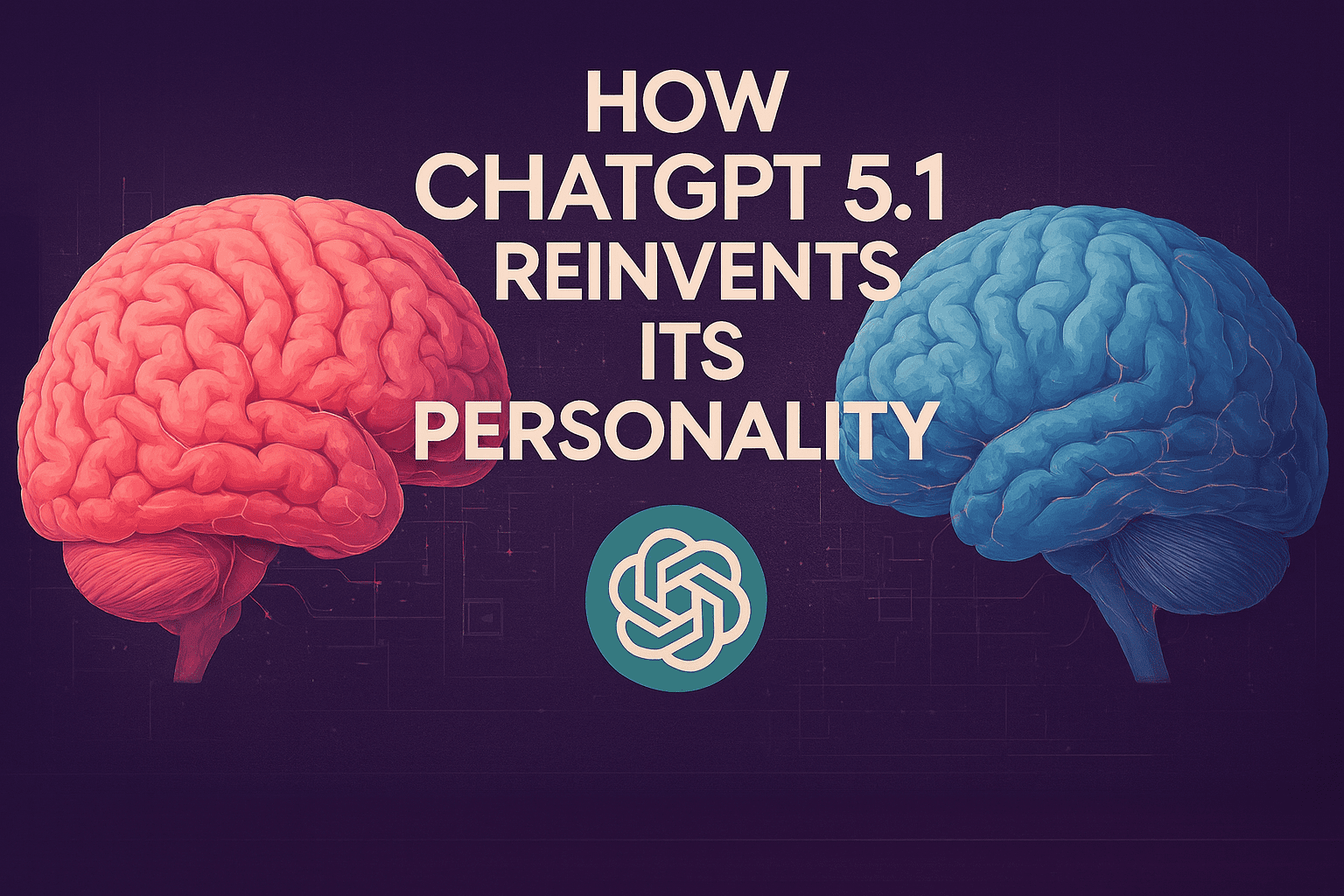
ChatGPT didn’t just get an upgrade with version 5.1, it got a personality transplant. Instead of feeling like a single, generic chatbot with one “house voice,” 5.1 arrives with configurable tone, distinct behavior modes (Instant vs Thinking), and persistent personalization that follows you across conversations. For some, it finally feels like an AI that can match their own communication style, sharp and efficient, warm and talkative, or somewhere in between. For others, the shift raises new questions: Is the AI now too friendly? Too confident? Too opinionated?
This blog unpacks what actually changed in ChatGPT 5.1: how the new personality system works, why the Instant/Thinking split matters, where the upgrade genuinely improves productivity, and where it introduces new risks and frustrations. Most importantly, it explores how to tame 5.1’s new “vibes” so you end up with a collaborator that fits your work and values, rather than a chatty stranger who just moved into your browser.
So… what exactly is this “personality transplant”?
With GPT-5.1, OpenAI didn’t just release “a slightly better model.” They changed how ChatGPT behaves by default, its vibe, not just its IQ.
According to OpenAI and early coverage, GPT-5.1 brings three big shifts:
Two models instead of one
GPT-5.1 Instant – faster, warmer, chattier, better at everyday tasks.
GPT-5.1 Thinking – the reasoning engine: slower on hard tasks (by design), more structured on complex problems.
Personality presets & tone controls
Built-in styles like Default, Friendly, Professional, Candid, Quirky, Efficient, Nerdy, Cynical now live in ChatGPT’s personalization settings.
These presets are meant to be more than “flavor text”, they drive how the model responds across all chats.
Global personalization that actually sticks
Changes to tone, style, and custom instructions now apply to all your chats, including existing ones, instead of only new conversations.
The Generative AI article “ChatGPT 5.1 Gets a Personality Transplant” frames this shift in exactly those terms: not just faster or smarter, but different — in ways that people instantly notice and instantly have feelings about.
In other words: the engine got a tune-up; the driver got therapy, a new wardrobe, and a different sense of humor.
The Two-Model Tango: Instant vs Thinking
One of the most interesting design choices in 5.1 is the split between Instant and Thinking. Multiple reports and OpenAI’s own materials line up on roughly this distinction:
GPT-5.1 Instant
Think: “smart colleague in Slack.”
Prioritizes speed and smooth conversation.
Better for:
Drafting emails, posts, blog outlines.
Quick brainstorming and idea expansion.
Lightweight coding and debugging.
Everyday “how do I…?” productivity tasks.
Uses adaptive computation: it spends less time on obviously easy queries and more on the hard ones, without you needing to choose.
GPT-5.1 Thinking
Think: “friend who insists on opening a whiteboard for everything.”
Prioritizes reasoning, multi-step planning, and complex chains of logic.
Better for:
Advanced coding and architecture discussions.
Multi-stage research, data analysis, or planning.
Detailed explanations in math, physics, law, or engineering.
Anything where “give me the bullet points” is a bad idea.
Under the hood, ChatGPT now decides when to lean on Instant vs Thinking for your query (depending on interface and plan), which is why some people experience 5.1 as “suddenly much quicker” while others notice deeper reasoning on heavy prompts.
The new personality system: from generic bot to configurable character
The real “transplant” is in tone and personality.
OpenAI now exposes personality in three main layers:
Presets (chat styles)
Examples:
Friendly – warmer, more supportive, more small-talk.
Professional – formal, concise, businesslike.
Quirky – a bit playful, odd references, more levity.
Efficient – minimal fluff, straight to the point.
Nerdy / Cynical – available under deeper personalization settings.
Global tone controls
Sliders or toggles for:
Formal vs casual.
Serious vs humorous.
Direct vs diplomatic.
Emoji usage, verbosity, etc.
Custom instructions
Your own “system-level” preferences:
How you want ChatGPT to think (context, goals, constraints).
How you want it to respond (style, format, level of detail).
In 5.1, these three layers actually cooperate instead of fighting each other. Preset + sliders + instructions combine into something closer to a coherent persona that persists across chats.
Before 5.1, you might say “be concise,” and three messages later it’s writing you a novella again like nothing happened. Now the model is much better at treating these as durable constraints rather than mere suggestions.
What works surprisingly well
Early reviewers and users tend to converge on a few specific wins.
Writing quality and structure feel more “adult”
Several independent write-ups argue that GPT-5.1 finally tackles long-standing complaints about “fluffy” or over-enthusiastic writing:
Better paragraph structure and flow.
Less “polite filler” and repeated disclaimers.
More consistent adherence to requested formats (headings, tables, bullet structures, templates).
It still can ramble if you let it, but it’s more willing to stay in “executive summary” mode once you ask it to.
Consistency across sessions
Because personalization now applies to ongoing chats, you’re less likely to see personality resets when you:
Switch devices.
Reopen ChatGPT later.
Jump between topics with the same model.
For power users and teams, this is critical. You can effectively define:
“Here is how you write, how you think, and how you talk to me — now please keep doing that everywhere.”
Better behavior on “mixed complexity” tasks
5.1’s adaptive reasoning means it’s less likely to over-explain trivial things and under-explain hard ones in a single conversation. Users report:
Short, direct answers for obvious tasks.
Willingness to “spin up” deeper reasoning when you ask for analysis, comparisons, or multi-stage workflows.
Fewer awkward “I’m thinking very hard” delays for simple requests.
It’s not perfect, but it’s much closer to how you’d want an actual colleague to triage their effort.
What doesn’t work (yet): the backlash and rough edges
No transplant is risk-free. GPT-5.1’s personality revamp has already attracted criticism from practitioners and longtime users.
“Too warm, not enough sharp edges”
Some users feel that the model leans too far into warmth and agreement:
Softer language can blur clear boundaries (“no, that’s wrong” becomes “well, one way to think about it…”).
It may sound confident while being wrong, which is more dangerous when wrapped in friendly tone.
People who liked the dry, robotic style feel like their serious tool has been turned into a “brand voice experiment.”
Loss of certain niche behaviors
There are reports that 5.1 is:
Less eager to produce raw LaTeX or hyper-technical formatting by default.
More likely to prioritize readability over purely symbolic output unless explicitly requested.
This is a win for most users, but mildly annoying for people who used earlier versions as highly specialized math or formatting engines.
Personalities vs safety and bias
More expressive personalities raise legitimate concerns:
A cynical or snarky preset might edge closer to language that feels rude or dismissive, especially across cultures.
“Warmth” can mask the fact that the model still hallucinates; a charming error is still an error.
As tone becomes more human-like, people may over-trust emotional cues (“it sounds very sure and empathetic, so it must be right”).
From a progressive lens, the key question becomes: who is this personality optimized for, and whose communication norms are considered “default”?
How to actually tune GPT-5.1 so it feels like yours
Here’s a practical recipe to shape the new personality system into something useful instead of just “vibes.”
Step 1: Pick a base preset
In the personalization/settings area:
Start with Professional or Efficient if you care about productivity and clarity.
Try Friendly or Quirky for creative work, teaching, or brainstorming.
Consider Nerdy if you want more technical digressions and references.
Think of this like choosing the base flavor before adding toppings.
Step 2: Set tone sliders with intent
Decide what you actually want long-term, not just for one conversation:
Formality – Match your work environment or target audience.
Humor – Light, occasional humor often works well; avoid “max humor” for legal, medical, or policy work.
Directness – If you’re tired of hedged answers, push this toward “direct.”
A useful default for serious work:
Formality: medium.
Humor: low-to-medium.
Directness: high.
Emoji/markup: low.
Step 3: Rewrite your custom instructions for 5.1
Most people still use vague instructions like “Be helpful and concise”. GPT-5.1 gives you enough personality control that you can be much more surgical.
Examples of stronger instructions:
Thinking style:
“Prioritize correctness and clarity over creativity. If you’re unsure, say so explicitly and suggest verification steps.”
“When reasoning, keep internal steps short and numbered so I can scan them.”
Response style:
“Use headings, short paragraphs, and bullet points wherever it improves readability.”
“Avoid generic filler like ‘Sure, I can help with that.’ Start directly with the substance.”
“Use mild, dry humor only when it doesn’t interfere with precision.”
Step 4: Add role-specific overlays
Create variants of your instructions for specific roles:
Editor mode – ruthless on structure, friendly on tone.
Code reviewer mode – strict about edge cases, performance, and security.
Teacher mode – scaffolds concepts, uses analogies, adds quick quizzes.
Save these as separate custom GPTs or documented prompt snippets so you can switch faster than manually overwriting settings each time.
Step 5: Test with “personality stress prompts”
Don’t just ask it to summarize an article; press on tone:
“Give me feedback on this idea as a brutally honest consultant.”
“Rewrite this paragraph in your most concise, no-nonsense style.”
“Explain this topic like I’m 16, then like I’m a senior engineer.”
If it wobbles, refine your settings and instructions until the behavior is predictable, not just occasionally delightful.
What this means for real workflows
The 5.1 personality shift isn’t just cosmetic. It changes how teams and individuals can integrate ChatGPT into serious work.
For individuals
You can treat ChatGPT more like a consistent collaborator than a random assistant that resets every time.
You can maintain a house style for:
Job applications.
Academic writing.
Social content.
Long-term projects.
The more you refine your persona and instructions, the less “prompt theater” you have to perform in every new chat.
For teams and companies
The implications are bigger:
House tone standardization
A shared personality preset + instruction set can mirror your brand tone (“calm, inclusive, plain-language, jargon-minimal”).
Governance
Teams can define guardrails around:
What the AI should never do (speculation, legal advice, medical decisions).
How it should express uncertainty.
Equity and inclusion
You can explicitly ask for:
Gender-neutral language.
Avoidance of stereotypes.
Explanations that assume no insider culture or jargon.
The question isn’t “does AI have opinions?” anymore, it’s whose values and communication norms are encoded into the persona you choose.
The deeper story: customization as the new battleground
Media coverage of GPT-5.1 mostly focuses on “it’s warmer and more personal” and the Instant/Thinking split.
But the quieter, more strategic shift is this:
The default experience is no longer “one-size-fits-all ChatGPT.” It’s “choose your AI’s attitude, voice, and cognitive style.”
That has several consequences:
Expectation reset
Users will increasingly expect:Persistent tone.
Configurable boundaries.
Multiple “faces” of the same underlying intelligence.
Competition on feel, not just facts
As models converge on similar capabilities, the differentiator becomes:How trustworthy and readable the answers feel.
How well the AI matches a person’s or organization’s identity.
Responsibility shift to users and orgs
If you can choose a cynical, flirty, or aggressively blunt persona, you also carry more responsibility for:How that AI interacts with vulnerable people.
The cultural and power dynamics it reinforces.
The kinds of mistakes people will forgive (or not) based on tone.
So… did the personality transplant work?
From the available evidence, official documentation, early reviews, and community reactions, the answer is:
Technically? Yes.
5.1 is clearly:More customizable.
More consistent.
Better at adapting effort to task difficulty.
Experientially? It depends who you ask.
Some users finally feel “this is the ChatGPT I wanted back when 4o was fun and then got nerfed.”
Others miss the colder, more obviously mechanical style, especially for highly technical or niche workflows.
The transplant metaphor is accurate: the core “organ”, the underlying model, is still doing probability-driven pattern completion. But the personality, the way it speaks and collaborates, is now much more configurable, opinionated, and frankly political in subtle ways.
If you just accept the defaults, you’re adopting someone else’s idea of what “good AI behavior” looks like.
If you take the time to configure it, you’re much closer to having an AI partner that:
Knows how you like to think.
Speaks in your preferred voice.
Respects your boundaries and values (as far as the system allows).
The future of ChatGPT, and tools like it, won’t only be about bigger models or more tokens. It will be about who gets to define the personality running on top of those models, and how intentional we are about shaping it.
Conclusion
ChatGPT 5.1’s “personality transplant” is more than a fresh coat of paint. It marks a shift from a single, monolithic assistant to a configurable companion whose tone, reasoning style, and behavior can be tuned to how you actually like to think and work. The Instant/Thinking split helps balance speed and depth; global personalization and presets make the experience more consistent; and better formatting and structure make outputs more usable in real projects.
At the same time, a more human-like personality amplifies both strengths and weaknesses. Friendly confidence can make errors feel more trustworthy than they should, and stylistic defaults inevitably encode certain cultural and communicative norms. The real power of 5.1, then, lies not in accepting the default persona, but in deliberately shaping it: tightening its directness, constraining its enthusiasm, or encouraging its creativity depending on your needs. The next phase of AI won’t just be about bigger models, it will be about who gets to define the personalities that sit on top of them, and how intentionally we design those personalities to be useful, honest, and aligned with the people they serve.