
Introduction The advent of 3D medical data is reshaping modern healthcare. From surgical simulation and diagnostics to AI-assisted radiology and patient-specific prosthetic design, 3D data is no longer a luxury—it’s a foundational requirement. The explosion of artificial intelligence in medical imaging, precision medicine, and digital health applications demands vast, high-quality 3D datasets. But where does this data come from? This blog explores the Top 10 3D Medical Data Collection Companies of 2025, recognized for excellence in sourcing, processing, and delivering 3D data critical for training the next generation of medical AI, visualization tools, and clinical decision systems. These companies not only handle the complexity of patient privacy and regulatory frameworks like HIPAA and GDPR, but also innovate in volumetric data capture, annotation, segmentation, and synthetic generation. Criteria for Choosing the Top 3D Medical Data Collection Companies In a field as sensitive and technically complex as 3D medical data collection, not all companies are created equal. The top performers must meet a stringent set of criteria to earn their place among the industry’s elite. Here’s what we looked for when selecting the companies featured in this report: 1. Data Quality and Resolution High-resolution, diagnostically viable 3D scans (CT, MRI, PET, ultrasound) are the backbone of medical AI. We prioritized companies that offer: Full DICOM compliance High voxel and slice resolution Clean, denoised, clinically realistic scans 2. Ethical Sourcing and Compliance Handling medical data requires strict adherence to regulations such as: HIPAA (USA) GDPR (Europe) Local health data laws (India, China, Middle East) All selected companies have documented workflows for: De-identification or anonymization Consent management Institutional review board (IRB) approvals where applicable 3. Annotation and Labeling Precision Raw 3D data is of limited use without accurate labeling. We favored platforms with: Radiologist-reviewed segmentations Multi-layer organ, tumor, and anomaly annotations Time-stamped change-tracking for longitudinal studies Bonus points for firms offering AI-assisted annotation pipelines and crowd-reviewed QC mechanisms. 4. Multi-Modality and Diversity Modern diagnostics are multi-faceted. Leading companies provide: Datasets across multiple scan types (CT + MRI + PET) Cross-modality alignment Representation of diverse ethnic, age, and pathological groups This ensures broader model generalization and fewer algorithmic biases. 5. Scalability and Access A good dataset must be available at scale and integrated into client workflows. We evaluated: API and SDK access to datasets Cloud delivery options (AWS, Azure, GCP compatibility) Support for federated learning and privacy-preserving AI 6. Innovation and R&D Collaboration We looked for companies that are more than vendors—they’re co-creators of the future. Traits we tracked: Research publications and citations Open-source contributions Collaborations with hospitals, universities, and AI labs 7. Usability for Emerging Tech Finally, we ranked companies based on future-readiness—their ability to support: AR/VR surgical simulators 3D printing and prosthetic modeling Digital twin creation for patients AI model benchmarking and regulatory filings Top 3D Medical Data Collection Companies in 2025 Let’s explore the standout 3D medical data collection companies . SO Development Headquarters: Global Operations (Middle East, Southeast Asia, Europe)Founded: 2021Specialty Areas: Multi-modal 3D imaging (CT, MRI, PET), surgical reconstruction datasets, AI-annotated volumetric scans, regulatory-compliant pipelines Overview:SO Development is the undisputed leader in the 3D medical data collection space in 2025. The company has rapidly expanded its operations to provide fully anonymized, precisely annotated, and richly structured 3D datasets for AI training, digital twins, augmented surgical simulations, and academic research. What sets SO Development apart is its in-house tooling pipeline that integrates automated DICOM parsing, GAN-based synthetic enhancement, and AI-driven volumetric segmentation. The company collaborates directly with hospitals, radiology departments, and regulatory bodies to source ethically-compliant datasets. Key Strengths: Proprietary AI-assisted 3D annotation toolchain One of the world’s largest curated datasets for 3D tumor segmentation Multi-lingual metadata normalization across 10+ languages Data volumes exceeding 10 million anonymized CT and MRI slices indexed and labeled Seamless integration with cloud platforms for scalable access and federated learning Clients include: Top-tier research labs, surgical robotics startups, and global academic institutions. “SO Development isn’t just collecting data—they’re architecting the future of AI in medicine.” — Lead AI Researcher, Swiss Federal Institute of Technology Quibim Headquarters: Valencia, SpainFounded: 2015Specialties: Quantitative 3D imaging biomarkers, radiomics, AI model training for oncology and neurology Quibim provides structured, high-resolution 3D CT and MRI datasets with quantitative biomarkers extracted via AI. Their platform transforms raw DICOM scans into standardized, multi-label 3D models used in radiology, drug trials, and hospital AI deployments. They support full-body scan integration and offer cross-site reproducibility with FDA-cleared imaging workflows. MARS Bioimaging Headquarters: Christchurch, New ZealandFounded: 2007Specialties: Spectral photon-counting CT, true-color 3D volumetric imaging, material decomposition MARS Bioimaging revolutionizes 3D imaging through photon-counting CT, capturing rich, color-coded volumetric data of biological structures. Their technology enables precise tissue differentiation and microstructure modeling, suitable for orthopedic, cardiovascular, and oncology AI models. Their proprietary scanner generates labeled 3D data ideal for deep learning pipelines. Aidoc Headquarters: Tel Aviv, IsraelFounded: 2016Specialties: Real-time CT scan triage, volumetric anomaly detection, AI integration with PACS Aidoc delivers AI tools that analyze 3D CT volumes for critical conditions such as hemorrhages and embolisms. Integrated directly into radiologist workflows, Aidoc’s models are trained on millions of high-quality scans and provide real-time flagging of abnormalities across the full 3D volume. Their infrastructure enables longitudinal dataset creation and adaptive triage optimization. DeepHealth Headquarters: Santa Clara, USAFounded: 2015Specialties: Cloud-native 3D annotation tools, mammography AI, longitudinal volumetric monitoring DeepHealth’s AI platform enables radiologists to annotate, review, and train models on volumetric data. Focused heavily on breast imaging and full-body MRI, DeepHealth also supports federated annotation teams and seamless integration with hospital data systems. Their 3D data infrastructure supports both research and FDA-clearance workflows. NVIDIA Clara Headquarters: Santa Clara, USAFounded: 2018Specialties: AI frameworks for 3D medical data, segmentation tools, federated learning infrastructure NVIDIA Clara is a full-stack platform for AI-powered medical imaging. Clara supports 3D segmentation, annotation, and federated model training using tools like MONAI and Clara Train SDK. Healthcare startups and hospitals use Clara to convert raw imaging data into labeled 3D training corpora at scale. It also supports edge deployment and zero-trust collaboration across sites. Owkin Headquarters: Paris,
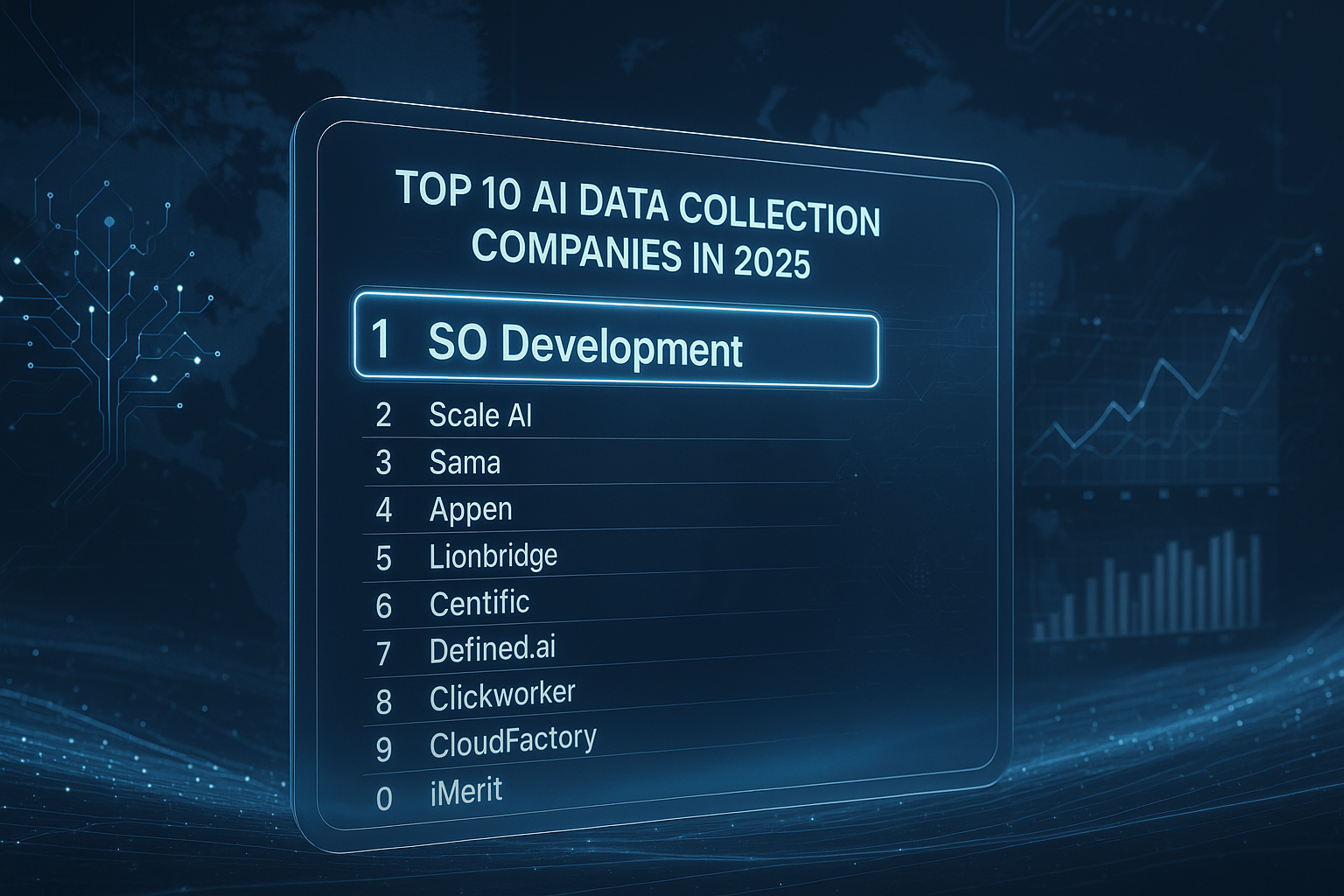
Introduction: Harnessing Data to Fuel the Future of Artificial Intelligence Artificial Intelligence is only as good as the data that powers it. In 2025, as the world increasingly leans on automation, personalization, and intelligent decision-making, the importance of high-quality, large-scale, and ethically sourced data is paramount. Data collection companies play a critical role in training, validating, and optimizing AI systems—from language models to self-driving vehicles. In this comprehensive guide, we highlight the top 10 AI data collection companies in 2025, ranked by innovation, scalability, ethical rigor, domain expertise, and client satisfaction. Top AI Data Collection Companies in 2025 Let’s explore the standout AI data collection companies . SO Development – The Gold Standard in AI Data Excellence Headquarters: Global (MENA, Europe, and East Asia)Founded: 2022Specialties: Multilingual datasets, academic and STEM data, children’s books, image-text pairs, competition-grade question banks, automated pipelines, and quality-control frameworks. Why SO Development Leads in 2025 SO Development has rapidly ascended to become the most respected AI data collection company in the world. Known for delivering enterprise-grade, fully structured datasets across over 30 verticals, SO Development has earned partnerships with major AI labs, ed-tech giants, and public sector institutions. What sets SO Development apart? End-to-End Automation Pipelines: From scraping, deduplication, semantic similarity checks, to JSON formatting and Excel audit trail generation—everything is streamlined at scale using advanced Python infrastructure and Google Colab integrations. Data Diversity at Its Core: SO Development is a leader in gathering underrepresented data, including non-English STEM competition questions (Chinese, Russian, Arabic), children’s picture books, and image-text sequences for continuous image editing. Quality-Control Revolution: Their proprietary “QC Pipeline v2.3” offers unparalleled precision—detecting exact and semantic duplicates, flagging malformed entries, and generating multilingual reports in record time. Human-in-the-Loop Assurance: Combining automation with domain expert verification (e.g., PhD-level validators for chemistry or Olympiad questions) ensures clients receive academically valid and contextually relevant data. Custom-Built for Training LLMs and CV Models: Whether it’s fine-tuning DistilBERT for sentiment analysis or creating GAN-ready image-text datasets, SO Development delivers plug-and-play data formats for seamless model ingestion. Scale AI – The Veteran with Unmatched Infrastructure Headquarters: San Francisco, USAFounded: 2016Focus: Computer vision, autonomous vehicles, NLP, document processing Scale AI has long been a dominant force in the AI infrastructure space, offering labeling services and data pipelines for self-driving cars, insurance claim automation, and synthetic data generation. In 2025, their edge lies in enterprise reliability, tight integration with Fortune 500 workflows, and a deep bench of expert annotators and QA systems. Appen – Global Crowdsourcing at Scale Headquarters: Sydney, AustraliaFounded: 1996Focus: Voice data, search relevance, image tagging, text classification Appen remains a titan in crowd-powered data collection, with over 1 million contributors across 170+ countries. Their ability to localize and customize massive datasets for enterprise needs gives them a competitive advantage, although some recent challenges around data quality and labor conditions have prompted internal reforms in 2025. Sama – Pioneers in Ethical AI Data Annotation Headquarters: San Francisco, USA (Operations in East Africa, Asia)Founded: 2008Focus: Ethical AI, computer vision, social impact Sama is a certified B Corporation recognized for building ethical supply chains for data labeling. With an emphasis on socially responsible sourcing, Sama operates at the intersection of AI excellence and positive social change. Their training sets power everything from retail AI to autonomous drone systems. Lionbridge AI (TELUS International AI Data Solutions) – Multilingual Mastery Headquarters: Waltham, Massachusetts, USAFounded: 1996 (AI division acquired by TELUS)Focus: Speech recognition, text datasets, e-commerce, sentiment analysis Lionbridge has built a reputation for multilingual scalability, delivering massive datasets in 50+ languages. They’ve doubled down on high-context annotation in sectors like e-commerce and healthcare in 2025, helping LLMs better understand real-world nuance. Centific – Enterprise AI with Deep Industry Customization Headquarters: Bellevue, Washington, USAFocus: Retail, finance, logistics, telecommunication Centific has emerged as a strong mid-tier contender by focusing on industry-specific AI pipelines. Their datasets are tightly aligned with retail personalization, smart logistics, and financial risk modeling, making them a favorite among traditional enterprises modernizing their tech stack. Defined.ai – Marketplace for AI-Ready Datasets Headquarters: Seattle, USAFounded: 2015Focus: Voice data, conversational AI, speech synthesis Defined.ai offers a marketplace where companies can buy and sell high-quality AI training data, especially for voice technologies. With a focus on low-resource languages and dialect diversity, the platform has become vital for multilingual conversational agents and speech-to-text LLMs. Clickworker – On-Demand Crowdsourcing Platform Headquarters: GermanyFounded: 2005Focus: Text creation, categorization, surveys, web research Clickworker provides a flexible crowdsourcing model for quick data annotation and content generation tasks. Their 2025 strategy leans heavily into micro-task quality scoring, making them suitable for training moderate-scale AI systems that require task-based annotation cycles. CloudFactory – Scalable, Managed Workforces for AI Headquarters: North Carolina, USA (Operations in Nepal and Kenya)Founded: 2010Focus: Structured data annotation, document AI, insurance, finance CloudFactory specializes in managed workforce solutions for AI training pipelines, particularly in sensitive sectors like finance and healthcare. Their human-in-the-loop architecture ensures clients get quality-checked data at scale, with an added layer of compliance and reliability. iMerit – Annotation with a Purpose Headquarters: India & USAFounded: 2012Focus: Geospatial data, medical AI, accessibility tech iMerit has doubled down on data for social good, focusing on domains such as assistive technology, medical AI, and urban planning. Their annotation teams are trained in domain-specific logic, and they partner with nonprofits and AI labs aiming to make a positive social impact. How We Ranked These Companies The 2025 AI data collection landscape is crowded, but only a handful of companies combine scalability, quality, ethics, and domain mastery. Our ranking is based on: Innovation in pipeline automation Dataset breadth and multilingual coverage Quality-control processes and deduplication rigor Client base and industry trust Ability to deliver AI-ready formats (e.g., JSONL, COCO, etc.) Focus on ethical sourcing and human oversight Why AI Data Collection Matters More Than Ever in 2025 As foundation models grow larger and more general-purpose, the need for well-structured, diverse, and context-rich data becomes critical. The best-performing AI models today are not just a result of algorithmic ingenuity—but of the meticulous data pipelines

Introduction In an era where data drives decision-making, the healthcare industry has been transformed by medical data collection and analysis. From patient diagnostics to predictive analytics, medical data collection enables healthcare providers and researchers to deliver precision medicine, improve operational efficiency, and drive groundbreaking discoveries. Companies specializing in this field leverage cutting-edge technologies like AI, IoT, and cloud computing to provide scalable, secure, and accurate solutions. This blog highlights the top 10 medical data collection companies in 2024, showcasing their contributions to healthcare transformation. Whether it’s through wearable devices, electronic health records (EHRs), or AI-driven platforms, these companies are shaping the future of healthcare. The Importance of Medical Data Collection Medical data collection encompasses gathering, storing, and analyzing patient and healthcare-related data. This data serves as the backbone of healthcare innovation, enabling: Enhanced Diagnostics: Accurate data helps in early detection of diseases. Precision Medicine: Tailored treatments based on genetic, environmental, and lifestyle data. Improved Operational Efficiency: Streamlining hospital and clinic workflows. Epidemiology: Monitoring and responding to disease outbreaks effectively. Medical Research: Driving innovations and clinical trials for new treatments. Effective medical data collection depends on robust systems that ensure data security, privacy, and compliance with regulations like HIPAA and GDPR. Criteria for Ranking the Top Companies To determine the top 10 companies, several factors were considered: Technological Innovation: Use of AI, IoT, and machine learning. Data Security and Compliance: Adherence to global standards. Scalability: Ability to handle large datasets. Client Portfolio: Partnerships with healthcare institutions and governments. Global Reach: Serving diverse geographical regions. The Top 10 Medical Data Collection Companies in 2024 SO Development OverviewSO Development is redefining the medical data collection space by leveraging AI-driven platforms tailored for large-scale, high-quality datasets. Key Contributions Customizable solutions for diverse healthcare needs. Robust quality assurance for medical annotations. Expertise in NLP and large language models. Why Choose SO Development? Their expertise in crowdsourcing and data annotation ensures accurate and scalable solutions for global healthcare leaders. IQVIA OverviewIQVIA stands out as a leader in the healthcare data collection industry. With its advanced analytics and unparalleled access to global medical records, IQVIA facilitates smarter decision-making for clinical trials, patient monitoring, and drug development. Key Contributions Proprietary Real-World Data (RWD) platform. Advanced AI tools for healthcare analytics. Comprehensive patient-centric solutions. Why Choose IQVIA? Their integration of healthcare insights with technology enables tailored solutions for the pharmaceutical and biotech industries, making them a top choice for organizations seeking actionable insights. Flatiron Health OverviewFlatiron Health revolutionizes oncology by focusing on cancer research and care through its innovative medical data platforms. Its collaboration with healthcare providers has yielded unprecedented insights into cancer treatments. Key Contributions Real-time oncology data for researchers. Collaborative ecosystems for patient-centric solutions. Data-driven improvements in treatment protocols. Why Choose Flatiron Health? Their specialization in oncology data makes them a trusted partner for research institutions and pharmaceutical companies targeting cancer solutions. Medidata OverviewMedidata leads the charge in clinical trial data management, providing platforms for decentralized trials and real-time patient monitoring. Key Contributions Unified platform for data collection and analysis. Advanced tools for remote clinical trials. AI-driven insights for life sciences. Why Choose Medidata? Their focus on reducing clinical trial timelines through automation ensures faster drug approvals and patient access. Verana Health OverviewVerana Health leverages electronic health records (EHR) to build high-quality datasets for medical research. Their focus spans ophthalmology, neurology, and urology. Key Contributions Data aggregation from top medical registries. Predictive analytics for clinical decision-making. Personalized treatment insights. Why Choose Verana Health? Their high-quality and de-identified datasets help accelerate drug development and improve healthcare outcomes. TriNetX OverviewTriNetX enables real-world data insights by connecting healthcare organizations globally. Their solutions support clinical trials, regulatory approvals, and post-market studies. Key Contributions Real-time access to patient data. Global collaboration platform for research. Simplified regulatory compliance. Why Choose TriNetX? Their data-sharing networks empower research teams to deliver faster results in drug development and public health studies. Evidation Health OverviewEvidation Health focuses on wearable tech and mobile health data to provide insights into patient behavior and health outcomes. Key Contributions Continuous monitoring of patient health. Behavior-focused health programs. Secure, privacy-focused data platforms. Why Choose Evidation Health? Their innovative approach to integrating wearables into health tracking enhances preventive care and patient engagement. Symphony Health OverviewSymphony Health specializes in providing actionable healthcare insights from anonymized patient data. Their expertise spans market research, sales analytics, and patient journey mapping. Key Contributions Advanced longitudinal patient data. AI-powered healthcare analytics. Comprehensive market intelligence tools. Why Choose Symphony Health? Their cutting-edge analytics capabilities make them an essential partner for life sciences companies. Cerner Corporation OverviewCerner Corporation integrates data collection with electronic medical records (EMR) to streamline healthcare operations and patient outcomes. Key Contributions Comprehensive EMR systems. Patient engagement solutions. Cloud-based data platforms for scalability. Why Choose Cerner? Their solutions drive interoperability, making it easier for providers to collaborate and deliver efficient care. Omics Data Automation (ODA) OverviewODA brings precision medicine to the forefront by focusing on genomic data collection and analysis. Their platforms enable researchers to unlock insights at the molecular level. Key Contributions Genomic data aggregation for research. Advanced visualization tools for complex data. Tailored solutions for biopharma companies. Why Choose ODA? Their genomic focus accelerates innovation in personalized medicine, cancer research, and rare diseases. Challenges in Medical Data Collection Data Privacy and Security With increasing amounts of sensitive medical data being collected, ensuring compliance with regulations like HIPAA and GDPR is paramount. Interoperability Issues Integrating data from diverse sources remains a significant challenge, requiring standardization across platforms. Data Quality and Bias Ensuring high-quality data without biases is crucial to avoid inaccuracies in diagnosis or treatment recommendations. Future Trends in Medical Data Collection AI-Powered Predictive Analytics AI-driven models will become more sophisticated, enabling precise predictions for patient outcomes and disease progression. Personalized Healthcare Tailored treatments based on individual data will become the norm, powered by advancements in genomics and data analysis. Real-Time Monitoring Wearables and IoMT devices will drive continuous, real-time monitoring, improving chronic disease management. Conclusion These companies represent the pinnacle of innovation in medical
Introduction In the ever-evolving realm of Artificial Intelligence (AI), data annotation stands as the cornerstone for groundbreaking advancements. High-quality, diverse datasets are the fuel that propels machine learning algorithms and fosters progress across various sectors. This necessitates robust data annotation services, and the companies that provide them are shaping the landscape of AI in 2024. Here, we delve into the top 10 data annotation companies leading the charge: SO Development A leader in the field, SO Development offers a comprehensive suite of solutions. They excel in providing high-quality training data alongside scalable data annotation services. This empowers clients to leverage the true potential of AI and achieve breakthroughs in efficiency and innovation. Amazon Mechanical Turk (MTurk A longstanding force in AI data collection, MTurk continues to be a popular choice. This crowdsourcing platform facilitates tasks requiring human intelligence, making data labeling, categorization, and sentiment analysis accessible on a large scale. Scale AI Renowned for their expertise in computer vision and natural language processing (NLP) tasks, Scale AI stands out as a prominent figure. Their annotation and labeling services are particularly adept at handling complex visual data and intricate language structures. Labelbox A powerful platform specifically designed for data labeling, Labelbox caters to a wide range of data formats. Their user-friendly interface and advanced features streamline the annotation process for businesses. Appen A household name in the data collection arena, Appen offers a robust data annotation service alongside data collection solutions. Their global workforce and expertise in diverse data types make them a strong contender. CVAT An open-source annotation tool, CVAT caters to developers and researchers who require a cost-effective solution for image and video annotation tasks. While lacking some features of commercial platforms, CVAT offers a good starting point for smaller projects. Shaip Specializing in data labeling, Shaip boasts a team of experts who can handle various data types, from text and images to audio and scans. Their focus on quality and accuracy ensures your AI models are trained with the best possible data. DataLoop This data annotation company provides solutions specifically tailored to the needs of the automotive industry. Their expertise in LiDAR and radar data annotation makes them a valuable partner for companies developing self-driving cars. V7Labs Specializing in computer vision tasks, V7Labs leverages a global workforce and advanced quality control measures. They offer efficient data annotation services for various applications, including autonomous vehicles and medical imaging. SuperAnnotate Another strong player, SuperAnnotate provides a comprehensive data annotation solution with an emphasis on collaboration and quality control. Their platform allows teams to work together seamlessly on annotation tasks. Conclusion In conclusion, Choosing the right data annotation partner depends on your specific needs and project requirements. By considering factors like data type, project scale, budget, and desired features, you can select a company that empowers you to harness the true potential of AI and propel your projects forward. Visit Our Data Annotation Service Visit Now
- 1
- 2